The laughter stopped before Mason Cole threw the punch.
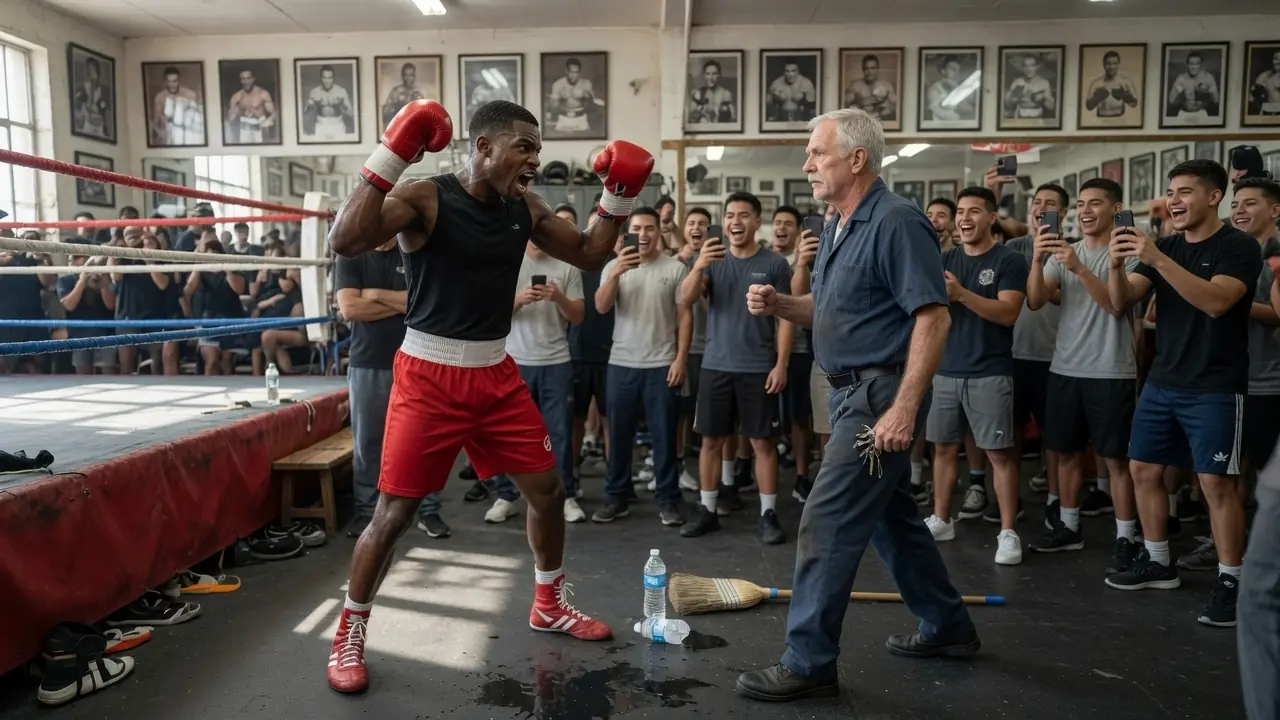
Thirty fighters stood around the center ring at Iron House Boxing, phones raised, gloves hanging from their wrists, waiting to record a sixty-eight-year-old janitor being humiliated.
Walter Hale stood beneath the white training lights in gray work pants and a faded blue shirt with the name of the gym stitched above his pocket. He had removed his rubber cleaning gloves and placed them beside the mop bucket. His shoulders appeared narrow beneath the loose fabric, and his silver hair was still damp with sweat from pushing equipment across the floor.
Across from him, Mason rolled his neck and smiled.
At twenty-three, Mason Cole was undefeated in seventeen professional fights. Sports reporters called him the future of the middleweight division. Sponsors placed his face on posters throughout the city, and every young fighter at Iron House watched the way he wrapped his hands, skipped rope, and punished heavy bags.
He was fast.
Powerful.
And completely certain the old man in front of him would never see the punch coming.
“Still want to do this?” Mason asked.
Walter looked at the phones surrounding the ring.
“No.”
Several fighters laughed again.
Mason spread his arms.
“Then apologize.”
“For what?”
“For spilling my water and acting like you own the place.”
Walter’s eyes moved toward the crushed plastic bottle near the wall.
“I didn’t knock it over.”
“You calling me a liar?”
“I’m saying you kicked it when you stepped backward.”
The laughter faded slightly.
Mason stepped closer until his chest nearly touched Walter’s.
“You’ve got a lot of confidence for a man holding a mop.”
Walter did not move.
Mason pointed toward the floor between them.
“One punch.”
Walter remained silent.
“Dodge one punch, and I’ll bow to you in front of everyone.”
A few fighters began shouting encouragement.
“Come on, Walter!”
“Teach the champ some respect!”
Most of them were not supporting the old man.
They wanted spectacle.
They wanted to watch Mason throw a wide right hand while Walter stumbled, flinched, or fell.
Mason raised both fists.
Walter looked at his stance.
Something changed in the old man’s expression.
Not fear.
Recognition.
Then he stepped into position.
His left foot moved forward.
His right heel lifted slightly.
His chin lowered.
His hands remained relaxed near his ribs.
The laughter disappeared.
Coach Raymond Ellis had been standing near the far corner of the gym when he saw Walter’s feet.
The clipboard slipped from his hand.
“No,” Raymond whispered.
Nobody heard him.
Mason bounced once on the balls of his feet.
Walter watched his shoulders.
Not his gloves.
Not his eyes.
His shoulders.
The old man breathed out slowly.
Mason’s smile weakened.
For the first time since the challenge began, he felt as though he was the one being studied.
Twenty minutes earlier, Walter had been cleaning beneath the speed bags.
It was Tuesday evening, the busiest training night at Iron House. Amateur fighters occupied the smaller rings. Professionals worked with trainers near the mirrored wall. Music played from old speakers above the lockers, mixing with the sharp rhythm of gloves striking leather.
Walter moved through it all quietly.
He emptied trash bins.
Wiped sweat from benches.
Replaced towels.
Mopped the areas where water had spread across the rubber flooring.
Most people treated him kindly enough.
Some nodded.
A few offered to move equipment.
Others barely noticed him.
Walter preferred it that way.
He had worked at Iron House for nearly six years. He arrived before sunrise, cleaned the locker rooms, repaired small things nobody else saw, and left after the final fighter finished.
He never spoke about boxing.
Never gave advice.
Never corrected anyone’s stance.
When young fighters asked whether he had ever trained, Walter smiled and said he had watched enough fights to know getting hit was unpleasant.
Nobody questioned him further.
Mason Cole had joined Iron House three years earlier.
At first, he was disciplined.
He arrived early.
Stayed late.
Helped younger fighters wrap their hands.
His father, Calvin Cole, often sat near the ring and watched with quiet pride. Calvin had worked two jobs to support Mason’s amateur career and had driven him across three states for tournaments.
Mason’s first televised fight.
Mason won that night with a second-round knockout.
Afterward, he pointed toward the ceiling and said the victory belonged to his father.
The moment made him famous.
Within a year, money arrived.
Then attention.
Then people who laughed before Mason completed a joke.
His confidence hardened into entitlement.
He stopped carrying his own bags.
He shouted at sparring partners who made him look slow.
He mocked beginners.
When trainers corrected him, he reminded them how many tickets his name sold.
Coach Raymond tolerated more than he should have.
Mason was the gym’s most successful fighter.
His membership, sponsorships, and promotional appearances paid bills Iron House had struggled with for years.
Raymond told himself the arrogance would fade with maturity.
Instead, every unchallenged moment taught Mason that talent protected him from consequences.
That Tuesday, Mason entered the gym surrounded by two friends and a young videographer who followed him for social media.
He wore a new black tracksuit with gold lettering and carried a sports drink that cost more than Walter earned in an hour.
The camera captured Mason greeting fighters, shadowboxing near the mirror, and predicting a knockout in his upcoming championship eliminator.
During a break, Mason placed the bottle on a bench.
Walter approached with the mop.
“Give me a second,” Walter said. “The floor is wet behind you.”
Mason continued talking to the camera.
Walter waited.
A fighter passed behind Mason, forcing him to step backward.
His heel struck the bottle.
It fell and spilled bright red liquid across the floor.
Mason looked down.
Then at Walter.
“What did you do?”
Walter stopped moving.
“You knocked over my drink.”
“No. Your foot hit it.”
Mason laughed.
“Seriously?”
The videographer kept recording.
Walter pointed toward the camera.
“It probably caught what happened.”
Mason glanced at the lens.
His friends became quiet.
Being corrected was one thing.
Being corrected while recorded was another.
“Turn that off,” Mason told the videographer.
The young man lowered the camera.
Mason stepped toward Walter.
“Get me another one.”
“There are bottles in the refrigerator.”
“I said get me one.”
Walter looked at the red liquid spreading toward the ring.
“You made the spill.”
Mason’s face tightened.
Several fighters nearby began watching.
“You work here to clean.”
“I do.”
“Then clean it.”
“I was going to.”
“And replace the bottle.”
“No.”
The answer was quiet.
That made it more powerful.
Mason looked around, aware of the eyes on him.
“You forget who pays this gym’s bills?”
Walter rested both hands on the mop handle.
“I know who cleans the floor.”
One fighter covered a smile.
Mason heard it.
His embarrassment sharpened into anger.
He slapped the mop from Walter’s hands.
It struck the floor.
Walter looked down at it.
Mason expected him to bend immediately.
The old man did not.
“Pick it up,” Mason said.
Walter raised his eyes.
“You should.”
The room changed.
Music continued playing, but conversations faded.
Mason moved closer.
“You want to disrespect me?”
“No.”
“You just did.”
“I asked you to pick up what you knocked down.”
Mason shoved him.
Walter’s back struck the padded wall.
The impact was not enough to injure him badly, but it knocked the air from his lungs.
Several people gasped.
Raymond began crossing the gym.
Before he reached them, Walter straightened.
Mason saw no fear on his face.
That made the shove feel incomplete.
“What?” Mason said. “You think you can take me?”
Walter rubbed one shoulder.
“No.”
“Then keep your mouth shut.”
“You should not put your hands on people.”
Mason laughed.
“Or what?”
Walter looked at him.
“Eventually, someone will put theirs on you.”
The fighters reacted with low murmurs.
Mason heard only a challenge.
He pointed toward the open space near the ring.
“One punch.”
Walter shook his head.
“I am working.”
“Dodge one punch.”
Mason raised his voice so the entire gym could hear.
“If you dodge it, I’ll bow to you and clean the whole place myself.”
Walter lifted the mop.
“If I don’t?”
Mason smiled.
“You apologize and admit you lied.”
“I didn’t lie.”
“Then prove it.”
Raymond reached them.
“That’s enough.”
Mason turned.
“Relax, Coach. I’m not going to hurt him.”
“You already shoved him.”
“He’s fine.”
Raymond looked at Walter.
The old man gave a small nod.
“I’m fine.”
Mason spread his arms toward the watching fighters.
“He thinks he knows boxing. Let him show us.”
Walter never said that.
But the room was already choosing the story it wanted.
Phones appeared.
Fighters gathered.
Raymond looked toward Walter again.
“Don’t do this.”
Walter bent and placed the mop against the wall.
He removed his cleaning gloves.
Then he said something Raymond had not heard in almost forty years.
“Just one?”
Raymond’s face changed.
The voice was older.
Slower.
But the rhythm of the question carried him backward.
A crowded amateur gym in Philadelphia.
A young fighter with narrow shoulders and impossible timing.
A coach shouting instructions that the fighter seemed to understand before they were spoken.
Raymond stared at Walter’s hands.
The knuckles were enlarged with age.
A thin white scar crossed the right thumb.
He had seen that scar before.
“Walter,” Raymond whispered.
The old man did not look at him.
Mason stepped toward the center of the gym.
“Come on.”
Walter followed.
Now the fighters stood in a circle around them.
Mason removed his jacket.
His upper body was built through years of repetition—thick shoulders, narrow waist, quick hands.
Walter remained in his work shirt.
He rolled his right shoulder once.
Then stepped into his stance.
That was when the laughter ended.
Coach Raymond knew the stance.
He knew the slight inward turn of the left toe.
The relaxed rear hand.
The shoulders positioned to invite the right cross.
Forty years earlier, boxing writers had called it the open door.
Walter Hale used to give opponents a target, wait for commitment, then disappear by less than an inch.
Not backward.
Not away.
Past the punch.
Raymond walked toward the circle.
“Mason, stop.”
The champion looked over.
“You worried about him?”
“I’m worried about you.”
Several fighters exchanged confused glances.
Mason smiled.
“Coach, he’s almost seventy.”
Raymond’s eyes stayed on Walter.
“Yes.”
Walter finally looked at him.
The two old men recognized each other fully.
Raymond’s voice became soft.
“I thought you were dead.”
Walter answered without emotion.
“A lot of people did.”
Mason lowered his hands.
“You know him?”
Raymond did not answer.
Walter looked toward Mason.
“You wanted one punch.”
Mason’s pride returned.
He raised his fists.
“Don’t blame me when you wake up on the floor.”
Walter placed his cane-like stiffness aside with a slight roll of the hips.
For the first time, he looked less like an elderly janitor.
The loose shirt still hung from his body.
His hair remained silver.
His face carried deep lines.
But the man standing before Mason seemed connected to a younger version of himself that age had covered rather than erased.
“Do not throw with everything,” Raymond warned.
Mason laughed.
“He said dodge one punch.”
Walter’s eyes stayed on Mason’s chest.
“Throw what you intended.”
The champion bounced lightly.
He began with a shoulder feint.
Walter did not react.
Mason shifted his weight toward the left hook.
Nothing.
A few fighters lowered their phones.
They recognized discipline when they saw it.
Mason circled.
Walter barely moved, but each small adjustment kept him outside the clean angle.
The old man was not following Mason.
He was placing Mason where he wanted him.
Mason felt the difference.
Anger returned.
He planted his lead foot and launched the right hand.
It was not a playful punch.
His shoulder turned fully.
His hip drove forward.
The glove cut through the air toward Walter’s jaw with enough force to knock down a trained middleweight.
Walter moved after the punch had already begun.
His head shifted less than three inches.
His left shoulder rolled.
His right foot turned.
Mason’s fist passed beside Walter’s cheek.
The old man stepped inside the extended arm.
For one impossible second, he stood close enough to whisper into Mason’s ear.
“You lift your elbow before the right.”
Then Walter was gone.
Mason stumbled forward.
His glove struck nothing.
The entire gym fell silent.
No cheering.
No laughter.
No music seemed loud enough to break the stillness.
Mason turned quickly.
Walter stood behind him.
The old man had not thrown a counterpunch.
He had not touched him.
That made the moment worse.
Mason had used speed, strength, and intent.
Walter had used knowledge.
Raymond stepped into the circle.
“That’s enough.”
Mason stared at Walter.
“What was that?”
Walter reached toward the wall for his gloves.
“You threw one punch.”
“No.”
Mason shook his head.
“You knew what I was going to throw.”
“You told me.”
“I didn’t say anything.”
“Your body did.”
Mason’s face flushed.
“Again.”
“No.”
“You got lucky.”
Walter bent toward the mop.
Mason grabbed his shoulder.
The movement happened quickly.
Walter turned.
His left hand redirected Mason’s wrist.
His right forearm touched Mason’s chest.
A small shift of weight broke the champion’s balance.
Mason found himself against the ropes before understanding how he had moved there.
Walter released him immediately.
“Do not grab people from behind.”
Mason stared at him.
Raymond stepped between them.
“Bow.”
The champion looked toward his coach.
“What?”
“You made an agreement.”
Phones remained raised.
Mason looked around.
The same crowd that had expected Walter’s humiliation now waited for his.
His pride fought desperately for another exit.
“He cheated.”
“How?”
Mason could not answer.
Raymond pointed toward Walter.
“Bow.”
Mason’s jaw tightened.
Walter picked up the mop.
“You do not have to.”
Everyone looked at him.
Mason almost appeared relieved.
Walter continued.
“A bow given because people are watching means nothing.”
The words landed deeper than mockery.
He turned toward the spilled drink.
Mason remained inside the circle.
“Who are you?” he asked.
Walter began mopping.
“The janitor.”
Raymond shook his head.
“No.”
He looked toward the fighters.
“His name is Walter ‘The Ghost’ Hale.”
Several of the older trainers went still.
A young amateur searched the name on his phone.
The results appeared slowly.
Old newspaper photographs.
Black-and-white images of a lean fighter standing beneath arena lights.
Headlines from the late 1970s.
HALE REMAINS UNTOUCHED IN NATIONAL FINAL
THE GHOST WINS OLYMPIC TRIALS
PHILADELPHIA BOXER DISAPPEARS BEFORE WORLD TITLE ELIMINATOR
Mason took the phone from the amateur.
The man in the photograph was unmistakable.
Younger.
Heavier through the shoulders.
But the eyes were the same.
Walter Hale had won three national amateur championships.
He represented the United States in international tournaments and returned with a silver medal.
As a professional, he won twenty-six fights and lost only one, a disputed decision early in his career.
His defense was considered extraordinary.
He had never been knocked down.
Then, at twenty-nine, he disappeared.
No retirement announcement.
No final fight.
No interview.
Nothing.
Mason looked from the screen to Walter.
“You were a champion?”
Walter continued cleaning the floor.
“No.”
“The articles say—”
“I won fights.”
“That makes you a champion.”
Walter pushed the red liquid toward the drain.
“Not always.”
Raymond picked up his fallen clipboard.
“Tell them.”
Walter’s shoulders became still.
“No.”
“You’ve hidden long enough.”
“That was my choice.”
Raymond looked toward Mason.
“He needs to hear it.”
Walter glanced at the young champion.
For the first time, anger had left Mason’s face.
In its place was confusion.
And something close to shame.
Walter leaned the mop against the wall.
“My last scheduled fight was against a man named Samuel Tate.”
Raymond closed his eyes.
Some of the older trainers knew the name.
Samuel Tate had been a powerful contender with an aggressive style and a wife expecting their first child.
During the final week of training, Walter and Samuel agreed to spar privately for promotional footage.
The session was not supposed to be intense.
Samuel turned it into a contest.
“He kept coming forward,” Walter said. “I kept moving.”
His voice had grown distant.
“Then he cornered me and threw a right hand.”
Mason looked toward Walter’s feet.
“The same punch?”
“Similar.”
“What happened?”
“I slipped it.”
Walter’s hands closed slowly.
“And countered.”
The gym remained quiet.
“My left hook landed behind his ear. Samuel fell.”
Walter looked at the floor.
“He did not get up.”
A blood vessel in Samuel’s brain had ruptured.
Doctors later determined that he carried an undiagnosed condition that could have killed him during any hard exchange.
Walter’s punch did not cause the weakness.
But it triggered the collapse.
Samuel remained in a coma for six days.
He died without meeting his daughter.
“No charges were filed,” Raymond said. “Every doctor called it a tragic accident.”
Walter looked at him.
“The doctors did not throw the punch.”
“You could not have known.”
“I knew I wanted to prove something.”
Walter turned toward Mason.
“That was enough.”
After Samuel’s death, Walter withdrew from the title eliminator.
Promoters called him afraid.
Reporters accused him of wasting talent.
Fans who once praised his intelligence called him a coward.
Walter stopped defending himself.
He sold his car.
Left Philadelphia.
Worked construction, shipping yards, and maintenance jobs.
He sent money anonymously to Samuel’s widow for more than twenty years.
When she discovered the source, she returned the final check with a letter.
It contained only one sentence:
My husband chose boxing too. You are not the only person who survived that day.
Walter kept the letter.
He never returned to competition.
Years later, Raymond found a maintenance application carrying Walter’s name.
He hired him without questions.
“You knew?” Mason asked.
Raymond nodded.
“Why didn’t you tell anyone?”
“Because Walter asked me not to.”
Walter looked around the gym.
“I did not come here to be remembered.”
Mason stared at the floor.
“I wasn’t going to kill you.”
“No.”
Walter picked up the cleaning gloves.
“You only wanted to humiliate me.”
The sentence left Mason with nowhere to hide.
The fighters lowered their phones.
One by one.
Mason looked toward the crushed bottle.
Then at the mop.
The challenge returned to him.
Dodge one punch, and I’ll bow to you.
He walked toward Walter.
Everyone watched.
Mason bent at the waist.
It was not a theatrical bow.
There was no smile.
He lowered his head and remained there for several seconds.
When he straightened, his eyes were wet.
“I’m sorry.”
Walter studied him.
“For the bottle?”
“For all of it.”
“You shoved an old man because he corrected you.”
“Yes.”
“You threw a full punch because people were watching.”
Mason swallowed.
“Yes.”
“You knew it could hurt me.”
“Yes.”
Walter looked toward the phones.
“What happens tomorrow when no one is recording?”
Mason had no immediate answer.
“That is where the apology matters,” Walter said.
Then he handed him the mop.
Mason accepted it.
The champion cleaned the spilled drink.
Nobody laughed.
He wiped the wall where Walter’s back had struck.
Picked up the bottle.
Emptied the trash bins.
When the floor was clean, he returned the mop.
Walter looked at the work.
“You missed a spot.”
A few fighters almost smiled.
Mason looked down.
A thin red line remained near the ring post.
He cleaned it.
The following morning, Mason arrived before sunrise.
Walter was already inside the locker room replacing a broken cabinet hinge.
Mason carried two coffees.
“I didn’t know what you drink.”
“Tea.”
Mason looked at the cups.
“Of course.”
Walter returned to the hinge.
Mason stood nearby.
“Will you teach me?”
“No.”
“Why?”
“You have coaches.”
“I want you to teach me what I did wrong.”
Walter tightened one screw.
“You already know.”
“My elbow?”
“That too.”
Mason waited.
Walter closed the cabinet.
“You fight as though every exchange is an argument you must win.”
“That’s boxing.”
“No.”
Walter picked up his tools.
“Boxing is solving a problem while someone tries to create another one.”
Mason followed him into the hallway.
“Then teach me that.”
“I do not train fighters.”
“You trained yourself.”
“That was a long time ago.”
Mason looked toward the empty gym.
“I need someone who isn’t impressed by me.”
Walter stopped walking.
For several seconds, he studied the young man.
“Come tomorrow at five.”
Mason nodded quickly.
“Gloves?”
“No.”
“Running shoes?”
“No.”
“What do I bring?”
“Patience.”
The first lesson had nothing to do with punching.
Walter placed a strip of tape across the floor and told Mason to walk along it without allowing his shoulders to rise.
Then he made him stand in front of a mirror and breathe.
After twenty minutes, Mason became frustrated.
“When do we box?”
“When you stop fighting the exercise.”
For three weeks, Walter taught him only movement.
Weight transfer.
Balance.
Breathing.
How to see tension before motion.
How to leave an opening without surrendering control.
Mason had always believed his speed came from effort.
Walter showed him how effort made the body announce itself.
“You prepare too loudly,” Walter said.
“What does that mean?”
“You tell everyone what you want.”
“I feint.”
“Your feints are lies told by a nervous man.”
Mason frowned.
Walter touched his shoulder.
“This moves before your right hand.”
He touched Mason’s hip.
“This loads before your hook.”
Then his eyes.
“And these look for approval after every good punch.”
Mason lowered his gaze.
“You fight the crowd as much as your opponent.”
Training changed him slowly.
He stopped bringing the videographer to every session.
He carried his own equipment.
He apologized to sparring partners he had mistreated.
Some accepted it.
Others did not.
Walter told him both responses were fair.
Coach Raymond watched the transformation with cautious hope.
One evening, he sat beside Walter after everyone left.
“You’re training again.”
“I’m correcting.”
“You always called it that.”
Walter looked toward Mason, who was cleaning the ring apron without being asked.
“He may still become what he was becoming.”
“Or not.”
Walter nodded.
“That is his decision.”
Three months later, Mason fought Andre Vega in a championship eliminator.
Vega was a pressure fighter with a powerful right hand.
Sports commentators expected Mason to attack early.
Instead, he waited.
He moved calmly.
Allowed Vega to overreach.
In the fourth round, Vega loaded the right hand.
Mason saw the shoulder rise.
He slipped inside by three inches.
The punch passed his cheek.
For a fraction of a second, the entire arena seemed to disappear.
Mason stood close enough to counter with the same left hook Walter had thrown decades earlier.
He hesitated.
Walter watched from a seat near the aisle.
He saw the fear enter Mason’s face.
The memory was not Mason’s, but the story had become part of him.
Vega began recovering his stance.
Walter stood.
“Finish the movement!” he shouted.
Mason understood.
Finishing did not always mean throwing the hardest punch available.
He placed a short right hand into Vega’s body, turned him, and moved away.
No reckless counter.
No need to prove power.
Mason won by unanimous decision.
Reporters praised his defense.
They asked which coach changed his style.
Mason looked toward Walter.
The old man shook his head once.
Mason understood.
“My team,” he answered.
He did not reveal Walter’s identity.
Not then.
After the fight, Mason found him near the service corridor.
“I could have landed the hook.”
“Yes.”
“I was afraid.”
“That is not always weakness.”
“I thought about Samuel.”
Walter’s face tightened.
Mason continued.
“I also thought about what you said. Boxing is solving a problem.”
Walter nodded.
“You solved it.”
Mason looked toward the arena.
“I used to think winning meant making someone feel powerless.”
“And now?”
“It means leaving with control of myself.”
Walter extended one hand.
Mason shook it.
Years later, the video from Iron House still circulated online.
Most versions ended after the dodge.
People saw Mason throw the right hand.
They saw Walter slip inside.
They saw the undefeated young champion stumble past an elderly janitor who had barely moved.
The clip gathered millions of views.
Viewers called Walter a hidden master.
A retired assassin.
A forgotten legend.
Walter disliked every title.
He continued cleaning the gym.
He continued arriving before sunrise.
But people treated him differently.
That troubled him.
Fighters who once ignored him now rushed to carry his equipment.
Visitors asked for photographs.
Some bowed dramatically when he entered.
Walter refused all of it.
One morning, he gathered the fighters around the same spot where Mason had shoved him.
“You learned the wrong lesson,” he said.
They became quiet.
“You think the story is that an old janitor was secretly dangerous.”
Walter looked around the circle.
“The story is that Mason should not have needed me to be dangerous before deciding not to humiliate me.”
Nobody spoke.
“He should not have needed newspaper articles.”
“Or medals.”
“Or an old coach recognizing my stance.”
Walter pointed toward the wall.
“I deserved not to be shoved when I was only the man cleaning the floor.”
Mason stood near the back.
He lowered his head.
Walter continued.
“Power does not reveal character when you meet someone stronger.”
“It reveals character when you believe the other person cannot stop you.”
That sentence became painted above the entrance to Iron House.
Not Walter’s name.
Not his record.
Only the lesson.
Mason eventually became world champion.
He won the title with a defensive performance that commentators described as patient, intelligent, and unusually mature.
After the decision, a reporter asked him when he knew he had changed as a fighter.
Mason looked toward the cameras.
“The day I missed one punch.”
People laughed lightly, expecting a joke.
He did not smile.
“I threw it at a man I thought could not defend himself.”
The room became quiet.
“He moved out of the way.”
Mason paused.
“But the punch had already shown everyone who I was.”
He looked toward Walter, who stood near the back of the room in a plain blue work shirt.
“The dodge saved me from hurting him.”
His voice became lower.
“What he taught me afterward saved me from becoming someone worse.”
Walter died peacefully at seventy-eight.
Iron House closed for the day of his funeral.
Hundreds attended.
Former champions.
Amateur fighters.
Janitors.
Trainers.
People Walter had helped without telling anyone.
Samuel Tate’s daughter came too.
She carried the final letter her mother had written to Walter and placed it beside the casket.
Mason stood last.
He did not speak about records or championships.
He spoke about a bottle on the floor.
A shove.
A challenge.
And one missed punch.
“I thought the gym went silent because he embarrassed me,” Mason said.
He looked toward the old fighters sitting in the front row.
“It went silent because everyone recognized something I could not see.”
“What?” someone asked quietly.
Mason looked at Walter’s casket.
“That he never needed to hit me.”
The young champion had entered the confrontation believing strength meant the ability to hurt another person.
Walter showed him a different kind.
The strength to move without panic.
To answer humiliation without cruelty.
To possess dangerous knowledge and choose restraint.
One dodge brought the entire gym to silence.
But the dodge was never the most important part of the story.
Walter Hale had already won before Mason threw the punch.
He won when he refused to become small merely because a stronger, younger man wanted an audience.
He won when he stood in the center of the gym without hatred.
He won when he had the chance to strike back and chose only to whisper the truth:
You lift your elbow before the right.
And Mason’s greatest victory did not come years later beneath championship lights.
It came the following morning, before anyone arrived, when he entered the empty gym, accepted a mop from the elderly janitor he had mocked, and finally learned that respect should never depend on discovering the other person can defeat you.