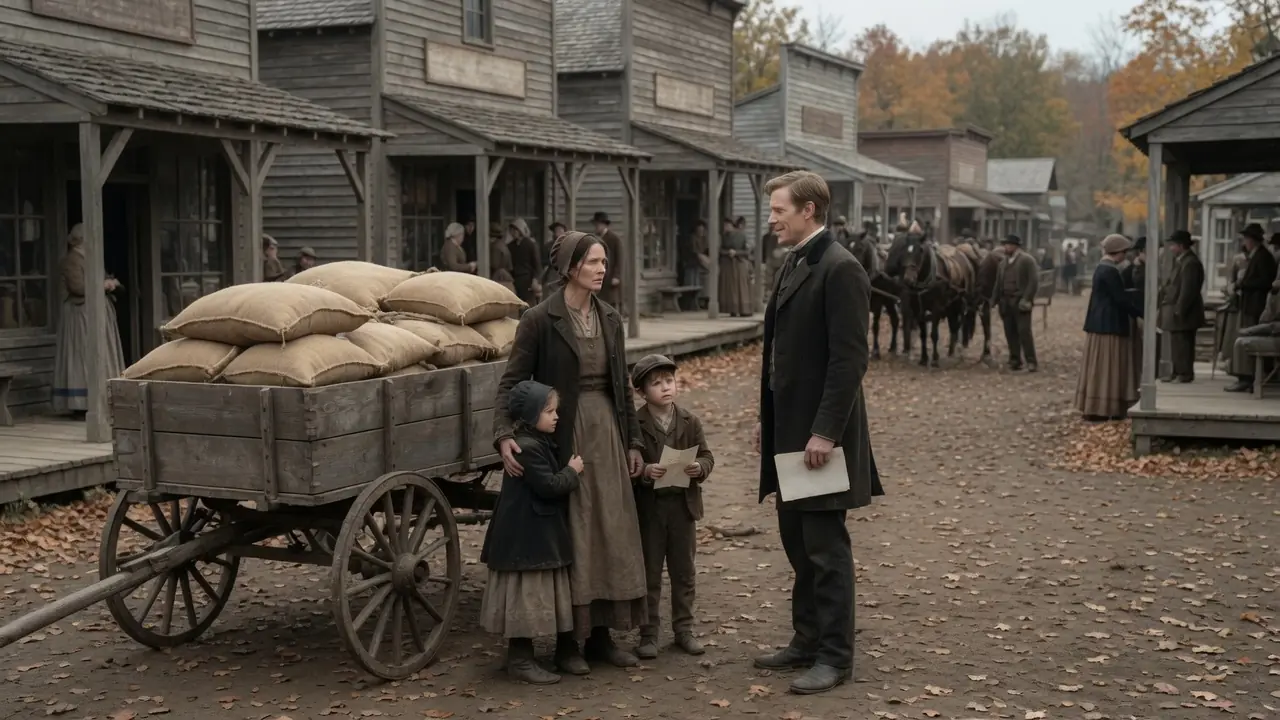
Thomas Owens stopped Julia on the main street on a cold Thursday morning with a land office paper in his hand and the kind of voice a man uses when he wants more than one person to hear him. Julia had just come out of the dry goods store with her children beside her. Luke, eight years old and already trying to stand like a man, held the flour list in one hand and kept his jaw tight. Ada, only six, clutched the edge of Julia’s coat because that was what she did when the world around her felt uncertain.
The wagon stood near the hitching rail with two sacks of flour already loaded and one waiting by Julia’s feet. The feed store, the post office, and the dry goods shop all faced the street close enough that anyone speaking loudly enough could turn private trouble into public judgment. Thomas knew that. That was why he had chosen the street instead of Julia’s door.
He unfolded the paper slowly, like a preacher opening scripture. “The claim is beyond you now, Julia,” he said. Julia did not answer at once. Thomas let his eyes move toward the people slowing on the boardwalk. He wanted witnesses.
He wanted every shopkeeper, teamster, widow, and farmer’s wife in town to hear him say that a woman alone could not keep up the residence and improvements a homestead required. He wanted the words to travel home in wagons and supper conversations until Julia heard them from every direction. “You have done what you could,” Thomas continued. “No one can fault a widow for trying. But the land office will see it plain.”
Luke’s hand tightened around the flour list. Ada pressed closer to Julia’s side. Julia kept her hands at her sides. The land had been her husband Daniel’s dream first. Then, when fever took him the previous spring, it became hers because grief does not stop chores, and children still need a roof even when a grave has been freshly cut on the north rise.
She had mended fence, hauled water, planted late, harvested what little the weather allowed, patched the roof, kept receipts, and written dates in Daniel’s old ledger until the pages were crowded with proof. Thomas knew all that. He was Daniel’s brother, after all. That made his words sharper. “I am prepared to help settle the matter cleanly,” Thomas said. “If you will be reasonable about it, we can avoid embarrassment.”
Julia finally looked straight at him. The cold wind moved a loose strand of hair near her bonnet. Her face stayed still, but inside her chest something burned low and steady. She had learned during widowhood that anger wasted strength when it came too early. Better to store it. Better to spend it when it could buy something.
“The land is mine and my children’s,” she said. “And I intend to keep it so.” She said it once. She did not raise her voice. She did not say it again.
Thomas waited, perhaps expecting more, perhaps hoping she would break and give the street something to remember. When she did not, he folded the paper back into his coat. His mouth tightened. “Spring will tell,” he said. Then he turned, mounted his horse, and rode out.
The street did not empty. It rearranged itself. People suddenly found barrels to inspect, parcels to tie, wagon wheels to check, and conversations to resume with forced casualness. Julia lifted her chin, because lowering it would have given Thomas something even after he had gone. Across the street, Frank Hale stood on the boardwalk with a small paper bag of fittings from the hardware.
He had heard enough. Frank was thirty-nine, quiet, and known mostly for his water route. He hauled barrels for three homesteads between town and the creek, kept his team well cared for, and lived in a rented room behind the livery with a trunk, two blankets, and no unnecessary furniture. He did not push himself into other people’s matters. He did not offer opinions in public.
Frank had known Daniel Owens the way men knew each other on the frontier, by returned tools, repaired harness, and a wave across a field. He did not cross the street while Thomas spoke. Julia noticed that later and understood it. He had not stepped between her and Thomas because the ground had been hers to hold. But when Thomas was gone and Julia moved to lift the last flour sack into the wagon bed, the sack slipped against the rail.
Before it could fall, Frank was there. He set it squarely into place, stepped back, and touched the brim of his hat. Julia looked at him. Frank said nothing. She gathered Luke and Ada, climbed into the wagon, and drove home.
That was Thursday. Friday morning, Frank came past on his water route. The team moved slow beneath the weight of the full barrels, and the iron rims creaked over the frost-hard track. Julia was at the north fence line, gloves on, wire in hand, checking posts that had leaned since the last storm. She heard the wagon before she saw him.
She did not stop working. Frank set the brake and climbed down. He came to the fence without calling out, without asking if she needed help, without making the moment larger than it was. He pressed one post with his hand. It held. He moved to the next one and tested it too.
Then he looked toward the farmhouse, where the curtain in the window shifted almost too little to notice. Ada, probably. Or Luke, pretending he was not watching. Frank turned back to Julia. “Would a husband on paper keep him off your land?” he asked.
The question settled between them like a tool set on a table. Julia did not answer right away. She pulled the wire taut and checked the tension with both hands. The wind moved across the pasture behind her, carrying the dry smell of winter grass. Thomas’s voice still lingered somewhere in her ears, loud and certain, telling the town she was already defeated.
“It would have to be filed quickly,” she said. Frank nodded. He knew that. He told her what he could put on paper. He told her what he would bring. He told her what he would not ask for afterward.
He spoke plainly, without romance, without pity, and without using the word rescue. At the last part, he looked again toward the house. “The children stay where their father is buried,” he said. “That is the shape of it.” Julia looked down the long fence run still needing work.
The stock had been restless for a week. The south posts were worse than the north, and the barn door dragged in damp weather, and the roof near the stove pipe needed patching before snow held on it. She was tired enough that some mornings she woke before dawn and lay still, not because she did not know what needed doing, but because she did know. “Come to supper,” she said. “We will settle the rest after.”
Frank nodded once and went back to his wagon. Julia returned to the fence. That evening, Frank came at dark. He washed at the pump, wiped his boots carefully, and came inside when Julia opened the door. Luke stood near the stove, watching him with narrow attention.
Ada hid halfway behind the curtain that separated the sleeping area from the front room. Frank ate what was put in front of him. He did not comment on the house. He did not comment on the children. He did not comment on the way Julia ran her table, the way widows were often made to hear little corrections from people who had never carried their burdens.
When the plates were cleared, he laid out the arrangement. He would marry her legally. He would live on the property because the land office would expect to see residence and stability. He would work the fence, stock, barn, hauling, and repairs. He would make no claim on the house, no claim on Julia’s bed, and no claim on the land beyond what the papers required to keep Thomas from prying it loose.
The children listened from behind the curtain. Everyone knew. No one said it. Julia sat with her hands folded on the table. “The claim stays in my name and theirs,” she said.
“That is the arrangement,” Frank answered. “The house stays mine to run.” Frank nodded. “The barn will do. I meant to say so before you had to.” Julia looked at him for a long moment.
“Then we are agreed.” Frank picked up his hat and went to the barn. That was the first night of it. Before the next week was out, the marriage had been filed, witnessed, and recorded. Reverend Pike kept his face solemn through the ceremony, though his wife cried into a handkerchief as if Julia and Frank had married for love instead of law.
Julia wore her brown dress, Frank wore a clean shirt, and Luke stood stiff beside Ada, who watched the whole thing with wide solemn eyes. No one kissed. No one expected them to. Still, by sundown, half the town had decided it knew exactly what the marriage meant. After that, every shared trip to the feed store was watched.
Every sack of flour Frank loaded into Julia’s wagon was measured. Every time they stood within ten feet of each other on the main street, someone carried the sight home and added it to the town’s growing account. Julia felt it every time she came to town. The particular quality of attention meant everyone had already talked and was now watching for the next piece. She kept her chin level and gave them nothing extra.
Frank seemed not to notice. Or perhaps he had simply decided that other people’s curiosity was not useful enough to carry. He loaded the wagon, checked the wheels, held doors, and drove home as if the staring had no weight at all. At the homestead, the house adjusted to itself. Frank rose before light and had the stock tended before Julia had the stove going.
He did not eat breakfast in the house the first week. The second week, Julia left a plate on the porch rail without comment. He took it without comment. Then he washed the plate and stacked it by the door before taking the team out on his route. That was how that matter was settled.
The children watched him the way children watch something they have not decided about yet. Luke studied Frank’s work. He noticed how Frank set a post, checked a wheel, tightened harness, and moved through chores with no announcement and no wasted motion. Luke did not trust quickly, but he trusted competence before kindness. Ada watched differently.
She watched from doorways, from behind Julia’s skirt, from the edge of the porch steps. There was a hunger in her attention that made Julia’s chest ache. Ada had been too young to understand death fully when Daniel was buried, but old enough to understand absence. Frank did not try to fill that absence. Perhaps that was why Ada kept looking at him.
Frank never tried to win either child. He simply came every morning, did the work, answered questions when asked, and thanked Julia for the evening meal with the same two words before returning to the barn. “Thank you.” Nothing more. Luke moved first.
One cold morning, he appeared at the fence line while Frank was resetting the north run. He stood without speaking, hands in his coat pockets, watching Frank work the wire. Frank glanced at him once, then handed him the far end. “Hold it taut,” Frank said. Luke did.
They worked the stretch in silence. When it was done, Luke looked at the line, straight and even, then went back inside without a word. The next morning, he was at the fence line before Frank had started. Ada moved in her own time. One evening in November, after supper had been set and the fire was burning low, she climbed down from her chair and went to the shelf.
Julia watched her take Frank’s tin cup, the one set high with the others, and carry it carefully to the table. She did not set it at the far end where Frank usually sat. She set it beside Julia’s place. Then she climbed back into her chair, picked up her spoon, and ate as if nothing particular had happened. Julia saw it.
She said nothing. She filled the cup when she filled the others. Frank came in, washed, and sat down. He looked at the cup, then at Ada. “Thank you, Ada,” he said quietly.
Ada studied her bowl with the serious expression of a child managing a feeling bigger than her words. Luke looked at the cup, looked at his sister, and went back to his supper. After the meal, Frank went to the barn. Luke stayed at the table whittling a piece of wood that had not found its shape yet. Ada leaned against Julia’s side while the fire settled and the wind moved along the walls.
The house held. The stove did its steady work. It was a quiet evening. And quiet had begun to mean something different. Thomas came back later in November.
He rode up to the north fence line, the one Frank and Luke had spent three days resetting after the filing. Julia was in the yard carrying kindling. Frank sat on the porch mending harness, his hands steady on the leather. Thomas spoke of legal provisions. He spoke of land office examiners and what they generally thought of arrangements made in haste.
He spoke of certain neighbors who might be willing to say that Frank’s presence on the land looked too convenient. He spoke like a man trying to make uncertainty sound official. Frank did not stand. He did not come to the fence. He kept his eyes on the harness because the matter was Julia’s to answer.
Julia handled every word herself. When Thomas finished, she told him the land office would have its answer in the spring and wished him a good ride back. Thomas’s mouth tightened. He looked once toward Frank. Frank looked up from the harness.
Nothing in his face moved. Thomas rode out. Julia came back to the porch and sat down. She picked up the mending she had been setting aside for a week. Frank went back to the harness.
The afternoon continued in the ordinary way, which somehow felt like the strongest answer either of them could have given. December brought hard weather. The first snow did not stay, but the second one did. Wind pressed against the farmhouse for three days, rattling shutters and pushing fine powder beneath the door. Frank moved inside to repair what could be repaired.
He fixed a cabinet hinge that had pulled since October. He resoled a boot by stove light, tightened a loose handle on the flour bin, and sharpened every tool in the place before hanging them back in order. Luke sat near the workbench on the second day. At first, he only watched. Then he asked a question about the team, technical and careful, the kind of question a boy asks after thinking about something longer than he wants anyone to know.
Frank answered the whole of it. Luke asked another. Frank answered that too. They were still bent over a piece of harness when Julia called them for the midday meal. She stood in the doorway and watched them come in, speaking in low voices about leather, buckles, and weight distribution.
She turned back to the stove before either of them could see her face. That evening, after the children were in bed, Julia sat at the table with mending in her lap. Frank sat across from her with the harness still needing attention. The stove put out steady heat. Outside, the wind pressed at the walls and did not get in.
For a long while, they worked without speaking. Then Julia said, “The south posts will need work before the hearing.” “I saw that,” Frank said. “I will get to them when the weather breaks.” She nodded.
He went back to the harness. She went back to the mending. The silence between them was no longer empty. It had become a place where things rested. The land office hearing came in January.
Julia had her documentation in order. Receipts. Improvement records. Dates written in Daniel’s hand for the summer work, then in her own for the autumn and winter work. Sworn statements from three neighbors who had watched her hold the place through a hard year and were willing to say so. Frank drove her to town.
They did not discuss what she would say. She already knew. Thomas arrived with a man from the county seat who carried a leather case and wore the expression of someone accustomed to being the most prepared person in the room. He spread papers on the table as if quantity could stand in for truth. Julia laid out her records.
She walked through every item without hesitation. The acreage. The fencing dates. The residence. The improvements. The crop records.
The repair receipts. The work done before Daniel died and the work done after. When the man with the leather case suggested the claim might have lapsed in the interval before the marriage was filed, Julia showed him the dates and explained the arithmetic quietly. Without hurry. Without apology.
The man set his pen down. Then he looked across at Frank. “And you claim interest in the property through marriage?” Frank kept his hands folded on the table. He did not look at Thomas.
He looked at the examiner. “I claim the work,” he said. “The land is hers.” Thomas looked at the floor. The examiner said he would review the file and issue his determination before the thaw broke.
Julia thanked him, gathered her papers, and stood. Frank stood when she stood. They walked into the January cold and climbed into the wagon. The drive home was mostly quiet. The road was frozen hard and the team moved well.
There was nothing that needed saying that the hearing had not already said. Yet Julia felt something beside her in the wagon that had not been there months before. Not protection exactly. Not ownership. Presence.
February pressed down hard on everything. Frank was up before light every morning for the stock, and Julia heard him go out and come back. The sound worked itself into the shape of her mornings. It became as familiar as the stove catching, Ada waking, and Luke pretending not to still be half asleep. One evening, after the children were in bed, Julia found Frank standing at the north window.
He was watching the far post lean in the freeze. She came and stood beside him. “I will get it in the morning,” he said. She knew he would. They stood there for a moment while the wind moved across the field.
The fence held mostly against it. Julia was aware of Frank beside her the way a person is aware of a post that has been reset and holds. Not with surprise anymore. With trust. She went to the stove and put the kettle on.
After a moment, she heard him pull out the chair at the table. They sat together in the warmth while the cold pressed at the walls. Neither said anything more. The quiet between them had changed enough that Julia noticed it and let herself notice it. She did not look away.
The determination came in March. Contest dismissed. Claim confirmed to Julia Owens. Secured for her children. Julia read the letter at the table.
Luke read it over her shoulder. Ada watched Luke’s face, and when his breath came out, hers came out too. Julia folded the letter carefully and placed it on the shelf where she kept what mattered. Frank was outside at the far post, working it back to true in the thaw. Julia went to the door.
The air smelled of wet earth and new grass hidden under old cold. “It is done,” she called. “We kept it.” Frank stood up straight. Something settled in his face, the way a man looks when he has been holding something carefully for a long time and can finally set it down.
He nodded once. Then he went back to the post. Julia went inside. Ada sat at the table drawing shapes in spilled flour with one finger. Luke came in from the back and picked up the horse he had been carving since December.
It was finally beginning to look like one. Spring came slowly and then all at once. The fields opened. The stock grew easier. The north fence line stood straight in the new light and needed nothing urgent from anyone for the first time in months.
The house seemed to breathe again. In April, on an evening warm enough to leave the door open, the four of them sat at the table after supper. The dishes had not yet been cleared. Ada was restless with good weather, and Luke kept glancing toward the yard. Julia looked across at Frank.
“The claim is settled now,” she said. Frank’s hand paused on his cup. “Your name did what it needed to do,” she continued. “You are not obligated to the arrangement any further than you want to be.” She said it plainly.
Then she looked down at her hands. Frank was quiet for a moment. He turned his cup once on the table. “The south posts are still soft,” he said. Julia looked up.
“And the roan favors her left foreleg when the weather turns.” Ada looked between them. Luke did not move. Frank set the cup down. “That is not obligation.”
Julia held his gaze. The room seemed to still around them. Ada looked between them again, then went back to her bread, losing interest in a thing she did not yet have words for. Luke picked up his cup and said nothing. Julia reached across and moved the bread plate toward Frank.
“Then stay as my husband,” she said. “Not for the claim.” Frank looked at the plate between them. Then he looked at her. “I will.”
And that was how it was settled. No grand declaration. No town audience. No paper waved in the street. Just the supper table, the open door, the children listening, and the evening coming in soft over land that had nearly been taken from them.
By the time the days stretched long enough for the children to stay outside until supper, the place had the sound of itself again. Stock lowed behind the fence. The gate Frank had rehung in October swung clean on its new pin. Ada’s voice carried from somewhere beyond the garden. Luke sat on the porch step with the carved horse in his hands, though he still would not admit it was finished.
Frank’s wagon came down the track at dusk. Ada heard it before anyone. She came from wherever she had been and moved toward the sound without being called, not running yet but close to it. Julia stood at the open door. The light lay soft over the fence line, the fields, and the land that had nearly slipped from her hands.
Luke came and stood beside her in the doorway. He said nothing. Together, they watched the wagon come in, the mare toss her head, and Ada finally break into a run across the last stretch of yard. The stove was warm behind them. The plates were set and waiting.
The south posts would need checking before summer. The stock would need moving to the far pasture by the end of the week. There was enough flour for ten days and not much more. The barn stood quiet and dark at the edge of the yard, its lamp unlit for the first time since October. Frank would not sleep there anymore.
It was an ordinary evening in all the ways that mattered. And it was theirs. Julia had kept the land. Luke had learned that strength could be quiet. Ada had made room at the table before any adult found the courage to name what was happening.
Frank Hale, who had first offered to be a husband only on paper, became the man who stayed when the paper had done its work. That was the story of Julia Owens. A widow who refused to surrender her children’s home. A man who offered his name without asking for her land. And a family that began as an arrangement, then grew roots deep enough to hold through winter.