The morning Veronica Hale became vice president of Harrow & Fletcher Logistics, she stood in front of the mirrored wall of the elevator and smiled at herself as if the promotion had been a crown placed on her head. The elevator carried her down from the twenty-third floor while the city glittered beyond the glass, and she adjusted the gold watch on her wrist, tilted her chin, and practiced the voice she imagined important people used. She had spent eight years clawing her way through junior account management, regional sales, and executive development seminars, and she had told herself every step of the way that compassion was what weak people called failure. By ten o'clock that morning, her name had been announced in the boardroom, her handshake had been photographed for the company newsletter, and her boss, Henry Fletcher, had told the room he believed she represented the future of the company.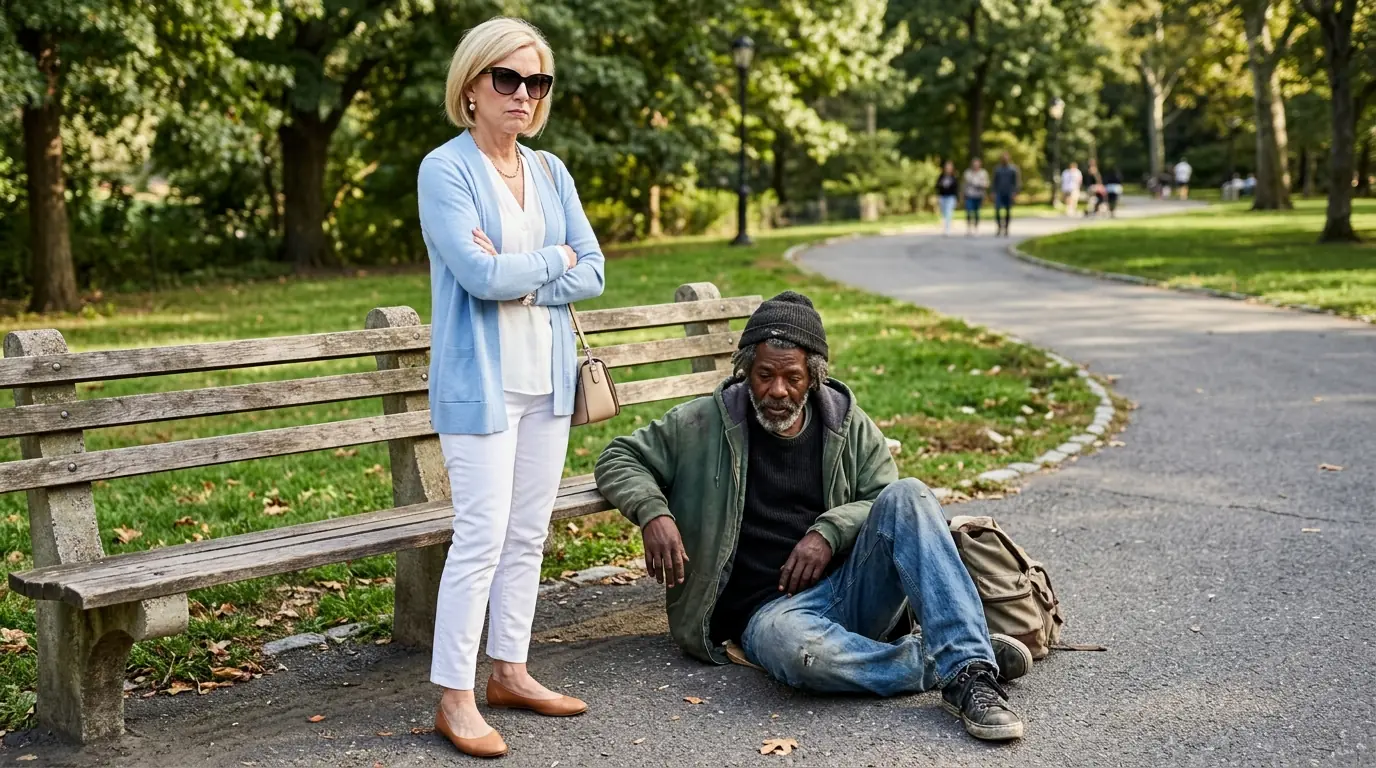
Veronica liked the sound of that. The future. She repeated it under her breath as she stepped out into the marble lobby, passing the reception desk where two assistants congratulated her with careful smiles. She barely looked at them. Her phone was already pressed to her ear, and she was laughing into it as she pushed through the revolving doors onto the sidewalk. "Yes, you are talking to the new vice president of the company," she said to her friend on the other end. "It's about time they realized how important I am. Honestly, I should have had the title a year ago."
Outside, the city had the hard shine of early afternoon. Delivery trucks lined the curb, taxis honked through traffic, and office workers moved around one another with coffees in hand and badges swinging from their necks. Veronica walked with the sharp, impatient stride of someone who believed the sidewalk belonged to her. She had a lunch reservation at a restaurant two blocks away, a bottle of champagne waiting at home, and a social media caption already drafted in her notes app. She was still talking when a hoarse voice reached her from near the corner.
"Spare some change?"
Veronica slowed and looked down. A man sat against the side of the building with his back pressed to the stone wall, a faded army-green jacket folded around his shoulders like it no longer fit the life he was living. His beard was patchy, his hair was matted beneath a worn knit cap, and his boots looked like they had survived too many winters and too many miles. A cardboard sign leaned beside his knee, but the words had been softened by rain until only parts remained visible. Hungry. Veteran. Anything helps.
Veronica covered the mouthpiece of her phone and stared at him as if he were something blocking the entrance to a store. "I have to call you back," she said. "There's a zombie trying to talk to me." She ended the call before her friend could respond and slipped the phone into her purse. Then she smiled in a way that did not reach her eyes.
The man lifted both palms, embarrassed by the attention he had already drawn. "I'm sorry to bother you," he said. His voice was dry and rough. "I haven't eaten in a couple days. Do you think you could help me out?"
"Sure," Veronica said brightly. "I can help you out." She leaned a little closer, lowering her voice like she was giving confidential advice. "Get a job, you bum."
The man blinked. He looked down at his hands instead of at her face. People were passing, some slowing just enough to listen and then pretending they had not. Veronica felt the small thrill of having an audience, and something crueler than pride warmed inside her chest. She had been applauded all morning, and the sensation had made her feel untouchable.
"I just got a big new promotion by working my butt off," she said. "You know what I didn't do? I didn't sit on a sidewalk begging like a rat. A filthy, dirty homeless rat." She pointed toward the street as if dismissing a stray dog. "Now get out of my face."
The man swallowed. "Yes, ma'am."
Veronica laughed. It came out sharper than she intended, but she liked the sound of it. "Oh my God," she said, looking around at the strangers who had stopped nearby. "That was funny." She opened her purse and pulled out a crisp hundred-dollar bill, holding it between two fingers. The man's eyes lifted despite himself. Hunger was stronger than pride, and Veronica saw the hope in his face. That made the moment sweeter to her.
"You know what?" she said. "Just for that, I do have something for you."
She held the bill out. The man reached slowly, as if afraid she would change her mind. At the last second, Veronica pulled the bill back, pinched both ends, and ripped it clean in half. A soft gasp moved through the people nearby. The man's hand stayed suspended in the air.
"What?" he whispered. "Why would you do that?"
For a few seconds, no one moved. The man stared at the scraps of money on the pavement. His mouth trembled, but he did not cry. He had the look of someone who had been humiliated so many times that even pain had learned to be quiet.
Veronica saw it and smiled. "There it is," she said softly. "The look of despair."
She took another bill from her purse, this one a twenty, and held it low near the ground. "Here. You want it? Crawl for it." She bent slightly at the waist and waved the bill back and forth. "Oh, like a good boy. Come on. Come on. Don't you want the money?"
The man looked at the bill, then at her. His face carried shame so deep it seemed to bend his shoulders. "Yes," he said. "Please. Just give me the money so I can get something to eat."
"Here is your money, you peasant." Veronica dropped the bill into the gutter, where dirty water from the curb darkened one corner. "You think you can put that back together? You can't even put your life back together."
"Veronica."
The voice behind her was calm, but it had the kind of weight that made her entire body stiffen before she turned around. Henry Fletcher stood beside the curb in a navy suit, his silver hair combed neatly back, his face pale not with age but with anger held under control. He had been on his way to the same restaurant where Veronica planned to celebrate. He had seen enough.
"Mr. Fletcher," Veronica said. Her voice changed instantly. "Hi. I was just talking to this nice man over here."
"No, you weren't." Fletcher looked from the torn money on the ground to the man against the wall. "I heard you say awful things. I watched you intimidate him. What is wrong with you?"
The color drained from Veronica's face. "He was threatening to mug me," she said quickly.
"Don't lie to me," Fletcher said.
The man on the ground lowered his head even further. "Sir, I didn't threaten anybody. I was just asking for food."
Fletcher stepped past Veronica and crouched with difficulty. He picked up the wet twenty-dollar bill and then gathered the torn pieces of the hundred, not because they could be used, but because leaving them at the man's feet felt like letting the cruelty stand. "I know," he said quietly. "I heard you."
Veronica tried to recover herself. "Mr. Fletcher, this is all a misunderstanding. I was celebrating, and he came at me, and I panicked."
Fletcher rose slowly. His eyes settled on her with a disappointment so complete it was worse than shouting. "I promoted you because I thought you embodied the company's values," he said. "Clearly, I was wrong."
"No," Veronica said. "Please don't do this. I worked so hard for this."
"When you get back to the office, pack your things and go."
Veronica stared at him. "You're firing me? Over this?"
"Over this," Fletcher said, "and over everything this revealed about you." He looked toward the man again. "Shame on you for treating a veteran like this after all our soldiers have done for this country."
The word veteran landed heavily. Veronica's eyes flicked to the cardboard sign as if she were seeing it for the first time. She looked around at the people still watching and realized that the audience had turned into witnesses. Her promotion, her caption, her champagne, her important lunch, all of it seemed to shrink into something cheap and embarrassing.
"Mr. Fletcher," she whispered. "Please."
"Go," he said.
Veronica walked away with the stunned, uneven steps of someone leaving not just a sidewalk but an identity she had built for years. Fletcher watched until she disappeared through the revolving doors. Then he turned back to the man, who was still staring at the ground as if the whole thing had been his fault.
"Thank you, sir," the man said.
"No," Fletcher answered. "Thank you for your service." He extended a hand. "What's your name, young man?"
The man hesitated before taking it. "Fred," he said. "Fred Mason."
"Nice to meet you, Fred." Fletcher helped him up carefully. Fred was lighter than he looked, his body thin beneath the layers of clothing. Fletcher noticed the way he favored his left leg and the way his hands shook as he tried to stand straight. "You know, I'm a veteran too. Navy, long time ago. Not the same war, not the same world, but I understand how hard it can be coming back home and trying to get your life together."
Fred gave a small laugh that held no humor. "It's been a bit of a struggle, sir."
"I bet it has."
Fred looked down the street where Veronica had gone. "You didn't have to fire her because of me."
"I fired her because of her," Fletcher said. "What she did to you was not a mistake. It was a window." He placed a hand gently on Fred's shoulder. "And I'm going to help you get back on your feet."
Fred lifted his eyes. "I don't know if that's possible."
"Then we will start with what is possible today." Fletcher nodded toward the hotel across the street, one of the business hotels Harrow & Fletcher used for visiting clients. "I'm going to get you a room so you can get cleaned up, eat a real meal, and sleep in a bed. After that, if you're willing, I'm going to offer you a position at my company. It may not be the best position at first, but it is a start."
Fred's lips parted, but no sound came out. For a moment, he looked as if kindness had frightened him more than cruelty. He had learned how to survive insults, cold sidewalks, and people pretending not to see him. He had not learned what to do when someone important looked him in the eye and treated him like a man.
"I don't have a suit," Fred said finally.
"We can fix that."
"I don't have an address."
"We can fix that too."
"I don't know if I'm worth all this trouble."
Fletcher's expression softened. "That is the first thing we fix."
The hotel clerk glanced up in surprise when Fletcher entered with Fred, but Fletcher's name changed the entire shape of the conversation. Within fifteen minutes, Fred had a room, a hot meal ordered to be delivered upstairs, and a small bag of clean clothes from the hotel gift shop. Fletcher gave the manager his card and told him to charge everything directly to Harrow & Fletcher. Then he walked Fred to the elevator.
Fred stood inside the elevator holding the key card like it was made of glass. "Why are you doing this?"
Fletcher leaned against the doorframe before it closed. "Because someone once did it for me."
The next morning, Fred came downstairs freshly shaved, his hair washed and combed back, wearing a plain button-down shirt that was a little too big but clean. He looked younger than he had on the sidewalk. Hard living had written lines on his face, but beneath them was a quiet steadiness Fletcher recognized from men who had carried more than they could explain. Fletcher took him to breakfast and asked questions without making them feel like an interrogation.
Fred had served two tours overseas as a mechanic attached to a supply convoy. He had come home with a back injury, nightmares, and a wife who had tried to wait for the man she married but could not live forever with the one who returned. He had worked warehouse jobs, delivery jobs, night jobs, anything that kept him moving. When his injury got worse and his pain medication became a problem, he lost the work, then the apartment, then the last few friends who had still answered his calls. By the time he realized he needed help, shame had already convinced him he did not deserve it.
"I wasn't always like that," Fred said, staring into his coffee.
"Nobody is only the worst day someone finds them on," Fletcher said.
Fred looked at him then, and something in his face loosened. It was not trust yet, but it was the first crack in the wall around it.
Two days later, Fred reported to Harrow & Fletcher Logistics as a janitor on the evening shift. The uniform was gray, the work was humble, and the first week was harder than he admitted. He mopped floors after executives walked across them without looking down. He emptied trash from cubicles where people left half-eaten lunches that reminded him of nights he had gone hungry. He cleaned bathrooms, polished elevator doors, stocked supply closets, and learned the building from basement storage to rooftop mechanical room.
He also showed up early. Every day. He signed in ten minutes before his shift and signed out only after checking whether anyone needed help. When a junior analyst spilled coffee across a presentation deck ten minutes before a client meeting, Fred found a copy machine, helped reprint every page, and wiped the conference table so fast the analyst barely had time to panic. When the night receptionist's car would not start, Fred spent forty minutes in the cold helping jump the battery. When the loading dock supervisor complained that half the new hires did not understand inventory flow, Fred quietly reorganized three shelves so the morning crew could find what they needed.
People began to learn his name. At first, it was Mr. Fletcher who greeted him. Then it was the receptionist. Then the warehouse staff. Then the sales associates who worked late and discovered that the quiet janitor knew more about supply routes, delays, fuel costs, and truck maintenance than half the operations team. Fred never bragged about it. He answered when asked. He solved things when they were in front of him. He kept his head down, but not in the defeated way he had done on the sidewalk. He kept it down the way a craftsman does when his hands are busy building something.
Three months after Fred started, a snowstorm hit the region and trapped three Harrow & Fletcher delivery trucks on the wrong side of an interstate shutdown. The operations floor became a mess of phone calls, missed time windows, and frustrated clients. Fred had been mopping near the break room when he heard the problem repeated three times. He stopped, leaned on the mop handle, and asked one question.
"Why are they trying to keep the trucks on the interstate?"
The operations manager, a young man named Aaron, looked up from his tablet. "Because that's the main route."
"Not tonight," Fred said. "Not with ice on that overpass. There's an old county road parallel to it about twelve miles east. It looks longer on paper, but if the snowplows already cleared the hospital route, your trucks can connect through there and come in from the south."
Aaron frowned. "How do you know that?"
"I used to drive that corridor." Fred shrugged. "And convoy work teaches you that the obvious road isn't always the road home."
Aaron checked the map, called the drivers, and within an hour the trucks were moving. Two clients who had expected to lose full shipments received them before morning. Fletcher heard about it by nine o'clock. By noon, Fred was sitting in his office, hat in his hands, looking like he expected bad news.
"Fred," Fletcher said, "how would you feel about moving into operations support?"
Fred stared at him. "I don't have a degree."
"I asked how you would feel."
"Scared," Fred admitted. "But I would do the work."
"That's the answer I wanted."
The transition was not easy. Fred made mistakes with software at first. He asked questions some younger employees laughed at until Fletcher heard about it and reminded the department that arrogance was not a qualification. Fred came in early to study route planning. He took night courses in business communication through a veteran assistance program Fletcher connected him with. He learned spreadsheets, client language, delivery analytics, and the strange office habit of saying "circle back" when people meant "talk later." Within six months, he was not just keeping up. He was improving things.
A year after Veronica Hale ripped money in front of him, Fred Mason became a junior sales representative. Fletcher had seen how clients responded to him. Fred did not use slick language. He listened. He remembered details. He treated warehouse workers, receptionists, drivers, and CEOs with the same steady respect. Clients trusted him because he did not make them feel sold to. He made them feel understood.
His first major account came from a family-owned manufacturing company that had nearly left Harrow & Fletcher after years of delayed pickups and poor communication. Fred visited their facility in person, not wearing an expensive suit but a simple jacket and the same polished shoes he had bought with his first full paycheck. He walked the floor with the owner, spoke to the loading crew, and asked the kind of questions salespeople usually skipped because they were too busy presenting. He discovered the problem was not delivery capacity at all. It was a mismatch between production schedules and pickup windows. He rebuilt the plan with operations, saved the account, and earned the company more revenue than anyone expected from a first-year representative.
Fletcher watched him rise with the quiet pride of a man who had not created Fred's worth, only made room for it to be seen. Fred moved from the hotel to a small apartment. He replaced the worn green jacket but kept it folded in his closet as a reminder. He reconnected with a veterans support group, then began volunteering there on weekends. He sent money to a shelter that had once given him soup without asking for his name. He never forgot the sidewalk, but he no longer lived there in his mind.
Veronica Hale, meanwhile, spent the first few months after being fired convinced she had been wronged. She told friends that Fletcher had overreacted, that the homeless man had manipulated the situation, that she had been made an example because it looked good for the company. At first, people listened. Then the story spread. Someone from the sidewalk had recorded enough of the incident for the truth to become impossible to polish. The video did not go viral worldwide, but it circulated through the professional circles Veronica needed most. Her calls to recruiters went unanswered. Her references became cautious. Companies that once admired her confidence began to hear arrogance instead.
Veronica refused entry-level offers because she believed they were beneath her. She leased a new car she could no longer afford because returning it felt like admitting defeat. She kept her apartment because moving somewhere cheaper would have been embarrassing. She bought clothes for interviews that never became offers and paid credit cards with other credit cards until the numbers stopped pretending to be manageable. Pride, once her fuel, became the weight around her ankles.
By the second year, the car was gone. By the third, the apartment followed. She moved into a friend's guest room, then out of it when the friendship collapsed under the strain of Veronica's bitterness. She took temporary work for a while, then lost it because she could not tolerate being managed by people she thought were less impressive than she used to be. The fall was not sudden. It came one unpaid bill, one burned bridge, one refused opportunity at a time.
On a bright Tuesday afternoon almost four years after the sidewalk, Fred sat at the head of a conference table on the twenty-third floor of Harrow & Fletcher. He wore a charcoal suit, not flashy but perfectly tailored, and a small lapel pin shaped like an American flag. The quarterly numbers were projected on the wall behind him. Sales were higher than they had ever been. Client retention had improved. Employee satisfaction in his division was the best in the company.
Fletcher sat at the other end of the table, older now, moving a little slower, but still sharp enough to make an entire room sit straighter when he spoke. "Fred," he said after the presentation ended, "your department is doing extraordinary work. Sales are at an all-time high, and profits have never been stronger. All because of your leadership."
Fred shook his head. "Thank you, sir, but it's my team that really makes me look good. They do a terrific job."
Fletcher smiled. "You see, that's what makes you a great leader. You never think you're better than anybody." He closed the folder in front of him. "Which is why I am promoting you to vice president of client development, effective immediately."
For a moment, Fred did not move. Around the table, people began to clap. The sound filled the room, but Fred heard another sound underneath it, a memory of traffic, torn paper, and a woman telling him to crawl. He looked at Fletcher, and his throat tightened.
"Thank you," Fred said. "I don't know what to say."
"There's no need to say anything," Fletcher replied. "I'm happy with my decision. I know you will continue to build your team up." He nodded toward the door. "Go take the rest of the day off. Enjoy this moment. You deserve it."
Fred laughed softly, wiping at one eye before anyone could pretend not to notice. "I won't let you down."
"I know you won't," Fletcher said. "Now go before I change my mind."
Fred left the building through the same revolving doors Veronica had walked through on the day she lost everything she thought mattered. The city looked different now, though it had not changed much at all. There were still delivery trucks, taxis, office workers, and strangers moving past one another with practiced indifference. Fred stood for a moment in the sunlight, breathing in the air like it belonged to him too.
His phone rang, and he answered with a grin. "Yeah," he said to an old friend from the veterans group. "It's crazy. I just got promoted to vice president of the company." He listened, laughed, and shook his head. "I know. Believe me, I know."
Then a voice came from near the corner.
"Spare some change?"
Fred turned, already reaching for his wallet. "Yeah, of course." He ended the call gently. "Let me call you back."
The woman sitting against the building had her hair tucked beneath a dirty scarf, her coat pulled tight around her body despite the mild weather. Her face was thinner than he remembered, roughened by exhaustion and exposure, but he knew her before she looked up. Recognition moved through him slowly, not like anger, but like the opening of an old door.
"Veronica?"
She froze. Her eyes lifted to his polished shoes, his suit, his face. Shame struck her so visibly that she turned away as if she could hide inside the collar of her coat. "Fred," she whispered. "Oh my God. I can't believe it's you."
He crouched in front of her, not standing over her, not making her look up too far. "Are you hungry?"
She gave a broken laugh. "That's the first thing you're going to ask me?"
"It seems like the most important thing right now."
Her eyes filled. "I'm so embarrassed."
"Why?"
"Because I treated you horribly," she said. "And now you're doing so much better in life than I am."
Fred looked at the sidewalk between them. There was no torn money there now, but he remembered exactly where it had landed. He remembered the way hunger had made him reach even after she had humiliated him. He remembered Fletcher's hand lifting him up. Then he looked back at Veronica.
"You shouldn't be embarrassed about asking for help," he said. "Everybody falls in life. What's important is that we get back up. And the truth is, most of the time, we don't get back up alone. There's usually someone willing to help us."
Veronica shook her head. "Not after what I did to you."
"Especially after what you did to me."
She looked confused, almost afraid. "Why?"
"Because I know what it feels like to have the world decide you're finished. I also know what happens when one person refuses to agree." He stood and offered his hand. "Come on. Let's get you up from there."
Veronica stared at his hand for a long time. Then she took it. Her fingers were cold. Fred helped her stand, steadying her when her knees wobbled. Several people passed without looking, but one older man slowed, watching the scene with a faint smile before continuing down the street.
"Where are we going?" Veronica asked.
"First, somewhere you can eat. Then I'm going to pay for a hotel room so you can shower and sleep safely for a few nights. After that, we'll talk about work."
She pulled back slightly. "Work?"
"Harrow & Fletcher has training positions. Entry level, not executive. It won't be glamorous. You'll answer phones, help with files, learn from people you may once have ignored. If you want a real second chance, it starts there."
Veronica's face crumpled. "Mr. Fletcher will never hire me back."
Fred smiled faintly. "He just made me vice president. I think he'll trust my judgment enough to let me recommend a probationary hire. But the rest will be up to you."
"Why are you helping me?" she asked. "I treated you worse than dirt."
Fred reached into his wallet and pulled out a hundred-dollar bill. For one suspended second, the past stood between them so clearly that Veronica flinched. Fred did not tear it. He folded it once and placed it gently in her hand.
"This world can be a harsh place," he said. "A lot of times, we make quick judgments based on how people look or what their situation is. But we don't know the whole story of how they ended up where they are." He closed her fingers around the bill. "I'm helping you because it's the right thing to do. I won't judge you or ask you to explain everything today. What matters right now is that you need help and I can help."
Veronica stared at the money. Tears fell onto her hands. "I don't deserve this."
"Maybe not," Fred said gently. "But grace isn't about what we deserve. It's about what we do after we receive it."
He took her to a small restaurant instead of the expensive place where she had once planned to celebrate. Veronica ate slowly at first, then with the hunger of someone who had trained herself not to admit how empty she was. Fred did not rush her. He told her about the veterans group, about Fletcher, about his first night in the hotel when he had slept twelve hours and cried in the shower because the water was warm. Veronica listened without interrupting. For the first time Fred could remember, she had nothing to prove.
When Fletcher heard Fred's request the next morning, he leaned back in his chair and studied him for a long moment. "You understand what you are asking?"
"Yes."
"You understand that forgiveness and trust are not the same thing?"
"I do."
"And you understand that if she returns, she starts at the bottom and earns every inch?"
Fred nodded. "That's exactly what I told her."
Fletcher looked toward the window, where the city moved below them with all its bright windows and hidden suffering. "You have a bigger heart than most men would in your position."
"Someone had a big heart for me," Fred said.
Fletcher turned back to him and smiled sadly. "Then bring her in. Probationary. Ninety days. No special treatment."
Veronica's return to Harrow & Fletcher was nothing like she once imagined returning to glory would be. She entered through the side entrance with temporary paperwork, not through the lobby with applause. She sat at a small desk near the training department, not in an executive office. People whispered. Some remembered the video. Some did not trust the sincerity of her humility. She could feel the judgment and knew, painfully, that she had earned much of it.
The first month nearly broke her pride. She answered calls from irritated clients and was expected to remain polite. She filed expense reports for people younger than she was. She attended empathy training, veteran awareness sessions, and leadership seminars where she had to listen instead of perform. She apologized to Fred in writing because speaking it once did not feel like enough, and he accepted it without turning the apology into friendship she had not yet earned.
Slowly, she changed. Not in a grand, dramatic way that made everyone clap, but in the quiet, repetitive way real change often happens. She learned the names of custodians. She asked receptionists if they needed help. She stopped measuring work by status and began measuring it by usefulness. Six months later, she was still not an executive, and she no longer expected to be one soon. For the first time in years, she was building something without pretending she had already arrived.
Fred continued to lead his department with the kind of authority that made people feel safer, not smaller. He spoke at veterans events and company trainings, though he never told the sidewalk story unless there was a reason. When he did tell it, he never made himself sound heroic or Veronica sound like a monster. He said only that people could become cruel when they forgot how quickly life could turn, and people could become whole when someone offered them a hand without making them crawl for it.
Years later, a framed photograph hung in the Harrow & Fletcher training center. It showed Fred Mason standing beside Henry Fletcher at the opening of the company's veteran employment initiative. Under it, a plaque read: Leadership begins where judgment ends. New employees walked past it on their first day, sometimes stopping to read, sometimes not. Veronica stopped every time.
She never forgot the hundred dollars she tore. Fred never forgot the hundred dollars he gave. Between those two moments lived the entire difference between humiliation and mercy, between power used to break someone and power used to lift someone from the ground.
And on the sidewalk where one life had fallen and another had revealed itself, strangers still passed each other every day. Some looked away from need. Some judged what they did not understand. But sometimes, when the right person saw the right moment clearly enough, a hand reached down instead of a voice telling someone to crawl.
That was how Fred Mason rebuilt his life. That was how Veronica Hale began rebuilding hers. And that was how Henry Fletcher proved that a company value printed on a wall meant nothing unless someone was willing to live it when no one expected them to.