Mackenzie Vale had rehearsed her answers so many times that morning that even the traffic lights on Kingston Avenue seemed to know them by heart. Leadership style? Calm under pressure. Greatest weakness? Expecting too much of herself. Why DuPriest Corporation? Because it was not just a company, it was a standard, a place where discipline, legacy, and vision still mattered in a world that kept rewarding noise over substance. She said those words in her apartment mirror, in the elevator, in the rideshare she almost canceled, and again in her own car when she finally decided driving would make her look more independent.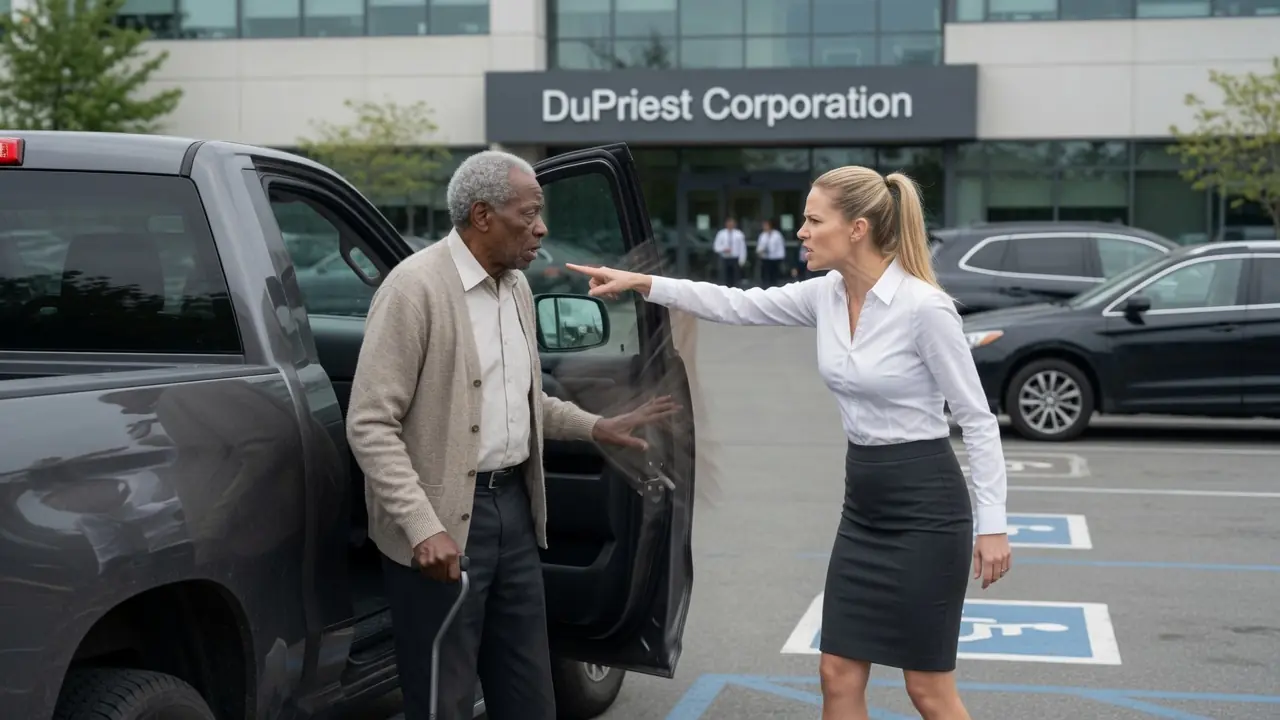
By 8:42 a.m., independence felt like a mistake. The highway into Raleigh, North Carolina, had narrowed to two lanes because of roadwork, and every driver in the city seemed to have chosen that morning to forget how turn signals worked. Mackenzie sat gripping the steering wheel of her silver sedan, watching the estimated arrival time on her dashboard crawl from 8:55 to 9:03, then to 9:08. Her interview at DuPriest Corporation was scheduled for 9:15. It was not just another interview. It was the interview, the one her graduate adviser had called a doorway, the one her father said could change the way people said her name in rooms she had not yet entered.
She had spent eight years building toward a morning exactly like this. Undergraduate honors, business school, internships where she stayed late enough for security guards to learn her coffee order, a consulting fellowship that paid almost nothing but looked impressive on paper. She was thirty-one years old and tired of almost making it. DuPriest Corporation had chosen her as a finalist for its strategy leadership program, a position that usually went to people with old money, family introductions, or last names printed on donor walls. Mackenzie had none of those things. What she had was a resume sharp enough to make recruiters stop scrolling, and an ambition that did not know how to rest.
When the glass towers of the DuPriest campus finally came into view, she felt the pressure in her chest loosen for one second. The headquarters rose from the edge of a manicured corporate park, all mirrored windows and dark stone, with a flag snapping above the entrance and a bronze sign that read DUPRIEST CORPORATION in clean, heavy letters. She had seen photographs online. In person, the building looked less like an office and more like a test. Everything about it seemed designed to reveal whether a person belonged before they even reached the lobby.
Mackenzie turned into the visitor lot at 9:10. Five minutes. She could still make it if she parked close, walked fast, checked in at security, and looked composed by the time she reached the forty-second floor. Her blouse was pale blue and newly pressed. Her heels were uncomfortable but expensive-looking. Her portfolio was in the passenger seat beside her, and inside it were printed copies of her resume, a case-study analysis, and three carefully written questions about DuPriest's expansion into sustainable logistics. She could recover from traffic. She could not recover from arriving breathless and sweating like someone who could not manage her own morning.
The first four visitor spaces were full. The fifth was blocked by a delivery van. Mackenzie cursed under her breath and drove farther down the row. Near the front entrance, just past the broad walkway that led to the glass doors, she saw one open space. It was wide, shaded, and close enough that she could make it across the lot in less than thirty seconds. Her relief lasted until she noticed the blue sign posted at the head of the space and the large wheelchair symbol painted on the asphalt.
She slowed anyway. The space beside it was also marked accessible. A dark pickup truck was sitting crooked across part of the painted access aisle, its passenger door open. An elderly man stood beside the truck, bent slightly forward, one hand gripping the door frame and the other holding a folded walking cane. A younger woman stood with him, steadying his elbow while he tried to swing his feet toward the pavement. The movement was painfully slow. He wore a gray cardigan despite the warm morning, polished brown shoes, and a flat cap that looked decades older than Mackenzie. His thin white hair showed beneath the cap, and his face carried the careful concentration of someone turning a simple movement into a negotiation with his own body.
Mackenzie stopped behind them. She glanced at the dashboard clock. 9:11. She waited three seconds. Then five. Then twelve. The old man lowered one foot to the ground and paused as though the pavement had become a puzzle he needed time to solve. The younger woman said something softly to him. He nodded, but the nod was slow too. Mackenzie felt heat crawl up her neck.
She tapped the horn once. Not a long blast, just enough to announce herself. The younger woman looked over her shoulder. Mackenzie pointed toward the space, then toward her watch. The woman raised one hand in a small apologetic gesture and turned back to the old man. He was still halfway out of the truck.
At 9:12, Mackenzie put the car in park and stepped out. She kept her portfolio tucked under one arm and tried to make her first words sound controlled. They did not.
"What are you doing?" she called. "Do you think I have all day to watch you unpack your whole life?"
The old man did not react. He seemed not to hear her at all. The younger woman's head snapped toward Mackenzie, her face tightening.
"Excuse me?" she said.
Mackenzie stepped closer, her heels clicking sharply against the asphalt. "Hey, old man. Can you hear me? Do you need me to draw you a picture? I need this space. Move."
The younger woman moved between them. She was in her late forties, tall, composed, with dark hair pulled into a smooth knot and a navy suit that fit as if it had been tailored that week. Nothing about her looked like someone Mackenzie should dismiss, but panic had already narrowed Mackenzie's vision. She saw only the clock, the building, the space, and the fragile old man standing between her and the morning she thought she deserved.
"Back up," the woman said. "Now."
The old man's fingers tightened around the cane. His eyes moved from Mackenzie to the woman beside him. His mouth opened slightly, but no words came. The woman turned to him at once.
"Dad, are you all right?" she asked, her voice softening.
Mackenzie blinked. "This glitch is your father?"
"He is," the woman said, turning back to her. "And you're terrifying him. What is your issue?"
"My issue?" Mackenzie laughed once, sharp and humorless. "My issue is that I have an interview that decides my career, and he's moving like he's underwater. My whole life rides on this, and he's in park."
The woman stared at her with a stillness that should have warned Mackenzie to stop. "My father's hearing is short, and he has osteoporosis. His balance isn't good. He physically cannot move faster. Cut him some slack."
"Then leave him on the couch," Mackenzie snapped. "Why is he here clogging up all the parking spots when he can barely walk?"
The old man's face changed. It was slight, but it was there: a flinch, not of fear exactly, but of recognition. He had heard enough. The daughter saw it too. Her jaw tightened.
"There are open spaces thirty feet that way," she said. "If time is that tight, take one."
Mackenzie glanced toward the far row. The empty spaces there were not far by any reasonable measure, but they felt like a mile under the rising sun and the weight of her own panic. "You want me to hike across this lot sweating through my blouse before the most important interview of my life? Either grandpa moves the truck, or I'll move it myself. Nobody's going to like the way I do it."
The woman's eyes narrowed. "How about you have some respect for your elders?"
"Respect?" Mackenzie scoffed. "How about thanks? People like me work, pay taxes, and keep the whole system running so people like him can retire and take up space."
For the first time, the old man spoke. His voice was thin, rough with age, but steady enough to carry. "Michelle. Let her park somewhere else."
The daughter, Michelle, touched his arm without looking away from Mackenzie. "No, Dad. She doesn't get to bully you because she's late."
Mackenzie heard the name but did not process it. Michelle. It meant nothing to her in that moment. She only heard defiance.
"You know what's wild about this?" Michelle said.
"Please," Mackenzie replied, spreading one hand, "enlighten me."
"You running your mouth about something you don't understand."
"I don't give a damn about your life story. Give me the spot."
"This is a parking space for disabled people who actually need it," Michelle said. "My father has a placard. He has medical reasons. You don't."
Mackenzie pointed toward her car. "You don't know what I have. What makes you think I can't park here?"
"I'm pretty good at reading people."
"Read this," Mackenzie said, stepping closer. "Stay out of it unless you want problems. I'll park anywhere I damn want to."
"No," Michelle said. "You won't."
A security guard near the front entrance had started watching. Two employees crossing the lot slowed their pace. Mackenzie sensed eyes on her now, but instead of shame, she felt the desperate need to win. She had not spent years fighting for rooms like this just to be made small in a parking lot by a woman with perfect posture and an old man who could not move out of her way.
"Oops," Mackenzie said, looking at the old man. "My bad. I didn't know this spot was reserved for people with missing brain cells."
Michelle inhaled slowly. The old man closed his eyes. The security guard took one step forward.
"My father's condition is real," Michelle said. "It seems you're the one missing empathy and self-awareness."
"Wrong," Mackenzie replied. "I've got stuck-around-idiots disease, and apparently there ain't no cure."
"Still doesn't give you a placard."
Mackenzie threw up both hands. "Fine. I'm done. I'm done with this." She turned back to her sedan, got in, and pulled forward just enough to angle across the front of the pickup, blocking it from leaving and partially blocking the accessible aisle. Then she stepped out again, grabbed her portfolio, and slammed the door. "There. No parking. If I can't use the spot, neither can he. You better pray I get this job."
Michelle looked at her with a strange calm. "I'm betting you won't."
Mackenzie laughed. "Bet on it. They'll be begging me to sign."
"That's cute, Mackenzie."
The name froze her where she stood. Her fingers tightened around the portfolio until the corners bent.
"How do you know my name?" she asked.
Michelle took one step closer, not aggressively, but with the quiet authority of someone stepping into a room she owned. "Let's call it due diligence. I make it a point to know the people I'm meeting. Michelle DuPriest, by the way."
The parking lot seemed to tilt.
Mackenzie looked at the woman again, really looked this time: the navy suit, the composed face, the calm that did not come from patience but power. Michelle DuPriest. President and chief operating officer of DuPriest Corporation. Daughter of the company's founder. The woman Mackenzie had studied for two weeks. The woman whose interviews she had watched online, whose article on leadership culture she had quoted in her own cover letter.
Her mouth went dry. "The president of DuPriest?"
Michelle did not smile. "Should we wrap up your interview in this parking lot?"
Mackenzie turned toward the old man, who had finally steadied himself beside the truck with both hands around his cane. Michelle placed a gentle hand at his back.
"And this gentleman," Michelle said, "is Ernest DuPriest, founder of DuPriest Corporation. Ring any bells?"
Every sound in the lot sharpened and blurred at once. The distant fountain near the lobby. A car door closing. A bird calling from a tree near the curb. Mackenzie saw the bronze sign at the entrance again and felt as if every letter had become a witness. Ernest DuPriest. The man whose biography she had read the night before. Born in a mill town. Worked loading docks at fourteen. Built a regional shipping company with one used truck and turned it into an international corporation. A man she had planned to praise in her interview as proof that grit and humility still mattered.
"Mr. DuPriest," she said, and the words came out thin. "I... I am so sorry. I had no idea. I mean, I am a huge fan of everything you've built. I would be honored to work for your company."
Ernest looked at her for a long moment. His eyes were pale blue, watery with age, but not weak. The softness Mackenzie had mistaken for confusion was not emptiness. It was restraint.
"You were not speaking to a company," he said. "You were speaking to a person."
Mackenzie's face burned. "Of course. You're right. I was stressed, and traffic was awful, and I didn't mean—"
"You meant every word until you learned who I was," Ernest said.
The sentence landed with such quiet precision that Mackenzie had no immediate defense. She looked at Michelle, then at the security guard, then at the two employees who had stopped near the walkway. One of them was holding a phone at his side, not openly recording, but enough that Mackenzie understood the moment might not belong only to the people standing there.
"Let's reset," Mackenzie said quickly. "Please. I'm going to move my car over there. I'll walk in. I'll apologize properly. This is not who I am."
Michelle's expression did not change. "Save it. The performance is worse than the meltdown. We saw exactly who you were when it counted."
"Please," Mackenzie said. The word came out before she could stop it. "I've worked so hard for this. You don't understand."
Michelle tilted her head slightly. "That may be the first true thing you've said. I don't understand how someone can work that hard to enter a company built on people and still treat people like obstacles."
Ernest took a slow breath. Michelle steadied him again, but he lifted one hand as if to say he wanted to speak for himself.
"Young lady," he said, "I built DuPriest Corporation with my bare hands. Blood, sweat, and years I'll never get back. I know what struggle is. I know what it means to be tired, late, scared, and desperate. Those things reveal character. They don't excuse the lack of it."
Mackenzie's eyes filled despite herself. She hated that. She hated crying in front of people, hated feeling like a child in a room where she had prepared to look brilliant. "I'm sorry," she whispered. "I really am."
"Respect isn't a buzzword," Ernest said. "It's the baseline here. We don't hire resumes. We hire people who can work with others, people who can grow, people who don't crumble the second they're inconvenienced. On paper, Mackenzie, you were our top pick. You had the job."
Her breath caught.
"You just threw it away," he said.
For a moment, no one moved. Then Michelle turned to the security guard. "Please escort Ms. Vale to the visitor desk so she can receive her validated parking slip and leave the campus. Also have facilities check whether her car blocked the accessible aisle long enough to require a report."
"Yes, ma'am," the guard said.
Mackenzie looked at the building, then at the space, then at Ernest DuPriest. "Mr. DuPriest, please. One mistake shouldn't ruin everything."
Ernest's expression softened, but not in the way she wanted. "No. One mistake doesn't ruin everything. But one moment can tell the truth about everything you've been hiding from yourself. What you do with that truth now is up to you. It won't be with my company."
The guard approached, not touching her, only standing close enough to make the direction clear. Mackenzie walked beside him toward the front entrance, each step heavier than the last. She did not look back until she reached the curb. When she did, she saw Michelle helping her father toward the walkway, moving slowly, patiently, at his pace. People waited for them without complaint. The glass doors opened. Ernest DuPriest entered the building he had built, and Mackenzie stood outside with the sun on her face and the ruins of her morning in her hands.
By noon, the story had already spread through the building. Nobody used her name at first. They called her the candidate in the parking lot, the woman who yelled at Mr. DuPriest, the applicant who blocked the accessible space. In corporate offices, gossip travels faster when it confirms what people fear most: that polished language can hide a rotten instinct. By two o'clock, human resources had formally removed Mackenzie from consideration. By three, Michelle had written a private memo to the executive hiring committee titled Character Under Pressure.
It did not mention Mackenzie by name in the subject line, but everyone who needed to understand understood. The memo was not long. Michelle wrote that DuPriest Corporation had spent years improving its interview process, adding case studies, panel questions, leadership assessments, and ethical decision exercises. Yet the most revealing interview that day had happened before the candidate entered the building. It had happened in a parking lot, beside an accessible space, when the candidate believed the person slowing her down had no power over her future.
"We must stop treating character as something we verify after competence," Michelle wrote. "Character is competence when the job requires leadership. A person who humiliates the vulnerable in private will eventually harm the company in public."
The memo became part of the company's hiring training within a month.
Mackenzie did not know any of that yet. She drove home in silence, still wearing the blouse she had worried about sweating through, still carrying the portfolio no one had opened. At every red light, pieces of the morning returned to her in cruel flashes. Do you need me to draw you a picture? His brain left the building. Leave him on the couch. Missing brain cells. She tried to tell herself she had been nervous, that anyone could lose control under pressure, that Michelle had been cold, that Ernest DuPriest could have shown grace. But each excuse collapsed under the weight of one fact she could not escape: she had been kind only when she thought kindness would benefit her.
At home, she dropped the portfolio on the kitchen table and sat there until the room grew dim. Her phone buzzed with an email from the recruiter. It was brief, professional, and final. DuPriest Corporation appreciated her interest but would not move forward with her candidacy. They wished her success in future endeavors. Mackenzie read the message five times. The words did not change.
Her first instinct was anger. She opened a blank email and began typing a response about disproportionate consequences, about stress, about how a lifetime of work should not be erased by a few words spoken in panic. Then she stopped. A few words. She heard Ernest again: You meant every word until you learned who I was. Her fingers hovered above the keys. Slowly, she deleted the draft.
The next morning, a short video appeared online. It had been filmed from a distance by someone in the lot, and while the audio was imperfect, enough of the confrontation was clear. The clip did not show Mackenzie's face at first, but it caught her voice. It caught her blocking the accessible space. It caught Michelle saying, "This is a parking space for disabled people who actually need it." It caught Mackenzie replying, "I'll park anywhere I damn want to." Within hours, the comments filled with outrage. By afternoon, her name was attached to it. By evening, strangers had found her professional profile.
Mackenzie watched her life become smaller and louder at the same time. Recruiters stopped responding. Former classmates texted careful messages that sounded more like curiosity than concern. A consulting firm postponed an interview indefinitely. Her father called three times before she answered. When she finally did, he did not yell. That was worse.
"Is it true?" he asked.
Mackenzie sat on the edge of her bed. "Yes."
There was a long silence. "All of it?"
Her eyes burned. "Enough of it."
Her father sighed, and in that sigh she heard disappointment older than anger. "Your grandmother used a cane the last two years of her life. You remember how people rushed her in grocery stores? How they sighed behind her when she counted change too slowly?"
Mackenzie closed her eyes. She did remember. She remembered standing beside her grandmother at a pharmacy counter, feeling embarrassed by the line forming behind them. She remembered wishing the old woman would move faster. She remembered not saying anything when the man behind them muttered, "Some people shouldn't come out alone." Her grandmother had pretended not to hear. Mackenzie had pretended too.
"I raised you better than that," her father said softly.
"I know."
"Knowing is not the same as doing."
After they hung up, Mackenzie sat in the quiet for a long time. Her anger had nowhere left to stand. It drained away and left something uglier beneath it: recognition. The parking lot had not created her contempt. It had revealed it. She had spent years worshiping speed, achievement, polish, and access. She had learned to see delays as enemies and vulnerable people as reminders of everything she feared becoming: dependent, inconvenient, easy to ignore.
Three days later, Mackenzie wrote a letter. She did not send it at first. She rewrote it twelve times. Every early version tried too hard to explain. She mentioned traffic. She mentioned pressure. She mentioned how important the interview was. Each time, the letter turned into a defense. Finally, she started over with one sentence: I treated you as if your age and disability made you less worthy of space than my ambition.
That sentence stayed.
She wrote to Ernest DuPriest first. She wrote to Michelle second. She did not ask for the job back. She did not ask for another chance. She apologized for the words, for blocking the accessible aisle, for making a difficult physical moment humiliating, and for only recognizing his dignity after learning his name. She wrote that she had begun looking for disability awareness training and volunteer opportunities not as public repair but because she needed to become less ignorant than she had allowed herself to be. Then she mailed the letters on paper, because email felt too easy.
Michelle received hers on a Friday morning and read it once in her office. She showed it to Ernest over lunch. He sat by the window in the executive dining room, eating soup slowly, as he always did now. His hands shook more than they used to. Michelle noticed everything and pretended not to notice the parts that would embarrass him.
"She doesn't ask for anything," Michelle said.
Ernest nodded. "Good."
"Do you believe her?"
He looked out at the parking lot below. From that height, the accessible spaces looked small, almost symbolic, blue squares near the entrance. "I believe she is ashamed. That's a beginning."
"Not enough for a leadership role."
"No," Ernest said. "Not enough for that. But maybe enough for a human being."
Michelle folded the letter and put it back in the envelope. "Do you want to respond?"
Ernest thought about it. "Not yet. Let her live with it without applause. That's where change has room to grow."
So Mackenzie lived with it. At first, unwillingly. Then deliberately. The job market punished her for a while, but public attention moved on, as it always does. What remained was the quieter consequence: she no longer trusted her own polished self-image. She took a temporary administrative job at a nonprofit that helped adults with disabilities navigate transportation, workplace access, and medical paperwork. It was not a strategic leadership program. It did not come with a glass tower or a salary that impressed anyone at reunions. It came with phone calls from people who had been stranded by broken elevators, denied accommodations, mocked by supervisors, or treated like burdens because their bodies moved differently through the world.
The work was uncomfortable because it was real. Mackenzie had to listen without managing the room. She had to help people fill out forms, wait on hold, arrange rides, and learn the difference between compliance and dignity. She met a veteran who left two hours early for every appointment because one late paratransit van could ruin an entire day. She met a retired teacher with Parkinson's who had stopped going to church because people kept grabbing her arm without asking. She met a college student who mapped every ramp on campus because the official accessibility map was wrong. Again and again, Mackenzie heard some version of the same wound: people did not mind needing help as much as they minded being treated like their need made them less human.
Six months after the parking lot, Mackenzie was asked to speak at a small internal training for new volunteers. She almost refused. She did not want to become one of those people who turned harm into a personal redemption story too quickly. But her supervisor, a direct woman named Alana who used a wheelchair and had no patience for performance, told her the point was not redemption.
"Tell them how easy it was to be cruel," Alana said. "People need to know cruelty doesn't always look like a villain twirling a mustache. Sometimes it looks like being late and thinking your schedule matters more than somebody's body."
So Mackenzie told the truth. She stood in a fluorescent meeting room with coffee in paper cups and twelve volunteers watching her, and she described the parking lot without naming DuPriest Corporation. She described the old man, the accessible space, her panic, her entitlement, and the moment she realized she had only valued him after discovering he was powerful. She did not cry. She did not ask anyone to forgive her. She ended with the sentence that had begun her letter: "I treated someone's age and disability as an inconvenience to my ambition. I lost an opportunity because of it, but he had to stand there and absorb the humiliation. That cost matters more than mine."
Afterward, a volunteer approached and said, "That was brave."
Alana rolled past them and said, "No, it was useful. Let's not overdecorate basic accountability."
For the first time in months, Mackenzie laughed, not because anything was funny, but because the correction felt clean.
A year later, DuPriest Corporation held its annual leadership summit. Michelle had expanded the event beyond executives and shareholders to include community partners, disability advocates, and workforce development groups. The theme was printed across the program in simple black letters: THE MEASURE OF RESPECT. Ernest DuPriest, now eighty-four, insisted on attending in person despite Michelle's concern. He moved even more slowly than before, but he still disliked being discussed as though he were absent from his own life.
Mackenzie attended as part of the nonprofit's accessibility panel. She did not know Ernest would be there until she saw him seated in the front row beside Michelle. For a moment, her body remembered the old panic. Then Ernest looked over and recognized her. He did not smile exactly, but he nodded once.
The panel went well. Mackenzie spoke for eight minutes about transportation access and workplace accommodations, then passed the microphone to Alana, who dismantled three common corporate excuses with surgical calm. When the session ended, Mackenzie gathered her notes and prepared to leave quickly. Michelle approached before she could.
"Ms. Vale," Michelle said.
Mackenzie straightened. "Ms. DuPriest. Thank you for having us."
Michelle studied her for a moment. "You've been doing good work with Access Forward. Alana speaks highly of your follow-through, which she does not do lightly."
"No," Mackenzie said. "She doesn't."
A faint smile crossed Michelle's face and vanished. "My father would like a word."
Mackenzie followed her to where Ernest sat near the aisle. Up close, he looked older than she remembered, but his eyes had the same clear steadiness. She stood before him with her hands folded, resisting the urge to overexplain her gratitude for the invitation, the panel, the chance to stand in the building again without being removed from it.
"Mr. DuPriest," she said. "I'm glad to see you."
"Are you?" he asked.
The question was not cruel. It was curious.
Mackenzie took a breath. "Yes. And I'm ashamed of how I met you. Both can be true."
Ernest nodded slowly. "That's better than the apology you gave in the parking lot."
"That apology was fear. The letter was shame. I hope what I'm doing now is something more useful than both."
He looked at her for a long moment. "Michelle tells me you never asked again about the job."
"I didn't deserve it."
"Deserving is a complicated word. You weren't ready for it. That's clearer."
Mackenzie accepted that. "No. I wasn't."
Ernest tapped one finger against the head of his cane. "A company can teach systems, markets, negotiation, finance. It cannot teach humility to someone determined not to learn it. But life can. If they let it."
Mackenzie felt her throat tighten. "I'm trying to let it."
"Good," Ernest said. "Keep trying when no one is watching. That's the part that counts."
Michelle returned then, and the moment ended without ceremony. There was no job offer, no dramatic forgiveness, no full-circle miracle. Ernest DuPriest did not hand Mackenzie the future she had thrown away. He simply gave her a sentence she could carry: keep trying when no one is watching.
Two years after the parking lot incident, Mackenzie became operations director at Access Forward. The title was smaller than the one she once wanted, but the work had weight. She helped design employer training programs that began not with laws and penalties, but with stories: a woman blocked from an accessible restroom by storage boxes, a man left waiting outside an office because the ramp was under repair, an elderly founder humiliated in his own company's parking lot by someone who thought ambition excused cruelty. Mackenzie told that last story carefully. She never made herself the hero of it.
DuPriest Corporation became one of Access Forward's largest corporate partners. Michelle approved funding for a regional initiative that helped small businesses audit accessibility barriers. Ernest recorded a short introduction for the training program, sitting in his office with his cane visible beside him. His voice was slower by then, but still unmistakably his.
"Respect is not proven by how we treat people who can reward us," he said in the video. "It is proven by how we treat people when we think there is nothing to gain."
The video played at every training. Mackenzie watched it dozens of times and never stopped feeling the sting of recognition. But the sting changed over time. It became less like punishment and more like a compass.
On an autumn morning three years after the interview she never had, Mackenzie arrived early at a community hiring fair downtown. The lot was crowded, and a delivery truck had blocked the main entrance ramp. Near the curb, an older woman with a walker waited beside a rideshare car, unable to reach the sidewalk safely. Several people hurried past her, glancing, apologizing with their faces but not their time.
Mackenzie parked in the far row and walked over.
"Ma'am," she said gently, "would you like help finding the accessible entrance?"
The woman looked up, wary from experience. "I'm slow."
Mackenzie thought of Ernest DuPriest standing beside the pickup, one foot on the pavement, the world demanding speed from a body that had already given enough. She thought of Michelle's hand on his arm. She thought of her own voice, cruel and frantic, echoing from a person she no longer wanted to be.
"That's all right," Mackenzie said. "I've got time."
The woman accepted her arm. Together, they moved across the lot slowly, carefully, at the pace the moment required. A man behind them sighed loudly because they were in his way. Mackenzie turned and looked at him, not with rage, not with performance, but with steady clarity.
"There are open spaces thirty feet that way," she said.
Then she kept walking.
Years later, people at DuPriest Corporation still told the parking lot story, though the details softened and shifted depending on who told it. Some told it as a warning about hiring. Some told it as proof that Ernest DuPriest never lost his instinct for character. Some told it as a moment when Michelle's leadership became impossible to question. Very few remembered Mackenzie Vale's name, and that was probably fair. The story had never really belonged to her.
It belonged to anyone who had ever been rushed, mocked, dismissed, or treated as an obstacle because their body, age, or pain made someone else wait. It belonged to the quiet truth Ernest had spoken before walking into the building he built: struggle reveals character, but it does not excuse the lack of it. It belonged to the accessible space near the front entrance, repainted every spring, kept clear by policy and by culture, not because the law required it but because respect did.
And if there was a lesson in it, it was not complicated. A resume can shine. A suit can impress. A person can say all the right things when the room is prepared and the questions are expected. But character is usually tested before the interview starts, before the meeting begins, before anyone important has introduced themselves. It is tested in parking lots, checkout lines, hospital lobbies, crowded sidewalks, and all the ordinary places where inconvenience tempts people to become cruel.
Mackenzie lost the job she thought would define her life. Ernest DuPriest lost a few minutes in a parking lot, but he refused to let that moment steal his dignity. Michelle protected her father and her company in the same breath. And somewhere between humiliation and accountability, a woman who once measured success by how quickly doors opened learned that the better measure was whether she made room for someone else to enter.