Malik Turner had learned to move quietly through neighborhoods that were not built for boys like him. He was seventeen, tall for his age but still narrow in the shoulders, with a delivery bag strapped across his back and a phone clipped to the handlebars of his old electric bike. On most afternoons, he liked the rhythm of the work. The app sent him from restaurant to apartment building, from grocery store to townhouse, from one doorstep to another, and for a few hours he could almost pretend that every street in the city belonged to him equally.
That morning had begun with ordinary hope. His mother, Kelsey, had kissed the top of his head before leaving for her shift at the medical billing office and reminded him not to skip lunch. Malik had laughed and told her he was trying to make money, not spend it. They lived in a small rented duplex on the east side of town, where the windows rattled when trucks passed and the porch light flickered no matter how many times Kelsey changed the bulb. But the home was theirs, and Kelsey had filled it with framed school pictures, used books, and the smell of cinnamon coffee.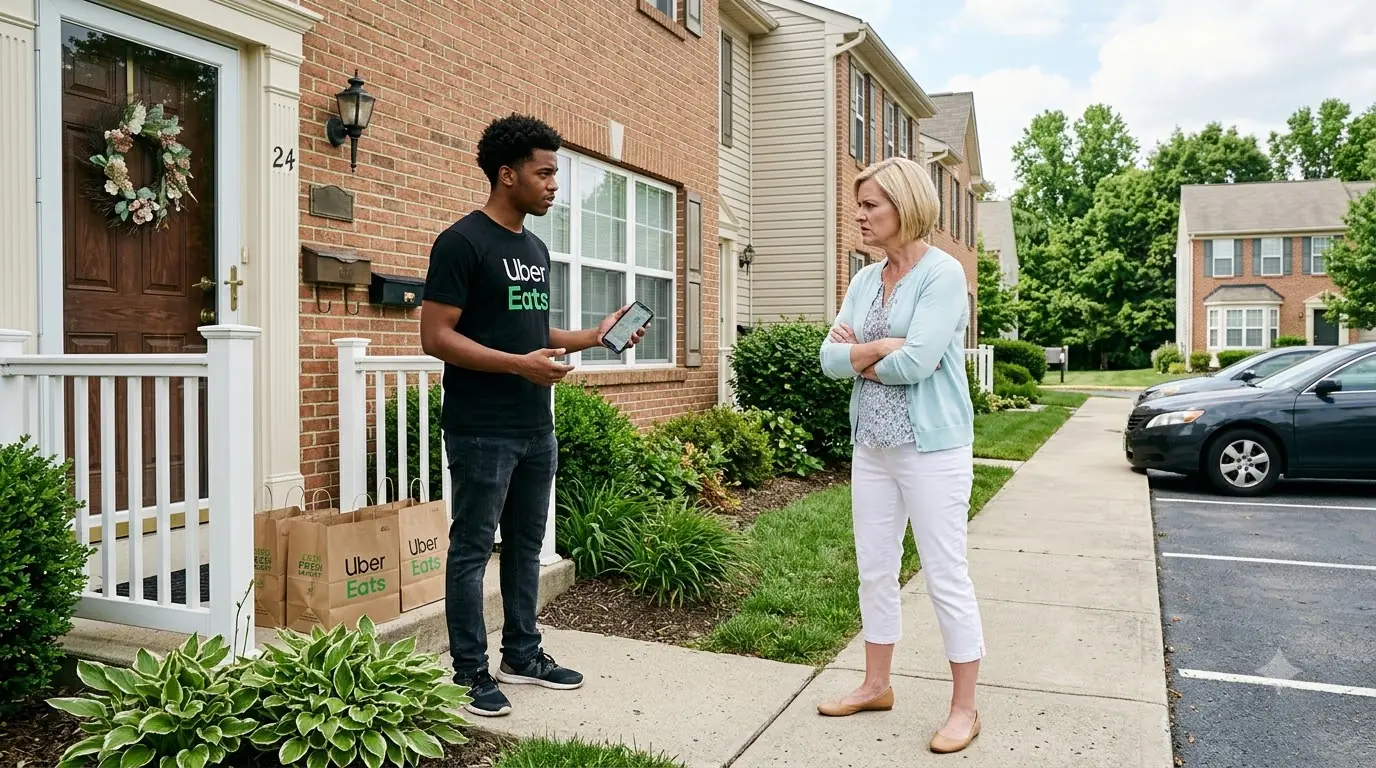
Malik was adopted. Kelsey had never hidden that from him. She was white, a single mother who had taken him in when he was four years old after fostering him for nearly a year. She used to say he had entered her life carrying a blanket, two toy cars, and a stare too serious for a child. He used to say she entered his life carrying paperwork, peanut butter sandwiches, and too many questions about whether he wanted the crust cut off. Between them, love had grown in small daily acts until no document in the world could have made it more official.
The delivery order came through a little after noon: groceries from Westbridge Market to a large house on Briar Glen Lane. Malik knew the neighborhood by reputation. It was the kind of place with curved driveways, trimmed hedges, and signs warning about private security even when no security was visible. He had delivered there only twice before, both times without incident, but he remembered how quiet the streets felt. Even birds seemed careful about making noise there.
The order was simple: almond milk, strawberries, two bags of organic salad, a rotisserie chicken, coffee pods, and a case of sparkling water. Malik packed the bags carefully into the insulated crate on the back of his bike and followed the map through town. The August heat shimmered over the pavement. By the time he reached Briar Glen Lane, sweat had soaked the collar of his T-shirt, but he was still on schedule. He checked the address twice, parked near the curb, and carried the groceries toward the front porch of a pale stone house with blue shutters.
The customer instructions said, Leave bags by the front door. Please place cold items near the shade. Malik did exactly that. He set the bags beside a large ceramic planter, took a photo for confirmation, and was about to mark the delivery complete when he noticed one of the salad bags had slipped sideways and was pressing against the chicken container. He crouched to adjust it. That was when a woman’s voice cut across the driveway like a thrown glass.
“Hey!”
Malik turned. A woman stood on the sidewalk holding a phone in one hand and a set of keys in the other. She was in her late fifties, dressed in expensive walking clothes, with sunglasses pushed into her hair and a tight expression that looked like it had been waiting all morning for a target. “What are you doing?” she demanded. “Trying to break in? Not on my watch.”
“No, ma’am,” Malik said, standing slowly. “I’m just here to deliver—”
“Give me that.”
Before he could step back, she marched up the driveway and snatched his phone from his hand. Malik froze. His phone was not only his ID for the delivery app; it was his route, his proof, his income, and his only way to call his mother if something went wrong. “Ma’am, please give me my phone back,” he said. “I can explain. I’m just trying to finish a delivery.”
“Nothing to explain,” she snapped. “You do not belong in this neighborhood. In fact, I have never seen you here before. And here you are trying to waltz into these people’s home like you own the place.”
“I wasn’t trying to go inside,” Malik said, keeping his voice low because his mother had taught him that a calm voice could sometimes keep a bad moment from getting worse. “The groceries are right there. The app has the address. My ID is on that phone.”
The woman lifted the phone higher, as if he might lunge for it. “They just think they can get away with anything these days,” she said, not really speaking to him anymore but to the phone camera now recording his face. “Well, too bad for you. I’ve got proof. And now the police are on the way.”
Malik’s stomach dropped. “Ma’am, please don’t call the police. I didn’t do anything.”
“You should have thought about that before you came creeping around here.”
“I’m not creeping. I’m working.”
She took a step backward and suddenly screamed, “Help me! Help me!”
Malik lifted both hands and stepped away from her. “What are you doing?”
“Back off!” she shouted. “Stay away from me!”
A garage door opened across the street. A man appeared at the edge of his driveway, then retreated inside. Curtains moved in the window of the house next door. Malik felt the neighborhood watching him without helping him. He stood there with empty hands, the groceries beside the door, his bike at the curb, and his phone in the hand of a woman who was turning him into a threat one sentence at a time.
The woman rushed toward them. “Officers, thank God. I caught this kid trying to break into this house. He’s dangerous.”
“No, sir,” Malik said quickly. “I’m a delivery driver. She took my phone.”
Bradley looked him up and down. “What’s your name?”
“Malik Turner.”
“Malik, do you have any ID?”
“It’s on my phone,” Malik said, pointing toward the woman. “She has it.”
Bradley’s eyes moved to the woman, then back to Malik. “Do you live here?”
“No, sir.”
The woman made a triumphant sound. “See? There it is.”
Bradley’s voice sharpened. “Why were you trying to get into this house?”
“I wasn’t. I was helping with the groceries. I was delivering them.”
“He can’t even come up with a good lie,” the woman said. “I’m so glad I caught him just in time.”
Edwards looked at the bags by the porch. “Sarge, those look like grocery bags.”
Bradley ignored him. “Do you have any business being in this neighborhood today?”
“Yes,” Malik said. “The delivery. If you just look at my phone, it’ll show—”
“Hands behind your back.”
Malik stared at him. “Why? I didn’t do anything.”
“I’m not taking questions right now,” Bradley said. “I’m giving you an order. Follow it if you know what’s good for you.”
The words hit Malik in the chest. He had heard stories. Every Black boy he knew had heard stories. Stories about traffic stops, convenience stores, walking home too late, standing in the wrong place, breathing wrong in front of someone with power. He did not want to become another story his mother cried over later. Slowly, he turned and put his hands behind his back.
The cuffs clicked around his wrists.
“He has my phone,” Malik said, his voice cracking now despite his effort to keep steady. “Please. She has my phone.”
The woman, whose name Malik would later learn was Helen Whitaker, stood with her chin raised and the phone still in her hand. “We have to be vigilant against these types of people,” she said to the small crowd gathering on the sidewalk. “I saved the day.” Then she noticed a neighbor recording her and snapped, “Why are you filming me? Film him. You should be thanking me.”
Malik’s breathing went shallow. The cuffs felt too tight. He saw his delivery bike still standing by the curb, the app timer still running somewhere on the stolen phone, the groceries sweating in the heat, and Officer Edwards watching him with a look that seemed less certain by the second. Malik wanted his mother. He hated that he wanted his mother, but he did.
A second patrol car rolled up then, and a third officer stepped out. This one was older than Edwards but younger than Bradley, with silver at the temples and a command presence that changed the air around him. His name was Sergeant Daniel Smith. He took one look at Malik, then at the groceries, then at Helen’s phone, and his expression tightened.
“Jake, Gary, what’s going on?” he asked.
Malik looked up. “Officer Smith. I didn’t do anything wrong.”
Smith’s eyes narrowed with recognition. “Malik?”
Bradley glanced over. “You know this kid, boss?”
“You’re from the summertime mentorship program,” Smith said. “I did a session there last month.”
“Yes, sir,” Malik said, embarrassed by the tears burning behind his eyes.
Smith turned to the officers. “All right. Break it down. Explain to me why you have this young man in cuffs.”
Bradley said, “This lady accused him of trespassing.”
“Worse,” Helen cut in. “He was breaking in.”
“He doesn’t have ID, and he doesn’t live here,” Bradley said. “She saw him try to get into the house.”
Smith’s face hardened. “Take the cuffs off. Now.”
Bradley opened his mouth, but Smith stepped closer. “We have no evidence to detain him or humiliate him like this. Your job is to ask questions. You don’t know that by now?”
Edwards moved first, unlocking the cuffs. Malik brought his hands forward and rubbed his wrists. He hated how badly they trembled. Smith noticed. “Look at him,” he said quietly. “He’s having a panic attack. Edwards, get him a bottle of water.”
“Yes, sir.”
Helen scoffed. “Of course. You take the criminal’s side when these two honest officers are just trying to do their job.”
Smith turned slowly. “Ma’am, are you trying to insult an officer of the law?”
“I mean, I’m just saying—”
“These two honest officers are my subordinates,” Smith said. “And right now, I’m trying to understand why a teenager delivering groceries ended up handcuffed in the street. Can you explain what happened so we can help you?”
“He was trying to attack me,” Helen said.
“Did he?”
“He could have.”
Smith’s tone stayed even. “Did he try to break the door? Did he try to force a lock? Did he use a key? Anything like that?”
“No, but he was there.”
“So you assumed he was trying to break in, just like you assumed he was trying to hurt you.”
Helen’s mouth tightened. “He does not belong here. I know all of my neighbors in this neighborhood. He’s an outsider. He’s encroaching.”
“Ma’am,” Smith said, “you are dangerously close to making a false felony report. I’m going to ask you again. What exactly did you see?”
Helen looked at Malik, then at the groceries, then at the phone in her hand. “I just… I saw him on the porch.”
A woman from across the street spoke up. “She was harassing him, officer. She took his phone, too.”
Smith looked at Helen’s hand. “Oh, really?”
Helen hid the phone behind her hip like a child hiding candy. “I was preserving evidence.”
“You took property from a minor,” Smith said. “Depending on how this goes, that can become a charge.”
Malik swallowed. “It’s all right,” he said, even though it was not. “It was just a misunderstanding. I just want to get back to my deliveries.”
Before Smith could answer, a small blue sedan screeched to a stop behind the patrol car. Kelsey Turner got out so fast she left the door open. Her face was pale with terror. “Malik!”
“Mom,” Malik said, and the word broke something in him.
Kelsey ran to him and pulled him into her arms, then looked at the red marks on his wrists. “My coworker sent me a live video,” she said, her voice shaking. “There you are getting handcuffed.” She turned toward Smith. “What happened to my son?”
Smith removed his hat. “Ms. Turner, I’m sorry for my officers’ behavior. I see they need more training.”
Kelsey turned to Helen. “How would you feel if that was your son getting attacked, having his phone ripped from him, watching him get handcuffed in front of strangers? Are you so blinded by your hate that you’re willing to put my son in harm’s way?”
Helen blinked. “You’re his mother? But you’re white.”
Kelsey stared at her. “Yeah, and the sky is blue.”
“But how is that possible? You—”
“I’m his adopted mother,” Kelsey said. “And you don’t get to decide who belongs to me.”
Officer Smith sighed through his nose. “Unfortunately, some people are still living in the wrong century.” Then he turned to Malik and Kelsey. “I’m going to ask you both. Would you like to press charges?”
Helen’s face changed. “Please. I’m sorry.”
Kelsey laughed once, bitterly. “Now you say you’re sorry. Now that your neck is on the line.”
Malik looked at Helen. He wanted the day to disappear. He wanted to rewind to the moment before she had taken his phone and choose a different street, a different order, a different job. But he also knew that if nothing happened, she would do this again to someone else, maybe someone younger, maybe someone alone, maybe someone who would not have a Sergeant Smith arrive in time.
“Mom,” he said softly, “I know you want to protect me.”
“I do.”
“I just don’t want this to happen to somebody else.”
Kelsey nodded, tears in her eyes. “Then we press charges.”
Smith turned to Helen. “Very well. Miss Whitaker, do you have any ID on you?”
Six months later, Helen Whitaker reported to the Southside Community Center for the first day of her court-mandated service. Malik saw her through the window before she saw him. She looked smaller without her expensive sunglasses and confidence, carrying a clipboard she did not know how to use. Kelsey stood beside Malik with her arms crossed.
“Surprised to see you here,” Kelsey said when Helen entered. “You don’t strike me as the community service type.”
“Court-mandated,” Helen muttered. “I have to work in the community center for the next six months.”
“Karma,” Kelsey said. “Now you get to see my boy shine in a place where he is loved by everyone. And here’s a tip for you. Try doing something good for someone and try meaning it.”
Malik did shine there. He had started volunteering after the incident because he hated how helpless he had felt and wanted to help younger kids feel safer than he had. He taught them how to apply for part-time jobs, how to save money, how to talk to customers without shrinking themselves. The first week Helen worked there, she barely looked at him. By the third week, she was stacking chairs after youth basketball. By the sixth, she was quiet enough to listen when a twelve-year-old told her people followed him around stores.
Malik did not forgive her quickly. He did not owe her that. But he learned that healing did not always look like forgetting. Sometimes it looked like walking past the person who hurt you without letting them control your breathing.
Officer Edwards did not forget either. He had watched Malik tremble in cuffs, and something in him had shifted. He was young, yes. Bradley never let him forget it. But youth had not been the reason Edwards hesitated that day. Conscience had. He had wanted to question the story more carefully, to look at the grocery bags, to ask for the phone, to slow the moment down before it became humiliation. He had failed Malik by not speaking up soon enough, and that failure followed him into every shift afterward.
A few weeks after Helen began community service, Edwards and Sergeant Bradley were parked outside a downtown hotel when they saw a man standing beside a black sedan with the driver’s door locked. The man was wearing a wrinkled button-down shirt and dress pants, and he was peering through the window with one hand cupped around his eyes.
Bradley leaned forward. “He’s going to try to steal that car. Just watch.”
Edwards frowned. “Maybe he locked his keys inside.”
“What did I tell you?” Bradley said as the man pulled on the door handle. “Let’s go.”
They got out of the cruiser. Bradley’s voice boomed across the parking lot. “Hands where I can see them.”
The man turned. “Is there a problem, officer?”
“Place your hands on the vehicle. You’re under arrest.”
“Under arrest for what?”
“Attempted grand theft auto.”
The man looked stunned. “Whoa. No. This is not what it looks like. I promise.”
“What it looks like,” Bradley said, “is that you were dumb enough to try to steal a car in front of two police officers.”
“Steal? No, this is my rental car. I lost my keys.”
Bradley laughed. “Sure you did. You hear the nerve on this guy, Edwards? Thinks he can lie right to our faces.” He pulled the man’s hands behind his back and began reciting the rights. “You have the right to remain silent. Anything you say can and will be used against you.”
“No, sir,” the man said. “This is really my car. Check inside. You’ll see my wallet and the rental agreement.”
Edwards hesitated. “Maybe we should check.”
Bradley snapped, “Maybe you should keep your mouth shut and open the rear door so I can process this scumbag.”
The man turned his head toward Edwards. “Please. Just look inside. My wallet is in the center console. My rental agreement is there too.”
“Save it for the judge,” Bradley said.
Edwards opened the rear door, but his stomach tightened. The scene felt too familiar: an assumption, a command, a person pleading for someone to verify the easiest fact in the world. Bradley shoved the man into the back seat and slammed the door.
“Shouldn’t we at least check out his story?” Edwards asked. “What if he’s telling the truth?”
Bradley gave him a cold look. “I know his kind. All they do is lie and steal.”
“His kind?” Edwards said. “Sir, that’s inappropriate.”
“Save the politically correct talk. You’re young. Give it a few years on the force. You’ll see.”
“It’ll only take a few seconds.”
“Let it go, Edwards. I’m your commanding officer. This is my call. Besides, this puts me over my quota for the month. Just in time, too. I’m chasing that promotion to lieutenant.”
Edwards looked at the man in the back seat. “I’ll give you one chance. Is that really your rental car?”
“Yes,” the man said. “Please. Center console. My wallet, my ID, rental agreement. Everything.”
“Okay,” Edwards said quietly. “I’ll check it out.”
The man blinked. “You believe me? Even though your partner doesn’t?”
“It’s my job as a police officer to serve every member of our community, regardless of what they look like,” Edwards said. “Not just lock people up without due process.”
“Thank you. What’s your name?”
“Officer Gary Edwards.”
But Bradley would not allow it. He called impound before Edwards could get near the car. When Edwards pushed again, Bradley stepped close enough that no one else could hear. “Either you drop this little investigation of yours, or I’ll make your life a living hell. I promise you, you’ll never make detective for the rest of your career. Got me?”
Edwards said, “I got you,” but he did not drop it.
That night, after the sedan had been moved to the impound lot, Edwards called Detective Lawrence, a man he knew from a previous investigation and trusted more than anyone in the department. They met under the weak yellow lights near the fenced rows of vehicles.
“Why’d you bring me all the way out here in the middle of the night?” Lawrence asked.
“I need to get into this car before it’s processed,” Edwards said.
“You don’t need me for that. Ask your sergeant.”
“I did. He said no.”
“Then maybe you should listen.”
“I’m trying to make sure we have the right guy,” Edwards said. “Bradley is letting bias blind him.”
Lawrence folded his arms. “That is a serious accusation.”
“You know how Bradley is.”
“I know enough to stay out of his way.”
Edwards looked through the fence at the car. “A teenager got handcuffed in a driveway because I didn’t push hard enough. I’m not doing that again. If it costs me, it costs me.”
Lawrence studied him for a long moment, then pulled a slim tool kit from his jacket. “If this goes sideways, you understand you’re taking responsibility.”
“Yes.”
They opened the car. Edwards checked the center console, the glove compartment, under the seats, the door pockets. Nothing. No wallet. No rental agreement. His chest sank. He had wanted so badly to be right that he had dragged another officer into trouble.
The next morning, Bradley was waiting by the lockers. “Do you have any idea how bad this looks for you?” he said. “Going behind my back to a detective? You’ll be lucky if this doesn’t cost you your badge.”
“I had to be sure,” Edwards said.
“And did you find anything?”
“No.”
Bradley smiled. “I’m always right. Remember that.”
Later, Edwards went to the holding area where the arrested man sat with tired eyes. “I searched the car,” Edwards said. “There was nothing there.”
The man stared at him. “That doesn’t make sense.”
“Do you know what kind of trouble I’m in for listening to you?”
“Something’s not right. My stuff was there. I swear.”
“I trusted you,” Edwards said, hurt sharpening his voice. “And you lied.”
“I didn’t.”
Edwards walked away before guilt could make him stay.
At roll call that afternoon, the chief entered with Detective Lawrence beside him. Sergeant Bradley stood taller than usual, already tasting the promotion he thought he had secured. The chief addressed the room.
“Lastly, I wanted to update the squad on our search for our newest lieutenant. Sergeant Bradley, would you join me up front?”
Bradley stepped forward. “Yes, sir.”
“Did you make an arrest yesterday?” the chief asked.
“Yes, sir. One less car thief on the streets.”
“One thing is certain,” the chief said. “Your actions last night made the lieutenant decision much easier.”
Bradley smiled. “Thank you, sir.”
“But before we get to that, there’s something else we need to address.” The chief turned. “Officer Edwards, is it true you broke the chain of command and searched the suspect’s car last night?”
Edwards stood. “Yes, sir.”
“What compelled you to do that?”
“I believed the suspect’s story about having rented the vehicle. It seemed reasonable. I thought we owed him a real investigation before charging him.”
Bradley cleared his throat. “I tried to explain how things work on the street, Chief.”
“That’s true,” Edwards said. “You did. I admit I went behind my sergeant’s back, and I take full accountability.”
“I’m glad to hear that,” the chief said. “Because I rigged the car you searched with cameras.”
The room went silent.
“We’ve been receiving complaints that officers in this squad have been racially profiling members of our community,” the chief continued. “I wanted to prove those complaints wrong. So I devised a test.”
The door opened, and the man from the parking lot walked in wearing a badge clipped to his belt.
Bradley’s face drained. “What’s he doing here? He’s supposed to be locked up.”
“This is Detective Lawrence’s colleague from Long Beach, Detective Marcus Reed,” the chief said. “He volunteered to pretend he was locked out of his rental car so we could observe officer reactions.”
Edwards looked confused. “But I searched the vehicle. I didn’t find anything.”
“That’s because Sergeant Bradley got to the car first,” the chief said. “And tampered with the evidence.”
Bradley lifted both hands. “Wait. I can explain.”
Detective Lawrence stepped behind him. “Save it for the judge. You’re under arrest for tampering with evidence and obstruction.”
As Lawrence cuffed Bradley, Edwards felt the room tilt. He had been right and wrong at the same time. Right to question the arrest. Wrong to doubt the man after the evidence disappeared. The difference, he realized, was that he had been willing to look. Bradley had been willing to bury the truth.
The chief turned to Edwards. “This squad owes you a debt. You risked your job to protect the rights of a citizen, and that takes courage.”
“Thank you, sir.”
“And since we now have an opening in our sergeant ranks, I’d like to promote you. How does that sound, Sergeant Edwards?”
Edwards swallowed hard. “Thank you, sir. I promise to do my best.”
“You will,” the chief said.
Weeks later, Sergeant Edwards visited the Southside Community Center in uniform. Malik was helping younger kids fill out job applications when Edwards approached. For a moment, Malik’s body remembered the cuffs before his mind remembered the man who had unlocked them.
“I wanted to apologize,” Edwards said. “For that day on Briar Glen. I should have spoken up sooner.”
Malik studied him. “But you spoke up eventually.”
“Eventually isn’t always enough.”
“No,” Malik said. “But it’s better than never.”
Edwards nodded. “I’m trying to build a youth and police workshop here, if you’d be willing to help shape it. Not as a poster kid. As someone whose voice matters.”
Malik looked across the room at Kelsey, who gave him a small nod. Then he looked back at Edwards. “Only if the first lesson is that people aren’t suspicious just because somebody says they are.”
Edwards smiled sadly. “That sounds like the right first lesson.”
Helen Whitaker, stacking chairs in the corner, paused long enough to hear him. She looked down at the chair in her hands, then at Malik, then at the floor. She said nothing. For once, that was enough.
By the end of the year, Briar Glen Lane had a new neighborhood policy about delivery workers, contractors, and visitors: ask before accusing, verify before calling, and never take someone’s property because fear feels like permission. The police department adopted a similar rule after Bradley’s arrest. Calls still came in. Suspicion did not disappear overnight. But more officers asked questions before grabbing wrists. More supervisors reviewed body camera footage. More young officers learned that courage could mean saying no to the person above you.
Malik kept delivering groceries for a while, but he did not move quietly anymore. He wore his delivery badge where people could see it. He kept his phone backed up, his ID in his pocket, and his head high even when old fear tried to pull it down. The world had not become fair, but he had learned something important: belonging was not something Helen Whitaker could grant, Sergeant Bradley could deny, or a neighborhood could vote on.
Belonging was the truth his mother had spoken in a driveway while everyone watched. He was her son. He was a worker. He was a mentor. He was a young man with a future.
And no false accusation, no stolen phone, no pair of handcuffs could take that away.