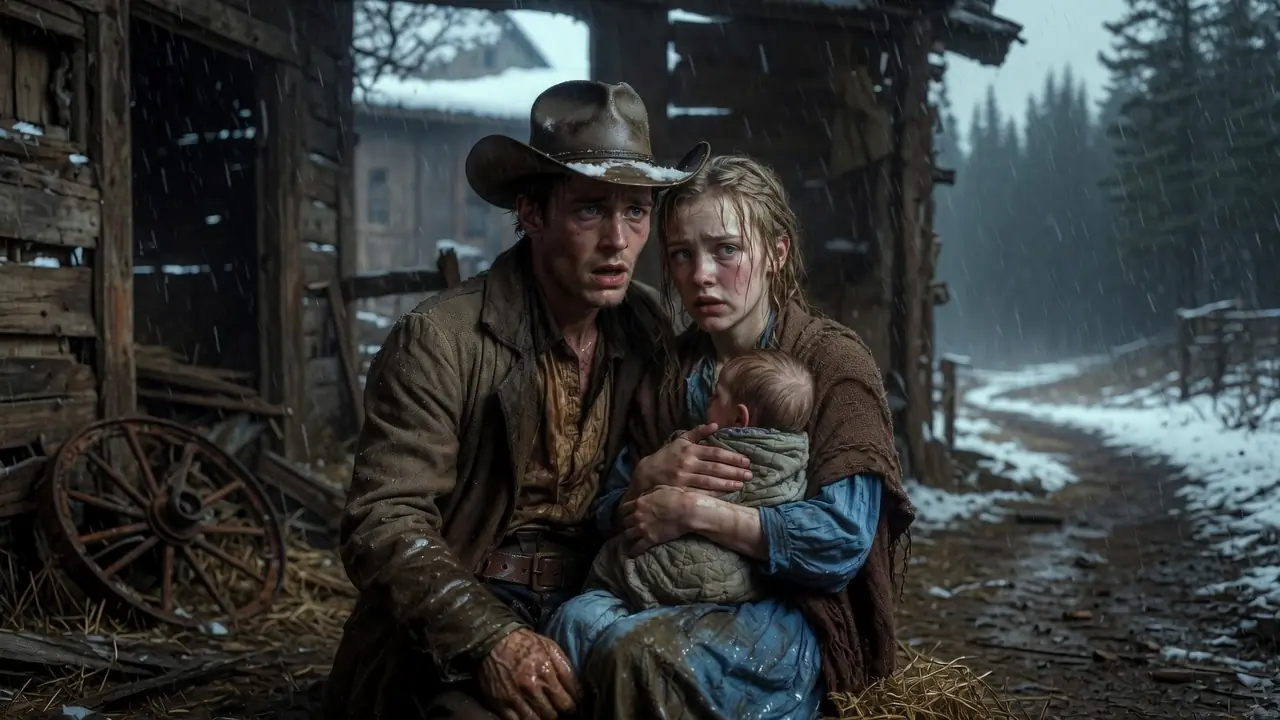
The storm came down on Dry Willow, Colorado, like the sky had split open and poured out every bitter thing it had been holding since winter. Jack Turner stood inside his small ranch cabin with his six-month-old daughter, Lily, wrapped in a quilt against his chest, listening to the wind claw at the walls like something hungry. The fire in the stone hearth had burned low, the kettle had gone cold, and the little girl in his arms had stopped crying hours ago. That silence frightened him more than any scream.
Jack was thirty-four years old, broad-shouldered, weather-burned, and hollowed out by grief that had never found a place to rest. His wife, Clara, had died before the baby could remember her face, leaving behind a cradle, a few folded dresses, and a widower who knew cattle, fence posts, and winter roads better than bottles, fever cloths, and lullabies. For months, Jack had done everything a man could do with shaking hands and too little sleep. He had learned how to warm milk, wash cloth diapers, hum badly through sleepless nights, and whisper promises into the dark even when he had no idea how to keep them.
But on that night, none of his learning was enough. Lily would not feed, would not settle, and would not hold warmth no matter how close Jack pressed her to his chest. Her small lips were dry, her little hands barely curled around his finger, and her breathing came in weak, shallow sounds that made Jack’s own lungs feel crushed. Outside, the trail to town had vanished under sleet and mud, and the only doctor within twenty miles might as well have been across the ocean.
He had already tried riding out once before sundown. His horse stumbled less than a quarter mile from the cabin, and the wind drove frozen rain so hard into Jack’s face that he could not see the fence line. He turned back because he had Lily under his coat, and one wrong step could have killed them both. Now he stood by the window with her in his arms, staring into blackness, wondering if a man could beg God and still feel unheard.
The cabin was rough but clean, built from pine logs Jack had cut with Clara’s brothers the year after they married. Clara had hung blue curtains over the windows, planted lavender by the step, and painted the cradle white even though Jack told her white paint never lasted on ranch wood. After she died, Jack left everything exactly where she had placed it, as if moving a spoon or folding a blanket differently might erase her completely. But grief did not preserve a house; it only made every room feel unfinished.
By midnight, Lily’s fever had lowered, but not in a way that comforted him. Her skin had gone too cool, her eyelids fluttered without opening, and Jack could feel something slipping away that he did not know how to pull back. He paced from the hearth to the bed, from the bed to the window, and from the window to the cradle, murmuring her name over and over. “Stay with me, Lily,” he whispered, his voice breaking. “Your mama put too much love into this world for you to leave it now.”
A sudden knock struck the cabin door. It was not loud, but in that storm and silence, it sounded like a gunshot. Jack froze, one hand tightening around Lily’s quilt, his other moving toward the rifle leaned beside the hearth. No decent traveler would be out in that storm unless the devil himself had chased them there.
The knock came again, followed by a woman’s voice. “Jack Turner, open this door before that child fades right out of your arms.” Jack stared at the door, unable to move for half a breath. Then he recognized the voice. Maggie Row.
Jack opened the door, and the wind shoved Maggie into the cabin like it had been carrying her there by force. She stood soaked from bonnet to boots, clutching a cloth bundle against her chest, her gray eyes sharp despite the rain running down her face. She looked at Jack only for a second before her gaze dropped to Lily. The hardness in her expression cracked.
“Lord have mercy,” she whispered. “How long has she been like that?” Jack could barely answer. “Since morning. She won’t take milk. She won’t cry. I tried to ride for the doctor, but the road’s gone.” Maggie stepped closer, and Jack saw she was trembling from the cold, but her voice stayed firm. “Give her to me.”
Jack pulled Lily back instinctively. He had lost Clara, and every part of him feared letting another person touch the last living piece of her. Maggie understood the movement because pain recognized pain. She softened her voice but not her demand. “Jack, that baby needs warmth, milk, and a steady hand. You are scared half out of your mind, and scared hands shake.”
“I can feed my own daughter,” Jack said, though the words sounded weak even to him. Maggie looked at the cold bottle on the table, the damp cloths, the untouched milk, and the cradle pulled too close to the fire. She did not shame him for any of it. She simply said, “Not tonight, you can’t.”
The words landed hard. Jack’s jaw tightened, and for one second pride rose in him like a wall. He had endured every neighbor’s pity, every sideways glance at church, every woman whispering that a baby girl needed a mother, not a rough-handed rancher who smelled of horse sweat and smoke. He had told himself he would prove them wrong. But Lily made a weak sound against his chest, and pride suddenly felt like a sin.
Maggie reached out again. “Let me feed her.” Jack looked down at his daughter’s pale face, then at Maggie’s outstretched arms. Slowly, as if handing over his own heart, he placed Lily into Maggie’s hold. Maggie drew the child close beneath her shawl, settling her with the care of someone who had once held a baby through worse nights than this.
She moved toward the hearth and sat in Jack’s old rocking chair without asking permission. “Warm that milk, but not too hot,” she said. “Bring a clean cloth. Then put more wood on the fire.” Jack obeyed because her voice left no room for argument. In ten minutes, the cabin changed from a place of panic into a place of work.
Maggie tested the milk against her wrist and adjusted Lily’s position with quiet patience. The baby resisted at first, too weak even to protest properly, but Maggie did not rush. She touched the bottle to Lily’s mouth, whispered soft words Jack could not hear, and waited. After a long breath, Lily swallowed.
Jack gripped the edge of the table. “She took it.” Maggie did not look up. “A little. Don’t celebrate yet.” But Jack saw her shoulders ease, just slightly.
For the next hour, the storm beat against the cabin while Maggie fed Lily drop by drop. She paused whenever the baby struggled, warmed cloths near the fire, and pressed them carefully around Lily’s feet and belly. Jack sat across from her, helpless and grateful and ashamed all at once. Every time Lily swallowed, something in him returned to life.
“Where did you learn this?” he asked finally. Maggie’s face changed. The question had stepped into a room inside her that no one in Dry Willow ever entered gently. She kept her eyes on Lily and said, “I had a son once.” Jack went still.
The fire cracked between them. Maggie adjusted Lily’s quilt and continued in a voice so quiet it nearly disappeared beneath the rain. “He was born early during a storm worse than this one. My husband had gone for the midwife and never made it back before morning. The boy lived three days.”
Jack closed his eyes. “Maggie.” She shook her head before he could say more. “Don’t pity me. I’ve had enough of that from people who never bothered to sit beside me.” Her voice was not bitter, only tired. “After he died, folks said I was cursed, or careless, or too cold-hearted to keep a child alive. Nobody cared that I had held him every second.”
Jack looked at her then, really looked at her, beyond the town rumors and the quiet woman at the edge of the creek. He saw the grief under her careful movements, the loneliness behind her steady hands, and the reason she had crossed a storm to reach his cabin. She had heard a baby was fading and could not stay away. Whatever the town had taken from her, it had not taken her mercy.
Lily drank more. Not much, but more than she had all day. Her fingers flexed against Maggie’s shawl, and a faint sound came from her throat. Jack leaned forward, hardly daring to breathe. Maggie looked up at him for the first time in nearly an hour. “She’s fighting.”
Those two words nearly broke him. Jack bowed his head and pressed his hands over his face. He did not sob loudly; frontier men were not taught how to do that without shame. But his shoulders shook, and Maggie let him have the mercy of not watching too closely.
By dawn, the storm had softened into gray rain. Lily slept against Maggie’s chest, warmer now, her breathing still weak but steadier. Jack had not slept. He had chopped wood, warmed cloths, boiled water, and watched Maggie fight for his daughter’s life with the stubborn patience of a woman who had already lost too much to surrender easily.
When the doctor finally arrived near noon, riding in behind two ranch hands who had cleared part of the trail, he found Lily alive. He examined her, listened to her lungs, checked her mouth, and gave instructions Jack barely heard because the first thing the doctor said was, “She may pull through.” Jack sat down hard on the bench. Maggie looked toward the window, but Jack saw the tears she tried to hide.
The doctor told him Lily had been dangerously weak and chilled. Another few hours without proper feeding and warmth might have ended differently. Jack understood what the doctor was too kind to say. Maggie had not only helped. Maggie had saved his daughter.
Word traveled quickly in Dry Willow, as it always did. By the next Sunday, every woman at church knew Maggie Row had spent the night in Jack Turner’s cabin during a storm. Some whispered that it was improper. Others hinted that maybe Maggie had done it for attention, or that Jack was too desperate to know better. The same town that had judged her grief now judged her mercy.
Jack heard the whispers outside the church steps. He had Lily in his arms, wrapped warm and pink-faced in a clean quilt, and Maggie stood several feet away with her shawl pulled tight, ready to leave before anyone could wound her openly. Mrs. Hollis, the preacher’s wife, said just loud enough, “A widow ought to know how things look.” Maggie’s face went pale.
Jack turned slowly. The whole group quieted because Jack Turner rarely spoke in public unless business required it. He looked at Mrs. Hollis, then at every person who had enjoyed Maggie’s silence too long. “That widow crossed a killing storm to save my child,” he said. “If any of you think that looks shameful, then shame is sitting in your own hearts, not hers.”
No one answered. Jack shifted Lily gently against his shoulder and walked to Maggie. “You’ll sit with us,” he said. It was not a question. Maggie stared at him, startled by the open invitation in front of everyone. Then she nodded once, and together they entered the church.
After that, Maggie came by the ranch often. At first, it was only to check Lily’s feeding, temperature, and strength. She showed Jack how to keep better records, how to notice small changes, how to tell the difference between fussing and real distress. She never made him feel foolish for not knowing, and that kindness humbled him more than criticism ever could.
Jack began leaving a lantern in the window on evenings when the creek road was passable. Maggie would come after finishing her own chores, bringing bread, broth, or mended baby clothes made from old flour sacks. She never stayed too late, and Jack never asked more than she was ready to give. They built trust slowly, the way fences were built on hard land, post by post, with steady hands.
Lily grew stronger. She began crying with power again, which Jack had never thought he would be grateful to hear. Her cheeks filled out, her eyes brightened, and she started gripping Maggie’s finger whenever Maggie leaned close. The first time Lily laughed, it was because Maggie made a ridiculous clicking sound with her tongue, and Jack stood in the doorway with a pail in his hand, frozen by the sound.
Maggie looked up and saw his face. “What?” she asked. Jack swallowed. “I didn’t know this house could sound like that again.” Maggie’s expression softened, and for a moment the room held Clara’s absence and Lily’s laughter at the same time. Neither erased the other.
Spring came late to Dry Willow. Snow melted into mud, cattle pushed against the fences, and the creek ran high enough to drown the lower pasture. Jack spent long days repairing damage from the storm season, and every evening he came home to find the cabin less haunted than before. Sometimes Maggie was there, sometimes only the small evidence of her care: folded blankets, a fresh loaf, a note about Lily’s feeding.
One afternoon, Jack found Maggie standing beside Clara’s old lavender bed. The plants were dead, brittle stems sticking out of hard soil. Maggie knelt and cleared the weeds with her bare hands. Jack watched from the porch, unsure whether to stop her. “Clara planted those,” he said.
“I know,” Maggie answered. “That’s why they shouldn’t stay dead.” Jack stepped down from the porch. “I didn’t know how to tend them.” Maggie looked up. “Then we’ll learn.”
The word “we” stayed with him for days. It was dangerous, that word. It opened doors grief had nailed shut. Jack told himself Maggie meant the plants, the baby, the practical work of survival, but the loneliness in him heard something else and feared wanting it.
The town noticed, of course. Dry Willow always noticed what it had no right to own. Men at the feed store joked that Jack had found himself a nursemaid. Women at church warned Maggie not to mistake gratitude for a proposal. Jack heard enough to know people were waiting for him to fail her or for her to shame herself by hoping.
Maggie heard it too. One evening, she arrived quieter than usual, set a basket on the table, and did not remove her shawl. Lily reached for her, but Maggie hesitated before taking the baby. Jack noticed. “What did they say to you?”
“Nothing new,” Maggie said. Jack stepped closer. “Maggie.” She drew a breath, tired and sharp. “They say I am trying to climb into a dead woman’s place. They say a woman who lost her own child has no business acting like she knows how to keep another alive.”
Jack’s face hardened. “That’s a lie.” Maggie’s eyes flashed. “Of course it is. But lies still bruise when enough people throw them.” She looked toward Lily, who was blinking sleepily in her cradle. “I won’t let them make your daughter’s life harder because I’m here.”
Jack understood then what she was doing. She was preparing to leave before anyone could accuse her of wanting too much. He felt panic rise in him, different from the night of the storm but just as fierce. “You think Lily’s life gets harder if you stay?” he asked.
Maggie looked at him with wet eyes. “I think people can be cruel.” Jack nodded slowly. “They can.” Then he stepped between her and the door. “But they don’t get to decide who belongs in this house.”
Maggie’s breath caught. Jack removed his hat, turning it in his rough hands. “I loved Clara,” he said. “I still do. That doesn’t mean this house has to stay half-dead forever.” He looked toward the cradle. “You gave Lily back to me when I was losing her. But you did more than that. You brought breath back into this place.”
Maggie shook her head, afraid of the words before he finished them. “Jack, don’t say something out of gratitude.” He stepped closer. “I’m not grateful enough to lie.” His voice was low, steady, and full of a fear he refused to let rule him. “I’m saying I want you here because when you leave, the room knows it.”
Tears slipped down Maggie’s face. “I don’t know how to be wanted without paying for it somehow.” Jack’s expression broke. “Then let me teach you slow.” He did not touch her without permission. He only stood there, hat in hand, offering not a demand but a place.
Maggie looked toward Lily, then toward the dead lavender bed outside the window. “People will talk.” Jack gave a rough little laugh. “They talk when cattle cross a road.” Maggie almost smiled through her tears. “And Clara?”
The question was quiet but heavy. Jack looked at the photograph of Clara on the mantel. “Clara wanted Lily loved. She wanted this house full. I think she’d be angry at me if I let fear keep kindness outside.” Maggie closed her eyes, and the silence between them was no longer empty.
They did not marry that spring. They did not rush into promises just because the town expected either scandal or ceremony. Maggie kept her own house for a while, and Jack kept lighting the window lantern. Some evenings she stayed for supper. Some mornings she came early to help with Lily while Jack checked the herd.
By summer, the lavender began to grow again. Small green shoots pushed up where Maggie had cleared the dead stems, stubborn and tender at once. Lily learned to sit on a quilt beneath the porch shade, clapping her hands when Jack came in from the pasture. Maggie would laugh, and Jack would pretend not to stare too long.
One Sunday after service, Mrs. Hollis approached Maggie with a pie and an apology that sounded stiff but real. Maggie accepted the pie, though Jack could tell she trusted the apology less than the dish it came in. Later, on the ride home, she said, “People do change sometimes.” Jack glanced at her. “Sometimes.” Then she added, “But I still don’t like her pie.”
Jack laughed so hard Lily startled awake and began laughing too, though she had no idea why. Maggie smiled then, the full kind of smile Jack had not seen before. It changed her whole face, making her look younger and less guarded. He realized he had started measuring days by whether he could make that smile appear.
Autumn came with gold cottonwoods and cold mornings. Jack harvested hay with help from neighbors who had learned to keep their opinions to themselves. Maggie mended Lily’s winter clothes and taught Jack to make broth without burning it. On the anniversary of Clara’s death, Maggie did not come inside uninvited.
She left flowers on the porch and walked back toward the creek. Jack found them after returning from the cemetery, and the gentleness of it nearly undid him. That evening, he carried Lily to Maggie’s place. Maggie opened the door, saw his face, and said nothing. She simply stepped aside.
They sat by her small stove while Lily slept between them in a basket lined with blankets. Jack told Maggie stories about Clara, not because he needed permission to love someone new, but because he needed Maggie to know there was room in truth for both grief and hope. Maggie listened without jealousy, only tenderness. When Jack’s voice failed, she placed a cup of coffee in his hand and let silence do the rest.
Winter returned, but it did not feel as cruel as the one before. Jack’s cabin held more firewood, more laughter, and more signs of life. Lily’s first birthday came with a small cake Maggie baked too dense but sweet enough to make everyone eat two slices. Tommy, the old ranch hand, said the child had Jack’s stubborn chin and Maggie’s serious stare, and then looked embarrassed when he realized what he had implied.
Maggie blushed. Jack only smiled. Later, after everyone left, Lily fell asleep against Maggie’s shoulder. Jack stood beside the hearth, watching them. The scene was so ordinary that it felt miraculous.
He walked to the shelf and took down Clara’s old blue ribbon, the one she had used to tie back the curtains when the sun came in too bright. He had kept it tucked away for two years, unable to use it or throw it away. Now he handed it to Maggie. She looked at it, confused.
“Clara used that ribbon,” Jack said. “She said blue kept a house calm.” Maggie touched it carefully, understanding the weight of what he was offering. “Jack.” He swallowed. “I’m not asking you to replace her. I’m asking if you’ll help me keep loving what she left behind.”
Maggie’s eyes filled. “And what about what I lost?” Jack stepped closer. “We’ll keep that too.” The answer was simple, imperfect, and true. Maggie held the ribbon to her chest and nodded.
By the next spring, nobody in Dry Willow dared call Maggie cursed. They had seen Lily grow strong, seen Jack smile again, and seen Maggie move through grief without letting it turn her cruel. Some still whispered, but whispers lost power when ignored long enough. The ranch became known not as the place Clara died or the place Lily nearly faded, but as the place where life stubbornly stayed.
On a bright April morning, Maggie stood beside the lavender bed with Lily on her hip. The plants had bloomed, small purple flowers trembling in the breeze. Jack came up from the pasture, dust on his boots and sunlight on his hat. Lily reached for him, squealing, and Maggie handed her over.
Jack looked at Maggie across the lavender. “I’ve been meaning to ask you something.” Maggie raised one eyebrow. “If it’s about the south fence, I already told you it needs fixing.” Jack smiled. “It’s not about the fence.”
He took off his hat. Maggie went still, because this time she understood before he spoke. “I can’t promise an easy life,” Jack said. “I can’t promise the town won’t talk, or the winters won’t come hard, or that grief won’t visit some nights without knocking.” His voice roughened. “But I can promise you a place at my table, a lantern in the window, a child who loves you, and a man who will never mistake your fire for shame.”
Maggie looked at Lily, then at Jack. “And if I say yes?” Jack’s smile trembled. “Then we plant more lavender.” Maggie laughed through tears, and that was answer enough.
Years later, Lily would remember Maggie’s hands more than the storm. She would remember the way those hands braided her hair, stitched her dresses, cooled her forehead, and held her steady when she was afraid. She would grow up knowing Clara was the mother who gave her life, and Maggie was the woman who helped keep it. In that house, love was never made smaller by being shared.
Jack would remember the storm differently. He would remember the knock, the soaked woman at his door, and the words that saved his daughter. Let me feed her. It had sounded simple then, practical and urgent, but over time he understood it meant more.
It meant let me help carry what grief has made too heavy. Let me bring warmth where fear has taken hold. Let me stand beside you when the town would rather judge than save. Let me prove that love can come back into a house without stealing from the love that came before.
And every spring, when the lavender bloomed outside the Turner cabin, Jack thought of Clara, Maggie, Lily, and the storm that nearly took everything. He learned that some miracles did not arrive with thunder or angels. Sometimes they came soaked to the bone, wrapped in a faded blue shawl, knocking on a widower’s door. Sometimes they simply stepped inside and said, “Let me feed her.”