Widowed Rancher’s Baby Was Dying - Then His Neighbor Knocked and Said “Let Me Feed Her”
What would a man do when the only thing keeping his baby alive seemed to be slipping away in his arms?
Jack Turner asked himself that question every sleepless night after his wife Mary died. Dry Willow, Colorado, early spring of 1879, was still half frozen, with snow clinging stubbornly to the corners of the hills and a wind sharp enough to cut through wool. The Turner Ranch sat alone in that valley, its fences leaning, its cottonwood trees bare, and its cabin weather-beaten from years of storms. Inside, the air smelled of smoke, damp wool, and fear.
Jack sat beside the dying fire with his boots muddy, his shirt half-buttoned, and his eyes hollow from too many nights without rest. In his arms, his tiny daughter Lily wailed, her fists trembling and her little face red with hunger. The bottle shook in his hand as he tried once more to feed her warmed goat’s milk. “Come on, baby girl,” he whispered, his voice cracking. “Please.”
Lily turned away from the bottle. Milk spilled down her chin and soaked into her blanket. Her cry grew weaker, but somehow more desperate, as if even her small body knew time was running out. Jack’s shoulders slumped beneath the weight of helplessness. He had not slept a full night since Mary died, and grief had carved deep shadows into his face.
Mary had bled out before the midwife could save her, leaving Jack alone with a child too small to fight the world’s cruelty. He buried his wife on a Tuesday. That same day, Lily turned two weeks old. Now, two months later, the baby was starving in his arms. Jack had tried goat’s milk, rice water, and even sugar water once, though he regretted it when Lily screamed harder.
He had walked from one ranch to another, begging for help. “My girl needs milk,” he had said, his voice breaking every time. “Does anyone have a nursing wife?” Most doors closed kindly. Some closed without a word. By the time he returned to the Turner cabin, the little hope he had left felt thinner than the smoke rising from the hearth.
The wind clawed at the windows while the fire burned low. Jack stood and rocked Lily slowly, his boots creaking against the wooden floor. Her cries softened into tiny gasps, and the sound frightened him more than her screaming had. He pressed his lips to her forehead and felt the heat of her hunger and weakness against his mouth. “I’m trying,” he whispered. “I swear I’m trying.”
He had faced wild horses, spring floods, and storms that ripped barns apart. He had buried the only woman he had ever loved with his own trembling hands. But none of that compared to the terror of watching his child slip away while his hands could do nothing. The bottle lay on the floor, rolling slowly back and forth each time the wind shook the cabin. Lily whimpered against his chest.
Outside, rain began to fall, thin at first, then hard and slanted. It struck the windowpanes like thrown gravel. The fire faded again, and Jack realized he had already burned everything he could spare: old scraps of wood, broken furniture, and even Mary’s rocking chair. The room darkened until the corners seemed to breathe. Then came the knock.
Three sharp knocks cut through the storm. Jack froze, unsure if the sound was real. Then it came again, firm and human. He rose with Lily in his arms and opened the door. Cold wind rushed in, carrying the smell of wet earth and pine. A woman stood on the threshold.
Her blonde hair was plastered to her cheeks. Her shawls were soaked, her boots were sunk in mud, and her face was pale with cold. But her eyes were steady. “I saw your note,” she said softly. “I’ve heard her crying at night.” Jack stared, too tired to understand what he was seeing. Then he recognized her. “Maggie?”
Maggie Row lived on the neighboring homestead down the ridge. She was a widow too, though grief had made her quieter than most people knew how to bear. She clutched her soaked shawl tighter around her shoulders and looked past him toward the crying baby. “Let me feed her,” she said. “Please.” Jack blinked as if the words had come from a dream.
Maggie’s voice broke as she continued. “My son passed six weeks ago. He was eleven weeks old. I still have milk. I have to do something with it.” Her eyes filled with tears, but she did not look away. “Please let me help her.” For a moment, Jack could not speak. His throat burned, and every part of him trembled. Then he stepped aside.
Maggie entered the cabin, dripping rain onto the floorboards. She set down her satchel and moved closer to the dying fire. Lily’s face was slick with tears, her breathing shallow and uneven. “May I?” Maggie asked quietly. Jack hesitated for only a heartbeat before placing the baby in her arms.
Maggie sat in the old rocker near the hearth, moving with a tenderness that looked both natural and painful. She cradled Lily close, humming softly as she settled the baby against her. Jack turned away and stared into the dark window, his jaw tight with shame, gratitude, and grief. Then he heard it. The faint sound of suckling. Desperate, wet, and alive.
Lily’s cries stopped. The silence that followed felt sacred. Only the rain tapped the window and the fire cracked softly under the last of the wood. Jack’s shoulders slumped, and his eyes closed as if something inside him had finally been allowed to breathe. Maggie looked down at the baby with tears mixing into the rainwater on her cheeks.
“She’s so hungry,” Maggie whispered.
“She hasn’t eaten in almost a day,” Jack said hoarsely.
Maggie smiled faintly. “She looks strong. Like her father.”
Jack swallowed hard. “Thank you.”
Maggie looked up at him, her lips trembling. “I needed this too,” she said. “More than you know.” Jack did not know what to say to that. He only stood there in the dim firelight while Lily fed for the first time in hours. Something that had felt like an ending became, quietly and impossibly, a beginning.
By morning, Lily’s color had returned. The baby slept peacefully against Maggie’s chest beside the fire. Jack watched from the corner of the room, saying nothing, listening to the steady rhythm of Lily’s breathing. The cabin no longer felt haunted by loss. For the first time since Mary died, it felt alive.
Outside, the snow began to melt. The wind softened across the valley, moving through the cottonwoods with less cruelty. Jack and Maggie did not speak much that first morning, because there was too much between them for words to carry. A man who had lost everything and a woman who carried milk meant for a child gone too soon had found one another through the fragile miracle of a hungry baby. Neither of them knew what would come next, but both understood that something had changed.
The days that followed passed like quiet whispers across the valley. Frost still clung to the mornings, but inside the Turner cabin, warmth slowly returned. Not just from the fire, but from the sound of life. Each dawn, Maggie rose before the sun and nursed Lily beside the hearth while Jack chopped wood outside. The baby’s tiny breaths filled the silence that had once belonged only to grief.
Jack did not know how to act around Maggie. He mumbled thanks, fixed things that did not need fixing, and kept busy from dawn until dusk. He patched fences, mended harnesses, hauled water twice when once would have been enough, and kept his eyes on the work when gratitude threatened to undo him. But his thanks showed in other ways. A clean blanket folded beside her cot. A bowl of stew waiting on the table. A latch repaired on the window she struggled to close.
Maggie noticed all of it, though she rarely said so. She understood heaviness when she saw it. Jack carried the guilt of a man who believed he had failed his wife and nearly failed his child. Maggie did not try to fix him. She simply stayed. By the third morning, she had moved her few belongings into the small side room that had once been used for tack and old rope.
Jack had cleared the space himself. He dusted the floor, dragged in a cot, and hung a spare blanket over the window where the wind slipped through. When Maggie found it ready, she stood in the doorway with one hand over her mouth. “Thank you,” she whispered to no one in particular. Jack, standing outside with an armful of firewood, pretended not to hear because he could not trust himself to answer.
Every night after Lily slept, they sat near the fire. Maggie knitted quietly, and Jack drank coffee gone cold. The silence between them changed over time. It stopped being awkward. It became full of things neither of them could say but both could feel. On the fifth night, Maggie finally spoke.
“I held him for two days,” she said softly, staring into the fire.
Jack looked up.
“My boy,” she said. “He died from fever. I didn’t know what to do. I just sat there waiting for someone to come. No one did.” Her breath trembled. “Not until he started to smell.”
The words broke in the air like glass. Jack did not speak. He only leaned forward, added another log to the fire, and handed Maggie his cup of coffee. She took it with shaking hands. “Thank you,” she whispered. That night, while Lily slept, Maggie cried quietly, and for the first time since her son’s death, the tears felt less like punishment and more like release.
The days stretched into weeks. Maggie cared for Lily as if the baby had been born from her own body. Jack worked the land with strength he had not known he still had. Together, they found a quiet balance, two broken souls mending in the light of a child’s laughter. But Dry Willow was a small place, and small places had sharp tongues. Not everyone saw mercy as mercy.
When Maggie rode into town one Saturday to buy flour and soap, she felt the stares before she reached the mercantile steps. Spring thaw had brought people out, and with them came whispers. “She’s living with him, you know.” “A widow feeding another woman’s baby like it’s her own.” “Milk’s not the only thing she’s offering.” No one said the words directly to her face, but they spoke loudly enough for her to hear.
Maggie kept her chin up and her hands tight around the basket. But when she caught her reflection in the mercantile window, pale, thin, and tired, shame crept up her throat like poison. By the time she returned to the ranch, her arms trembled. She handed Jack the supplies without a word and disappeared into her room. Jack did not ask what happened. He did not need to.
That night, while hammering a loose board on the porch, Jack heard two ranch hands riding past from the neighboring fields. One of them laughed and said Maggie was probably warming his bed too. The other said something crueler about the baby nursing from another man’s wife. Jack froze. His jaw clenched, and the hammer trembled in his hand. He did not shout after them. He only stood in the dark until the horses faded into the night.
When he walked back inside, the cabin felt colder. Maggie sat in the rocker with Lily asleep against her chest. She did not look up. Her face was pale, her eyes hollow. Jack set food on the table and waited, but Maggie said nothing. Finally, he turned and went back outside. The door shut softly behind him.
That night, rain fell again. Thin, cold, and steady. Maggie sat in the rocker long after the fire went out, staring into the dying embers. Her body trembled, not from cold, but from the shame twisting inside her. She looked down at Lily sleeping peacefully in her arms and whispered through tears, “Maybe they’re right. Maybe I don’t belong here. Maybe I never did.”
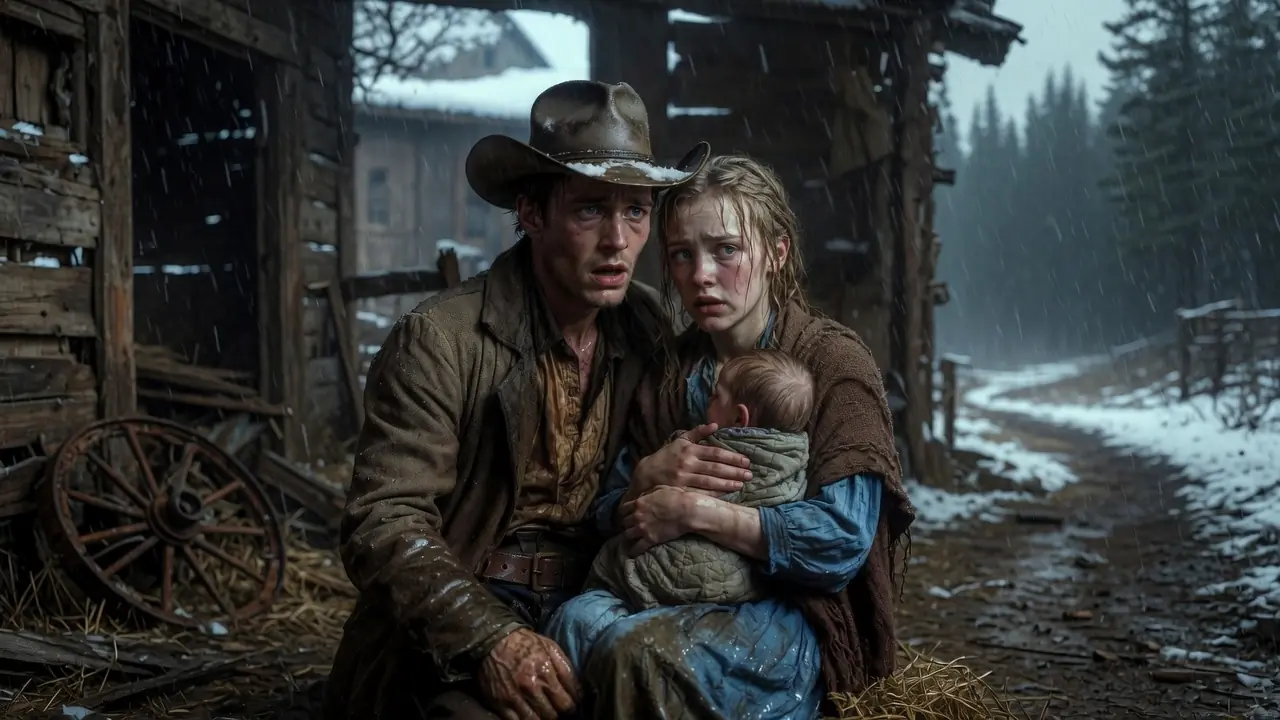
Before dawn, while Jack slept in the front room with his boots still on and his rifle by the door, Maggie wrapped Lily in a quilt and slipped into the storm. The path toward the barn was dark and slick with mud. Rain soaked her hair, her dress, and her bones. Lily cried softly against her chest, and every sound from the baby broke Maggie a little more. “I just wanted to help,” she whispered. “That’s all. I just wanted to help.”
Inside the barn, the air was cold and heavy with the smell of old hay. Maggie sank into a corner and clutched Lily close. Thunder rolled over the hills, and rain hammered the roof. She pressed her lips to the baby’s head. “I love you,” she whispered. “I stayed for you. I swear I stayed for you.” Then she cried until her whole body shook, until the storm outside became one with the storm in her chest.
She did not see the faint blue light of dawn creeping over the hills. She did not hear the cabin door slam open. She did not hear Jack’s desperate voice calling her name. The storm swallowed the sound, but Jack did not stop. He woke to silence, and that silence turned his blood cold. The cradle was empty. The blanket was gone. Maggie was gone too.
“Maggie,” he called, voice rough with sleep.
No answer.
He threw on his coat, grabbed his rifle, and burst into the freezing wind. The world had turned white, snow mixing with rain and sweeping sideways across the ranch. His breath became fog in front of him. He looked toward the barn, then the south field, seeing nothing but storm. Then, faintly, through the howling air, he heard what sounded like a baby’s cry.
He ran. Snow clawed at his boots, and cold bit through his clothes, but he did not stop. He stumbled over the fence line and pushed through the yard, calling Maggie’s name again and again. Then he saw movement near the old lumber shed, its door swinging in the wind. Jack sprinted toward it, heart pounding so hard it hurt, and threw the door open.
Inside, the air was cold and still. Damp hay and rust scented the dark. In the far corner, Maggie sat curled on the floor, holding Lily against her chest. Her hair was wet, her dress soaked through, her lips pale. Lily whimpered weakly in her arms. Maggie rocked the baby and whispered through tears.
“I thought maybe I shouldn’t stay,” Maggie said as Jack dropped to his knees beside her. “They’re right, Jack. I’m not her mother.”
Jack did not speak at first. He took off his coat and wrapped it around both Maggie and Lily, his hands shaking, not from the cold, but from the fear of what he might have lost. He looked at the woman in front of him, the woman who had carried her grief into his cabin and given life to his daughter when he could not. His voice broke when he finally answered. “You didn’t take her from me,” he whispered. “You gave her back to me.”
Maggie stared at him through tears. Then she broke, collapsing against his shoulder, sobbing into his chest. Jack held her tighter, pulling her close and shielding them both from the cold with his body. Lily stirred between them, and her cries softened. Outside, the wind screamed through the cracks in the shed. But inside, warmth began to grow from breath, skin, and the desperate closeness of two people afraid to lose the only pure thing left in their lives.
They stayed like that until the storm quieted. By sunrise, the snow lay silver beneath a pale sky. Jack carried Lily in one arm and kept his coat draped around Maggie’s shoulders as they walked back toward the cabin. The air was strangely calm, as if the storm had washed the world clean. Inside, Jack lit the fire again. Maggie sat by it, cradling Lily, her eyes red but peaceful.
Jack moved through the room checking windows, feeding the fire, and pouring Maggie a cup of warm milk. When he turned, their eyes met. “You don’t ever have to run again,” he said quietly. “Not from me.” Maggie looked down at Lily, then back at Jack. For the first time since he had known her, she smiled without hiding it.
By the next morning, sunlight spilled through the cabin windows. Maggie woke to the smell of bread baking and the sound of hammering. She wrapped Lily in a blanket and followed the noise to the small room beside Jack’s. There, Jack knelt on the floor near a newly built wooden crib. His sleeves were rolled up, sawdust dusted his arms, and he was carving letters into the headboard.
The words read, “Lily Turner.” Beneath them, in smaller letters, he had carved one word: “Stay.”
Jack looked up when he heard Maggie. “I wasn’t sure how to ask,” he said softly. On the table beside him lay a folded quilt, a small shelf with wooden toys, and a piece of paper weighted down by a smooth stone. Maggie stepped closer and read the note. “Stay. Not as a helper. As her mother.”
Her hands trembled. Jack stood slowly, uncertain, his eyes raw and honest. It was not a proposal, not a promise written in gold. It was something deeper than that. It was a choice. Maggie looked down at Lily in her arms, at the baby whose cheeks were full again and whose lips had turned soft and pink. “I didn’t just save her,” Maggie whispered. “She saved me too.”
Jack stepped closer. “I never thought I’d have another family,” he said. “But I can’t imagine this place without you.” Maggie’s smile came from deep inside her, from some place grief had not been able to kill. It was the kind of smile that heals what once seemed unfixable. Jack did not touch her until she reached for his hand first. Then he held it like something sacred.
Three years later, Turner Ranch had changed. The storms had passed, the land had grown greener, and the fences stood mended under the Colorado sky. The sign at the front gate read, “Turner and Row Ranch.” Lily ran across the yard, her laughter ringing like bells. Maggie sat on the porch steps with one hand resting on her round belly. Jack stood beside the barn, carving the last letters into a wooden post.
Together, they planted a young apple tree beside the gate, with Lily helping by pushing dirt around the roots with her tiny hands. “What if it doesn’t grow?” Lily asked. Jack knelt beside her and brushed her hair back. “Then we try again,” he said. “But this one is strong like you.” Lily smiled proudly and added, “And Mama.”
Jack looked at Maggie, his face soft with love. “She’s the strongest of us all.” The wind carried the scent of spring through the valley. The apple blossoms had not bloomed yet, but they would in time, just like the love that had taken root there. It had not grown from comfort. It had grown from hunger, grief, shame, courage, and the choice to stay.
That night, the family sat on the porch beneath the stars. Lily slept inside, her small arms wrapped around the wooden mare Jack had carved for her. The fire glowed through the window, and the new apple tree moved gently in the wind near the fence. Maggie leaned her head against Jack’s shoulder. “Do you know what I think about sometimes?” she whispered.
“What?”
“How I came here with nothing but milk and grief.”
Jack kissed her hair. “You gave her more than milk. You gave her a mother.” Maggie looked at him, eyes glistening. “She gave me more than I ever gave her,” she said. “She gave me you.” They sat in silence, hands entwined, while the stars shimmered above Dry Willow.
Each spring, the apple tree bloomed beside the gate. Its roots grew deep, strong, and alive, just like the love that had survived the storm. The woman who came with nothing but milk and grief found a home. The man who lost everything found a reason to hope again. And the baby they saved became the bridge between them.
Love returned to Dry Willow quietly, not as a miracle shouted from the rooftops, but as bread baking in the morning, firelight in the window, a child’s laughter in the yard, and two hands reaching for each other after the worst of the storm had passed.