The auctioneer had already lifted his gavel when Jonah Mercer heard himself say, “They stay together.” The words crossed the courthouse square like a shot. Men who had spent the morning pretending not to stare at the children turned openly now, while women in Sunday hats stopped whispering behind gloved hands.
On the platform, thirteen-year-old Nora Hart stood with one arm around her little brother Samuel, who was eight and thin enough that Jonah could see the sharp line of his shoulder through his borrowed coat. A brass compass hung from Samuel’s neck on a worn leather cord, and he held it so tightly that the metal had left a red circle in his palm.
The placement agent, a narrow man named Mr. Pruitt, lowered the gavel. “Mr. Mercer, perhaps you misunderstood the terms. The girl has already drawn interest from the Tolland household. The boy is a separate placement.”
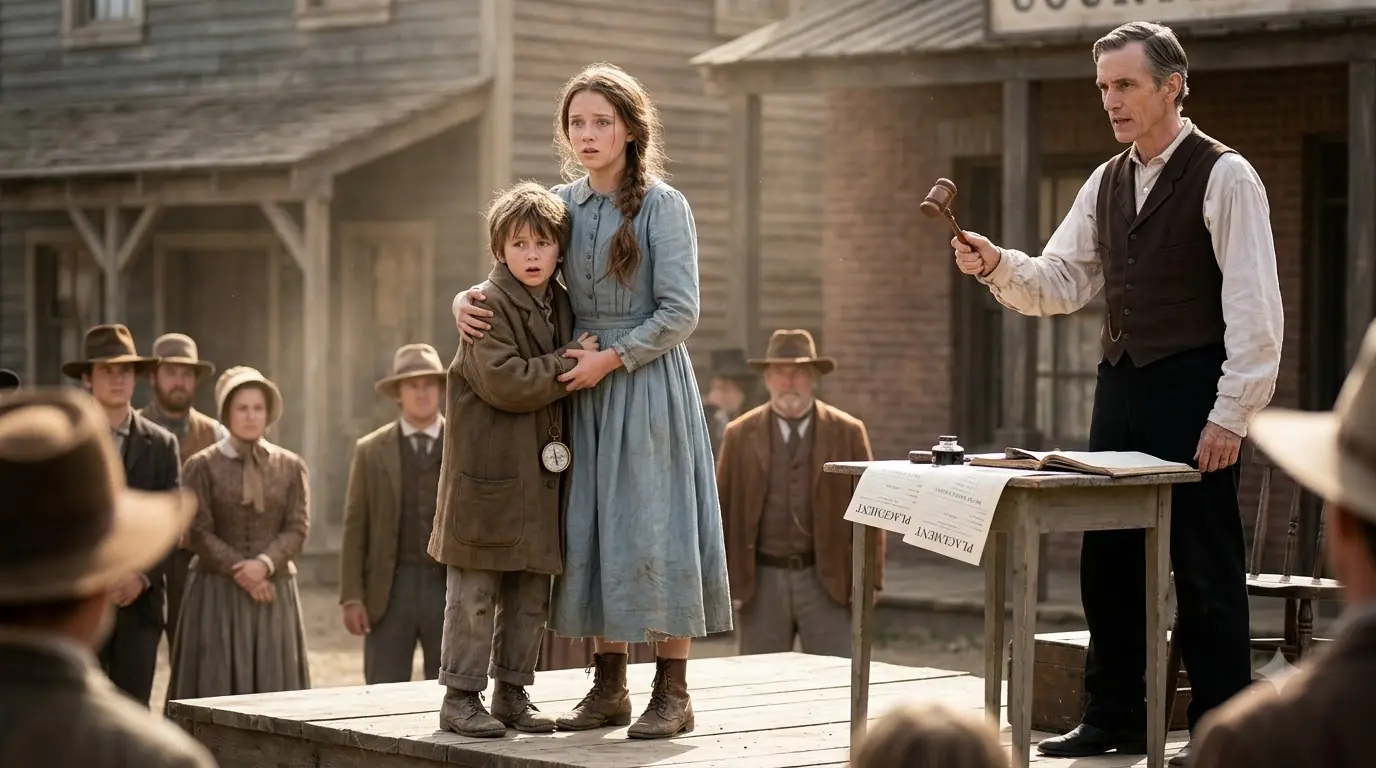
“I heard the terms.” Jonah climbed the first step of the platform. “I said they stay together.”
A murmur rolled through the crowd. Jonah had come to town for lamp oil, coffee, fencing staples, and medicine for a lame mare. The money in his pocket had been measured against a month of winter needs, not against the lives of two strangers. But ten minutes earlier he had seen Nora drop to her knees in the dust and wrap both arms around Samuel when Pruitt announced that bidders could take only one child if they preferred. She had not cried. That was what had caught Jonah. Children should have been allowed to cry when someone tried to split their world in half.
Gideon Rusk stood under the awning of the general store, watching. Everybody in Briar Glen knew him. Rusk owned the freight warehouse, half the cold-storage building by the rail line, and the Children’s Relief Society that had brought Nora and Samuel into town under the respectable language of placement. He was a broad man in an expensive black coat, with silver at his temples and the habit of smiling as if every conversation had already ended in his favor.
Pruitt cleared his throat. “You understand there is a sponsorship fee for each child.” Jonah looked at him. “Call it what it is.”
Pruitt stiffened. “It covers transport, lodging, medical inspection, and administrative services.” “How much?” “Twenty-two dollars for the girl. Seventeen for the boy.”
Jonah almost laughed. Not because the sum was small, but because it was obscene that a number could be spoken so neatly over two living people. He counted the bills in his pocket. Forty-six dollars. He had planned every dollar before leaving the ranch. Now he put thirty-nine on Pruitt’s table.
“Both,” Jonah said. The man who had bid for Nora muttered something ugly about foolish widowers. Jonah ignored him. Nora did not. She watched Jonah as if kindness were just another kind of trap she had not yet learned to recognize.
“Why?” she asked. It was the only question in the square that mattered.
Jonah looked at Samuel, then back at her. Two years earlier, scarlet fever had taken his wife, Clara, and their seven-year-old daughter, Mae, within nine days of each other. Since then, Jonah had lived in a house where every chair remembered a body that no longer filled it. He knew what it meant to wake every morning and realize the person who made the world make sense was still gone.