Avery Black discovered her boyfriend’s betrayal because she forgot her thesis notes.
She had returned to the computer-science building after midnight, expecting an empty classroom. Instead, she found John Brooks leaning against her desk with Mia Carter in his arms. Pages from Avery’s thesis draft lay torn across the floor.
Avery had transferred to PF University partly because John promised they would build a future together. She had worked nights, survived on scholarships, and treated every page of research as proof that a girl raised in poverty could still belong among the country’s best young programmers.
John looked at the wreckage and shrugged.
“You’re overreacting.”
“You destroyed my thesis.”
“It wasn’t good enough anyway.” He glanced at Mia, who smiled against his shoulder. “Look at yourself, Avery. You’re dull, old-fashioned, and lucky I stayed as long as I did.”
Mia added, “Nobody here wants a scholarship thief from the slums.”
Avery slapped John, ended the relationship, and walked out before they could see her cry.
She made it as far as a hotel bar several blocks from campus. There, a stranger in a dark coat found her struggling to gather papers she had dropped. He was older than the graduate students she knew, composed without being cold, and handsome in a way that made her newly broken confidence feel even more fragile.
When Avery admitted that her boyfriend had cheated, the stranger offered no empty sympathy.
“Then he has no vision,” he said. “Losing you is his failure, not yours.”
John’s insults still burned. Avery asked whether the man genuinely found her attractive.
“Prove it.”
It was reckless. They were both adults, both unattached, and both more lonely than either admitted. What began as a drink became one night neither expected to repeat.
At dawn, the stranger gave her his name.
“James Brooks.”
Avery, still shaken by everything that had happened, did not connect the surname to John.
The following morning, she entered Advanced Artificial Intelligence and saw James standing behind the lectern.
Her one-night stand was Professor James Brooks—the youngest recipient of the Turing Award in the university’s history, founder of a multibillion-dollar AI company, and the visiting professor known for impossible standards.
Then John walked in and called him Dad.
Avery wanted the floor to open beneath her.
James’s surprise lasted only a second. In front of the class, his expression became professional.
“On campus, I am your professor,” he told John. “Address me as Professor Brooks.”
His gaze moved briefly to Avery and away again.
Mia, the daughter of a powerful board member, had already started rumors that Avery obtained her scholarship through sex. She poured water over Avery’s notebook and invited the class to laugh. James ordered her to clean it, apologize, or leave.
“My father can have you fired,” Mia said.
James calmly lifted his phone. “My AI program just brought several billion dollars of research funding to this university. Shall we ask him which of us he wants investigated for misconduct?”
Mia apologized, but the humiliation only sharpened her hatred.
After class, James called Avery into his office. They agreed that what happened before either knew of the academic connection could not happen again while he controlled her grades or research opportunities. He arranged for a second faculty member to review all her assessed work so no one could claim favoritism.
“At school, we are professor and student,” James said. “Nothing more.”
Avery agreed. Neither of them found the boundary easy.
Mia’s attacks escalated. She and several classmates trapped Avery in a locker room, tried to strip her, and recorded the assault. James entered after hearing her scream, confiscated the recording for campus police, and reported everyone involved to the conduct committee.
Mia called it a joke.
“A joke ends when the other person is afraid,” James replied. “This was an assault.”
Her father pressured the university to treat it as a minor dispute. Mia received a formal suspension rather than permanent expulsion, but James removed her from his class and preserved the evidence.
John became hostile after discovering that Avery had truly ended their relationship. He cornered her in the library and grabbed her when she refused to reconcile.
James pulled him away.
“She said no.”
John stared in disbelief as his father ordered him to stop contacting Avery.
“She’s my girlfriend.”
“She is your former girlfriend, and you will respect that. I am ashamed that my son needs this explained.”
Only then did Avery learn how distant James and John had become. John’s mother, Serena, had left James when his academic career appeared unlikely to earn money. John chose to live with her and her wealthy lover. Years later, after James’s research made him famous, both mother and son began treating his success as an inheritance waiting for them.
James apologized for John’s conduct.
“You didn’t teach him to betray me,” Avery said. “You do not owe me an apology for choices he made.”
The kindness in her answer weakened his resolve.
Their feelings had begun before James became her professor, but that did not erase his power over her. When Avery lost her housing because John removed her belongings from the apartment they had shared, James offered a guest room. She refused until the dean’s office helped place her in temporary graduate housing.
James then formally recused himself from decisions affecting her scholarship, grades, and research placement. The university assigned Professor Elena Morris as Avery’s academic evaluator.
Outside campus, however, Avery and James could not pretend indifference forever.
They spoke for hours about neural networks, ambition, and the loneliness of proving oneself in rooms designed for richer people. James admired her mind before anything else. Avery saw beneath the stern reputation to a man who had spent years being valued for awards rather than character.
Their relationship resumed in private only after the academic safeguards were documented.
They knew secrecy would still invite scandal. PF University prohibited faculty relationships with students under their direct authority, and public opinion rarely cared about procedural distinctions. Avery feared being branded an opportunist. James feared that every achievement she earned would be attributed to him.
At a college dance, Mia ruined Avery’s dress and arranged another public humiliation. Her friends spilled punch on her, dragged her toward a fountain, and filmed while guests mocked the poor scholarship student.
James stopped them and called campus police. This time, witnesses and security footage made the assault impossible to dismiss. Mia’s father negotiated another temporary suspension, promising it would be her last chance.
Avery accepted the compromise because she feared a larger investigation would expose James. That decision gave Mia room to return.
Several weeks later, Avery became nauseated during class. A clinic confirmed she was one month pregnant.
Her first emotion was wonder. Her second was terror.
If the university learned that a student carried her professor’s child, James could lose his position and Avery’s scholarship might be questioned. She decided to hide the pregnancy until she understood her options.
John stole the clinic report from her bag. Assuming the child was his, he accused Avery of betrayal and demanded the father’s name. James arrived during the confrontation.
“You’re about to be a grandfather,” John told him mockingly.
James looked at Avery. She denied the pregnancy because she thought denial would protect him.
The lie lasted only days. Stress caused severe pain, and Avery collapsed. At the hospital, the physician confirmed the pregnancy in front of James and Dean Philip, who had accompanied him.
James did not ask Avery to sacrifice the baby, her education, or herself.
“This changes my responsibilities,” he said, “not your potential.”
Dean Philip warned them that even with James’s recusal, the situation created an unavoidable conflict of interest. James submitted a confidential plan: he would complete the current examination period without supervising Avery, transfer his scholarship foundation to independent faculty control, and resign before the next academic term. Avery would retain enrollment and take medical leave after her doctoral qualifying examination if needed.
James did not tell Avery about the resignation immediately. He feared she would blame herself and abandon her studies.
That secrecy became a weapon for Serena.
After John told his mother that James had another woman, Serena returned. She called herself James’s wife even though they had never married and had been separated for years. She wanted access to his fortune and believed John entitled her to it.
Mia approached Serena with photographs and rumors. Together, they planned to break Avery’s trust.
Serena forged James’s handwriting on a surrogacy agreement. The document claimed Avery had been selected only to produce an heir and would be paid off after delivery. She showed it to Avery along with intimate photographs secretly taken by Mia.
“Why hasn’t he proposed?” Serena asked. “Why won’t he acknowledge you publicly? You have youth and a healthy womb. What else could a man like James want from you?”
Avery recognized what appeared to be James’s signature. Every insecurity she had tried to overcome returned at once. She left his home and asked for time apart.
Her friend Lily urged her not to trust Serena, but before Avery could confront James, Serena called with a threat. Avery had to attend a private AI exchange or the photographs would be sent to the university and the press.
At the event, Avery was mocked for arriving without formal clothes. Professor Jasper Hale, an old professional rival of James, claimed James had sent him to host her.
Then he offered Avery research funding and a guaranteed doctoral place in exchange for joining his project—and submitting to him personally.
When she refused, Hale locked the door and tried to assault her.
James arrived after Serena, confident in her trap, told him Avery had gone to find a new mentor. He did not believe the accusation, but it gave him a location.
He pulled Hale away and called security rather than allowing anger to destroy the evidence. Avery reported the assault to police and the academic association. Other complaints against Hale surfaced once she spoke.
Afterward, Avery showed James the alleged surrogacy contract.
“I have never signed this,” he said.
A document examiner later confirmed the signature was traced from a university agreement. Digital records linked the file to Serena’s computer.
“I should have told you about every decision I was making,” James said. “Protection without truth is still a form of control. Give me a chance to become trustworthy, not merely ask you to trust me.”
Avery agreed to hear him.
James showed her his resignation letter and the independent arrangements for the scholarship program. He had chosen to leave the university a month earlier, before their relationship could affect another term. His private company and research laboratory would allow him to continue his work without authority over Avery’s education.
“You should not have to disappear so I can remain respected,” he said. “And your future should never depend on keeping me comfortable.”
Once James’s resignation took effect, he and Avery stopped hiding from the people closest to them. He tutored her privately for the doctoral qualifying examination but had no role in setting questions, grading answers, or selecting candidates.
Avery passed on her own score.
She ran into his arms outside the examination hall. Mia photographed the embrace and submitted it to the board as evidence of an improper faculty relationship.
At the disciplinary hearing, James admitted they were partners. Avery tried to take the blame, but he stopped her.
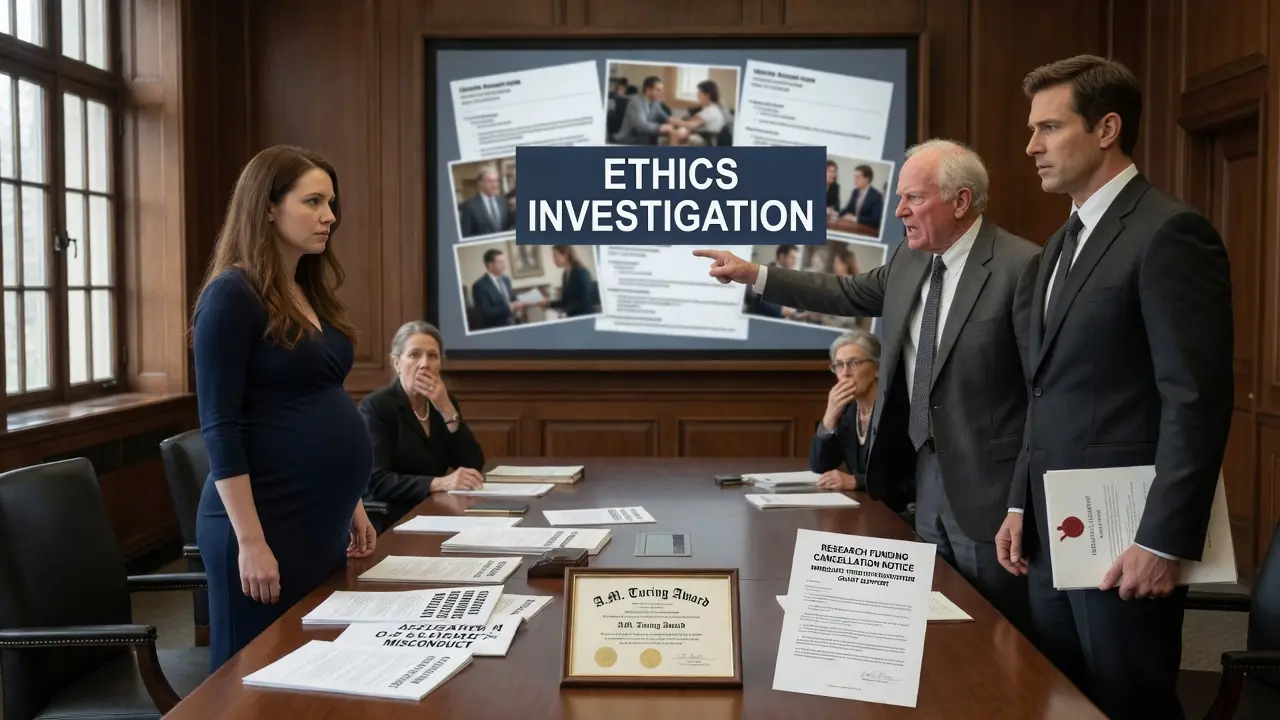
Dean Philip presented the dated resignation, the faculty-recusal records, and proof that James had transferred the scholarship foundation before the relationship became public. James had remained on campus only long enough to finish responsibilities unrelated to Avery’s assessment.
Mia’s father threatened to cancel research donations and pressure professional organizations to discredit James. The dean reminded him that donors could not revoke a Turing Award or dictate academic findings.
Then the hearing changed direction.
Campus police submitted evidence from the locker-room assault, the dance, the harassment campaign, and the forged complaints. Investigators traced payments connecting Mr. Carter, Mia, Serena, and Professor Hale. Serena was arrested for forgery, blackmail, unlawful surveillance, and conspiracy. Hale faced criminal and professional investigations. Mia and her father were referred for charges related to assault, witness intimidation, and obstruction.
John, confronted with the consequences of helping them, finally provided messages that confirmed the plot. It did not erase his treatment of Avery, but it prevented Serena and Mia from harming her again.
The university cleared Avery of academic misconduct. Her scholarship remained intact, and independent review confirmed that every major piece of her work predated her relationship with James.
Outside the hearing, she confronted him about resigning.
“You are a Turing Award winner. You should not give up teaching because of me.”
“I did not give up my career,” James replied. “I changed where I practice it. I already achieved the honor I dreamed of. You are only beginning. Do not shrink your future to protect mine.”
Dean Philip approved Avery’s medical leave and guaranteed her right to return after the birth.
James did not ask her to remain a secret. He proposed after the disciplinary case closed and after he no longer held any academic power over her. Avery accepted because the choice no longer threatened her education.
Their marriage was quiet. Lily stood beside Avery. Dean Philip attended as James’s friend rather than his employer. John did not come, though he sent a short apology that Avery read once and put away.
Avery gave birth to a healthy daughter. Motherhood delayed her studies but did not end them. With childcare shared rather than assigned, she returned to PF University and entered the doctoral program.
James supported her without attaching his name to her publications. When she struggled, he reminded her that assistance and ownership were not the same. Her dissertation on adaptive neural systems earned distinction under an independent committee.
Years after the night she found her thesis torn across a classroom floor, Avery stood before a new group of doctoral candidates as their elected student representative.
She looked toward the audience. James held their daughter on his lap, trying unsuccessfully to keep the child from waving at the stage.
“The person I want to thank most is my husband,” Avery said. “Not because he opened a door for me, but because when I was tempted to walk away from my own future, he reminded me that it still belonged to me.”
After the ceremony, James met her at the steps.
“Congratulations, Dr. Black.”
“Not yet,” she laughed. “There is still work to do.”
“Then I will be proud of every step.”
Avery took their daughter’s hand and placed her other hand in his.
The scandal that once seemed capable of ending both their lives had forced them to confront the difference between desire and responsibility. Love alone could not make an unequal situation safe. Honesty, boundaries, and the willingness to surrender power had to do that work.
James had once been her professor. John had once been her boyfriend. Those facts made their story complicated, but complication was not the same as destiny.
Avery was no longer the girl who believed other people could decide whether she belonged.
Her future had never been James’s gift to give.
It was hers—and at last, she chose to share it with him.
THE END