The first time Lila Moreno heard the old Harley cough, every mechanic in Redline Customs heard an expensive problem.
Lila heard a warning.
She was thirteen years old, five feet tall in worn canvas sneakers, and thin enough that the oversized gray shop shirt she wore after school hung from her shoulders like it belonged to somebody else. Her dark hair was tied back with a red bandana that had once belonged to her father, and there was a permanent crescent of grease beneath her right thumbnail no matter how hard her mother made her scrub. Officially, Lila was not a mechanic. Officially, she was not even supposed to be near the lifts. She swept floors, emptied drain pans, sorted sockets, wiped fingerprints from chrome, and waited in the office until her mother finished the late shift at the hospital across town.
Unofficially, Lila could identify a failing compensator by sound, set ignition timing on a forty-year-old V-twin without touching a computer, and tell when a carburetor was running lean by the smell of the exhaust before most grown men in the shop found their flashlights.
Her father had taught her.
Miguel Moreno had spent twenty-two years rebuilding motorcycles in garages across California’s Central Valley. He could make engines run that other men had already pronounced dead, and he believed every machine had a language if a person was patient enough to learn it. When Lila was six, he taught her the difference between a knock and a tick by letting her press the handle of a long screwdriver against an engine case and place her ear against the other end. When she was eight, he let her clean carburetor jets with a strand of copper wire. At ten, she could rebuild a petcock on a workbench while he made coffee.
Then, when she was eleven, Miguel died on Highway 58.
A pickup crossed the center line in the rain. Miguel never made it home.
After the funeral, everything changed. Lila’s mother, Sofia, began working extra shifts. The small savings account disappeared beneath medical bills, rent, and the cost of a funeral they had never imagined paying for. Miguel’s tools were sold one drawer at a time until only a battered red toolbox remained in the back of Lila’s closet. Redline Customs belonged to Miguel’s oldest friend, Ray Maddox, and when Sofia could no longer afford after-school care, Ray agreed Lila could wait at the shop as long as she stayed out of the way.
“School first,” Ray always told her. “Homework second. Engines never.”
Lila nodded every time.
Then she listened to engines anyway.
Redline Customs sat on the industrial edge of Bakersfield between a tire warehouse and a fenced lot filled with irrigation equipment. The building was old enough that summer heat lived permanently in its concrete walls. The front office smelled of paper invoices and burnt coffee. The service bays smelled of gasoline, hot metal, rubber, penetrating oil, and the faint metallic dust of grinding wheels.
Ray was fifty-seven, broad around the middle, with a gray horseshoe mustache and hands swollen from decades of wrenching. He was not a bad man, but he was tired, and tired men often protected whatever made life easiest. At Redline, what made life easiest was pretending his lead mechanic, Curtis Vane, knew more than he actually did.
Curtis was thirty-six, tall, heavily tattooed, and loud enough that customers often mistook confidence for competence. He was good with newer touring bikes, especially anything that could be connected to diagnostic software. He could replace modules, install kits, and sell upgrades. What he lacked was patience. Old motorcycles irritated him because they refused to explain themselves in error codes.
He disliked Lila for the same reason.
She noticed things.
On a hot September afternoon, Curtis spent forty minutes trying to solve a rough idle on a 1997 Softail. He replaced the plugs, cleaned the carburetor, and blamed bad gasoline. Lila, sweeping ten feet away, listened to the motor surge every time Curtis turned the handlebars to the right.
“The throttle cable’s pulling,” she said.
Curtis looked over slowly.
“What?”
“The cable’s routed wrong under the tank. When you turn right, it lifts the slide a little.”
The other mechanic, Ben, looked down to hide a smile.
Curtis killed the engine.
“You finish algebra yet?”
“Yes.”
“Then find something useful to do.”
Lila lowered her eyes and returned to sweeping.
Ten minutes later, she watched Curtis reroute the throttle cable when he thought no one was paying attention.
By closing time, he was telling Ray he had “tracked down a weird cable bind.”
Lila said nothing.
She had learned that adults could forgive being wrong faster than they could forgive a child for being right.
At 4:37 the following Thursday, the front windows began to vibrate.
Ray looked up from an invoice.
Curtis stopped mid-sentence.
The sound coming up the street was not the clean thunder of a healthy Harley. It was deeper, uneven, and ugly, with a dry metallic slap buried under each combustion stroke. The engine sounded like something inside it was trying to escape.
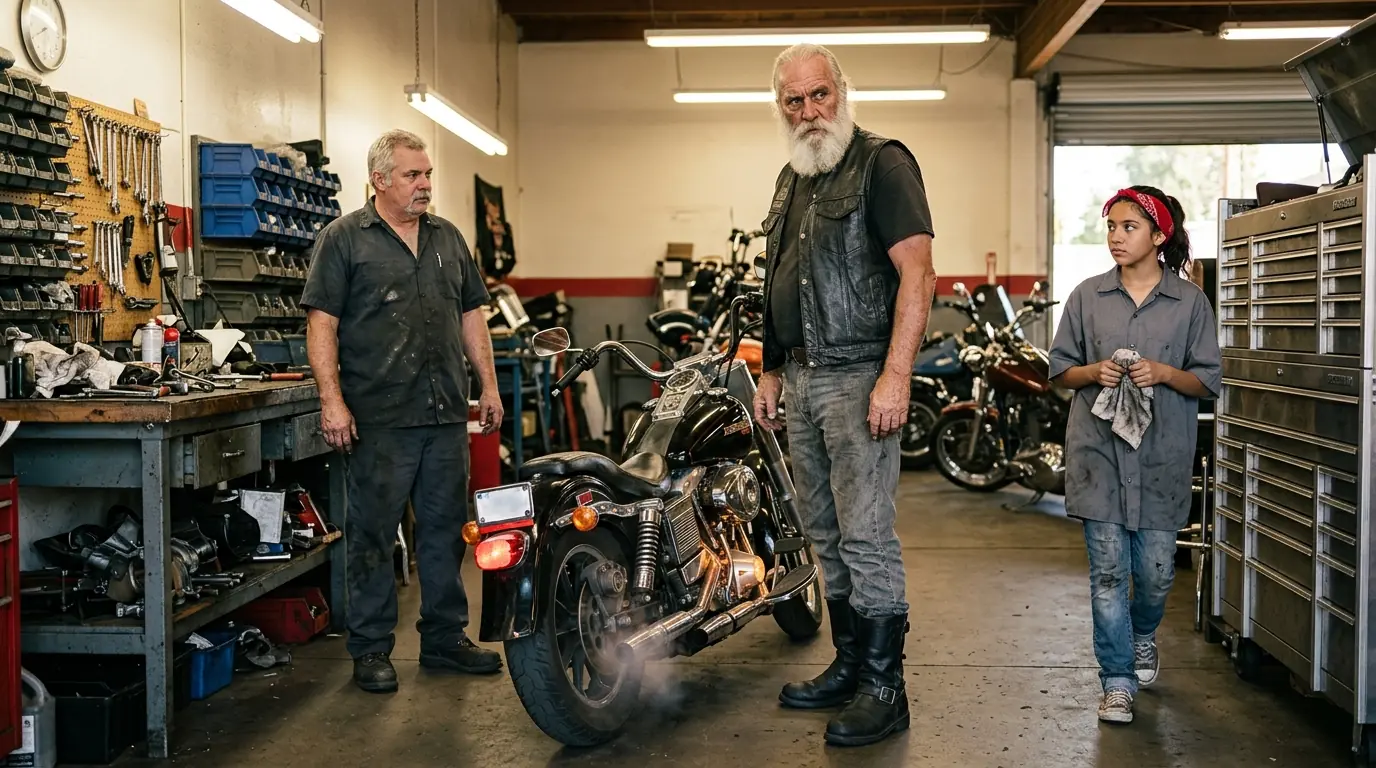
A black 1982 Harley-Davidson FLH Shovelhead rolled into the lot trailing a thin ribbon of blue smoke.
The rider was older than the men in the shop expected.
Silas Creed was sixty-eight, tall even with age bending him slightly through the shoulders. His white beard reached the top of his leather vest, and his left leg moved stiffly when he put the kickstand down. Across the back of his vest was the patch of the Iron Psalm Riders, an old California motorcycle club known less for crime than for the fact that its members seemed to know every tow operator, union welder, veteran, trucker, and independent repair shop between San Diego and Redding.
Silas was not famous outside biker circles.
Inside them, he was something else.
He had spent forty years on the road. He had buried friends, escorted fallen veterans, organized toy runs, broken down in nearly every western state, and once ridden nine hundred miles overnight because a club brother’s wife had died before he could get home from a job site. People did not fear Silas because he shouted.
They feared disappointing him.
He killed the ignition.
The motor stopped with one final hard clack.
Silence spread across the shop.
Silas walked in carrying a black helmet under one arm.
“Ray Maddox?”
Ray wiped his hands.
“That’s me.”
Silas nodded toward the motorcycle.
“I need her running by six tomorrow morning.”
Curtis gave a short laugh before realizing Silas was serious.
Ray glanced at the bike.
“What’s tomorrow?”
Silas looked at him.
“My brother’s funeral ride.”
That changed the air.
He explained without drama. His older brother, Mason Creed, had died four days earlier after a long fight with pancreatic cancer. Mason had founded the Iron Psalm Riders with Silas in 1979. The black Shovelhead outside had been Mason’s first club bike before he sold it to Silas in 1988. Every dent and scratch meant something. The funeral procession would leave Bakersfield at sunrise and ride north to the small cemetery outside Kernville where Mason wanted his ashes buried beside their parents.
“I lead on that motorcycle,” Silas said. “Not another one.”
Ray nodded carefully.
“We’ll do everything we can.”
Silas’s eyes moved to Curtis.
“You the engine man?”
Curtis straightened.