Why don't you go back to whatever hood you crawled out of? He didn't answer. He stood in his own doorway, hands at his sides, still, like a man who learned long ago that silence is a weapon, too.
We don't need your kind here. This was a good neighborhood before you people moved in. His doorbell camera caught every word. His grandson's phone caught the rest. 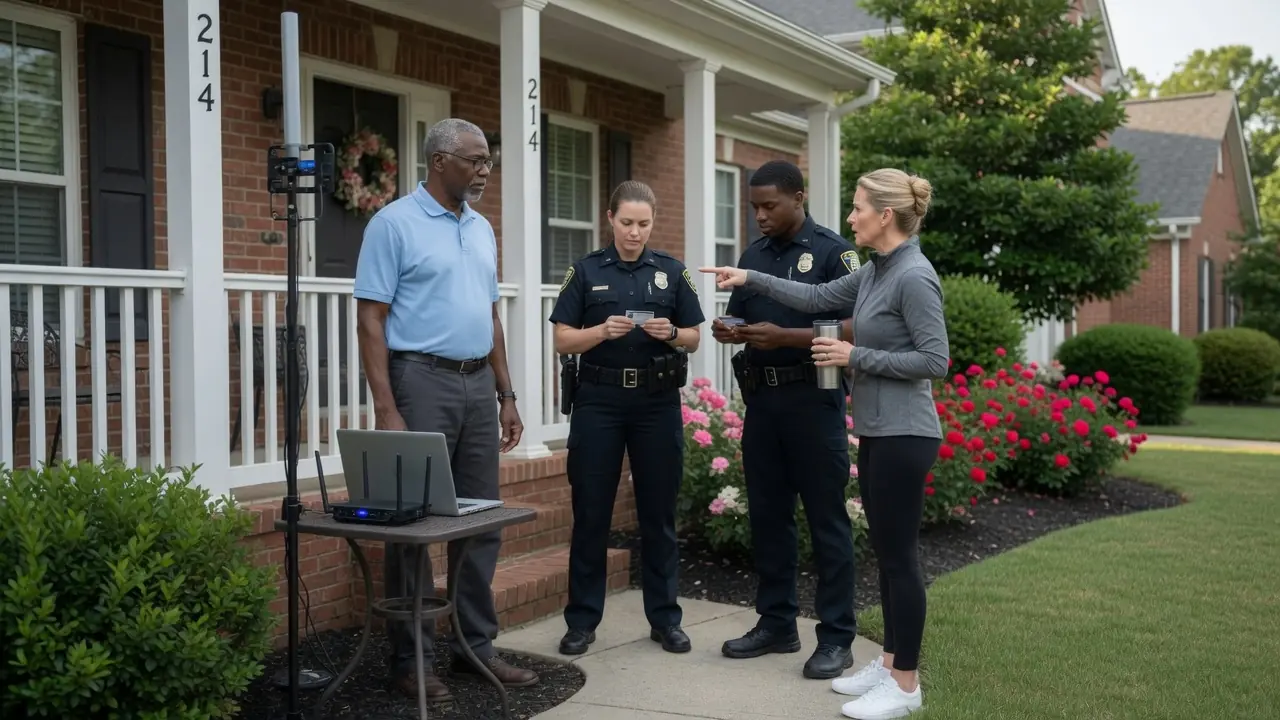
She called 911 on him twice. Once for changing his Wi-Fi password, once for directing electronic signals at her television. Both times, the cops found nothing. But here's the thing about inviting police to investigate your neighbor. Sometimes they find what you were hiding.
Behind her basement door, 18 months of stolen internet, paying guests, and zero taxes. One password change destroyed her. This story is just getting started. Wendell Sable was the kind of man who moved through the world quietly and left it a little better than he found it.
58 years old, 6'1, hands that could rewire a hospital server room or thread a fishing hook with equal precision. He'd spent 28 years as an IT infrastructure engineer at Duke University Hospital, managing networks that connected thousands of devices across multiple campuses. When a surgeon needed a real-time image from an MRI machine in building C to appear on a screen in operating room seven at building A, it was Wendell's architecture that made it happen.
He retired 3 years ago. Not because he wanted to, because Lorraine got sick. Lorraine Sable was 5'4, laughed like a jazz trumpet, and grew roses that made the whole block smell like heaven from April through October. She was diagnosed with pancreatic cancer in the fall. She was gone by spring.
14 months had passed since the funeral, and Wendell still kept her oxygen concentrator in the bedroom closet. He couldn't bring himself to call the medical supply company to pick it up. Some mornings, half asleep, he still heard the rhythmic hiss, that steady mechanical breath that meant she was still alive.
He lived alone now in Cedarfield Commons, a planned suburban development of 34 homes on the east side of Durham. The neighborhood had been built in 2008, right at the peak of the housing boom. Brick facades, two-car garages, a decorative entrance gate that hadn't worked since 2019.
The HOA had dissolved two years prior when the former treasurer vanished to Myrtle Beach with $22,000 of community funds. Nobody bothered to reorganize. The shared infrastructure, fiber trunk line, community mailbox cluster, irrigation timer, sat in legal limbo. Nobody maintained it. Nobody cared. Well, almost nobody.
Wendell's daughter Janay was 32, sharp as a scalpel, and worked in marketing in Atlanta. She called every Sunday and Wednesday without fail. His grandson Elijah, Janay's boy, 16 years old and already taller than Wendell, came to stay every summer. It had been Lorraine's tradition.
Elijah would arrive with a suitcase full of graphic novels and a laptop loaded with coding projects, and Lorraine would have the guest room smelling like lavender and fresh sheets. After she died, Wendell kept the tradition going. Elijah was arriving next week. The kid needed solid Wi-Fi for his coding camp.
That's why Wendell was on the porch that Tuesday afternoon with a Ubiquiti mesh router, a directional antenna, and a laptop, upgrading the network. Standard equipment, consumer grade, legal, boring. The kind of thing 10 million Americans do every weekend without anyone calling the National Guard.
The cicadas were screaming so loud the air itself vibrated. Humidity thick enough that Wendell's glasses fogged every time he stepped outside. The smell of Lorraine's rose garden, still alive, still blooming, tended by muscle memory, drifted across the porch.
The mesh router powered on with a soft click hiss. Its blue LED blinking in the afternoon shade like a tiny heartbeat. One thing about Wendell you should know, he grew up in Moultrie, Georgia, small town, deep south. In 1974, when he was 8 years old, his father Clarence Sable was arrested for trespassing on his own 12-acre farm.
A white neighbor disputed the property line. The sheriff came with two deputies. They handcuffed Clarence in the front yard while little Wendell watched from the porch steps. Charges were dropped in 48 hours. The deed was clear as daylight, but Clarence Sable never stood the same way again. Something in his spine just softened.
Wendell kept a photocopy of that deed in his desk drawer for the rest of his life. Every false accusation echoes. Now, let's talk about Colleen Ashbury. Colleen was 52, Pilates-toned, and moved through the neighborhood like she owned the HOA, the streets, and the airspace above them.
She wore premium athleisure the way some people wear armor. Lululemon leggings, Alo yoga tops, hair pulled into a French twist so tight it could survive a category 3 hurricane. Her nails were always done, gel, French tip. Her white Lexus RX350 sat in the driveway with a vanity plate that read B L S S D because blessed was already taken.
She carried a stainless steel tumbler everywhere. It looked like iced tea. It was not iced tea. After the HOA dissolved, Colleen simply appointed herself. She created a Facebook group called Cedarfield Commons Neighbors. She launched a Nextdoor page. She started a group text chain with 17 households.
Nobody voted for her. Nobody asked her. She just began issuing reminders and community advisories. And everybody was either too polite or too exhausted to push back. Her husband, Garrett Ashbury, was 55 and worked as a building inspector for Durham County. Quiet man. Compliant man.
She passed Wendell's house. She saw a man sitting on his own porch with a laptop, an antenna, and a tangle of ethernet cables. She did not wave. She did not walk over and ask what he was doing. She did not mind her own business.
She went inside, poured her tumbler of rosé, and picked up the phone. Two officers arrived at Wendell's house 14 minutes later. Officer Tanya Briggs, mid-30s, experienced, professional, and Officer Deshawn Colter, late 20s, and the kind of cop who built his own home server on weekends and watched network security YouTube channels during his lunch break.
Colleen met them at the curb, performing distress the way some people perform Shakespeare. Hand on chest, wide eyes, voice just shaky enough. "Thank God you're here. I didn't know what he was doing with all that equipment."
The officers walked to Wendell's porch. He was calm. He always was. He stood, set down his sweet tea, and offered his ID before anyone asked. A habit drilled into him by a father who learned the hard way what happens when a man reaches for his wallet too quickly.
"Good afternoon, officers. I'm Wendell Sable. This is my home. I'm setting up a new Wi-Fi router." Officer Briggs was professional, checked the ID, confirmed the address, asked about the equipment. Wendell explained, "Mesh router, directional antenna for signal testing, all consumer grade, FCC compliant, available at Best Buy for $249."
Then, Officer Colter looked at the setup, tilted his head. "UniFi Dream Machine Pro?" Wendell blinked. "You know your hardware." "I run one myself."
And here's where Colleen Ashbury's Tuesday went sideways. While Officer Briggs walked back to Colleen to take her statement, during which Colleen doubled down with "I know what hacking equipment looks like. I watch the news." Officer Colter asked Wendell a routine follow-up.
"Sir, have you had any issues with your network, unauthorized access, unusual activity?" Wendell paused. "Actually, now that you mention it, my old network was unsecured for a while. My wife used to handle the password. After she passed, I just left it."
Colter asked if he could glance at the router's admin panel. Wendell consented. Colter pulled up the DHCP client list, the log of every device that had connected to that network. And then Colter frowned. "Mr. Sable, you live alone?"
"Yes, sir." "There are 17 unique devices logged on your network in the past 30 days. Phones, laptops, tablets, none of them match yours." Wendell stared at the screen.
17 devices on his personal home network, in his house where one man lived alone and used exactly three devices. Colter pointed at one entry. The host name read Ashbury-iPad. Another, Garrett-work-laptop.
Several others had generic names, the kind of default host names you see on guest devices, temporary connections, people passing through. Colter called Briggs over, showed her the screen. Briggs looked at the device list, looked at the Ashbury house across the street, looked back at the list.
"That's a lot of devices for a neighbor who just called to report hacking." The officers didn't make an arrest. They didn't issue a citation. But Colter filed an internal memo flagging the anomalous network connections. Standard procedure. Flag it, file it, let it breathe.
Before he left, Colter handed Wendell his card. "Secure that network, Mr. Sable. And if anything else comes up, call me." Wendell watched them drive away. Then he looked at the Ashbury house, then at the card in his hand.
He didn't know what any of it meant, not yet. But a man who spent 28 years managing hospital networks knows when something doesn't add up. The next morning, Colleen, blissfully unaware that the cops had found her own devices on Wendell's network, went on the offensive.
She posted on Nextdoor at 7:14 a.m. before the coffee was even cold. "Just a heads-up, neighbors. Saw some unusual tech activity at Wendell's address. Police were called and responded. Stay vigilant." 14 likes, three comments.
One from a guy named Doug. "Thanks for keeping an eye out, Colleen." That afternoon, at the mailbox cluster, Colleen found Wendell checking his mail. She deployed the smile, teeth first, eyes completely vacant, like a hostess at a restaurant where the food was terrible, but the confidence was unshakeable.
"Wendell," she touched his arm, actually touched it. "I hope you understand. With everything going on these days, you just never know who's doing what on computers." She tilted her head, the way a person tilts their head when they're performing sympathy, the way a dog performs obedience.
"Technically correct, emotionally hollow. Better safe than sorry, right? I'm sure you're a perfectly nice man." Wendell pulled his arm back, slowly. Didn't speak, walked to his porch, sat in Lorraine's rocking chair, the one that still smelled like her hand lotion if you pressed your face into the cushion, stared at her rose garden.
His blood pressure was pounding. He could hear it, that dull metronome behind his ears that his doctor had warned him about. "Your blood pressure doesn't need any more enemies, Wendell." He whispered to the empty chair beside him. She would have handled this better than me.
That night, Wendell couldn't sleep. He lay in bed hearing phantom sounds. Lorraine's oxygen concentrator, the rhythmic hiss click hiss that meant she was still breathing. It wasn't there. It hadn't been there for 14 months, but grief plays its own soundtrack and Wendell couldn't find the off switch.
He called Janay. Didn't tell her about the 911 call. Didn't tell her about Colleen. Just said, "Tell me about your day, baby." And he listened for 40 minutes while his daughter talked about a client presentation and a bad salad and a funny thing her co-worker said.
Janay knew something was wrong. She always knew, but she didn't push. Not yet. Meanwhile, Wendell's brain, the brain that had spent three decades solving network problems, was working in the background. 17 devices, Ashbury iPad, Garrett's work laptop, guest devices appearing in clusters.
He pulled up the full DHCP log, started sorting by connection times, and there it was. A pattern so clean it practically announced itself. Groups of two to three new devices appearing every Friday evening, disconnecting every Sunday morning, like clockwork, like guests checking in and checking out.
The mail carrier, Destiny Price, 24, built like a point guard, fastest route on the East Side, delivered Wendell's mail that afternoon. She'd seen the police cars the day before, seen Colleen performing for the officers, seen Wendell standing calmly on his own porch with his own equipment.
She didn't say anything that day, but she remembered. Two weeks later, Colleen escalated, because of course she did. People like Colleen don't call 911 and then move on with their lives. They call 911 and then build a campaign.
She created the Cedarfield Common Security Committee. Membership, one. And circulated a petition demanding all residents register their network equipment with the neighborhood coordinator for community safety. She emailed it to every household.
The language was polished, professional, and deliberately vague. "In light of recent incidents involving unauthorized electronic installations." She even contacted a local real estate blog and left a concerned neighbor tip about suspicious tech activity in Cedarfield. Building a paper trail, making Wendell look like the problem.
Then came the potluck. Cedarfield summer potluck was a tradition. Plastic tables on the cul-de-sac green, paper plates, someone's Bluetooth speaker playing Earth, Wind, and Fire. Colleen arrived with a charcuterie board that cost more than most people's groceries for the week and an agenda that cost nothing but caused damage anyway.
Midway through the event, she climbed onto the decorative bench like she was addressing Congress and cleared her throat. "I just want to take a moment. We all want to be good neighbors and most of us are." She smiled. That smile.
"But I think we can agree that some of us are more tech-savvy than the rest of us feel comfortable with." She looked directly at Wendell who was holding a paper plate of potato salad. "I think transparency about what kind of equipment we're running is just common courtesy. Don't you all agree?"
Three neighbors avoided eye contact with Wendell. A white guy named Doug, same Doug from the Nextdoor comment, muttered loud enough to hear, "She's got a point. You never know these days." Wendell set down his plate, didn't respond, walked to the trash can, scraped the potato salad into the garbage, appetite gone, and walked home.
He didn't slam the door. He closed it with the soft click of a man who had spent his entire life practicing restraint because the alternative was a luxury he couldn't afford. That evening, he almost posted on Nextdoor. Almost told everyone about the 17 devices. Almost named the Ashbury iPad.
He drafted the post, read it twice, deleted it. Not yet. Not enough. Janay called for her Wednesday check-in. A neighbor, someone from Janay's childhood, had forwarded the Nextdoor post.
"Dad, what is going on? Who is this woman?" Wendell deflected. "It's nothing, baby, just a busybody." "Dad, the last time you said it's nothing was when Mom got the diagnosis." Silence on the line, the kind that weighs a hundred pounds.
"I'm coming home this weekend," Janay said, and the way she said it was not a question. Wendell couldn't sleep again that night. Lay in the dark living room staring at Lorraine's photo on the mantel. The oxygen concentrator hum that wasn't there filled the silence anyway.
But the next morning he started documenting. Exported the router logs to encrypted USB drives, one at home, one in his locker at Mount Calvary AME Church. Screenshot every Nextdoor post. Saved the petition PDF with metadata intact.
Started a composition notebook, black ink, small handwriting. The kind of meticulous documentation style he'd learned during 28 years of hospital compliance work. Date, time, exact words. Every interaction logged.
Then Destiny the mail carrier found him at the mailbox. She looked left, looked right, leaned in. "Mr. Sable, I need to tell you something." Her voice was barely above a whisper.
"That woman, Mrs. Ashbury, she filed a complaint with the post office last month. Said I was loitering on her street. Tried to get me reassigned from this route." Destiny's jaw tightened.
"My supervisor showed me the form. She wrote, 'This carrier spends excessive time at certain addresses.'" Wendell looked at her. "Which addresses?" "Yours and the Calvins'. The Calvins are black." "Yes, sir. She didn't complain about any other houses."
Wendell opened his composition notebook, wrote it down. Date, time, Destiny's words, exact phrasing from the complaint form. And here's the part that made the whole thing worse, or better, depending on your perspective.
That same week, Wendell kept digging through his router logs. The Friday to Sunday pattern of guest devices was undeniable. So, he did what any IT professional would do. He searched vacation rental listing sites for Cedarfield Commons addresses.
And there it was, cached on a travel review aggregator, a listing for a charming private suite in quiet Durham neighborhood. The photos showed a renovated basement, kitchenette, queen bed, separate entrance, decorative accent wall with exposed brick.
And right there in the amenity list, bolded, fast Wi-Fi included. The address wasn't listed on the site, but that accent wall, Wendell could see it through the Ashbury basement window from his own driveway. He'd walked past it a hundred times. Same exposed brick, same Edison bulb sconce, same IKEA shelving unit.
Colleen Ashbury was running an Airbnb out of her basement. And the Wi-Fi she advertised to paying guests, it was Wendell's network, his internet, his connection, listed as an amenity in a rental he didn't own, operated by a woman who just called the police on him for using his own equipment.
But Wendell didn't have the full picture yet. He had pieces, patterns, suspicions. What he didn't have was confirmation. That was about to come from the last place Colleen expected. Before that though, Colleen had one more round of escalation left in her.
She called Garrett, told him to look into Wendell's home office setup. Garrett, dutiful, compliant, always the first to sign whatever Colleen slid across the kitchen counter, showed up at Wendell's front door the next day with a clipboard and his county building inspector ID.
"Mr. Sable, we've received a report about commercial server equipment being operated in a residential zone. I'm here for an informal inspection." Wendell let him in. Wendell had nothing to hide.
His home office contained a desk, a laptop, a consumer-grade router, a printer, and a coffee mug that said, "World's Okayest IT Guy." A Christmas gift from Janay 3 years ago. Garrett walked through the house, opened one closet, glanced at the garage, found a workbench, a table saw, and a half-finished birdhouse Wendell had been building since February.
Garrett wrote, "No findings." on his clipboard, left without making eye contact. The man knew somewhere in the part of his brain that Colleen hadn't colonized, he knew this was wrong. Two days later, Wendell was backing out of his driveway.
He checked his mirror and stopped. Colleen's white Lexus was parked directly behind his car, blocking him in. She stood next to it with her arms crossed, rosé tumbler in hand, sunglasses pushed up on her forehead like a crown.
"We need to talk." Wendell put his car in park. "You're blocking my driveway, Mrs. Ashbury." "This will only take a minute. I've been patient, Wendell, very patient."
"Patient about what?" "About you." She stepped closer. The sweetness evaporated like rubbing alcohol. "About your equipment, your business, the police at your house, the disruption to this community."
"The police were at my house because you called them." Something shifted in her face. The performance dropped. What was underneath was colder. "You people always think you can just do whatever you want, run your little operations."
She waved at his house like it was contaminated. "This is a family neighborhood, Wendell, not a tech shop, not a whatever you're turning it into. You people." "Don't twist my words. You know exactly what I mean. I've lived here for 9 years. I know this neighborhood, and I know when something doesn't fit."
Wendell said nothing, looked at the Lexus blocking his driveway, looked at her, got back in his car, put it in park, turned on gospel radio, WSHA 88.9. The Clark sisters filled the silence. He waited, hummed along to Wade in the Water, that song, the one Lorraine used to say meant trouble was coming, the good kind.
He waited 11 minutes. Colleen, furious, red-faced, finally moved the Lexus. Wendell backed out slowly, waved politely through the window, drove to Mount Calvary for Wednesday evening Bible study. He didn't yell, didn't argue, didn't give her a single frame of use.
But Elijah, his grandson, who'd arrived for summer 3 days earlier, had seen it. Not the driveway confrontation itself, but the aftermath. He'd heard the edge in Wendell's voice at dinner, seen the way his grandfather's hands gripped the napkin like he was strangling something invisible.
That night, Wendell found Elijah in the guest room, phone in hand, face lit by the screen. The boy was Googling, "Can you get arrested for having a router?" Then, "What to do when someone calls police on you for nothing?"
Wendell sat on the edge of the bed. "Elijah, look at me." The boy looked up, 16 years old, already 6 ft tall, already carrying the weight that black boys in America start carrying before they're old enough to understand why.
"You didn't do anything wrong. I didn't do anything wrong. Sometimes people see what they want to see, and sometimes what they want to see is a reason to be afraid of us." "Grandpa, why didn't you yell at her?"
Wendell put his hand on Elijah's shoulder. "Because yelling is her game, and I don't play games I can't win." Across the street, Mrs. Loretta Gladwell, 71, retired school teacher, owned the yellow house with the wind chimes, had watched the driveway confrontation from her living room window.
She'd seen Colleen block Wendell's car, heard the raised voices, seen the phrase, "You people," land on Wendell's face like a slap. She reached for her front door handle, paused, dropped her hand. Went back to her crossword puzzle. "It's not my business." she told herself.
The guilt started that day. It would take a while to bloom, but it started. Meanwhile, Wendell called Adrian Voss, an old colleague from Duke Hospital, now a cybersecurity attorney in Raleigh. Adrian came over that Saturday.
Wendell showed him the router logs, the device patterns, the cached Airbnb listing, the documentation notebook. Adrian leaned back in his chair, rubbed his jaw. "Wendell, this isn't just a neighbor stealing your Wi-Fi. This is unauthorized access to a private computer network. That's federal. Computer Fraud and Abuse Act. And if she's using your network to run a commercial operation for paying guests, that's theft of services at minimum."
"What do we do?" Adrian held up a finger. "We don't do anything, yet. We build. And when the time is right, we let it all fall at once." He flagged one more thing. "If Garrett inspected your house while his wife is running an illegal rental from theirs, and he signed off on no code violations at his own address, that's a building inspector self-dealing. That's his license, Wendell. His career."
Wendell opened his composition notebook, wrote, "Garrett, conflict of interest, license at risk." Closed the book and began to hum. Three weeks after the driveway confrontation, Wendell's phone rang on a Saturday morning. The caller ID read, "Durham PD, Coulter, D."
"Mr. Sable, this is Officer Coulter. I apologize for calling on a weekend, but this is going to sound unusual, and I thought you should hear it from me first." Wendell set down his coffee, Lorraine's mug, the one with the chipped handle he refused to throw away.
"Go ahead, Officer." "After our visit to your house, I filed an internal memo about those unauthorized devices on your network. Standard procedure, flag and file. I figured it had sat in a folder somewhere." Coulter paused. "It didn't."
What happened next was the kind of coincidence that isn't a coincidence at all. It was the kind of thing that happens when one person's lie bumps into another person's truth and the whole house of cards starts vibrating. A week after that first 911 call, the Durham PD Cybercrime Unit received an unrelated complaint.
A traveling pharmaceutical sales rep, a man named Gregory Cullen from Raleigh, reported that sensitive files on his laptop had been accessed while he was staying at a short-term rental in Cedarfield Commons. Client medical data. HIPAA-adjacent material. The kind of stuff that makes corporate lawyers lose sleep.
The Cybercrime Unit traced the Wi-Fi network the guest had been connected to. It wasn't a commercial network. It wasn't even the rental property's network. It was Wendell's. But Wendell didn't operate any rental property. He was a widower who lived alone and fed the birds on Tuesday mornings.
The Cybercrime Unit pulled Coulter's memo, connected it to the guest complaint, and the picture that emerged was, well, let's just say Colleen Ashbury should have stuck to yoga. "Mr. Sable," Coulter said, and Wendell could hear him choosing his words carefully. "Our investigation has confirmed that the Ashbury household has been operating an unlicensed short-term rental from their basement for approximately 18 months. They advertised Wi-Fi as an included amenity. The Wi-Fi they advertised was your network."
Wendell sat very still. "Over 90 guest devices connected to your personal network during that period. Your files, your stored documents, your network-attached storage, all of it was accessible to those guests." 94 strangers in his network for 18 months with access to everything.
"It gets worse," Coulter continued. "Mr. Ashbury, as county building inspector, appears to have waived inspection requirements on his own property. The basement conversion has no fire egress, no separate electrical panel, no CO detectors, no business license, no occupancy tax registration. The estimated unreported income is north of $48,000."
Wendell didn't speak for a long time. The phone was warm against his ear. Through the kitchen window, he could see Colleen's house, the basement windows, the separate entrance he'd walked past a hundred times without thinking twice. "Officer Coulter, thank you."
He hung up, opened his notebook, wrote one line, "They found it." Then he went to his office, sat down at his NAS drive, opened the folder labeled Lorraine, her scanned medical records, insurance claims, last prescription list, final hospital discharge summary. The one that listed time of death as 3:47 a.m., March 12th. All of it.
Sitting on a network that 90 strangers had accessed while sleeping in Colleen Ashbury's basement, eating her decorative breakfast pastries, and using her stolen Wi-Fi to scroll through whatever they wanted. Wendell sat there for a long time. He didn't cry. He was past that.
He just breathed, slow, deliberate, the way you breathe when you're deciding between grief and purpose. And you choose purpose because grief doesn't build anything. He encrypted the folder, 256 bit, then locked the room, then called Adrian Voss.
"It's time." Now, look, I need to pause here for a second because I know what some of you are thinking. This is crazy. This can't be real. And I get it. But this is the thing about neighbors like Colleen Ashbury. They don't just steal your Wi-Fi, they steal your peace, your privacy, your sense of safety in your own home.
And then they call the cops on you for the crime of existing while competent. So, before you tell me this is extreme, ask yourself, have you checked your own router's client list lately? Because someone might be living in your bandwidth right now.
And they might be charging rent for it. What followed was 3 weeks of the most precise, methodical preparation Wendell Sable had ever undertaken. And this was a man who once rebuilt an entire hospital network during a hurricane without losing a single patient file.
First, the hardware. Wendell installed an enterprise grade Ubiquiti security gateway with full packet capture and intrusion detection. Every connection logged, every packet timestamped, every device fingerprinted. Then he set up a honeypot, a Wi-Fi network with the same name as his old unsecured one, Sable_Home.
Anything that connected was walking into a surveillance room it couldn't see. The network provided internet access, but routed everything through a monitoring proxy. Think of it this way, Wendell rebuilt the old unlocked door, same paint, same hinges, but this time there was a camera behind it, a motion sensor above it, and a very patient man watching the monitor.
He also installed two discreet outdoor cameras covering the Ashbury basement entrance and the shared property line. Legal, on his property, pointed at his own yard. If they happened to catch the neighbor's guests coming and going, well, that's just geometry.
Second, the legal architecture. Adrian Voss built a three-front strategy, and here's where it gets good for anyone watching who's ever dealt with a neighbor who thinks the rules don't apply to them. Track one, federal. The Computer Fraud and Abuse Act, 18 USC section 1030. That's the same law they use to prosecute actual hackers.
Unauthorized access to a protected computer network, whether you used it to steal government secrets or binge watch Netflix on your neighbor's dime. Doesn't matter. Unauthorized means unauthorized. Adrian filed a formal complaint, simple as that.
Track two, county. Two complaints, one to the Durham County tax assessor for unreported short-term rental income exceeding $48,000, and one to the State Building Inspector Licensing Board for Garrett's self-dealing. When a building inspector approves his own illegal construction, that's not a conflict of interest, that's a career-ending mistake.
The Licensing Board doesn't send warnings for that, they send revocations. Track three, state. North Carolina's Vacation Rental Act requires registration, safety inspections, and occupancy tax collection. The Ashburys had done none of it.
Running an unregistered Airbnb in North Carolina isn't a gray area, it's a violation with teeth, and the county can shut you down and collect every dollar you owe with interest, penalties, and a smile. Third, the allies. Officer Coulter, now the lead investigator on the cybercrime case, coordinated timing.
Destiny Price, the mail carrier, provided a written statement about the reassignment attempt and the pattern of complaints targeting only black households. Ray and Donna Calvin, the black couple two houses down, shared their own Colleen stories. Three noise complaints filed against them for their Saturday evening Bible Study Group.
The white family on the corner hosted louder Friday cocktail parties every single week. Zero complaints. And Sergeant Amos Pruitt, retired Durham PD, 68, lived on the outer loop, had his own file. Colleen had reported his ring cameras as neighborhood surveillance equipment two months after he moved in.
The man had spent 30 years as a cop. He knew how to build a case. Fourth, the timeline. The Cedarfield Commons annual summer cookout was three weeks away. Wendell volunteered to run the grill, same as every year.
He'd bring the charcoal. He'd wear Lorraine's apron, the one that said, "Seasoned with love." Nobody would suspect a thing. He explained the plan to Janay during her weekend visit. Using her marketing brain to keep it simple.
"Think of it like this. She had a copy of our house key. She was letting strangers in through the back door every weekend. Those strangers sat in our living room, used our electricity, and went through our drawers. And she charged them for the privilege for 18 months."
Janay stared at him. "Dad, that's not a metaphor. That's literally what happened." "I know, baby. That's why it's going to work." But Colleen wasn't done yet. Two weeks before the cookout, she went nuclear.
She filed a restraining order against Wendell. The petition claimed cyberstalking and electronic harassment and stated that Wendell had been monitoring her household's electronic activity and conducting surveillance of her property. Using Garrett's county connections, the paperwork was fast-tracked.
A Durham County deputy served the restraining order at Wendell's front door on a Saturday morning. Elijah was eating cereal at the kitchen table. Two neighborhood kids were on the porch waiting to walk to the park with him.
Colleen was on her front porch, phone raised, recording the whole thing. She posted it to the Cedarfield Facebook group that afternoon. "Finally, some protection for our neighborhood. The system works when good people speak up." 12 likes, one heart emoji from Doug.
Elijah set down his spoon. "Grandpa, are we in trouble?" Wendell kneeled down, eye level. "No, son, we are not in trouble. Someone is trying to make us feel like we're in trouble. There's a difference. Do you understand?"
"Yeah." Elijah's voice was small. "But it still feels the same." Wendell sent Elijah to the park, then sat on the back porch, alone. The roses were blooming, Lorraine's climbers, the ones she'd trained up the trellis the summer before the diagnosis.
He could smell them. That sweet, dusty, alive smell that meant summer and meant her and meant everything that used to be normal. His hands shook, not from fear, from fury held perfectly still.
He almost picked up the phone to call a realtor. Almost. The thought surfaced like a bubble. Sell the house, take the money, move to Atlanta near Janay, let Colleen win, let it all go. Then he looked at the roses. Her roses.
The soil she'd kneeled in. The thorns she'd never complained about. He called Adrian instead. "The restraining order hearing. When is it?" "Two weeks from Monday. The cookout is the Saturday before." "I know." "Then we don't change a thing."
Janay called that evening, furious. She'd seen the Facebook post. "Dad, I'm hiring you a lawyer. This is ridiculous." "You should sell that house and your mother planted those roses, Janay. I'm not leaving her garden." The line went quiet.
The kind of quiet that sounds like a daughter remembering she underestimated her father. "Then we fight." "We're already fighting. She just doesn't know it yet." Five days before the cookout, Colleen called 911 again. Her third act. Her worst mistake.
"I need to report a restraining order violation. The man at this address has been directing electronic signals at my house. I can hear interference on my television." Two new officers responded. Different shift. No history.
They found Wendell on his porch reading a James Baldwin novel. Doing absolutely nothing to anyone's television. No signal interference. No violation. No evidence of contact.
The officers apologized for the inconvenience and walked back toward their cruiser. But Colleen was at the curb. Wine flushed. Arms crossed. And the evening had drawn neighbors outside. Watering lawns. Walking dogs. Pretending not to watch.
The mask came off. It started as frustration. "You're not going to do anything? He's clearly doing something to my house." Then it became indignation. "Why do I even pay taxes if the police won't protect?"
Then it became something else entirely. She turned to Wendell, standing in his doorway, hands at his sides, Elijah's phone propped in the window, recording a second angle alongside the 4K doorbell camera.
"Why don't you go back to whatever hood you crawled out of?" Her voice cracked the evening air like a whip. "We don't need your kind running wires and doing God knows what. This was a good neighborhood before you people moved in."
Nine years I've been here, and never once had a problem until she caught herself, or tried to. The rosé wouldn't let her. "Until people like you started buying houses you have no business being in."
Silence. The cicadas stopped, or maybe they didn't. Maybe it just felt that way. An officer flinched visibly. Sergeant Pruitt, walking his dog on the sidewalk, stopped mid-stride. Mrs. Gladwell's front door was open.
She was standing on her porch, hand pressed over her mouth, and this time she didn't go back inside. Wendell, perfectly still, hands at his sides. He looked at the officers, then at Colleen, then at the small red light on his doorbell camera.
"I trust you heard that, officers, and I trust my camera did, too." He turned to go inside, paused at the door, looked back. "Ma'am, you just gave me everything I need." Closed the door, softly. Locked it. Walked to the guest room where Elijah sat holding his phone, with hands steadier than a boy his age should need.
"You okay, Grandpa?" "I'm okay. Did you get it?" "All of it." "Good boy."
The cookout was on Saturday. Durham heat shimmered off the asphalt like the whole neighborhood was sweating. The cul-de-sac green had been set up with folding tables, a rented canopy, two charcoal grills, and a projector screen.
The one they normally used for neighborhood movie night, when kids sat on blankets and watched something Disney while parents drank beer in lawn chairs. Wendell was at the grill, Lorraine's apron, hickory charcoal, the good stuff, not the chemical briquettes.
Elijah managed the cooler. Janay had driven up from Atlanta that morning and was arranging chairs with a face that said, "I am here for my father, and I am not leaving until this is finished." 42 residents gathered.
Kids chased each other through the sprinklers. Somebody's golden retriever stole a hot dog bun off a plate. The smell of charcoal and hickory smoke and fresh cut grass hung in the air like a Saturday is supposed to smell.
Colleen arrived at 4:15, white linen pantsuit, statement necklace, casserole dish in one hand, neighborhood coordinator clipboard in the other. The BLSSD plate on her Lexus caught the sun. She had no idea.
At 4:30, an unmarked sedan parked at the curb. Officer Coulter stepped out in plain clothes, accompanied by a detective from the cybercrime unit. They nodded to Wendell. He nodded back, turned a burger.
At 4:35, a Durham County Tax Assessor's representative arrived, clipboard, county ID badge, official vehicle. At 4:40, a representative from the North Carolina Building Inspector's Licensing Board, briefcase, official letterhead.
At 4:45, a Channel 5 WRAL consumer investigation reporter named Janelle Michaels and her cameraman set up at the edge of the green. Janelle was known in Durham for one thing, dismantling scam operations on the 6:00 news with a smile that could cut rebar.
Adrian Voss walked to the center of the gathering and asked for everyone's attention. The kids kept playing. The adults went quiet. "Folks, I apologize for interrupting your evening. My name is Adrian Voss, attorney-at-law. I'm here on behalf of your neighbor, Wendell Sable, regarding a matter that affects everyone in Cedarfield Commons."
What followed was five beats of justice delivered with the precision of a hospital defibrillator. Beat one. The county tax assessor's representative stepped forward and presented Garrett Ashbury with a formal audit notice.
$48,000 in unreported short-term rental income. 18 months of unpaid occupancy taxes, penalties, interest. "Mr. Ashbury, this notice requires your response within 30 days." Garrett's face went the color of old cement.
Beat two. The licensing board representative informed Garrett that his building inspector's license was suspended effective immediately. Pending investigation of self-dealing. Specifically, waiving inspection requirements on his own property while conducting retaliatory inspections of a neighbor's home.
"You will surrender your county identification before leaving today, sir." Garrett reached for his wallet with shaking hands. Beat three. Officer Coulter addressed the crowd.
His voice was steady and professional, but there was something underneath. The controlled anger of a man who takes his oath seriously. "Durham PD has been investigating unauthorized access to Mr. Sable's home computer network. Our investigation confirmed that devices belonging to the Ashbury household, along with over 90 guest devices connected to a short-term rental operated from the Ashbury residence, accessed Mr. Sable's network without his knowledge or consent for approximately 18 months."
"Mrs. Ashbury is being formally notified of pending charges." Beat four. Adrian connected Wendell's laptop to the projector. The same screen where kids watched Moana last August now displayed a network access timeline. 17 months of unauthorized connections. 94 unique guest devices.
The host name Ashbury iPad highlighted in yellow and the cached Airbnb listing, complete with basement photos and the bolded amenity line, fast Wi-Fi included. Beat five. Janelle Michaels, mic in hand, camera light glowing red, walked toward Colleen.
"Mrs. Ashbury, can you explain why you were using your neighbor's internet to run an unlicensed rental operation while simultaneously reporting him to police for his own equipment?" Colleen dropped the casserole. Actual ceramic shattering on concrete. Marinara sauce spread across the pavement like a crime scene.
She went full Darvo, the playbook, the only playbook she'd ever known. "This man has been harassing me. I'm the victim here. He's been hacking into my" Wendell stepped away from the grill, removed Lorraine's apron, folded it neatly over the back of a lawn chair, walked to the front of the gathering.
42 pairs of eyes, plus a camera. He didn't raise his voice, didn't point, didn't gloat. He reached into his back pocket and pulled out a single printed page.
"Mrs. Ashbury." His voice was low, even, the voice of a man who had rehearsed nothing because the truth doesn't need rehearsal. "This is a log of every device that accessed my network without authorization. Your phone, your husband's laptop, your iPad, and 94 devices belonging to guests you charged money to sleep in your basement."
He paused, let it breathe. "94 strangers had access to my files, my late wife's medical records, my financial documents, my grandson's homework, for 18 months." Another pause, longer this time. The only sound was the charcoal popping on the grill.
"I didn't hack anyone, Mrs. Ashbury. You did. You stole my internet. You sold it. You exposed my family's most private information, and when I changed my own password in my own house, you called the police."
He folded the paper, put it back in his pocket. "And the police, they found you." Silence. 2 seconds. 3. Then someone in the back, Ray Calvin, started clapping, slow, deliberate. Then Donna Calvin joined.
Then Sergeant Pruitt. Then Destiny Price, who'd come on her day off wearing civilian clothes and a look that said she'd been waiting for this. Then Doug, the same Doug who'd muttered, "She's got a point." at the potluck, clapped too, with the look of a man trying to applaud his way out of shame.
Colleen, surrounded, turned to Garrett. "Do something." Garrett was sitting in a folding chair. His county ID lay on the table in front of him. He was staring at his shoes. Mrs. Gladwell stood up. She'd been in the back row crying quietly.
She walked to Wendell and took his hand. 71 years old. 37 years of teaching children to stand up for what's right. And when it was her turn, she'd done a crossword puzzle instead.
"Mr. Sable, I watched that woman block your driveway and call you you people. I was 10 feet away." Her voice broke. "I should have said something. I should have stood beside you. I was a coward and I am sorry."
Wendell held her hand, didn't let go. "You're standing here now, Mrs. Gladwell. That counts." Colleen walked to her Lexus, alone. The BLSSD plate caught the camera's wide shot as she backed out of the cul-de-sac.
Janelle Michaels' stand-up news began right there, with the shattered casserole still on the pavement behind her. "A Durham woman is facing multiple charges tonight after a 911 call about her neighbor's Wi-Fi led investigators to discover an illegal rental operation, tax fraud, and a building inspector's conflict of interest, all hiding behind a single stolen internet connection."
The casserole stayed on the concrete until Monday. Nobody picked it up. It became a neighborhood legend. For years afterward, pulling a Colleen meant one thing in Cedarfield Commons, creating the evidence of your own crime.
Now, the aftermath. Colleen Ashbury was charged with two counts of filing a false police report, class two misdemeanor in North Carolina. Unauthorized access to a computer network under NC General Statute 14-454 and operating an unlicensed short-term rental in violation of the Durham County rental ordinance.
Her attorney withdrew representation three days after the WRAL segment aired. Garrett Ashbury's building inspector license was permanently revoked. He was charged with malfeasance in office and resigned from the county before they could fire him. His pension was frozen pending review.
The Durham County tax assessor assessed the full damage, $48,000 in unreported rental income, $4,200 in back occupancy taxes, $11,500 in state income tax adjustments. Total tax liability, $63,700. The kind of number that turns a Lexus into a Civic.
Adrian Voss filed a civil suit on Wendell's behalf. Invasion of privacy, theft of services, intentional infliction of emotional distress, and data exposure liability. The Ashburys, staring down criminal charges and a collapsing financial situation, settled for $45,000.
Wendell used the money exactly the way Lorraine would have wanted. The restraining order was dissolved at the hearing. Colleen didn't show up. Her chair sat empty in the courtroom like a punchline nobody needed to explain.
Three former Airbnb guests, including Gregory Cullen, the pharmaceutical rep whose complaint had started the cybercrime investigation, joined a separate civil action against the Ashburys for data exposure. That case is still pending. The number being discussed would make your eyes water.
And Durham County, they adopted an enhanced false report ordinance with a racial motivation enhancer. Modeled after California's Karen Act, the city council sponsor who drafted the bill called it Wendell's Law during committee session. It passed unanimously.
Cedarfield Commons voted to reestablish a proper homeowners association with actual bylaws, elected officers, term limits, and for the first time, a written anti-discrimination policy. Wendell was asked to be the first president. He declined.
"I've had enough of neighborhood politics," he said, "but I'll run the Wi-Fi." At the next cookout, 3 weeks later, Wendell manned the grill, Lorraine's apron, hickory charcoal, Elijah on the cooler wearing a new T-shirt that said, "Encrypt everything."
Janay brought her signature peach cobbler. The Calvins brought their famous corn pudding. Sergeant Pruitt brought ribs so good the whole block could smell them from the parking area. Destiny Price came on her day off again, this time with her mother.
Even Doug showed up. He brought a six-pack and a handshake. "I owe you a beer and an apology, in that order." Wendell accepted both. Mrs. Gladwell arrived last. She carried a peach cobbler of her own and a handwritten letter in a lavender envelope.
She handed it to Wendell without a word and went to help set up the dessert table. He read it that evening on his porch in Lorraine's rocking chair. With the roses blooming and the cicadas singing and the last light of summer turning the sky the color of sweet tea.
"Dear Wendell, I was a school teacher for 37 years. I taught children to stand up for what's right. And when it was my turn to practice what I preached, I sat down. I will carry that shame for the rest of my life, but I will also carry the memory of your dignity, a man who held his ground without raising his voice and who let the truth speak louder than anger ever could. You deserved better from a neighbor. Loretta Gladwell."
Wendell folded the letter carefully, put it in his desk drawer, right next to the photocopy of his father's deed from Moultrie, Georgia. Two documents, 50 years apart, both proof that a man's home is his own.
The next weekend, Wendell knelt in Lorraine's garden and planted a new rose bush at the end of the row, a climbing variety called justice, deep red, thorny, resilient, the kind that blooms slow, but blooms for years. Elijah knelt beside him holding the stake.
"What's this one's name?" "Justice." Wendell patted the soil. "Because it takes its time, but when it blooms, everybody sees it." He launched a program the following month, called it Cedar Field Connected, free monthly Wi-Fi security audits and router setup help for elderly and low-income neighbors across Durham, funded by the civil settlement, run from his front porch with sweet tea and Lorraine's roses and a folding table covered in ethernet cables and patient explanations.
First client, Mrs. Gladwell. She still had her original router, factory password, default SSID, wide open. Wendell changed it for her. The new password, good neighbor 2026. She laughed for the first time in weeks.
The Ashbury house went on the market 26 days after the cookout, listed at $389,000. It sold in a week. The buyers, a young black couple with a baby girl and a chocolate labrador named biscuit. They moved in on a Saturday, set up their living room by Sunday, and the very first thing they did on Monday morning was configure their own Wi-Fi network.
The SSID, not Colleen's network. Wendell saw it on his device scanner, laughed so hard he had to sit down. And that, my friends, is a story for another day. But before you go, if you've ever had a neighbor who treated your house like her personal property, who called the cops for the crime of existing while competent, who smiled to your face and dialed 911 behind your back, drop your story in the comments, because you are not alone, and neither was Wendell.
Hit subscribe, because next week, we've got a Karen who tried to tow a veteran's wheelchair van from his own driveway. You are not ready for that one. See you next time. One password change, that's all it took to unravel 18 months of stolen internet, $48,000 in hidden income, and a building inspector's entire career.
But here's the part of Wendell's story that stayed with me. This man lost his wife. He was still keeping her oxygen machine in the closet, still tending her roses every morning, and in the middle of all that grief, his neighbor looked at him setting up a router on his own porch and saw a criminal.
She called the cops twice, filed a restraining order, tried to turn the whole neighborhood against him, and Wendell, he never raised his voice, not once. He wrapped his composition notebook and wrote down every word, every date, every device. Because his father taught him something back on that farm in Georgia.
When someone comes for you, the only thing that saves you even anger is proof. And that's the real lesson here. Colleen didn't lose because Wendell was louder. She lost because he was more prepared.
Patient isn't weakness. Patient isn't paranoia. Sometimes the quietest person in the room is the most dangerous one because they're building a case you never see coming.
Now, I got to ask, have you ever had a neighbor who's treated your property like this? Tell me in the comments. Hit subscribe because next week a Karen tried to tow a veteran's wheelchair van from his own driveway. You are not ready. Stay smart. Stay documented. And always change your default passwords.