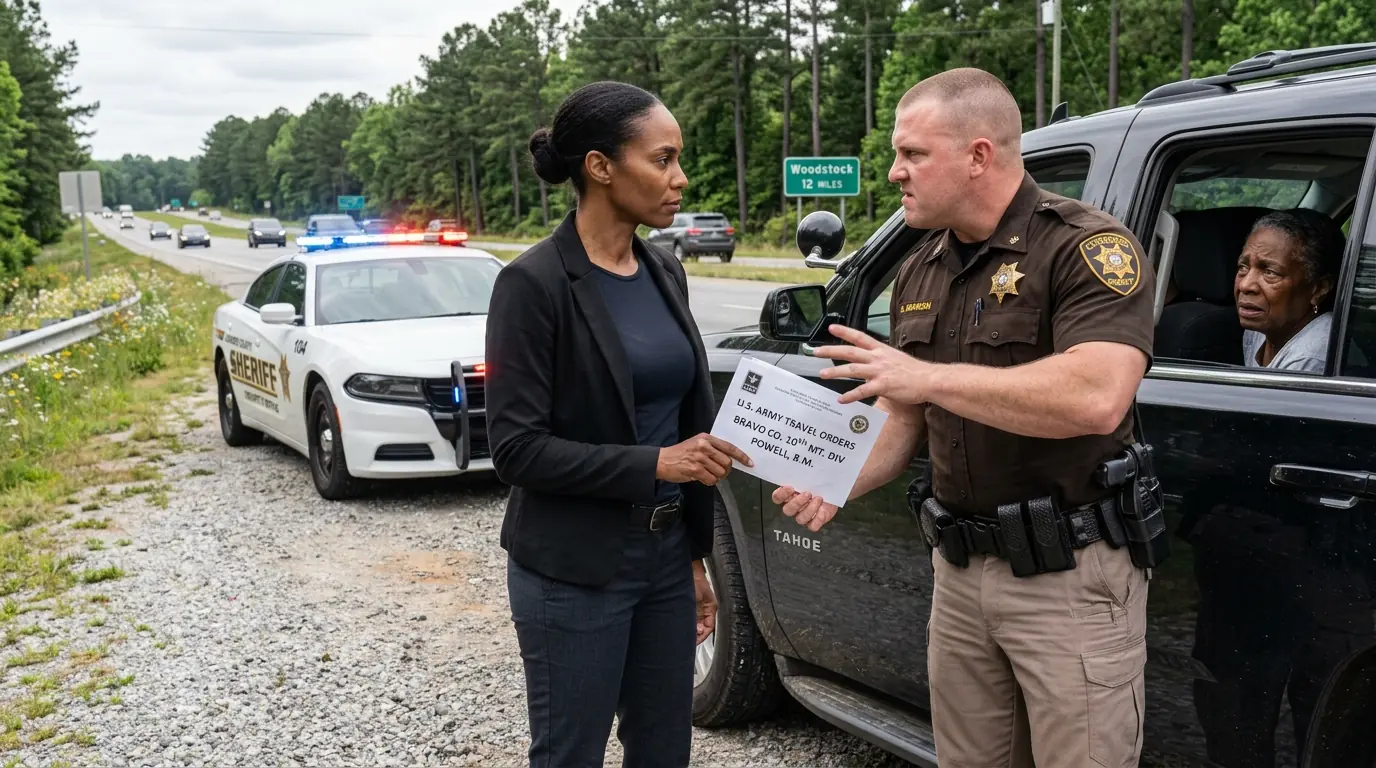
Deputy Derek Swanson looked at the document for less than ten seconds before deciding it was fake.
That was the part Lieutenant Colonel Briana Powell would remember later.
Not the flashing lights.
Not the handcuffs.
Not even her seventy-one-year-old mother crying quietly in the passenger seat.
Ten seconds.
That was apparently all the time Swanson needed to dismiss twenty-two years of military service printed on official United States Army letterhead.
Briana stood beside the rented black Chevrolet Tahoe on a rural Georgia shoulder, her hands visible, her breathing slow, her face controlled.
Swanson held the travel orders between both hands.
The paper had been folded once across the center.
Her name appeared near the top.
POWELL, BRIANA M.
Below it:
LIEUTENANT COLONEL, UNITED STATES ARMY
Duty location.
Reporting instructions.
Official authorization.
Contact numbers.
A command authentication block.
None of it seemed to matter.
Swanson looked at Briana.
Then at the photograph on her military identification card.
Then back at her face.
“You expect me to believe this?”
Briana’s expression did not change.
“It isn’t something you need to believe, Deputy. You can verify it.”
Swanson smiled.
Not pleasantly.
“You people always have an explanation.”
From inside the Tahoe, Denise Powell inhaled sharply.
Briana heard.
Her mother had already been told twice not to speak.
Briana kept her eyes on Swanson.
“What exactly are you accusing me of?”
“Right now?”
He flicked the edge of the paper.
“Possession of suspicious government documents. Possible false identification. Possible vehicle irregularities.”
“The rental agreement is valid.”
“We’ll see.”
“You have the company number.”
“I said we’ll see.”
Briana nodded toward the orders.
“There’s also a duty number printed at the bottom. Call it.”
Swanson’s smile disappeared.
“You don’t tell me how to conduct my stop.”
“I’m giving you a way to verify what I’ve told you.”
“You’ve been doing a lot of telling since I walked up.”
Briana stared at him.
The road behind them stretched between pine trees and flat winter fields. A pickup truck approached, slowed as the driver saw the cruiser, then continued.
No houses.
No businesses.
No crowd.
Just Briana.
Her mother.
And a deputy who seemed increasingly offended by the possibility that she might be exactly who she said she was.
Swanson looked at the document again.
“Lieutenant colonel.”
“Yes.”
He laughed softly.
“Sure.”
Briana said nothing.
“Where’s your uniform?”
“In the garment bag behind my seat.”
“You’re traveling in civilian clothes.”
“Yes.”
“Convenient.”
“It’s authorized.”
“By who?”
Briana pointed to the paper in his hands.
“The officer whose signature is on the orders.”
Swanson glanced at the signature block.
Brigadier General Samuel Mercer.
Swanson read the name aloud.
“Samuel Mercer.”
“Yes.”
“And he knows you?”
Briana almost answered sarcastically.
She stopped herself.
“He is in my chain of command.”
Swanson looked toward Denise.
Then back at Briana.
Something uglier appeared in his expression.
“You know what I think?”
Briana waited.
“I think you got somebody’s paperwork.”
Denise could not stay quiet.
“My daughter has been in the Army since she was nineteen.”
Swanson snapped his head toward the passenger window.
“I told you to stay out of this.”
Denise flinched.
Briana’s voice changed.
“Deputy.”
He looked back at her.
“You will not speak to my mother that way.”
For the first time, a trace of command entered Briana’s voice.
Not loud.
Not aggressive.
Precise.
Swanson heard it.
And hated it.
“You don’t give orders here.”
“I didn’t give you one.”
“You just did.”
“I told you how you will not address a seventy-one-year-old woman who has done nothing wrong.”
Swanson stepped closer.
“Turn around.”
Briana did not move.
“For what?”
“I’m detaining you.”
“Based on what articulable offense?”
That question hardened everything.
Swanson reached for his cuffs.
“You want to play lawyer?”
“No.”
Briana looked toward the body camera on his chest.
“I want you to state why you are detaining me.”
He grabbed her left wrist.
Denise cried out.
“Briana!”
Briana’s body reacted instantly.
Twenty-two years of training understood leverage before conscious thought arrived.
Angle.
Balance.
Grip.
Distance.
Swanson’s stance was poor.
His elbow high.
Weight too far forward.
Briana could have broken the control in less time than it took Denise to say her name.
She did nothing.
That was discipline.
Swanson pulled her arm behind her.
“You think because you memorized some military language you’re smarter than everybody?”
Briana remained still.
“Do not resist.”
“I’m not.”
He tightened the cuff.
Then reached for the papers again.
Briana turned her head enough to see him.
“Preserve those.”
“What?”
“The orders.”
He looked at them.
“They’re evidence.”
“They’re my official travel documents.”
“Not anymore.”
And then, directly in front of his body camera, Deputy Derek Swanson tore them in half.
Once.
Then again.
Four pieces.
Denise began crying.
Briana stared at the fragments in his hand.
For the first time, genuine disbelief crossed her face.
Swanson seemed to enjoy it.
“What?”
Briana’s voice became very quiet.
“You just destroyed my orders.”
“I destroyed what appears to be a fake document.”
“You have no basis for that conclusion.”
“We’ll let investigators determine that.”
He shoved the torn pieces onto the hood of his cruiser.
Then he looked at the Common Access Card he had removed from Briana’s wallet.
Her military ID.
Her photograph.
Her name.
Her service affiliation.
Her grade.
He looked at it for several seconds.
Then back at her.
Briana saw the moment something inside him chose not to accept what the card said.
Not because the card was unclear.
Because accepting it would mean everything he had done so far had been wrong.
And Derek Swanson had spent fourteen years learning how to defend a bad decision more quickly than he could reconsider one.
“What unit?” he demanded.
Briana answered.
He frowned.
“Never heard of it.”
“That doesn’t make it imaginary.”
His eyes narrowed.
“Watch yourself.”
She looked at the body camera again.
“You should probably do the same.”
Three hours earlier, the morning had smelled like bacon and coffee.
Denise Powell’s small house sat near the edge of Colleton County, Georgia, on a street where the porches were older than some of the families living behind them.
White paint peeled from the railing.
Marigolds lined the walkway.
A wooden rocking chair creaked whenever wind passed beneath the porch roof.
Briana had arrived the previous evening just before dark.
She drove a rented Tahoe because her own vehicle remained near Fort Moore, where she had spent most of the week in meetings she could not discuss with her mother.
Denise asked anyway.
“Where are they sending you?”
“Can’t say.”
“Is it dangerous?”
“Probably not.”
“That means yes.”
“It means probably not.”
Denise stared at her.
“You have been giving that answer since Afghanistan.”
Briana kissed her forehead.
“And it still works.”
It did not.
But Denise allowed the lie because motherhood sometimes required accepting that adult children had responsibilities they could not explain.
Briana Powell was forty-three.
Lieutenant colonel.
Twenty-two years in the United States Army.
She had entered through ROTC, stayed after her first planned commitment, and eventually built a career in military intelligence and operational planning.
She did not command thousands.
She was not some secret assassin.
She had no magical authority over civilian police.
Her rank mattered inside the military chain of command.
Outside it, she remained subject to the same laws as everyone else.
Briana understood that better than most.
That was why she carried documentation.
Her trip that morning was routine in one sense and sensitive in another.
She had been directed to report to a secure installation outside Augusta for a senior planning conference. Some material she would receive there was classified.
The travel itself was not a secret mission.
Her destination was simply something she did not discuss casually.
The written orders were administrative authorization.
Useful if military police, base security, travel offices, or other officials needed confirmation.
They were not a magic exemption from traffic laws.
They did not order local deputies to salute her.
They simply established who she was and why she was traveling.
Briana had stopped at Denise’s home because her mother needed a ride to her sister Lorraine’s house in Dalton.
It added time.
Briana had planned for it.
Her report time was 1400.
She would make it comfortably.
At 6:10 that morning, Denise was already cooking.
“You don’t eat enough.”
Briana entered the kitchen.
“I eat.”
“You drink coffee and call it breakfast.”
“That is breakfast.”
“That is a beverage.”
“Mama.”
“Sit.”
Lieutenant Colonel Powell sat.
There were places where hundreds of soldiers waited for her decisions.
This kitchen was not one of them.
Denise put eggs, bacon, toast, and grits on the table.
Briana looked at the plate.
“You feeding a platoon?”
“You’re too skinny.”
“I am forty-three.”
“And?”
Briana smiled.
Nothing changed.
Her father had died when she was twenty-six.
Denise had retired from teaching several years later.
She still ironed church clothes on Saturday evenings.
Still kept hard candy in a bowl near the television.
Still called Briana if weather reports mentioned storms anywhere in Georgia.
On the mantel stood a photograph of Briana in dress uniform.
Denise dusted it weekly.
Briana had discovered that because once she moved the photograph half an inch and found it restored to precisely the old position when she returned.
“You still polish this thing?”
Denise looked from the kitchen.
“I dust my house.”
“You dust around everything else.”
“That photograph has your father’s fingerprints on the frame.”
Briana stopped.
She looked at it differently.
“I didn’t know.”
“He put it there.”
“When?”
“Your promotion to major.”
Denise carried coffee into the room.
“He said he wanted anybody who walked through that door to know what his daughter had done.”
Briana smiled.
“That sounds like Dad.”
“He was unbearable.”
Briana’s phone vibrated.
The warmth left her posture immediately.
She answered.
“Powell.”
A voice from the other end spoke.
“Yes, sir.”
She listened.
“Understood.”
Another pause.
“I’ll be there by fourteen hundred.”
She ended the call.
Denise watched her.
“Military voice.”
“What?”
“You sound like a different person.”
“Occupational hazard.”
“Who was it?”
“General Mercer’s office.”
“Everything okay?”
“Yes.”
Denise looked skeptical.
Briana kissed her forehead.
“Everything’s fine.”
Before leaving, Briana opened the black leather briefcase she carried.
Travel orders.
CAC.
Unclassified administrative materials.
Notebook.
A sealed packet she was not authorized to open until arrival.
She checked everything.
Then closed the latches.
Her dress uniform hung behind the driver’s seat because the afternoon briefing would be followed by a formal dinner.
Denise came outside wearing a lavender blouse and carrying a handbag large enough to support a weekend evacuation.
Briana looked at it.
“You’re visiting Aunt Lorraine for one night.”
“I have things.”
“You have supplies.”
“Drive.”
Twenty-five minutes later, Briana noticed the sheriff’s cruiser.
It sat partially concealed beside a stand of pine trees near mile marker twelve.
She checked the speedometer.
Fifty-three.
Speed limit fifty-five.
Seat belts on.
Rental agreement valid.
Nothing to think about.
Then the cruiser pulled out.
Denise saw it.
“Oh.”
Briana glanced over.
“What?”
“I don’t like police behind me.”
“Mama.”
“I’m serious.”
“We’re fine.”
Denise looked at the side mirror.
“Police out here are different.”
“Different how?”
“You know how.”
Briana did.
She also disliked conversations that turned every officer into a stereotype before an interaction occurred.
“Let’s not decide anything before it happens.”
Denise looked at her daughter.
“You always this reasonable?”
“No.”
“Good.”
The cruiser followed for almost a mile.
Then the lights came on.
Briana signaled.
Pulled onto a wide gravel shoulder.
Turned off the engine.
Placed her hands on the steering wheel.
Denise’s body stiffened.
Briana noticed.
“Stay calm.”
“I am calm.”
“You’re gripping the handbag.”
“It cost forty dollars. I protect investments.”
Briana almost smiled.
Then Deputy Swanson reached the window.
No introduction.
No explanation for the stop.
“License and registration. Where you headed?”
Briana answered carefully.
“Good morning, Deputy. My license is in the center console. I’m going to reach for it.”
He gave no response.
She retrieved it.
Then the rental agreement.
Swanson stared at the paperwork.
“This vehicle isn’t registered to you.”
“It’s a rental.”
“I can see that.”
“Then what’s the issue?”
He looked up.
“Did I say there was an issue?”
Briana paused.
“No.”
“Then stop trying to create one.”
Denise looked at her daughter.
Briana knew the game had changed.
She kept her voice calm.
“May I ask why you stopped me?”
Swanson looked toward the Tahoe’s rear.
“Vehicle made a lane deviation.”
Briana replayed the previous mile in her head.
She had moved slightly away from a pothole.
Never crossed the center line.
Possibly touched the fog line.
Maybe.
“Understood.”
Swanson studied the rental paperwork.
Then her license.
“Rental agreement doesn’t look right.”
“It came from the rental desk yesterday.”
“I said it doesn’t look right.”
Briana stopped answering.
Her mother tried to help.
“We’re just going to my sister’s house.”
Swanson snapped at her.
That was the first moment Briana became truly concerned.
Not because he was rude.
Because he appeared to interpret every additional fact as interference.
She decided to provide the cleanest verification available.
“Deputy, I am currently traveling under official military orders. My military ID is in my wallet, and my travel orders are in the briefcase on the rear seat.”
Swanson looked at her.
“You military?”
“Yes.”
“What branch?”
“Army.”
He looked her over.
Civilian jacket.
Dark trousers.
No uniform.
“What do you do?”
“I’m a lieutenant colonel.”
That was when he laughed.
Not loudly.
Just once.
“Right.”
Briana looked at him.
He requested the documents.
She gave them.
And the encounter began sliding toward a place none of them expected.
Now, standing handcuffed beside the Tahoe twenty minutes later, Briana watched Swanson make a radio call.
“Dispatch, Eleven-Six. I need another unit for possible false government credentials.”
Briana closed her eyes briefly.
Denise whispered through the passenger window.
“Baby.”
“I’m okay.”
“You’re in handcuffs.”
“I know.”
“I don’t like this.”
“I know, Mama.”
Swanson returned.
“Don’t talk through the vehicle.”
Briana looked at him.
“That’s my mother.”
“I know who she is.”
“No.”
Briana’s voice became almost gentle.
“You know who she says she is.”
Swanson stared.
He understood the point.
Did not appreciate it.
A second cruiser arrived seven minutes later.
Deputy Michael Torres stepped out.
Mid-thirties.
Latino.
More cautious in the way he approached.
“What’ve we got?”
Swanson handed him the CAC.
“Possible fake military identification.”
Torres looked at the card.
Then Briana.
Then the torn orders on the hood.
His face changed.
“You verified this?”
“Working on it.”
Torres looked closer.
“This looks real.”
“That’s why fakes work.”
Briana spoke.
“There’s a verification number on the orders.”
Swanson snapped.
“You stay quiet.”
Torres looked toward her.
“Ma’am, your name?”
“Lieutenant Colonel Briana Powell.”
Swanson laughed.
Torres did not.
“Unit?”
She told him.
“Fort Moore?”
“Yes.”
Torres looked back at Swanson.
“Why don’t we call the duty officer?”
Swanson’s jaw tightened.
“You think I don’t know how to do my job?”
“I think this is easy to verify.”
“Then verify it.”
Torres walked back to his cruiser.
That was the first decision that saved the department from making the situation even worse.
Swanson remained beside Briana.
“You know impersonating military personnel is serious.”
“Yes.”
“So you understand why you’re detained.”
“No.”
His eyes narrowed.
“No?”
“You have not articulated what made the documents suspicious beyond your disbelief.”
“They don’t add up.”
“What doesn’t add up?”
“You.”
Briana went still.
Denise heard it.
So did Swanson’s body camera.
Briana looked directly at him.
“Explain.”
He realized too late what he had said.
“I mean the circumstances.”
“What circumstances?”
“Woman in a rental car. Civilian clothes. Sensitive orders.”
“You said me.”
“I meant everything.”
“Then say exactly what about me does not add up.”
Swanson looked away.
The radio saved him.
Torres called.
“Swanson.”
“What?”
“I’ve got a number for Fort Moore duty operations. They’re asking for her DOD ID number.”
Briana nodded.
“Give it.”
Swanson turned.
“We are not sending numbers from possibly fake credentials to some number she gave us.”
Torres looked at him.
“I got the number independently.”
“How?”
“Dispatch directory.”
Silence.
“Call it,” Swanson finally said.
Torres did.
At Fort Moore, Staff Sergeant Camille Foster answered the duty line.
Torres explained.
Foster asked for Briana’s full name.
Then identification number.
Then went quiet.
“Deputy, hold.”
Three minutes passed.
Torres stood beside his cruiser.
Swanson began pacing.
Briana watched.
Then Foster returned.
“Deputy Torres?”
“Yes.”
“Lieutenant Colonel Briana Michelle Powell is active-duty United States Army.”
Torres looked toward Swanson.
Foster continued.
“She is assigned to the unit she gave you.”
Torres’s expression tightened.
“Can you verify she is traveling under orders today?”
A pause.
“I can confirm she has authorized official travel. I cannot discuss her destination over an unsecured line.”
“Understood.”
Another voice came onto the call.
Male.
Older.
“Deputy, this is Colonel Aaron Webb, installation operations officer. Is Lieutenant Colonel Powell detained?”
Torres looked toward Briana.
“Yes, sir.”
“Why?”
Torres glanced at Swanson.
“Possible document concerns.”
“What concern?”
Torres did not know how to answer.
Swanson walked over and took the phone.
“This is Deputy Derek Swanson. We have a woman carrying documents that raised concerns.”
The colonel’s voice remained calm.
“Your other deputy just provided information matching an active-duty lieutenant colonel.”
“We’re continuing our investigation.”
“Have you contacted military law enforcement?”
“No.”
“Do you have evidence the credential is fraudulent?”
“We have inconsistencies.”
“What inconsistencies?”
Swanson’s face hardened.
“I’m not discussing an active investigation with someone on a phone.”
Colonel Webb paused.
“Then contact your supervisor and the nearest military police liaison. Lieutenant Colonel Powell is expected at an official engagement this afternoon. Her delayed arrival has already been noted.”
Swanson ended the call.
Torres stared at him.
“Why did you hang up?”
“Because I’m not taking instructions from Fort Moore.”
“No one told you to.”
Briana watched the younger deputy carefully.
Torres was becoming uncomfortable.
Not with her.
With Swanson.
“Mike,” Swanson said quietly, “back me up here.”
Torres glanced toward the handcuffs.
“What are we backing up?”
That question changed everything.
Swanson stared.
Torres continued.
“She has a valid Georgia license.”
“Yes.”
“Rental agreement.”
“Questionable.”
“Rental company confirmed it.”
Briana’s head turned.
“When?”
“While I was calling Fort Moore.”
Swanson looked at him.
“You called them too?”
“Yes.”
The rental had been confirmed.
The military identity had been confirmed.
The official travel had been confirmed.
Facts were arriving.
And Swanson’s suspicion was somehow becoming stronger.
Torres looked at Briana.
“Why is she still cuffed?”
Swanson’s voice hardened.
“Because I haven’t completed the stop.”
“For what offense?”
“Don’t do this.”
“Do what?”
“Undermine me in front of a detainee.”
Briana saw Torres’s expression change.
There it was.
The real conflict.
Not evidence.
Hierarchy.
Torres stepped away and keyed his radio.
“Dispatch, request patrol supervisor to my location.”
Swanson stared.
“I didn’t request a supervisor.”
“I did.”
“You’re making a mistake.”
Torres looked toward the torn papers.
“I think one already got made.”
Sergeant Frank Dwyer arrived fifteen minutes later.
Gray mustache.
Twenty-six years with the sheriff’s office.
Swanson met him halfway.
They spoke quietly.
Briana could not hear everything.
She caught fragments.
“Fake orders.”
“Attitude.”
“Possibly sensitive materials.”
“Army confirmed…”
Then Dwyer approached.
“Ma’am, I’m Sergeant Dwyer.”
“Lieutenant Colonel Briana Powell.”
“Yes, ma’am.”
Swanson looked irritated at the ma’am.
Dwyer noticed the handcuffs.
“Any weapons?”
“My licensed personal handgun is locked in a case in the rear cargo compartment. I disclosed that when Deputy Swanson asked.”
Dwyer looked sharply at Swanson.
“She disclosed?”
“Yes.”
“Did you secure it?”
“No.”
“Why not?”
“She hasn’t attempted to access it.”
Dwyer frowned.
Then he looked at the torn papers.
“What happened there?”
Swanson answered.
“Suspected fraudulent documents.”
“You tore evidence?”
“I prevented her from using it.”
Dwyer stared at him.
Briana watched that sentence sink in.
“What was she going to use paper for?”
Swanson said nothing.
Dwyer turned toward Torres.
“You verified her military status?”
“Yes.”
“Official travel?”
“Confirmed.”
“Rental?”
“Confirmed.”
Dwyer looked toward Briana.
Then Swanson.
“Take the cuffs off.”
Swanson’s face reddened.
“Sergeant—”
“Now.”
Swanson hesitated.
Torres stepped forward.
“I’ll do it.”
He unlocked Briana.
She rubbed her wrists.
Denise immediately opened the passenger door.
Briana held one hand up.
“Stay seated, Mama.”
Denise ignored her and climbed out.
She wrapped both arms around her daughter.
Briana closed her eyes.
For the first time that morning, she allowed herself to look tired.
Denise whispered:
“He tore your papers.”
“I know.”
“You need those.”
“I can get copies.”
“That isn’t the point.”
Briana looked at her mother.
No.
It wasn’t.
Sergeant Dwyer requested Briana’s statement.
She declined to give a detailed one roadside.
“I will provide everything through your formal complaint process.”
Swanson scoffed.
“There it is.”
Dwyer turned.
“What?”
“She’s going to use her rank.”
Briana looked at him.
“No.”
He laughed.
“You expect me to believe that?”
“I expect your body camera to do most of the work.”
Swanson’s smile disappeared.
Briana continued.
“I will not contact your sheriff and demand punishment.”
“You won’t?”
“No.”
“I’ll provide a statement.”
“I’ll preserve the torn orders.”
“I’ll provide verification from the Army.”
“And your department can decide whether the stop matched your policy.”
Swanson stared at her.
“That’s it?”
Briana’s voice became cold.
“No.”
“I’m also going to ask why the only fact you refused to verify immediately was the one that contradicted what you already believed.”
Dwyer looked down.
Torres remained silent.
Then three dark vehicles appeared over the rise.
Not police cruisers.
Government SUVs.
Swanson watched them approach.
The first carried government plates.
The second did too.
The third was an Army staff vehicle.
Dwyer frowned.
“What now?”
Briana knew.
She checked the time.
Her report delay had passed forty-five minutes.
The installation had been unable to reach her government phone because it remained inside the Tahoe.
Colonel Webb had escalated after hearing she had been detained and after Torres reported torn orders.
The convoy stopped behind the cruisers.
Two military police personnel exited first.
Then a tall Black man in civilian business clothes stepped from the rear vehicle.
Sixty, perhaps.
Silver at his temples.
Straight-backed.
No uniform.
But Briana recognized him immediately.
Brigadier General Samuel Mercer.
Her commander.
Swanson looked at him.
“Who are you?”
Mercer held up credentials.
“Brigadier General Samuel Mercer. United States Army.”
Dwyer straightened instinctively.
Not a salute.
Just recognition.
Mercer looked past everyone.
“Colonel Powell.”
Briana stepped forward.
“Sir.”
“You all right?”
“Yes, sir.”
“Your mother?”
“Shaken. Uninjured.”
Mercer looked toward Denise.
“Mrs. Powell.”
Denise blinked.
“You know me?”
“Your daughter talks about you.”
Briana looked horrified.
“Sir.”
Mercer almost smiled.
Then he saw the torn orders on the cruiser hood.
His expression changed.
“Those mine?”
Briana nodded.
“You signed them.”
Mercer picked up one fragment.
His own signature was visible across the bottom half.
Swanson stepped forward.
“General, we had reason to believe the documents might be fraudulent.”
Mercer looked at him.
“What reason?”
“We had concerns.”
“About what?”
“The circumstances.”
Mercer waited.
Swanson shifted.
“She was in civilian clothes.”
“So am I.”
Silence.
“She was driving a rental.”
“So do thousands of service members.”
“She claimed a high rank.”
Mercer looked toward Briana.
Then back at Swanson.
“She didn’t claim it.”
He held up the CAC.
“She has it.”
Swanson’s jaw tightened.
“With respect, General, rank in the Army doesn’t give her authority over civilian law enforcement.”
Briana spoke before Mercer could.
“He’s correct.”
Everyone looked at her.
Briana continued.
“My rank does not place me above Georgia law.”
Mercer nodded.
“Exactly.”
That seemed to confuse Swanson.
Mercer stepped closer.
“But neither does your badge place you above verification.”
No one spoke.
Swanson gestured toward Briana.
“She was confrontational.”
Torres looked away.
Mercer noticed.
“What did she do?”
“She questioned the stop.”
“Is that unlawful here?”
“No, but—”
“Did she threaten you?”
“No.”
“Attempt to leave?”
“No.”
“Provide false identification?”
“That was under investigation.”
“Which your colleague verified.”
Swanson’s face reddened.
Mercer looked toward Sergeant Dwyer.
“Is she under arrest?”
“No, sir.”
“Detained?”
“No.”
“Then we need to leave. Colonel Powell is already late.”
Dwyer nodded.
“Of course.”
Then one of the younger deputies who had arrived with Dwyer whispered something to another officer.
Swanson heard.
“So now everybody bows because she’s some colonel?”
Mercer turned.
“What did you say?”
Swanson stiffened.
“Nothing.”
“No.”
Mercer’s voice remained calm.
“Say it.”
Swanson looked toward Briana.
“I said everybody’s acting differently because she’s a lieutenant colonel.”
Mercer considered that.
Then surprised everyone.
“You’re right.”
Briana looked at him.
Swanson seemed almost relieved.
Mercer continued.
“You shouldn’t.”
The relief vanished.
“She outranks every soldier standing with me except me.”
He gestured toward the military personnel.
“She has spent more than two decades serving this country.”
Then his eyes moved to the deputies.
“But none of that is why your behavior should be reviewed.”
He pointed toward Denise.
“If she had been a nurse driving her mother to a doctor, the law would be the same.”
“If she had been unemployed, the law would be the same.”
“If that military identification had never existed, you would still need facts.”
Mercer looked toward the body camera.
“You do not need to fear Colonel Powell because of her rank.”
A pause.
“You need to explain what you did before you knew it.”
No one answered.
That was the sentence that made the roadside go quiet.
Not she outranks you.
Not military authority.
Accountability.
Briana collected the torn pieces of her orders.
Swanson tried to object.
“Those are part of my investigation.”
Sergeant Dwyer stopped him.
“No.”
Dwyer placed each piece into a clear evidence sleeve.
“We’ll photograph them and return them to Colonel Powell with a receipt. If this becomes an administrative matter, preservation cuts both ways.”
Briana nodded.
“Thank you.”
Torres approached before she left.
“Colonel.”
“Yes?”
“I’m sorry.”
Briana looked at him.
“For what?”
“I should’ve challenged this sooner.”
“You did eventually.”
“That isn’t the same.”
No.
It wasn’t.
Briana looked toward Swanson.
Then back at Torres.
“Remember that.”
Torres nodded.
She helped Denise into the government SUV.
Her mother stared at General Mercer.
“You really her boss?”
Mercer smiled.
“Some days.”
Denise looked at Briana.
“She listen to you?”
“Rarely.”
Briana stared out the window.
“Sir.”
Denise laughed for the first time in nearly an hour.
They dropped her at Lorraine’s house with an Army driver.
Denise hugged Briana so tightly the general tactfully looked away.
“Call me.”
“I will.”
“Tonight.”
“Yes.”
“Not tomorrow.”
“Yes, Mama.”
“And don’t tell me classified.”
Briana smiled.
“I love you.”
“I love you too.”
At the installation, Briana received replacement orders.
She attended the briefing fifty-eight minutes late.
No one treated the delay as her failure.
She did not discuss the roadside stop during the meeting.
Work came first.
That evening, she sat alone in temporary quarters and finally watched the photograph she had taken of the torn orders.
Her hands began shaking.
Not during the stop.
Not while cuffed.
Now.
When there was nothing to command.
Her phone rang.
Denise.
Briana answered.
“You okay?”
“Yes.”
“You lying?”
“Yes.”
Denise was silent.
Then:
“Good. At least we’re honest.”
Briana laughed weakly.
Her mother said, “I hated seeing those cuffs on you.”
“I know.”
“You looked so calm.”
“I wasn’t.”
“You fooled me.”
“That’s the job.”
“No.”
Denise’s voice softened.
“That’s survival.”
Briana closed her eyes.
The investigation began Monday.
Because Briana was military and the incident involved potential civil-rights issues, several agencies communicated, but no black convoy of federal agents descended on Colleton County.
No one arrested Swanson at home.
No general fired a deputy.
That was not how accountability worked.
The sheriff’s office opened an internal investigation.
Georgia state authorities reviewed whether any criminal offense was implicated.
Army legal counsel preserved copies of Briana’s travel records and confirmation logs.
The rental company supplied verification timestamps.
Body cameras were downloaded.
Dispatch audio preserved.
Everything slowed into paperwork.
That was exactly what Derek Swanson had not expected.
People who misuse authority often imagine consequences as dramatic confrontations.
They are usually more dangerous when they arrive as timestamps.
The first problem appeared at 9:14 a.m.
Swanson’s written report claimed the Tahoe “crossed the center lane on multiple occasions.”
Dash camera showed no center-line crossing.
There was one moment when Briana’s right tires approached the fog line while avoiding broken pavement.
His speed allegation?
None.
Radar had never been activated.
The report described Briana as “immediately argumentative.”
Body camera showed her first words:
“Good morning, Deputy.”
Then:
“My license is in the center console. I’m going to reach for it now.”
Then calm answers.
The report stated Denise “repeatedly interfered.”
Video showed the seventy-one-year-old woman speaking twice before Swanson ordered her quiet.
Then came the document.
Investigators froze the frame as Swanson inspected the CAC.
The card was valid.
Its features visible.
He never contacted military authorities himself.
Torres did.
Swanson tore the orders after Briana specifically offered a verification number.
Investigators asked why.
Swanson answered:
“I believed she might use the paperwork to perpetuate a false identity.”
“Use it where?”
He did not have a clear answer.
“Did you believe the paper itself posed a safety threat?”
“No.”
“Was she attempting to conceal or destroy it?”
“No.”
“Then why destroy it instead of preserving it as evidence?”
Swanson paused.
“I was frustrated.”
That sentence changed the investigation.
Not because frustration automatically meant misconduct.
Because his actions suddenly had a motive unrelated to evidence preservation.
Then investigators reached the sentence recorded by his body camera.
You.
Briana had asked what did not add up.
Swanson answered:
You.
“What did you mean?”
“Her demeanor.”
“What about it?”
“She was too rehearsed.”
“She told you where she was reaching before moving.”
“Yes.”
“Is that suspicious?”
“Can be.”
“She provided documentation.”
“Yes.”
“Suspicious?”
“Potentially.”
“She answered questions.”
“Yes.”
“Suspicious?”
“She knew legal language.”
“Suspicious?”
Swanson became angry.
“You weren’t there.”
The investigator nodded.
“No.”
Then replayed the video.
“That’s why we have this.”
The review expanded.
Swanson had fourteen years of traffic contacts.
Nobody reviewed every stop manually.
Analysts sampled them.
Then searched complaints.
Seven formal complaints in eight years.
Most minor.
Three involved Black drivers alleging prolonged detention after providing valid documentation.
One involved a Nigerian-American physician driving a luxury SUV whose ownership Swanson questioned for twenty-three minutes.
Another involved a Black contractor towing equipment.
Swanson repeatedly asked whether the trailer was stolen even after registration matched the driver’s company.
A third involved a Latino college student in his father’s Mercedes.
No arrest.
No citation.
Twenty-eight-minute detention.
Each complaint had previously been treated as isolated.
Together, they looked different.
Investigators then compared randomly selected stops.
A pattern emerged.
Drivers from outside Colleton County received more scrutiny from Swanson.
Black drivers received longer average questioning during equipment and vehicle-ownership inquiries.
Not every Black driver.
Not every stop.
No dramatic evidence that Swanson had consciously decided to target all Black motorists.
Something subtler.
He appeared more likely to treat ownership as suspicious when the driver did not match his mental picture of who should possess the vehicle.
The same error he made with Briana.
Briana gave her interview in civilian clothes.
The investigator asked why.
“Because I’m here as Briana Powell.”
“Not Lieutenant Colonel Powell?”
“That rank explains my orders.”
“It does not change what happened before he knew it.”
She described the stop.
No exaggeration.
When asked about Swanson tearing the orders, she paused.
“That was when I realized this wasn’t about verification anymore.”
“What was it about?”
“Being right.”
The investigator waited.
Briana continued.
“He had decided I was lying.”
“Every fact after that became something he had to explain away.”
“Rental agreement was suspicious.”
“Military ID was suspicious.”
“Orders were suspicious.”
“My willingness to verify was suspicious.”
She looked at the investigator.
“At some point, an investigation has to allow innocence to remain one of the possible outcomes.”
That line appeared in the final report.
Torres gave his statement too.
“Why did you call a supervisor?”
“Because the stop no longer made sense.”
“When did you realize?”
“Fort Moore confirmed her.”
“Not before?”
Torres looked ashamed.
“Before.”
“Explain.”
“The CAC looked right.”
“The rental had already checked out.”
“She was calm.”
“Swanson had no clear offense.”
“Why not intervene immediately?”
Torres looked down.
“Fourteen years versus six.”
“What?”
“He had fourteen years on. I had six.”
“Does seniority determine lawfulness?”
“No.”
“Then why?”
Torres took a breath.
“Because challenging another deputy in front of a detainee feels like betrayal.”
The investigator waited.
Torres added:
“I know how that sounds.”
“How does it sound?”
“Like I was more worried about loyalty to him than duty to her.”
That honesty mattered.
Deputy Torres was not fired.
He received formal counseling for delayed intervention and later helped revise the department’s duty-to-intervene training.
Sergeant Dwyer received no discipline.
The review concluded he acted appropriately once called, though investigators noted supervisors should be requested earlier when document authenticity becomes central to a prolonged detention.
Swanson’s case was different.
The sheriff placed him on administrative leave.
The police union defended him.
His attorney argued the stop began lawfully due a lane concern and evolved through reasonable uncertainty about identity.
The first part could be debated.
The later part could not.
Once the rental company verified the vehicle and military channels confirmed Briana’s identity and travel status, continued detention had no clear foundation.
More importantly, the inaccurate report and destruction of potential evidence created integrity concerns.
A disciplinary board sustained:
Improper extension of detention.
Failure to reasonably investigate exculpatory evidence.
Unprofessional conduct.
Improper destruction of documents.
Inaccurate reporting.
Bias-based selective enforcement based on the broader pattern analysis.
Swanson appealed.
During the appeal, his attorney asked Briana:
“Colonel Powell, isn’t it true your commanding general arrived at the scene?”
“Yes.”
“And his presence intimidated Deputy Swanson?”
“You would have to ask Deputy Swanson.”
“General Mercer emphasized your rank.”
“He also said my rank was not the reason the conduct was wrong.”
“Nevertheless, you are a powerful military officer.”
Briana looked at the attorney.
“Inside my chain of command.”
“You outrank hundreds of soldiers.”
“Yes.”
“Does that not give you influence an ordinary citizen lacks?”
“Yes.”
The attorney seemed pleased.
Briana continued.
“That’s exactly why it should not decide this case.”
Silence.
She looked toward the panel.
“If your conclusion is that Deputy Swanson acted improperly because I turned out to be a lieutenant colonel, then you have learned nothing.”
The attorney shifted.
Briana continued.
“My mother is a retired teacher.”
“She had no rank.”
“She deserved courtesy.”
“If I had been a civilian engineer, same law.”
“If I cleaned hotel rooms, same law.”
“If I were unemployed, same law.”
She paused.
“The question isn’t whether Deputy Swanson picked the wrong Black woman.”
“The question is why he kept demanding more proof after every ordinary verification told him his suspicion was wrong.”
Swanson’s termination was upheld.
Not because General Mercer demanded it.
He never did.
Not because Briana was powerful.
Because video, records, dispatch logs, comparison data, and Swanson’s own report supported the findings.
The sheriff publicly addressed the case three months later.
He did not defend the department with the usual phrase about one bad apple.
Instead he said:
“Our responsibility is not merely to identify misconduct after a public incident. It is to recognize patterns earlier, particularly when individual complaints appear minor in isolation.”
The department changed several procedures.
Supervisors automatically reviewed roadside detentions exceeding a certain duration when no citation or arrest resulted.
Complaints involving disputed ownership of vehicles or property were centrally coded so patterns could be seen across years.
Officers received updated instruction on military credentials—not because service members were entitled to special treatment, but because officers needed to know how to verify them properly.
And duty-to-intervene training used Torres’s body-camera footage.
Torres volunteered for it.
He stood before recruits and played the moment he asked:
Why is she still cuffed?
Then stopped the video.
“This was too late,” he told them.
One recruit asked, “But you did intervene.”
“Eventually.”
“That helped.”
“Yes.”
Torres looked at the frozen image of Briana.
“But the standard cannot be whether you eventually become brave after someone else has already paid for your hesitation.”
Briana heard about the training months later.
She respected him for it.
General Mercer never mentioned the roadside incident publicly.
At Briana’s promotion ceremony the following year, Denise attended wearing a navy-blue dress and carrying enough tissues for an entire battalion.
Briana became a colonel.
Mercer pinned the insignia.
Afterward, Denise hugged him.
“You the one who went out to that road?”
“Yes, ma’am.”
“You told those police my daughter outranked everybody?”
Mercer laughed.
“That story has grown.”
“It’s on Facebook.”
“That explains it.”
Denise looked suspicious.
“So you didn’t?”
“I told them she outranked the soldiers with me.”
Denise frowned.
“That’s less dramatic.”
“Reality usually is.”
Briana approached.
“What are you two discussing?”
“Your mother is editing history.”
Denise waved him away.
“I’m improving it.”
Briana laughed.
Then Denise became serious.
“Thank you for coming.”
Mercer looked toward Briana.
“I came because one of my officers was overdue and the circumstances had become concerning.”
“That’s still coming.”
He nodded.
Denise looked at her daughter’s new colonel insignia.
“Your father would’ve talked about this until everybody stopped answering his calls.”
Briana smiled.
“I know.”
Years later, the roadside story followed Briana more than she liked.
Online versions changed details.
Some claimed Swanson had torn classified documents.
He had not.
Some claimed destroying the orders was automatically a federal felony.
It was not that simple.
Others claimed General Mercer ordered the deputy arrested on the spot.
He did not.
One popular version said Briana revealed she was a secret Delta Force commander.
She laughed so hard when Denise sent it that coffee came out her nose.
But the most persistent headline always said some variation of:
Racist Cop Picks Wrong Black Woman — She’s a High-Ranking Army Colonel
Briana disliked that most.
Years after retirement, she spoke at a leadership seminar where a college student asked about the stop.
“Was it satisfying when your commander showed up?”
Briana thought about it.
“No.”
The student seemed surprised.
“Not even a little?”
“It was reassuring.”
“What’s the difference?”
Briana looked toward the audience.
“If satisfaction comes from watching somebody suddenly respect you because they discover you have power, then you’re still accepting their idea that respect belongs to powerful people.”
The room went quiet.
She continued.
“I didn’t need Deputy Swanson to admire my military career.”
“I needed him to let facts change his conclusion.”
Another student asked:
“Do you think he was racist?”
Briana paused.
“The disciplinary investigation found evidence of biased selective enforcement.”
“That isn’t exactly what I asked.”
“I know.”
She smiled slightly.
“You’re asking whether I know what lived inside another man’s heart.”
The student nodded.
“No.”
Briana shook her head.
“I know what he did.”
“I know the patterns.”
“I know his choices.”
“I know the evidence.”
“That’s enough for accountability.”
She looked toward the front row.
“Sometimes people spend so much time trying to prove whether someone is secretly hateful that they forget conduct can be evaluated without mind reading.”
After the event, an older Black woman approached.
She introduced herself as Lorraine Davis.
Retired nurse.
Seventy-three.
“I saw your story when it happened.”
Briana smiled.
“I’m sorry.”
Lorraine laughed.
“Your mother sounds like mine.”
“That is probably dangerous.”
Lorraine became serious.
“You know what I remember?”
“What?”
“Your mama sitting in that passenger seat.”
Briana stopped.
Most people remembered the torn orders.
The general.
The rank.
Lorraine remembered Denise.
“She looked scared.”
“She was.”
Lorraine nodded.
“My mother used to look like that when police got behind us.”
Briana swallowed.
“Yes.”
“She didn’t care what rank you were.”
“No.”
“She just saw her baby in cuffs.”
Briana looked away.
For the first time in years, the roadside returned vividly.
Pine trees.
Gravel.
Her mother’s hands folded in her lap.
The torn paper.
“Mom?”
“Yeah.”
That single frightened word.
Lorraine squeezed Briana’s hand.
“That’s the story.”
Briana nodded.
Maybe it was.
Denise lived to ninety.
In her final years, she moved into Briana’s home.
Colonel Powell had retired by then.
No more official travel.
No uniforms except ceremonies.
No classified briefings.
Briana cooked badly.
Denise complained professionally.
One Sunday morning they found the old garment bag while cleaning a closet.
Denise pulled out Briana’s lieutenant colonel uniform.
“Look at you.”
“Mama, you’ve seen it a thousand times.”
“Still skinny.”
Briana laughed.
Inside one pocket was a folded plastic evidence sleeve.
She had forgotten it.
The torn travel orders.
Four pieces.
Preserved all those years.
Denise touched the sleeve.
“You kept them.”
“Apparently.”
“Why?”
Briana sat on the edge of the bed.
“I don’t know.”
Denise looked at her.
“You know.”
Briana smiled.
“Yes.”
“What?”
Briana took the sleeve.
“Because everybody thinks this paper proved who I was.”
Denise waited.
“It didn’t.”
“No.”
“My CAC didn’t either.”
“No.”
“General Mercer showing up didn’t.”
Denise smiled.
“I knew who you were before all of them.”
Briana laughed.
“That’s because you made me.”
“Exactly.”
Denise sat beside her.
“Throw it away.”
Briana looked at the torn orders.
“Really?”
“You don’t need it.”
Briana thought about the roadside.
Derek Swanson.
Michael Torres.
Sergeant Dwyer.
General Mercer.
The body cameras.
The hearings.
All the people online celebrating because an arrogant deputy had accidentally challenged someone powerful.
Then she thought about Denise.
A retired schoolteacher in the passenger seat.
No badge.
No rank.
No commander coming for her.
If Denise had been driving alone that morning, would Swanson have listened when she explained herself?
Briana would never know.
That uncertainty was precisely why the paper mattered less than people believed.
She removed the four pieces from the evidence sleeve.
Walked to the kitchen.
Dropped them into the recycling bin.
Denise nodded approvingly.
“Good.”
Briana smiled.
“Still giving orders.”
“Until I die.”
She almost did.
Years later, after Denise was gone, Briana would drive through Colleton County again.
Same route.
Different car.
The pine trees seemed smaller.
At mile marker twelve, she recognized the shoulder.
Nothing marked it.
No plaque.
No memorial.
Just gravel.
She pulled over.
Not because she was emotional.
At least that was what she told herself.
She stepped out.
Cars passed.
Nobody stopped.
Briana looked toward the place where the Tahoe had stood.
For years, people had told the story as though its climax came when General Mercer arrived.
The powerful commander stepping from a government vehicle.
The deputy realizing the Black woman he had dismissed was a lieutenant colonel.
The satisfying reversal.
But standing there alone, Briana understood the real turning point had happened earlier.
It happened when Torres asked Swanson to verify.
When the rental company said the contract was valid.
When Fort Moore confirmed her identity.
When every new fact offered Swanson a door out of his mistake.
And he chose not to take it.
That was the danger.
Not being wrong.
Everyone was wrong sometimes.
The danger was needing the other person to remain guilty because admitting they were innocent would mean admitting your first instinct had failed.
Briana looked down the empty road.
Then smiled slightly.
Her mother had worried about this road.
In the end, Denise had been right about one thing.
The uniform in the garment bag had not protected her daughter.
Neither had the rank.
Neither had the orders.
What protected Briana eventually was evidence.
A deputy willing to make a verification call.
A supervisor willing to reassess.
A commander who understood his own authority did not replace civilian law.
Body cameras that preserved what people later tried to describe differently.
And a process slow enough to distinguish anger from proof.
Briana returned to her car.
Before getting in, she looked once more toward the shoulder.
People still called her the wrong woman for Derek Swanson to stop.
She never accepted that.
There had been no right woman.
Not a colonel.
Not a teacher.
Not a cashier.
Not an immigrant.
Not someone driving a fifteen-year-old sedan instead of a rented Tahoe.
No person should have needed an impressive title before ordinary documents became believable.
Swanson’s greatest mistake was not tearing the orders of a lieutenant colonel.
It was deciding the woman holding them could not possibly be telling the truth.
Everything that followed began there.
Long before General Mercer arrived.
Long before anybody said who outranked whom.
And long before a quiet roadside in Georgia became the place where one deputy finally discovered that authority did not mean never being wrong.
It meant knowing when the facts required you to stop being certain.