The first gray light of dawn touched the rusting skeletons of the old auto plants that ringed Eastwood. Lena Torres ran the same loop she had run every morning since transferring to the 12th Precinct three months ago. Black hoodie up, earbuds in, silver medallion bouncing against her sternum with each steady stride. The park was empty except for the occasional early-shift worker cutting across the grass. No one looked twice at a Black woman in a hoodie running at 5:40 a.m. Until today.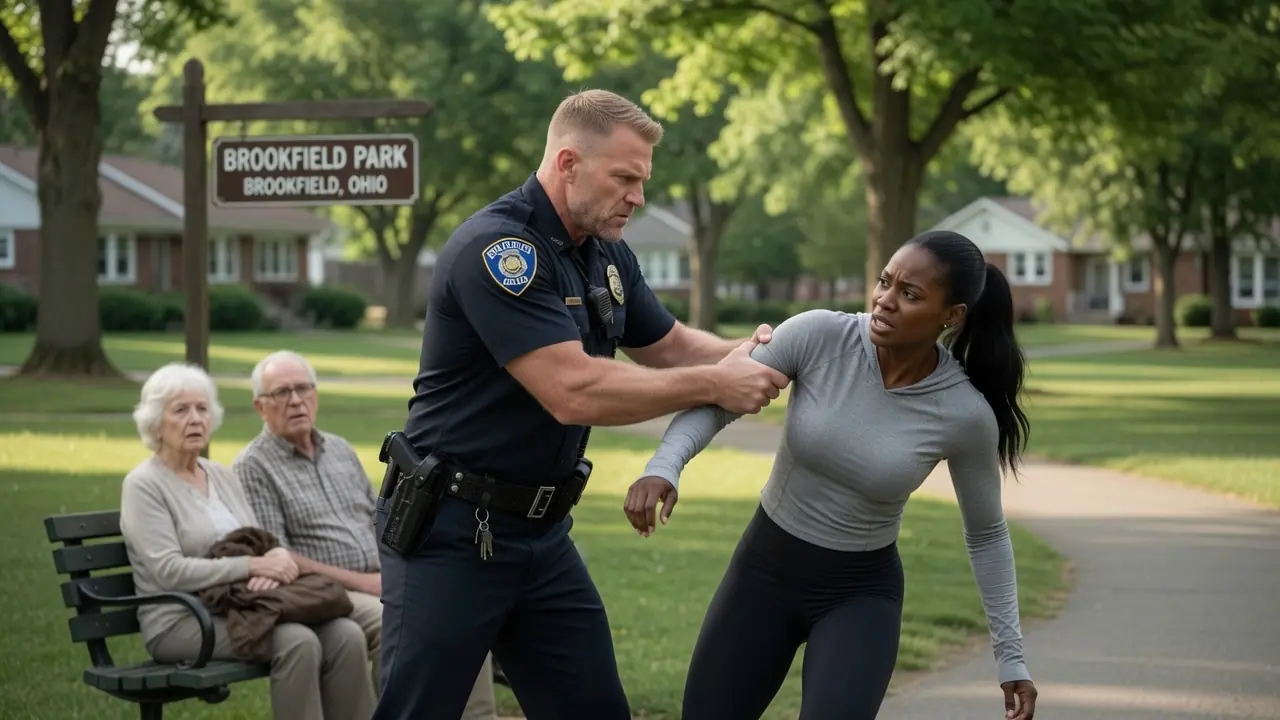
The patrol car had been sitting two blocks back for the last five minutes, engine idling, headlights off. Lena felt it before she saw it. A low, crawling sensation between her shoulder blades. She kept her pace even, breaths controlled, and reached the old stone fountain at the west edge of the park. She stopped, bent to retie her shoe, and pulled one earbud out.
The car door opened.
Officer Derek Harlan stepped out. Forty-five, white, fifteen years on the force, the kind of man who walked like the sidewalk belonged to him. He didn’t greet her. Didn’t ask if she was okay. He just closed the distance until he was less than six feet away and spoke like he was already writing the report in his head.
“You live around here?”
Lena straightened slowly. She kept her hands visible, palms open at her sides. “I run here every morning.”
“That wasn’t the question.”
She met his eyes. Calm. Unblinking. The same look she gave suspects who lied to her face in the interrogation room. Harlan didn’t like it. His jaw tightened.
“Hands where I can see them.”
“They are.”
He stepped closer. The smell of his aftershave mixed with the damp earth and the faint metallic tang of the fountain. “You got ID?”
“In my pocket.”
“Reach for it slow.”
Lena didn’t move. “You haven’t told me why you stopped me.”
“Because I said so.” His voice dropped. “Hoodie. No bag. Running in a neighborhood that’s had three robberies this month. Attitude. That’s enough.”
She felt the first cold needle of rain on her cheek. The sky had been clear when she left her apartment. Now low clouds were rolling in from the river.
She moved her right hand slowly. Harlan’s right hand went to his holster. She stopped.
“Both hands up. Now.”
Lena raised her hands to shoulder height, palms out. The rain started in earnest, fat drops darkening the concrete. Harlan closed the last two feet. He grabbed her left wrist, spun her, and slammed her chest against the warm hood of the cruiser. The impact knocked the air from her lungs. Before she could speak he had her other wrist and the cuffs were on, ratcheting tight enough to bite skin.
“You’re resisting,” he said, almost conversational.
“I’m not moving.”
He shoved her face harder into the metal. The rain ran down the hood in sheets now, mixing with the blood that had already begun to well where the cuff cut her left wrist. Lena didn’t cry out. She turned her head just enough to keep breathing and stayed silent.
Harlan’s radio crackled. He keyed it with his free hand. “Got a female, possible 10-55, resisting. Requesting backup.”
Lena felt the chain of the medallion snap as he twisted her arm higher. The silver disk and her detective’s badge both slipped from the torn pocket of her hoodie and clattered onto the wet hood beside her face. Blood from her wrist dripped onto the medallion, then onto the badge, red against silver and gold. Harlan froze for half a second when he saw the shield.
The radio in his hand went silent.
A kid on the second-floor balcony of the nearest apartment building had his phone up, recording. The red light blinked steadily through the rain.
Harlan leaned down until his mouth was near her ear. “You think that badge means something out here?”
Lena’s voice was quiet, almost lost under the rain. “It means you just cuffed a detective.”
He laughed once, short and ugly. “Nice try.”
A black SUV came around the corner fast, lights flashing but no siren. It stopped hard. Captain Marcus Reyes stepped out, rain already soaking his uniform shirt. He took in the scene in one sweep: the cuffs, the blood, the badge and medallion lying in the rain on the hood, the kid filming from above.
“Uncuff her,” Reyes said. His voice was flat. Deadly flat.
Harlan didn’t move. “Captain, she was—”
“Uncuff her right now, Harlan. That’s Detective Lena Torres. And you just put your hands on the daughter of the only man in this department who ever had the balls to stand up to people like you.”
The cuffs came off with a metallic click. Lena pushed herself upright. She didn’t rub her wrists. She didn’t look at Harlan. She bent, picked up the medallion and the badge, wiped the blood off both with her thumb, and slipped them into her pocket. The rain had already washed most of it away.
Reyes looked at the blood on her sleeve, then at Harlan. “Get in the car. Station. Now. Do not speak to anyone until I get there.”
Harlan stood frozen for three full seconds, rain plastering his hair to his forehead. Then he turned and walked to his cruiser like a man moving through deep water. The kid on the balcony kept filming until the patrol car pulled away.
Lena stood in the rain beside Reyes. She looked at the spot on the hood where the medallion and badge had lain. A faint red smear remained, already thinning under the downpour.
“You okay?” Reyes asked quietly.
She nodded once. “I need to change and get to the station. I have a meeting at seven.”
“Lena—”
“I’m fine, Captain.” She started jogging again, slower this time, back toward her apartment two blocks away. The rain swallowed her footsteps.
Behind her, the kid on the balcony lowered his phone. The video was already uploading.
By 6:30 a.m. the clip had been viewed 47,000 times. By 7:00 it was 312,000. By 8:00 the hashtag #BloodOnTheBadge was trending in three states. The image that spread fastest was not the slap or the cuffs. It was the moment the silver medallion and the gold badge lay side by side on the wet hood, blood mixing with rain between them, while Lena Torres stood perfectly still, eyes calm, as if she had been waiting her entire life for that exact second.
Lena watched the numbers climb on her phone while she changed into a clean shirt and blazer in her apartment. She didn’t post anything. She didn’t call a lawyer. She didn’t call the union. She slipped the medallion back around her neck, tucked the badge into its usual place on her belt, and drove to the 12th Precinct through streets already slick with rain.
The building was quieter than usual when she walked in. Officers who normally nodded or said good morning looked away. A few stared. She ignored all of them and went straight to the third-floor conference room where the morning briefing was supposed to happen.
Captain Reyes was already there with two other lieutenants and the internal affairs sergeant. A laptop on the table played the video on loop. Lena stood in the doorway for a moment, watching herself get slammed against the car for the tenth time that morning.
“Close the door,” Reyes said.
She did.
For the next forty minutes she answered questions in the same calm voice she used with victims. Yes, she had been running her usual route. No, she had not resisted. Yes, she had identified herself as soon as it was safe. No, she did not want to press charges at this time.
When they asked why, she looked at the paused frame on the laptop—the medallion and badge lying in blood and rain—and said only, “Because I have work to do.”
They let her go at 9:15. She walked down the hall to the small office she shared with two other detectives. Her desk was exactly as she had left it the night before: case files stacked on the left, a half-drunk cup of coffee gone cold, a single photograph of her father in uniform taped to the inside of the top drawer. She opened the drawer, looked at the photo for three seconds, then closed it again.
At 9:47 her phone buzzed with a text from an unknown number.
You should have stayed in your lane.
She didn’t reply. She opened the case file she had been building for four months—the one no one else in the precinct knew existed. Operation Iron Veil. Internal corruption. Kickbacks on seized property. At least two officers in the 12th running protection for a mid-level fentanyl crew that operated out of the old warehouse district. One of the names on her list was Derek Harlan. Not as a main player. As a useful idiot who looked the other way on the right nights and got paid in “found” cash that never made it to evidence.
Lena closed the file. She had been planning to bring it to Reyes quietly after she had one more piece of evidence—a wire recording she was supposed to pick up from a CI at 10:30 that morning. The incident in the park had just made everything infinitely more complicated.
At 10:05 Harlan walked into the squad room. His uniform was clean. His face was gray. He went straight to his desk, sat down, and stared at the wall. No one spoke to him. After five minutes he stood up and walked over to Lena’s desk.
“I didn’t know,” he said, voice low.
She didn’t look up from her computer. “You didn’t ask.”
“I thought you were—”
“You thought I was what, Harlan? A threat? A suspect? A Black woman who didn’t smile fast enough?”
He opened his mouth, closed it. The squad room had gone completely silent. Everyone was pretending to work while listening.
Lena finally looked at him. “You broke my father’s medallion chain. The one he gave me the week before he died. You’re going to fix it.”
Harlan blinked. “What?”
“After shift. You’re going to take it to the jeweler on 4th Street and get the chain repaired. Then you’re going to bring it back to me. And while you’re doing that, you’re going to think about every single time you’ve done the same thing to someone who didn’t have a badge in their pocket.”
He stared at her for a long moment. Then he nodded once, turned, and walked out of the squad room. The door clicked shut behind him.
Lena went back to her screen. The cursor blinked on an empty report. She typed three words, deleted them, and typed them again.
She had a choice to make.
By noon the video had been picked up by two national outlets. The local paper ran the headline “Detective Assaulted by Fellow Officer in Eastwood Park.” The photo they used was the still of the medallion and badge in the rain. Someone had already made T-shirts.
Lena ignored all of it. She met her CI in a diner two blocks from the precinct, got the wire recording, and listened to it in her car with the rain drumming on the roof. Harlan’s name came up twice. Once as the officer who had “lost” a stack of cash during a raid six weeks earlier. Once as the man who had told a uniform to “forget” a witness statement that would have tied the fentanyl crew to a shooting the month before.
She drove back to the precinct, parked in the underground garage, and sat in the car for ten minutes with the engine off. The medallion rested against her collarbone, the repaired chain cool against her skin. Harlan had dropped it off at her desk at 11:40 without a word. The jeweler had done clean work. You could barely see where it had been broken.
At 1:15 p.m. she walked into Reyes’s office and closed the door.
“I want Harlan,” she said.
Reyes looked up from a stack of reports. “You want to file a complaint?”
“I want him assigned to me. Full access. Every case I’m working. Starting today.”
“Lena, that’s not how this works.”
“He put cuffs on me in front of half the neighborhood and a camera. The only way this doesn’t turn into a circus is if I control the narrative. And the only way I control the narrative is if he’s right next to me where I can watch him.”
Reyes studied her for a long moment. “You’re playing a dangerous game.”
“I’ve been playing it since I was sixteen,” she said. “This is just the first time the other side knows my name.”
He sighed, rubbed his face, and nodded. “I’ll have the paperwork done by end of shift. But Lena—if this blows up, I can’t protect you.”
“I’m not asking you to.”
She left his office and went back to her desk. Harlan was still sitting at his own desk, staring at nothing. She walked over and dropped a fresh case file in front of him.
“Operation Iron Veil,” she said. “You’re my partner until I say otherwise. We start with the warehouse district tonight at 2200. Wear soft clothes. Bring a vest.”
He looked at the file, then at her. “You’re serious.”
“Dead serious. And Harlan?” She leaned down so only he could hear. “If you ever put your hands on another person the way you put them on me, I will make sure the only badge you ever touch again is the one they give you when you retire from mall security. Do we understand each other?”
He nodded slowly.
She straightened. “Good. See you at 9:45.”
The rest of the afternoon passed in a strange, suspended quiet. The rain never let up. It hammered the windows and turned the parking lot into a shallow lake. Lena worked through her emails, ignored three calls from reporters, and at 4:30 received a text from her younger brother Marcus in Detroit.
Saw the video. You okay?
She typed back: I’m fine. Don’t do anything stupid.
He replied with a single thumbs-up emoji. She stared at it for a while, then put the phone face-down.
At 5:50 she stood in the women’s locker room and looked at herself in the mirror. The bruise on her cheek from Harlan’s slap had started to darken. She touched it once, lightly, then buttoned her jacket over the medallion and walked out into the rain.
Harlan was waiting by her car in the garage, already in civilian clothes, vest under a dark hoodie. He didn’t speak. She didn’t either. They drove to the warehouse district in silence, the wipers beating a steady rhythm against the glass.
The CI had given her an address. An old textile mill on the edge of the river, half collapsed, used mostly for storage now. They parked two blocks away and approached on foot through the rain. Lena’s badge was in her pocket. Harlan’s was in his. Neither of them wore it visible.
At 10:17 they watched three men load long boxes into a white panel van. One of them was wearing a 12th Precinct windbreaker under his jacket. Lena took photos with a long lens. Harlan stayed quiet beside her, breathing through his mouth.
When the van pulled away, she turned to him. “You know that guy?”
He shook his head. “Never seen him.”
“You’re lying.”
Harlan’s jaw worked. Rain ran down his face. “I’ve seen the jacket. Not the face.”
Lena studied him for three seconds, then nodded. “That’s a start.”
They followed the van at a distance. It led them to a storage facility on the south side of the city. Lena called in the plates to a contact in the state police. While they waited, she and Harlan sat in the car with the engine off, rain drumming on the roof.
After twenty minutes of silence, Harlan spoke.
“Your father,” he said. “What happened to him?”
Lena kept her eyes on the storage units. “He was a sergeant in the 9th. He testified against two officers who were shaking down drug dealers in 2014. Three weeks later he was found in his patrol car with a single gunshot to the head. They called it suicide. The gun was his service weapon. The only prints were his.”
Harlan was quiet for a long time. “I remember the case. I was still in uniform then.”
“You remember who worked the scene?”
He didn’t answer.
Lena turned to look at him. “You do. Because one of them was your training officer. And the other one was the man who signed your first evaluation.”
Harlan’s hands tightened on the steering wheel. “I didn’t know they—”
“You didn’t want to know,” Lena said. “That’s the same thing.”
The state police contact texted back. The van was registered to a shell company that traced to the same fentanyl crew. Lena saved the message, then started the car.
“We’re done for tonight,” she said. “Drop me at the precinct. I’ll take the bus home.”
Harlan drove without speaking. When they reached the garage he put the car in park but didn’t turn off the engine.
“I can help you,” he said finally. “With the case. I know people. I know which doors to knock on without getting shot.”
Lena looked at him for a long moment. The bruise on her cheek had darkened to a deep purple. The medallion rested against her skin under her shirt.
“You’re not helping me because you want to be a good person, Harlan. You’re helping me because you’re scared. And that’s fine. Fear is useful. Just don’t mistake it for redemption.”
She got out of the car and walked away without looking back.
The next three weeks moved like a slow fever. Lena and Harlan worked the Iron Veil case in the open now—Reyes had signed off on it after Lena showed him the wire recording. They interviewed witnesses together. They executed a search warrant on a stash house at 3 a.m. and came out with two kilos and a ledger that had Harlan’s name in it three times. Each time they came back to the precinct, the room went quiet. Lena ignored it. Harlan kept his head down and did the work.
At night she went home to her apartment, showered, and sat on the edge of her bed with the medallion in her hand. She thought about her father’s face the last time she saw him alive—laughing at something stupid on TV, medallion catching the light from the kitchen. She thought about the moment it had fallen onto the hood of the cruiser in the rain. She thought about the choice she had made not to go public with everything she knew.
On the twenty-second day, the choice tried to make itself for her.
They were in the old textile mill again, this time with a warrant and a tactical team. The raid went clean until the last room on the second floor. A man in a 12th Precinct jacket came out of a side door with a gun raised. Harlan moved first. He tackled the man low, drove him into the wall, and the gun went off once into the ceiling. Plaster rained down. Lena cuffed the suspect while Harlan stood over them, breathing hard.
When they got back to the precinct, Internal Affairs was waiting. The man in the jacket was Harlan’s nephew—his sister’s kid. The same kid who had been arrested twice for possession and once for assault. The same kid whose name had appeared in one of the early Iron Veil tips as a low-level runner.
Harlan sat in the interrogation room for six hours. Lena watched through the glass. He didn’t ask for a lawyer. He didn’t deny anything. He just answered every question in a flat, exhausted voice.
When they finally let him out, Lena was waiting in the hallway.
“You knew,” she said.
He nodded once. “I knew he was running for them. I didn’t know he was this deep.”
“You covered for him.”
“I thought I could get him out. I thought if I kept him close enough to the job, he’d see what it cost and walk away.”
Lena studied his face. The lines around his eyes had deepened in three weeks. “And my father?”
Harlan looked at the floor. “I didn’t pull the trigger. But I knew who did. And I kept my mouth shut because the man who gave the order was the same man who signed my first evaluation. I was twenty-three. I wanted to keep my job.”
The hallway was empty. Rain tapped against the high windows.
Lena reached into her pocket and pulled out the repaired medallion. She held it out to him.
“Fix what you broke,” she said. “Not the chain. The rest of it.”
Harlan took the medallion. His hand shook slightly. “How?”
“Testify. Everything. Names, dates, the night my father died. In exchange I keep your nephew out of the worst of it. He still does time, but he doesn’t disappear into the system the way they made my father disappear.”
Harlan closed his fist around the medallion. “You’d do that?”
“I’m not doing it for you,” Lena said. “I’m doing it because if I burn everything down, the only people left standing will be the ones who already have lawyers on retainer. I want the ones who still think they can get away with it to watch their own people turn on them. And I want you to live long enough to see it.”
She turned and walked away. Harlan stood in the hallway holding the medallion until his hand stopped shaking.
The hearing lasted four days. Harlan testified for eleven hours across three sessions. He named names. He produced old notebooks. He led them to a storage unit where a backup hard drive from 2014 still sat in a box labeled “Evidence – Destroy.” On it was bodycam footage from the night Lena’s father died—footage that had never made it into the official file. The two officers who had been with him that night were clearly visible. One of them was still on the force. He was arrested in the courthouse parking lot before the hearing ended.
Lena sat in the back row every day. She didn’t testify. She didn’t speak to reporters. She wore the medallion under her shirt and kept her badge on her belt where everyone could see it.
On the last day, after the final witness, she walked out of the courthouse into a bright, cold afternoon. The rain had finally stopped. Harlan was standing on the steps, hands in his pockets, looking older than he had three weeks earlier.
“It’s done,” he said.
“No,” Lena answered. “It’s started.”
He nodded. “What happens to me now?”
“You go home. You think about every person you ever put in cuffs the way you put me in cuffs. Then you come back to work tomorrow and do it differently. Or you don’t come back. That part’s up to you.”
She started down the steps. Harlan called after her.
“Torres.”
She stopped but didn’t turn.
“Your father,” he said. “He would have been proud of you.”
Lena looked up at the sky. It was the same color as the hood of the cruiser had been that morning in the rain. She touched the medallion through her shirt.
“He already knew,” she said. “I just had to catch up.”
She kept walking. The afternoon sun caught the edge of her badge and threw a small, bright reflection across the wet pavement. It lasted only a second before she turned the corner and disappeared into the stream of people heading home.
Behind her, Derek Harlan stood on the courthouse steps for a long time, the repaired silver medallion still in his pocket, the weight of it heavier than any badge he had ever worn.
In the weeks that followed, the 12th Precinct changed in small, invisible ways. Officers who used to joke about “attitude adjustments” stopped telling those jokes. A new training module appeared on de-escalation that everyone had to complete, even the veterans. The old evidence room was audited for the first time in eight years. Three more names from Harlan’s testimony were quietly removed from the roster.
Lena kept working Iron Veil. The case grew. It reached a captain in another precinct and two city council members before it was done. She never gave another interview about the morning in the park. When people asked, she said the same thing every time: “I was running. It started to rain. I went to work.”
On a clear morning in late October she ran her usual route again. No hoodie this time—just a long-sleeve shirt and the medallion against her skin. She reached the stone fountain, stopped, and retied her shoe even though it didn’t need it. She looked at the spot on the concrete where the cruiser had been. The rain had washed everything away months ago. There was no mark left.
She touched the medallion once, then started running again. Her stride was steady. Her breathing even. The city moved around her—sirens in the distance, traffic building, people heading to jobs and schools and court dates. Lena Torres ran through all of it, badge on her belt, medallion against her heart, the weight of both exactly where they belonged.
She didn’t look back.
The sun rose higher over the old factories. The day began like any other day in Eastwood. But somewhere in the quiet between one footfall and the next, something small and permanent had shifted. Not because a video went viral. Not because a badge fell in the rain. But because one woman had decided that the only way to break the cycle was to stay inside it long enough to change the shape of the wheel.
She kept running. The city kept waking up. And for the first time in a long time, the silence between the sirens felt like it might finally hold something other than fear.