The sound of my own gasp was swallowed by his roar. When my son-in-law, Mark, shoved me, it was with the impersonal disgust of a man clearing an obstacle from his path. My hip, still tender from the pneumonia that had ravaged my body weeks earlier, buckled instantly. I collapsed onto the cold, unforgiving tile of his immaculate Boston kitchen.
A sharp pain shot up my leg, eclipsed only by the sudden bright agony in my shoulder as it struck the base of the gleaming stainless steel refrigerator. He yelled that I was a useless old woman, that I could not even be trusted to stir a simple risotto correctly, and that the texture was ruined. Through the doorway, in the soft light of the living room, I could see my daughter Clara. She sat frozen on the beige sofa, her gaze fixed on the television, her entire body rigid in a desperate, practiced performance of not hearing and not seeing.
What neither of them knew, what Mark in his petty rage and Clara in her terrified paralysis could not possibly imagine, was that the thin cream-colored envelope resting in my apron pocket had already changed the molecules in the room. It was a letter from a bank I had never heard of. It held a secret that would not just alter my destiny, but theirs. As I lay on that sterile floor, staring up at the man who despised me and the daughter who had abandoned me, a cold, quiet smile bloomed deep inside my chest.
The game, I realized, had just begun. My name is Eleanor Vance, and I am seventy years old. For the past two decades, ever since my husband Arthur passed suddenly from an aneurysm, I had lived a life of quiet sufficiency in our small, weathered farmhouse in the hills of Vermont. It was a life I had built with my own hands.
I tended the gardens Arthur had planted. I managed the modest finances he had left, and I prided myself on my independence. It was there I had raised Clara, our only child, instilling in her the values of strength and self-respect that I believed were our family’s bedrock. I thought I had taught her to be strong, but I was wrong.
Everything changed three months earlier with the pneumonia. It came on fast and brutal, leaving me hospitalized for two weeks and terrifyingly weak upon my release. The doctor was firm, stating that I could not be alone for at least two months. That was when Clara insisted I come stay with her and Mark in Boston.
Her voice on the phone had been frantic with concern, a daughter’s love pulling me toward the city. “It will just be temporary, Mom. Just until you get your strength back,” she had pleaded. “And you know how much Mark loves your cooking. You can help out a bit. We miss you.”
I had hesitated. A deep instinctive tremor warned me against it. My relationship with Mark, a fast-talking real estate broker with eyes that never seemed to settle, had always been polite but distant. He was a man who valued shiny surfaces, and I was all worn wood and faded flannel.
Still, the thought of being an invalid alone in the Vermont winter was a more immediate fear. This was my daughter, my Clara, asking for me. I packed two suitcases and left the home I had not slept a night away from in twenty years. Their apartment was on the twelfth floor of a glass tower overlooking the harbor.
It was a sterile expanse of white walls, gray furniture, and cold marble countertops. It felt less like a home and more like a showroom, a place where no object was ever out of place. As I would soon learn, that included me. The guest room was small, but I was grateful.
But as my strength returned, the dynamic shifted. It began subtly. Mark would note with a tight smile that the dishwasher had not been emptied. He would ask if I could perhaps wipe down the counters since I was already in the kitchen.
Soon, those polite requests vanished, replaced by a silent, crushing weight of expectation. My physical therapy exercises, meant to rebuild strength in my lungs and legs, became an inconvenience slotted between his laundry, the vacuuming, and the preparation of their elaborate nightly meals. I had not come to Boston as a mother recovering from illness. I had come as unpaid staff.
I tried to speak to Clara one evening, finding her alone in the living room as she scrolled through her phone. “This isn’t what we agreed upon,” I said softly, my hands aching from scrubbing the grout in their glass shower. “I feel like I’ve become Mark’s housekeeper.” Clara did not look up.
Her thumb froze on the screen. That familiar, painful shadow crossed her face, the same look she had worn as a teenager when she knew she was wrong but refused to admit it. “Mom, you know how Mark is,” she murmured. “He’s just very particular. He’s under a lot of stress at work. Please don’t make things difficult. It’s just for a few more weeks.”
A few more weeks became two months. My recovery was complete, but any mention of returning to Vermont was met with Clara’s panicked evasions or Mark’s cold logic. “Why rush back? The winter is brutal there. You’re helpful here.”
His version of helpful was servitude. Nothing I did was ever right. The coffee was too weak, the floors were not clean enough, and the shirts I ironed had creases that were, in his words, an embarrassment. Clara, my bright, strong-willed daughter, simply evaporated.
She became a ghost in her own home, her eyes perpetually averted, her laughter thin and brittle. She had erected a fortress of silence around herself, and I was left outside to face her husband’s escalating tyranny alone. That brought me to that afternoon. I was making saffron risotto, a dish Arthur and I had perfected together.
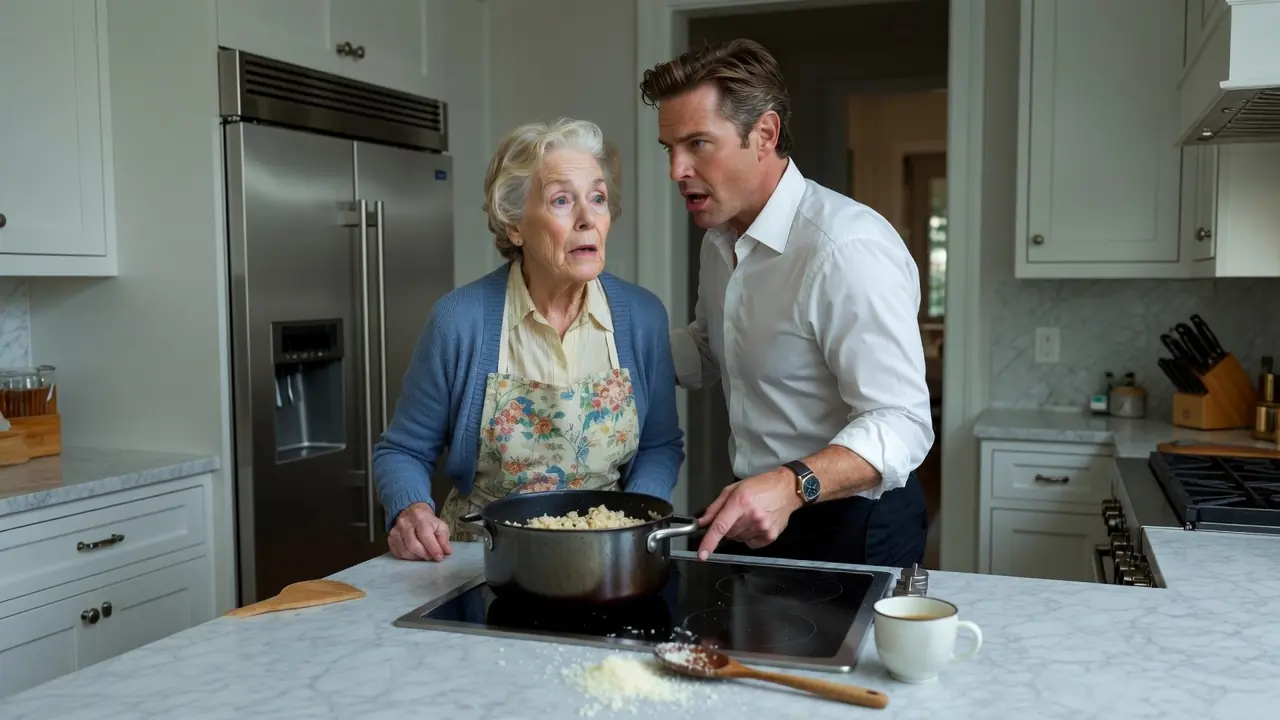
I was stirring the arborio rice, letting it absorb the chicken broth slowly, when Mark entered the kitchen. He had been in his home office all day, the muffled sounds of his angry phone calls forming a tense soundtrack to my chores. He looked into the pot, and his face contorted in a mask of theatrical disgust. “What is that?”
“It’s risotto,” I replied, my voice tighter than I intended. “For dinner.” He sneered, dipped a spoon in, and tasted it. “That’s not risotto. It’s mush. The color is completely wrong. You’ve ruined it.”
I took a deep breath, the smell of saffron and parmesan filling my lungs. “Mark, I have been making this dish since before you were born. It is perfectly fine.” His reaction was terrifyingly swift. The politeness he wore like a cheap suit vanished, revealing the raw, ugly rage beneath.
His face flushed a deep mottled red. “You’re wrong. Useless. You don’t know how to do anything right, you old, incompetent woman. It’s all wrong.” He grabbed my arm, his fingers digging into the thin skin above my elbow, and yanked me away from the stove.
The shove was a continuation of that yank. I lost my balance, my legs still not as steady as I liked, and I went down. Clara’s voice from the doorway was thin, a ready whisper of protest. “Mark, what happened?”
“She fell,” he snapped, not even looking at her. He was already stirring the risotto himself, adding more broth with violent splashes. “You know how clumsy she is.” Lying on the floor, the pain in my shoulder radiating down to my fingertips, I looked at my daughter.
Our eyes met for a fraction of a second. I saw her terror, her shame, and her choice. She looked away, turning her gaze to the floor, her body trembling, and she said nothing. Absolutely nothing.
The physical pain became a dull throb, a distant signal. The true wound was in my soul. It was the profound, searing agony of abandonment. The daughter I had nursed through fevers, whose heartbreaks I had mended, whose college education I had funded by selling my mother’s jewelry after Arthur died, had just watched her husband assault me and chosen silence.
Slowly, using the refrigerator handle, I pulled myself up. I did not stagger. I would not give him the satisfaction. I walked out of the kitchen, passed my daughter, who still refused to look at me, and went to my room.
I locked the door. I sat on the edge of the small, uncomfortable bed, the entire room seeming to pulse with my heartbeat. That was when I saw it. The envelope had arrived in the morning mail, addressed to me, Mrs. Eleanor Vance.
The return address was Consolidated Trust Bank, a name I did not recognize. I had slipped it into my apron, thinking it was sophisticated junk mail. With hands that trembled from rage, not weakness, I tore it open. It was a thick, formal letter from a man named Mr. Harrison, a senior trust officer.
He wrote that he was the executor of a private trust established by my late husband, Arthur. He had been trying to locate me for some time and had finally found my whereabouts through a property tax forwarding address. The letter continued in dry legal language, slowly painting an impossible picture. Arthur, my quiet, unassuming husband, a man I believed had left behind only the farmhouse and a modest pension, had been a secret and brilliant investor.
He had built a portfolio primarily in technology stocks in the early 1990s, a portfolio that had been quietly compounding for over two decades in a blind trust. A second, smaller envelope was tucked inside. It was a handwritten letter from Arthur. “My dearest Eleanor,” it began, his familiar, elegant script blurring through my sudden tears.
“If you are reading this, it means I am long gone, and you have found yourself in a position of need. I kept this from you, not out of mistrust, but out of love. I knew your strength. I knew you would build your own life on your own terms, and I never wanted this money to be a crutch. I wanted it to be a shield. If you are reading this, it means you need a shield. Use it, my love. Use it to be safe.”
I turned back to the bank’s letter, my eyes scanning for the number, my breath caught in my throat. The trust’s current value was just over eight point two million dollars. Then came a final paragraph. The trust was managed through a holding company, Beacon Hill Properties, which held several real estate assets.
This included, the letter noted, the title deed for a condominium at his wife’s current address of residence: Unit 12B. I read the sentence three times. This apartment, this cold white prison where I was treated like a servant, the floor I had just been thrown onto, was mine. Arthur had bought it, perhaps as an investment, perhaps as a future home for Clara, and I now owned it.
They were tenants. My tenants. I sat there with the letters in my lap, and the pain in my shoulder faded. The humiliation evaporated.
In its place, a cold, diamond-hard clarity settled over me. I thought of Mark’s sneer, of Clara’s averted eyes, of the endless thankless chores, the casual cruelty, and the crushing disrespect. I wiped a single tear from my cheek. Then I stood, walked to the small mirror, and looked at myself.
The woman staring back was not a victim. She was a landlord, and she was about to deliver an eviction notice. The next morning, I woke before sunrise. My shoulder was a constellation of purple and blue, a painful but useful reminder.
I moved with deliberate quiet, dressing in my best and only decent wool suit. I applied a touch of lipstick I had not used in months. When I entered the kitchen, Mark was already there, tapping angrily at his laptop at the island. He grunted when he saw me but did not look up.
I prepared his coffee exactly as he liked it, black with one sweetener, and placed it beside him. I made toast. I was the perfect invisible servant. Clara emerged, her eyes puffy, dark circles beneath them.
She flinched when she saw me, her gaze darting to my face, perhaps looking for a bruise, then quickly away. “Mom, are you okay this morning?” she asked in a guilty whisper. “I am perfectly fine, dear,” I replied, my voice smooth as glass. I poured her coffee.
“I have some errands to run today, so I won’t be here to make dinner.” Mark’s head snapped up. “Errands? What errands?” “Just some personal matters to attend to,” I said, gathering my purse.
“I’m sure you two can manage for one evening.” Before either of them could protest, I was out the door. I did not take a taxi. I used a car service app on my phone and summoned a black sedan.
I directed it to Consolidated Trust Bank. The lobby was all marble and hushed reverence. I was escorted immediately to the top floor and into the office of Mr. Harrison. He was an older gentleman, kind-eyed but all business.
“Mrs. Vance,” he said, shaking my hand warmly. “We are so very glad to have finally made contact. Your husband was a remarkable man. He left very specific instructions.” For the next two hours, he walked me through the portfolio.
It was vast, and I was the sole beneficiary. I signed signature cards. I was given a new checkbook, a debit card, and a platinum credit card. We then discussed Beacon Hill Properties.
He confirmed that the holding company, which I now controlled, owned four properties in Boston. The largest was Unit 12B, currently leased well below market value to Clara and Mark Jennings. I asked if there was a property manager. He said a firm called Boston Realty Management handled the leasing and maintenance.
“Mr. Harrison,” I said, my voice steady, “I would like you to arrange a meeting for me with them this afternoon. And I need you to do one more thing. I need you to transfer all authority for that holding company to me personally, effective immediately.” By noon, I was not Eleanor Vance, the unwanted guest.
I was the president of Beacon Hill Properties. My next stop was not the apartment. It was the Copley Plaza Hotel. I booked a suite overlooking the square.
I told the concierge I had arrived without luggage and would need assistance. For the next three hours, I used the new credit card. I went to Saks and bought two new suits, silk blouses, cashmere sweaters, and a proper winter coat. I bought new shoes with a solid low heel.
I went to a high-end salon and had my hair cut and styled. The gray was shaped into an elegant, sharp bob. I looked in the mirror and saw the woman Arthur had married, the woman who had run a farm, raised a child, and faced the world head-on. She had been dormant, but now she was awake.
Back in my hotel suite, I ordered room service, a perfectly cooked steak. As I ate, I made the call. A man with a brusque voice answered, “Boston Realty Management.” I said I was calling about Unit 12B at the Harborview Tower.
“This is Eleanor Vance, the new owner of record for Beacon Hill Properties,” I said. There was a pause before he replied that they had received the notification from the bank. I asked him to draw up a new lease agreement for that unit, effective the first of the next month. I wanted it to reflect the full current market rate.
The man paused again. He said that would be nearly a three hundred percent increase, because the current tenants were on a legacy rate. I told him I was aware and that the new rate stood. I instructed him to have the notice delivered to them the following morning.
When he said it was highly irregular, I interrupted. “That is my decision. Send me a copy of the notice. And one more thing, what is your policy on late payments?” He told me there was a three-day grace period, then a five percent late fee, and eviction proceedings began on the fifteenth.
“Excellent,” I said. “Please enforce that policy to the letter.” I hung up and finished my wine. That night, I slept in a king-sized bed with thousand-thread-count sheets.
It was the first truly restful sleep I had had in months. The call from Clara came the next evening. She was hysterical, and I let it ring three times before answering. “Mom, where are you? We’ve been so worried.”
“I’m perfectly fine, Clara. I’m at a hotel.” She demanded to know with what money, then said I would not believe what had happened. The company that owned the apartment had sent a rent increase. It was thousands of dollars, impossible, and Mark was going insane.
He was in his office trying to find a lawyer. He said it was illegal. I asked if it was. It sounded to me like they were simply adjusting to the market rate.
Clara’s voice cracked. She said they could not afford it, that they would be ruined, and asked what they were going to do. “That does sound like a terrible problem,” I said, my voice cool and distant. “Perhaps you and Mark should look for a more affordable place to live.” She protested that it was their home.
I let the silence stretch. “Clara,” I said, my voice hardening just a fraction, “do you remember yesterday when your husband threw me to the floor? Do you remember how you sat there and watched? Coldness, my dear, is a lesson I learned in your kitchen.”
Then I excused myself, saying I had a dinner reservation. The next two weeks were a precise, calculated education. I did not return to the apartment. I moved from the hotel into a fully furnished, high-end rental in Beacon Hill.
I hired a sharp lawyer who specialized in tenant disputes and corporate law. On the first of the month, as expected, no rent was paid for Unit 12B. On the second, Boston Realty Management, at my direction, delivered a formal notice to pay or quit. Clara called me sobbing.
Mark had been furious. He had thrown his laptop against the wall, started drinking, and kept demanding to know where I was, what I was doing, and where I had gotten money. “He’s obsessed, Mom,” she whispered, clearly hiding in a closet. “He thinks you’re doing this. He thinks you somehow found a way to do this to us.”
“What a ridiculous notion,” I replied. “I’m just an old woman. How could I possibly have anything to do with your landlord?” Then she said Mark was demanding she get money from me, saying I must have some of Arthur’s old savings.
My heart seized. “Is he hurting you, Clara?” There was a long pause filled with a choked-back sob. “He grabbed my arm. He shook me, but he didn’t hit me. Not really.”
This was the moment. The abuse once directed at me had now turned, as it always does, to the person closest. I told Clara to listen carefully. I would send a car to her building, and it would be at the front entrance in ten minutes.
She was to pack a small bag with essentials: wallet, passport, any medication. She was to leave her phone, leave everything else, walk out the front door, and get in the car. She whispered that Mark would be home any minute. I told her she had better be fast.
I waited in the lobby of my new building. Ten minutes passed, then fifteen, then twenty. My stomach was a knot of ice. Had I misjudged? Had she chosen him again?
Then the black car pulled up. The door opened, and Clara stumbled out. She was pale, trembling, and carrying nothing but her purse. But she was there.
I met her at the door and pulled her inside, holding her as she collapsed against me. She cried with the dry, racking sobs of a person who had been holding her breath for years. “You’re safe,” I told her, stroking her hair. “You are finally safe.”
That night, I told her everything. I laid out the bank statements and showed her Arthur’s letter. I told her about the holding company and the ownership of the apartment. She stared at me, her eyes wide with disbelief, horror, and dawning terrible understanding.
“The rent increase,” she whispered. “The notices. That was all you.” “Yes,” I said.
“He pushed me,” I continued, my voice quiet but unyielding, “and you let him. I needed you to see, Clara. I needed you to see what happens when the money is threatened and the control is lost. I needed you to see the real man you married.”
Then I added that I also needed to see whether my daughter was still in there, the one I had raised. Clara’s face crumbled. She told me Mark had said I was clumsy, that she was overreacting, that she was lucky to have him, and that no one else would want her. I took her hand and told her she was many things, but she was not weak.
She was Arthur Vance’s daughter, and she was my daughter. She had only forgotten. The final act came a week later. Mark had been served with a formal eviction summons and, of course, refused to leave.
He had changed the locks, barricading himself inside my apartment. My lawyer informed me that the final step was a physical eviction by a sheriff’s deputy. I told her to schedule it and that I would attend. Clara said she was coming with me.
We stood in the hallway of the twelfth floor, flanked by my lawyer, two sheriff’s deputies, and a locksmith. The deputy knocked with a hard official rap. “Mark Jennings. We have a court order to reclaim this property. Open the door.”
A muffled roar came from inside. Mark screamed for them to go away, insisting it was his home. The deputy nodded to the locksmith, who began drilling the lock. When the door swung open, it revealed a scene of utter chaos.
The apartment was a wreck. Trash was everywhere, empty liquor bottles littered the floor, and in the middle of it all stood Mark, unshaven and wearing a dirty bathrobe. His face was a mask of defiant rage. “Get out,” he screamed.
The deputy calmly told him the apartment was no longer his and that he needed to vacate the premises. Then Mark saw me standing behind the officers. His eyes narrowed to slits. “You. This is you. You did this, you old witch. You poisoned my wife.”
“His wife,” I replied, stepping forward so he could see me clearly. “Clara, would you like to say hello?” Clara stepped out from behind me. Her face was calm, and her hands were not shaking.
Mark’s jaw dropped. “Clara, baby, what are you doing with her? She’s crazy. She’s trying to ruin us. Come here.” Clara took one step forward, and I felt a moment of panic, but she stopped just outside the doorway.
“No, Mark,” she said. “I’m not coming here. I’m not going anywhere with you ever again.” He began calling her ungrateful, shouting about everything he had given her, this apartment and this life. That was when I cut through his tirade.
“This apartment, Mark, belongs to me. It has always belonged to my family. You were a guest, a tenant who assaulted his landlord. And now your lease is terminated.” The color drained from his face.
The deputy stepped forward and told him he could pack one bag, while the rest of his belongings would be itemized and stored. Mark looked from me to Clara and back again, the entire foundation of his world crumbling. He had no power. The money was gone, the wife was gone, and the apartment was gone.
Then he lunged, not at me, but at Clara. “You will regret this,” he roared. Before he could take two steps, the deputies had him, pinning his arms behind his back with practiced efficiency. As they led him away, handcuffed, he was still screaming.
We stood in the doorway of the ruined apartment. The stench of stale alcohol and defeat hung in the air. Clara looked at the mess, the physical manifestation of the life she had just escaped. “What do we do now?” she whispered.
I put my arm around her shoulder. “Now,” I said, turning her away from the wreckage, “we go home.” In the months that followed, Clara truly came back to life. It was a slow process, like a garden returning after a hard frost.
She started therapy to unpack the years of Mark’s insidious, corrosive abuse. She reenrolled in school, finishing the art history degree she had abandoned when she met him. We sold the Boston apartment after its surfaces were scrubbed and repainted, washing away the last physical traces of Mark. We did not return to Vermont.
We bought a beautiful, light-filled house in Cambridge, one with a garden in the back for me and an art studio for her. We used Arthur’s money, the shield he had left for us, to build a new life. But we both knew the lesson. The money had been the weapon, the tool, the key.
The strength to use it, and the strength to walk out that door, had come from us. We established the Arthur’s Shield Foundation, a fund dedicated to providing legal aid and emergency housing for women and elderly individuals trapped in abusive situations. Clara ran it. She had found her calling and her voice by helping others find theirs.
Sometimes in the evening, we sit in the garden, and I watch her. She is strong, confident, and whole. The fall on that cold kitchen floor felt like an ending, but it was not. It was a beginning.
It was the moment a seventy-year-old woman and her forty-five-year-old daughter finally learned to stand up. Dignity, I realized, is not something given. It is something taken back. And true strength is not about never falling.