The first time Daryl Johnson carried a lamp out of the house at 1846 Briar Glen Drive, Mrs. Evelyn Collins stepped off her porch like she had been waiting for him all morning.
He had the lamp tucked under one arm, a roll of painter's tape looped around his wrist, and a small cardboard box balanced against his hip. The neighborhood was quiet in the polished way expensive neighborhoods often were, with trimmed hedges, swept driveways, and little flags near mailboxes that looked decorative but also somehow like warnings. Daryl had been in the house for less than two hours, and already he could feel eyes on him. He was used to that. A Black man with tattoos along his neck and a small design near his cheekbone could not walk through certain rooms, certain stores, or certain streets without people deciding they had understood his whole life before he opened his mouth.
"Those do not belong to you," Mrs. Collins said.
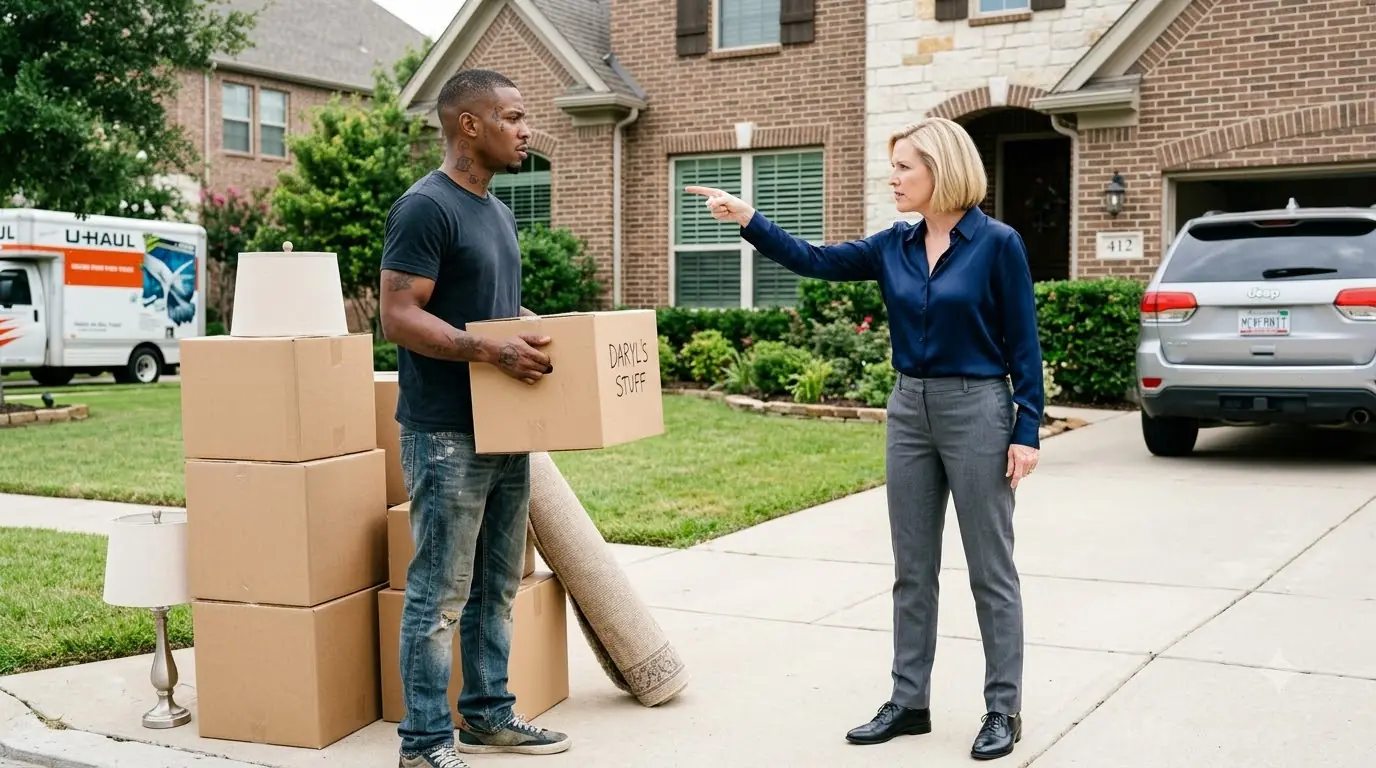
Daryl stopped on the walkway and looked at her. She was in her late fifties, dressed in a cream blouse and navy slacks, with silver-blond hair pinned so tightly it looked painful. One hand held a phone. The other pointed at the lamp as if it were evidence in a murder trial.
"Excuse me?" Daryl asked.
"I am stopping a criminal from robbing my neighbor," she said, louder now, as if volume could create authority.
Daryl glanced back at the house, then at the driveway where his black coupe sat with the trunk open. "You got it wrong, lady. I'm not robbing anybody."
"Please," she snapped. "I saw you walking from that house with their things. So don't tell me you're not robbing anybody."
"That house right there?" Daryl tilted his head toward the property. "I just bought that house. I'm moving in."
Mrs. Collins stared at him. Her eyes traveled from the lamp to his sneakers, from his sneakers to the tattoo near his face, then back to the house. "You bought that house?"
"Yes."
She gave a dry little laugh. "I'm not stupid, you know. I live right next door. I know how much these houses go for in this neighborhood."
"So?"
"So there's no way someone like you can afford to buy that house."
Daryl's expression did not change, but something in his chest tightened. He had heard different versions of that sentence all his life. People rarely said exactly what they meant at first. They placed it behind phrases like someone like you, people from your background, not a good fit, unusual candidate, not what we expected. The insult changed clothes, but it always walked the same way.
"Someone like me?" he asked.
Mrs. Collins lifted her chin. "Don't do that. Don't try to spin it. It's not about the color of your skin. It's about that." She pointed toward his face. "Only rappers, athletes, or hoodlums get their faces tattooed like that. No one with a real job does that to their face."
Daryl almost laughed. A real job. He had built his first trading algorithm at fifteen on a used laptop held together with black tape. By seventeen, he was managing a small private pool of money for three local business owners who thought he was too young until the returns made them forget his age. By twenty-six, he ran one of the hottest hedge funds in the country. He owned homes he rarely had time to sleep in, cars he usually let his brother drive, and enough quiet influence to make powerful people suddenly become polite. Still, on a sunny street in Briar Glen, a woman with a phone had decided he was a thief because he was carrying a lamp out of a house he owned.
"Okay, lady," he said. "I don't know what to tell you. I bought the house, and I'm moving some things out before my mother's furniture arrives. So if you don't mind—"
"I do mind," Mrs. Collins said. "And I think the police will, too, when they get here."
Daryl sighed, set the lamp carefully on the grass, and looked toward the open front door. He could have called his attorney. He could have called the bank officer who handled the closing. He could have called the former owners, the Millers, who had hugged him at the title office when he told them the house would be for his mother. Instead, he waited. He had learned that certain people needed their mistake to become official before they could see it.
The patrol car arrived twelve minutes later.
Officer Ramirez stepped out first, followed by Officer Chen. Ramirez looked at Daryl, then at Mrs. Collins, then at the lamp on the grass and the half-filled trunk. "What's going on here?"
"I'm just trying to move into my new house," Daryl said, keeping his voice level, "and this lady shows up and goes full Karen on me."
"How dare you?" Mrs. Collins snapped. "I am not being a Karen. I'm trying to be a decent neighbor to people who actually live here."
Officer Chen held up a hand. "Let's not rile everyone up. We'll get to the bottom of this." She turned to Daryl. "You moving in by yourself?"
"Yes, officer. My brother was supposed to help, but he's running late."
"By driving the getaway car?" Mrs. Collins muttered.
Daryl looked at her. "You know what? Officer, when she saw me, I was coming out of the house with items because I bought the house fully furnished and I'm clearing out some pieces before my mother's furniture gets here."
Mrs. Collins pointed toward the doorway. "That's the Millers' lamp. I remember it from their Christmas party."
"Because I bought the house fully furnished," Daryl repeated. "You can talk to the bank, the closing attorney, or the Millers if you want to."
Ramirez asked for his identification. Daryl handed it over along with the closing packet from the front seat of his car. Mrs. Collins crossed her arms and watched as if paperwork might still confess to being stolen. Ramirez made a phone call. Chen checked the packet, then walked toward the front window and looked at the temporary documents taped inside.
Ten minutes later, Ramirez returned. "Checks out."
Mrs. Collins blinked. "What do you mean, it checks out?"
"Exactly what I said, ma'am. The station ran this gentleman's information. The deed transfer is valid. It is his house."
"There must be some mistake," she said. "There is no way he bought this house. And if he did—"
Daryl turned. "If I did, what?"
Her mouth tightened. "The whole neighborhood's property value is going to plummet."
A silence fell over the driveway. Even the officers looked uncomfortable. Daryl picked up the lamp. "Thank you, officers. I appreciate your time."
Officer Chen gave Mrs. Collins a pointed look. "Ma'am, you need to be careful about making accusations without facts."
"I was protecting the neighborhood."
"Protecting the neighborhood from its new homeowner?" Chen asked.
Mrs. Collins did not answer. She marched back across the lawn with the stiff dignity of someone who had lost but refused to admit the scoreboard existed.
Daryl watched her go, then carried the lamp to the trunk. He had not bought the house for himself. He had bought it for his mother, Gloria Johnson, who had spent thirty years working double shifts in hotel kitchens and medical laundry rooms, saying she didn't need anything nice while giving her son everything she could. When Daryl was small, she used to point at houses like the ones on Briar Glen Drive and tell him, "Don't envy the windows, baby. Learn how they were paid for." He had learned. Now he wanted her to sit on a quiet porch and drink coffee without hearing sirens, without checking three locks, without wondering whether the landlord would raise rent again.
Mrs. Collins was not going to ruin that.
Two days later, his brother Terrence arrived in paint-splattered jeans and a T-shirt with primer on one sleeve. Terrence was two years older, broader, louder, and far more willing to argue with strangers in public. He took one look at the retro wallpaper in the living room and said, "Mom is going to disown you if this stays."
"That's why you're here," Daryl said.
They spent the morning hauling boxes, taping trim, and laughing about old family stories while a playlist from their childhood echoed through the empty rooms. Around noon, Terrence stepped outside to look at Daryl's car, which he had parked near the curb. Daryl followed him, holding two paint rollers.
Mrs. Collins appeared at her window within seconds.
"You see that?" Terrence whispered. "She's watching like we came to steal the grass."
"Ignore her."
"I am ignoring her. I'm just ignoring her out loud."
A second police car arrived twenty minutes later.
Officer Chen stepped out, looked at Daryl, and sighed as if she already knew. "Mr. Johnson."
"Officer."
Mrs. Collins hurried down her driveway. "I reported a potential chop shop."
Terrence stared at her. "A what?"
"Potential chop shop," she repeated. "Do you see the car he's been driving around in? And that shady-looking guy he's trying to sell it to?"
Daryl held up a hand. "That stolen car is my car, and that shady character is my brother."
Terrence pointed at himself. "I knew I should've worn the nice paint pants."
Mrs. Collins ignored him. "That doesn't make him look not shady. He looks like a drug dealer."
Officer Chen's jaw tightened. "Mrs. Collins, you cannot keep making unwarranted calls about your neighbor because you don't like how he or his family looks."
"I'm not crazy here, right? I mean, you're a woman. If you saw these two with a car like that, wouldn't you be thinking—"
"I would be thinking they are standing in front of the home Mr. Johnson legally owns," Chen said. "If you continue using police resources this way, I will have to cite you."
When the officer left, Terrence laughed under his breath. "Man, this neighborhood is going to be fun."
Mrs. Collins glared at both of them. "What are you two smirking about?"
Daryl wiped paint from his wrist. "I just think it's funny that you're old enough to know misjudging someone never ends well."
"Is that supposed to be a threat?"
"No. It isn't." He looked at her more carefully then. Behind the anger, he saw fear. Not the kind that excused anything, but the kind that explained why she held on so tightly to control. "My mom is moving in here. We're going to be seeing each other a lot. I'd prefer to try to get along. I think you'd feel better if you actually knew us. So how about this? Let's start over. Clean slate."
Mrs. Collins looked at his outstretched hand as if it might stain her. "Why would I ever want that?"
Daryl let his hand fall. "Suit yourself."
The following Monday, Evelyn Collins arrived at the glass tower downtown where she worked as vice president of operations for Harrow Martin Capital. She was proud of that title. She wore it like armor. Her office overlooked the river. Her assistant, Ellie, knew exactly how she liked her coffee, her calendar, and the silence outside her door. Evelyn had climbed hard to reach that floor, and she believed hardness was the reason she stayed there.
"I asked for iced, not hot," she snapped as Ellie placed a cup on her desk.
"No, ma'am," Ellie said carefully. "That is iced coffee. The outside is just warm because the courier had it in the same bag as the breakfast sandwiches."
"Do better, Ellie. You think I got where I am in this company by making mistakes like that?"
Ellie lowered her eyes. "No, ma'am."
"Has Mr. Martin landed yet?"
"He's on his way, Ms. Collins. The board meeting begins in twenty minutes."
Evelyn smoothed her blazer. The meeting mattered. Harrow Martin Capital had been struggling through a turbulent year. Rumors of a major outside investor had circulated for weeks. Evelyn believed that if she positioned herself properly, the restructuring could make her untouchable. She had prepared charts, performance summaries, and a plan that quietly blamed three other departments for failures she had helped create.
The conference room filled slowly. Board members arrived with folders and closed expressions. Mr. Martin, the company's founder, entered last. Beside him walked Daryl Johnson.
Evelyn stood so quickly her chair rolled back. "Are you crazy? Now you're following me to work? Get out of my office."
The room froze.
Daryl did not move. He wore a dark tailored suit, no tie, and the same calm expression she had seen in his driveway. The tattoo near his face remained visible. So did the quiet confidence she had mistaken for arrogance.
"Mrs. Collins," Mr. Martin said sharply. "What are you doing?"
"Samuel, call security now," Evelyn said to a junior associate near the wall.
"Hold on," Daryl said. "You don't have to do that."
"Do it," Evelyn insisted. "This man has already threatened me once. Now he's stalking me at work. Who knows what he'll do next? Just look at his face."
Ellie, standing near the door with a tablet in hand, whispered, "But Ms. Collins—"
"Nothing, Ellie. This man is dangerous."
Mr. Martin's voice went cold. "That is enough."
Evelyn turned toward him, confused by the tone. "Sir, you don't understand."
"No," Mr. Martin said. "You don't understand. Daryl Johnson owns fifty-one percent of this company as of this morning. The board approved the transaction before you entered the room."