At 7:32 every weekday morning, Claire Whitmore sat on the same cold concrete planter outside the Hawthorne Street station and divided her breakfast in half.
It had begun by accident in September, when she had missed the family car after arguing with her mother and taken the train to St. Alden’s Academy instead. She had bought a toasted bagel from a cart near the platform, then noticed a boy about her age standing under the overhang in a rain-darkened sweatshirt, staring at the steam rising from her coffee as if warmth itself were expensive.
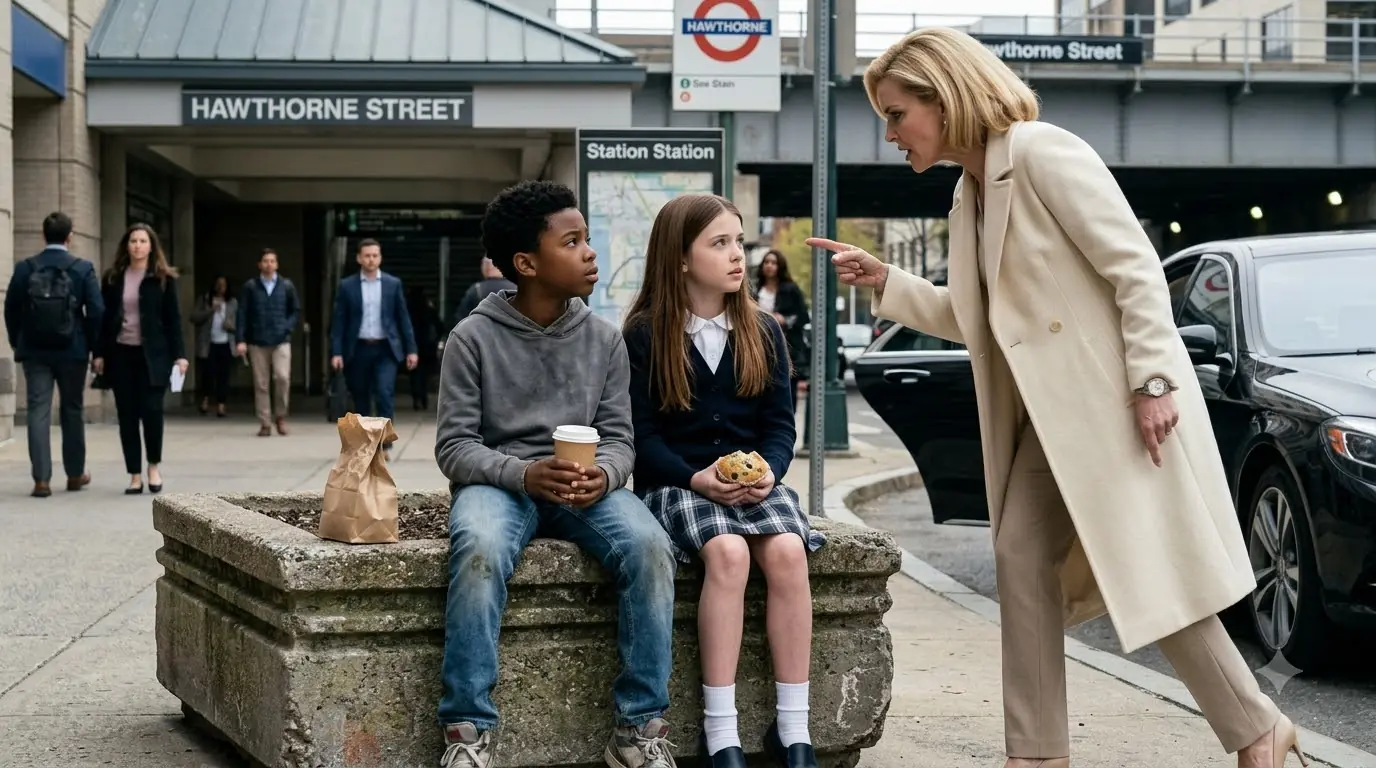
Claire had handed him half the bagel before she could overthink it. He had thanked her, introduced himself as Jamie, and asked why someone wearing a blazer with a school crest worth more than his entire outfit was waiting for public transportation.
Claire laughed harder than she had in weeks.
That was how it started.
By October, Jamie had become the one unscheduled thing in Claire’s life. Her mornings were otherwise designed down to the minute by assistants, tutors, drivers, coaches, and her mother’s calendar. Wake at six. Run at six fifteen. Breakfast at six forty. French vocabulary in the car. Classes until three. Debate on Mondays. Piano on Tuesdays. Foundation youth council on Wednesdays. College strategy sessions twice a month, even though Claire was only seventeen.
Her mother, Victoria Whitmore, liked to say that freedom was what happened after discipline had already done the hard work.
Claire increasingly suspected that what Victoria called freedom was simply a room with expensive furniture and no unlocked doors.
Jamie was different. He never asked Claire which universities she was considering. He did not know that her father’s name was on a wing of the city children’s hospital. He did not care that Whitmore Meridian, Victoria’s consulting empire, advised corporations and political campaigns across three continents. To Jamie, Claire was simply the girl who ate too fast, hated pears, pretended not to be lonely, and always saved the better half of the breakfast sandwich for someone else.
He told her little about himself. He said he slept “wherever works.” Sometimes that meant a youth shelter. Sometimes a friend’s basement. Sometimes, Claire suspected, nowhere he wanted to describe. He carried a battered sketchbook and drew buildings from memory, especially old train stations and fire escapes. His hands were usually cold. His shoes leaked when it rained.
Claire never photographed him. She never posted about him. She never mentioned him at home.
That secrecy made the friendship feel almost sacred.
It was the only part of her life her mother had not curated.
Until the Tuesday morning Victoria appeared at Hawthorne Street.
Claire saw the black sedan before she saw her mother. It stopped in the bus lane with the confidence of a vehicle whose passengers assumed rules existed for other people. The rear door opened. Victoria stepped out in a cream wool coat, dark glasses, and narrow heels that struck the wet pavement with hard, efficient clicks.
Claire froze with half a blueberry muffin in her hand.