It was a story that unfolded in the cold, sterile glow of a roadside diner, a place where kindness was a liability and compassion was against company policy. It's the story of a young woman named Sarah, a waitress with a heart too big for her threadbare apron, who lost her job for the simple crime of giving a glass of water to a man in need. But this was no ordinary man, and his gratitude was not a simple thank you.
It was a promise. And when that promise was called due the very next morning, it arrived not as a whisper, but as a thunderous roar, as 200 avenging angels on machines of chrome and steel surrounded the restaurant, ready to teach a lesson not with fists, but with a form of justice so profound, so complete, it would change Sarah's life and the soul of that small town forever.
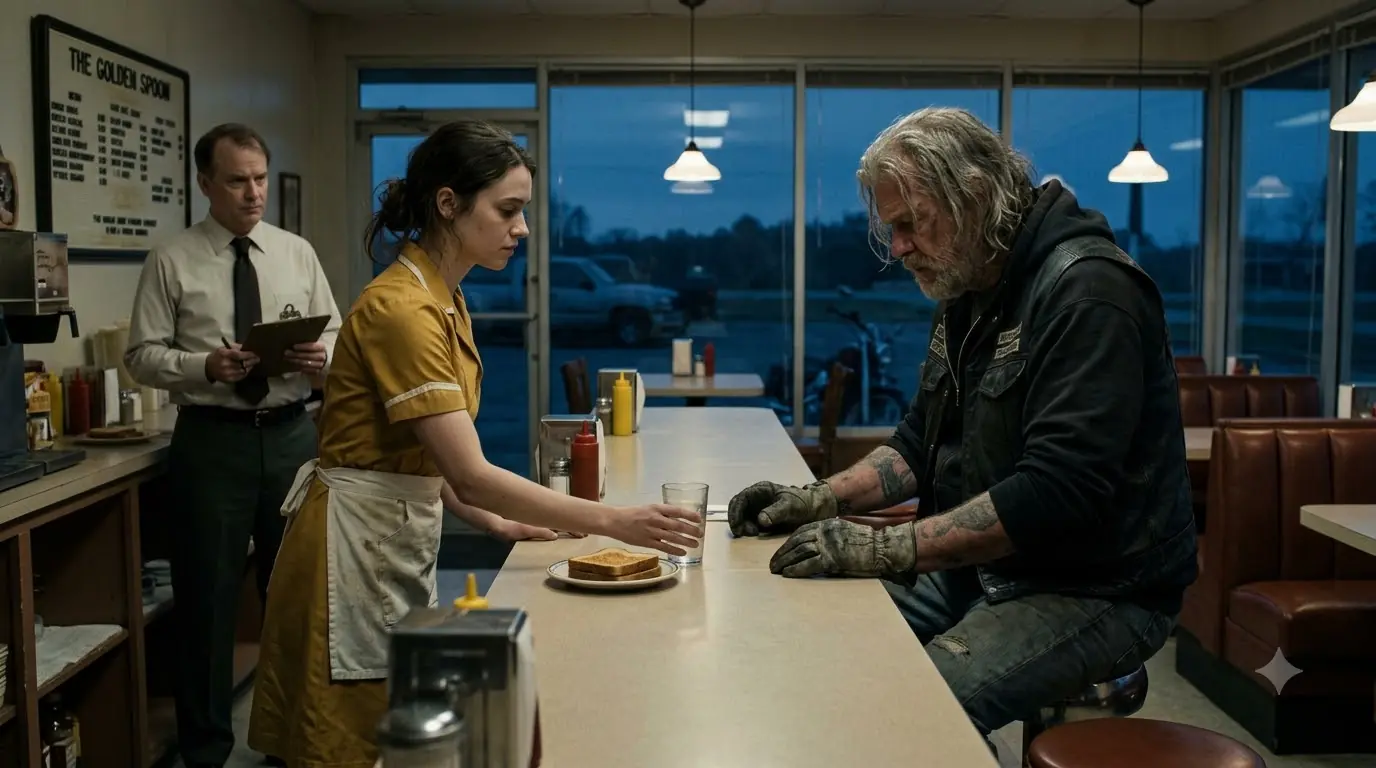
Sarah felt the cold before she even saw it. It was a damp, seeping chill that lived in the bones of the Golden Spoon Diner, a cold that the wheezing HVAC system could never quite conquer. It was the color of the fluorescent lights that hummed overhead, casting a pale, unforgiving glare on the Formica tabletops and the sticky patches the night shift busboy always missed. It was the chill of 5:00 in the morning, the hour of ghosts and regrets, when the world was painted in shades of charcoal and regret.
She stood behind the long, curving counter, polishing a coffee pot that was already gleaming. The motion was automatic, a mindless ritual that kept her hands busy and her thoughts at bay. Her reflection stared back at her from the polished steel, a girl who looked younger than her 22 years, with tired eyes and a tightness around her mouth that hadn't been there a year ago. Her uniform, a mustard yellow polyester dress that was supposed to look cheerful, felt like a shroud.
The diner was empty, utterly, profoundly empty. It was her favorite and least favorite time of day. The quiet was a blessing, a brief respite from the endless cycle of more coffee, "Can I get a check?" And the demanding snap of a customer's fingers.
But the quiet was also a vacuum, and into that vacuum rushed all the worries she spent the rest of her day trying to outrun. Money. It was always money. The word itself felt heavy, a physical weight pressing down on her chest.
It was the rent, 2 weeks late and counting. It was the clattering sound her old car made every time she turned the key, a sound that screamed of impending catastrophic failure. Most of all, it was the small, brown prescription bottle that soon sat on her mother's bedside table, a bottle that seemed to get emptier with terrifying speed. Her mother.
The thought of her was both an anchor and a millstone. Sarah loved her with a fierce, protective intensity that was the core of her being. She remembered her mother not as the frail woman who spent her days in a worn armchair by the window, but as the vibrant force of nature who had raised her alone, the woman who could bake a perfect apple pie, fix a leaky faucet, and scare away monsters from under the bed with a single, unwavering look. Now Sarah was the one who had to scare away the monsters.
The monster of illness, the monster of poverty, the monster of a health care system that saw her mother not as a person, but as a delinquent account. The new medication was working, the doctor had said with cautious optimism. It was a small miracle, but miracles, Sarah had learned, came with a price tag, a price tag that was exactly $342 a month after insurance. $342 was a mountain.
Her paycheck from the Golden Spoon was a shovel, and it felt like she was trying to move that mountain one spoonful of loose gravel at a time. So she worked. She worked double shifts until her feet were swollen, aching masses and her smile felt like a mask cracking at the edges. She picked up every extra hour offered, covering for sick coworkers, staying late to close, coming in early to open.
She lived on the diner's leftover toast and weak coffee, stuffing her tip money into a stained envelope hidden under her mattress. It was a grueling, soul-crushing existence, but every time she felt the despair creeping in, the exhaustion threatening to pull her under, she would picture her mother's face. She would remember the slight return of color to her cheeks, the way her laugh, though still weak, was starting to sound like it used to. And Sarah would pick up her shovel and keep digging.