The night the river froze over in St. Louis, nobody at Rosie’s Blue Plate Diner noticed the two children at first.
That was how cold nights worked in that part of Missouri. People came in with their collars up, shoulders hunched, eyes on the floor, thinking only about coffee hot enough to burn their tongues and plates heavy enough to make the world feel less cruel. The sleet had been falling since four o’clock, tapping the front windows like a thousand fingernails. By seven, the sidewalks were slick, the parking lot had turned silver, and every time the diner door opened, a blade of wind cut through the room hard enough to make the napkins flutter.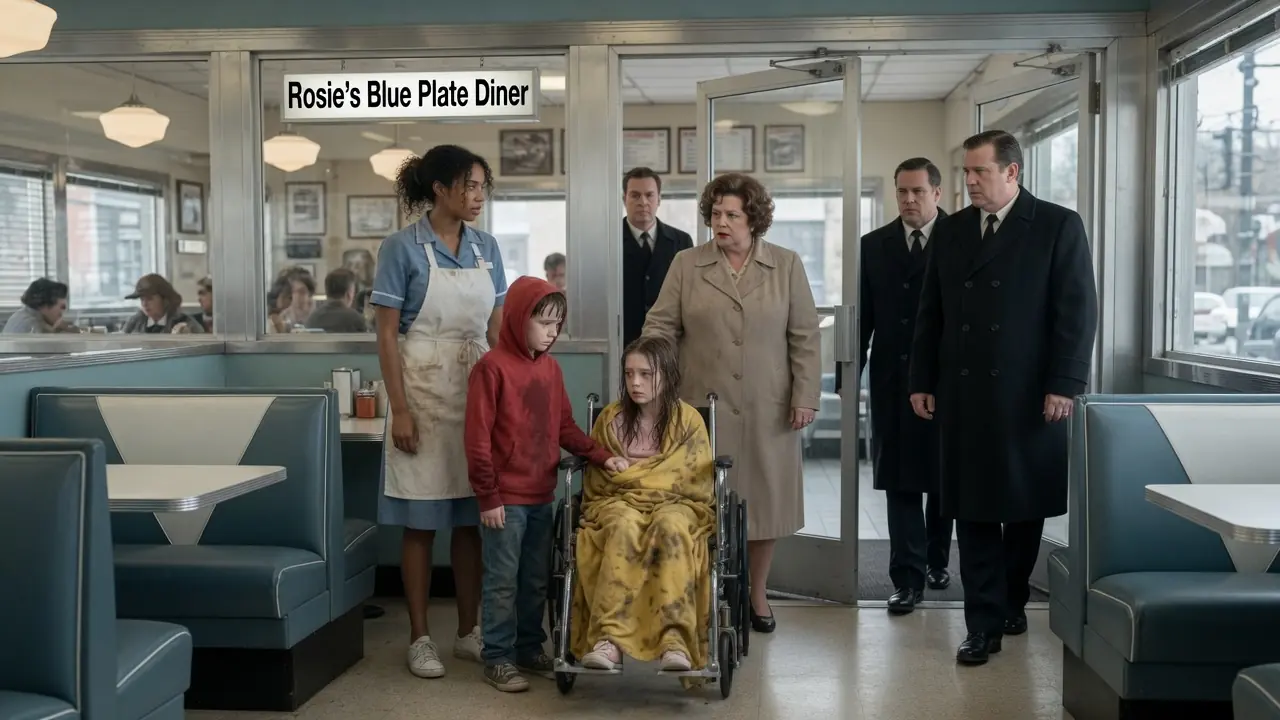
Maya Ellis was twenty-four years old, wearing a faded blue uniform dress, white sneakers with cracked soles, and a name tag that had lost half its shine. She had been on her feet for eleven hours, moving between booths with a coffee pot in one hand and a stack of order slips in the other. Her dark curls were twisted into a loose knot at the back of her head, and there was a small burn mark near her wrist from where the fryer had spit grease at her that morning. She should have been thinking about closing, about the bus she might miss, about the envelope of overdue rent folded inside her purse. Instead, she kept glancing at the window.
The first time she saw the children, she thought they were reflections. A small boy in a soaked red hoodie stood beside a wheelchair near the alley entrance, his hands wrapped around the handles, his skinny shoulders shaking under the weight of the cold. In the chair sat a little girl wrapped in a blanket that had once been yellow but was now gray from rain and street grime. Her knees were tucked carefully beneath the blanket, and one pink sneaker dangled from her left foot as if it had been tied in a hurry. The boy leaned close to her ear, said something Maya could not hear through the glass, and then looked toward the diner with the kind of fear children learn only after adults fail them.
Maya set the coffee pot down so quickly that it sloshed over her fingers.
“Hey,” called Darlene from behind the counter, without looking up from the register. “Table six still needs their check.”
“In a minute,” Maya said.
Darlene was fifty-eight, broad-hipped and sharp-eyed, the kind of woman who could balance three plates on one arm and smell trouble before it sat down. She followed Maya’s gaze to the front window. Her expression tightened. “No. Absolutely not.”
“They’re kids,” Maya said.
“They’re trouble for the owner if we bring them in and somebody calls. We already had two inspectors sniffing around last month.”
Maya stared at the window. The boy had taken off one of his gloves and was trying to wipe sleet from the little girl’s face with his bare hand. He could not have been more than nine. The girl looked six, maybe seven, with pale cheeks and big brown eyes fixed on the diner’s neon sign like it was a lighthouse.
“They’re freezing,” Maya said.
Darlene lowered her voice. “Maya, I’m not heartless. But you let every lost soul in this city sit in here, you’ll lose the only job keeping a roof over your own head.”
Maya heard her, but she was already moving. She grabbed two clean towels from the rack, pushed through the swinging door, and stepped outside before Darlene could stop her. The cold slapped her breath away. Sleet stung her face and hands. The boy jerked back as she approached, pulling the wheelchair with him, his eyes wild and suspicious.
“It’s okay,” Maya called gently, holding her hands where he could see them. “I work here. You can come inside.”
The boy shook his head, water dripping from his lashes. “We don’t have money.”
Maya felt those words land somewhere deep and old inside her. Not because she had never heard them before, but because she had once said them herself in a grocery store when she was eleven, clutching a loaf of bread while her mother cried into her sleeve.
“I didn’t ask for money,” Maya said.
The little girl in the wheelchair stirred. “Noah,” she whispered. “My legs hurt.”
The boy’s face broke for half a second, then hardened again. “She just needs to warm up. We’ll go after that.”
“You’ll come inside now,” Maya said, keeping her voice soft but firm. “Both of you. I’ve got soup, towels, and a heater booth. We can talk about the rest after your sister stops shivering.”
“She’s not my sister,” the boy said too quickly. Then he gripped the wheelchair handles tighter, as if ashamed of correcting her. “I mean, she is. Just not by blood.”
Maya nodded as if that made perfect sense. “Family is who stays. Bring her in.”
Something in the boy’s face changed. Not trust, not yet, but the tiniest pause before running. Maya took hold of one wheel rim while he pushed from behind, and together they guided the chair over the icy curb and through the diner door. The bell rang overhead, thin and bright. Every head in the room turned.
A trucker at the counter stopped with his fork halfway to his mouth. Two college girls in the corner booth looked up from their phones. A man in a wool coat near the window frowned like the children had brought the weather in with them. Darlene stood behind the register, lips pressed into a hard line, but she did not tell Maya to put them back outside.
“Booth by the heater,” Maya said.
She wheeled the little girl to the booth beneath the old wall vent, then helped the boy lift her carefully from the chair onto the vinyl seat. He moved with surprising skill, one arm behind her back, the other under her knees, as if he had done it a hundred times. The girl winced but tried not to cry. Maya noticed that and remembered it. Children who apologized with their faces for needing help usually had learned it from being punished for needing anything at all.
“What’s your name, sweetheart?” Maya asked, tucking one towel around the girl’s shoulders.
“Lily,” the girl said, teeth chattering.
“And you?” Maya looked at the boy.
“Noah.”
“Okay, Noah and Lily. I’m Maya.” She pointed to her name tag. “This booth is yours for now. Nobody’s moving you.”
Noah’s eyes flicked toward Darlene. “That lady looks mad.”
“That’s just her face when she cares and doesn’t want anyone to know.”
Maya smiled despite herself. “See?”
Lily wrapped both hands around the mug, her small fingers red from cold. Noah did not touch his. He watched the room, then the door, then the window, tracking every movement like a guard dog. Maya brought chicken noodle soup, grilled cheese cut into triangles, a plate of fries, and a slice of cherry pie she paid for by writing her employee number on the ticket. Noah stared at the food as if it might disappear.
“You can eat,” Maya said.
He swallowed. “We’re not stealing.”
“No. You’re eating.”
“What if we can’t pay later?”
“Then later can argue with me.”
Lily giggled, a small surprised sound that seemed to startle even her. Maya placed a spoon in her hand. Lily tried to lift it, but her fingers trembled, and broth spilled onto the table. Noah reached for the spoon immediately.
“I can do it,” Lily whispered, embarrassed.
“I know,” Noah said, too gentle for a boy his age. “Just let me help with the first one.”
Maya pretended to wipe the next table so she would not make them feel watched. Out of the corner of her eye, she saw Noah blow on the soup, test it with his lips, then feed Lily before taking a bite for himself. He did it automatically. Feed her first, check the exits, eat only after she swallowed. A child should not know that kind of routine.
When Lily had finished half the bowl and Noah had finally taken his first hungry bite of grilled cheese, Maya slid into the opposite side of the booth. The diner had settled again around them, though not completely. People still glanced over. The man in the wool coat whispered something to the woman beside him. The trucker at the counter turned his stool slightly, listening without pretending otherwise.
“Where are your parents?” Maya asked.
Noah’s hand stopped over his plate. Lily looked down at the table.
“We don’t have any,” Noah said.
The sentence came out flat, practiced, stripped of drama by repetition.
Maya kept her face calm. “Who were you staying with tonight?”
Noah’s jaw tightened. “A place.”
“What kind of place?”
“A house with too many kids and a lady who locks the fridge.”
Lily whispered, “She said my chair scratched the floor.”
Noah put down his sandwich. “She said a lot of things.”
Maya felt a slow anger rise through her chest, but she held it down. Anger would not help them if it made them run. “Did you leave because of the storm?”
Noah shook his head once. “We left because they were going to separate us tomorrow.”
Lily began to cry silently.
Maya looked from one child to the other. “Who told you that?”
“The lady,” Noah said. “Mrs. Kline. She said Lily needed a medical foster home, and I was too much trouble, so they found different placements. She said I should be grateful somebody wanted me at all.”
Lily wiped her nose on the towel. “Noah promised Mom he wouldn’t leave me.”
Maya’s throat tightened. “Your mom?”
“Our foster mom,” Noah said, softer now. “Before Mrs. Kline. Her name was Grace. She was trying to adopt us. She said papers take time, but promises don’t. She died in September.”
The diner noise seemed to fade. Maya heard only the heater clicking overhead and the sleet scratching the glass.
Noah reached into the front pocket of his hoodie and pulled out a small blue button, the kind from an old cardigan. It was tied to a length of yellow thread, making a crooked bracelet. He laid it on the table between them like evidence.
“Grace gave Lily this when she got scared,” he said. “She said blue was for brave days.”
Lily touched the button with one finger. “It was from her sweater. The soft one.”
Maya stared at the button. It was nothing. Cheap plastic, scratched at the edges, almost weightless. But Lily touched it the way some people touched wedding rings, and Noah watched it like it was the only thing he had managed to save from a burning house.
“What happened to Grace?” Maya asked.
Noah looked toward the window. “Car accident. A man ran a red light. The caseworker said it was quick.”
Lily’s eyes filled again. “She was going to make pancakes on Saturday.”
Maya reached across the table slowly, giving them time to pull away. Neither did. She touched the edge of the towel around Lily’s shoulders. “I’m so sorry.”
Noah shrugged, but it was a broken shrug, too heavy for him. “People say that and then send us somewhere else.”
“I’m not sending you outside.”
“You have to call someone.”
“Yes,” Maya said. “But not until you’re warm, fed, and ready to tell me what you’re afraid of.”
Noah studied her with suspicion and desperate hope mixed together. “You can’t fix it.”
“Maybe not alone.”
At the counter, Darlene turned away quickly, but Maya saw her wipe under one eye with her thumb.
The door opened again. Wind burst through, carrying sleet and the smell of wet asphalt. A police officer stepped inside, shaking ice from his shoulders. Maya’s heart lurched, and Noah saw it before she could hide it. He grabbed Lily’s button bracelet and shoved it back into his pocket.
“We have to go,” he whispered.
“No,” Maya said, firm but low. “Sit still.”
The officer, young and red-faced from the cold, approached the counter. “Evening. Anyone seen two kids? Boy about nine, girl in a wheelchair. Report came in from a foster residence near Benton Park.”
Noah’s face went white.
Maya stood. “Officer, they’re here. They’re safe.”
The whole diner seemed to inhale at once.
The officer looked toward the booth. His expression softened slightly when he saw Lily wrapped in towels, then hardened again into procedure. “Kids, I need you to come with me. Your foster guardian is worried sick.”
Noah let out a small bitter laugh. “No, she’s not.”
“Son, it’s not optional.”
Maya stepped between the officer and the booth. “They’re eating. They’re cold. The little girl may need medical attention. Can you give them a minute?”
The officer frowned. “Ma’am, don’t interfere.”
“I’m not interfering. I’m making sure two freezing children aren’t rushed back into the same situation they ran from.”
“That’s for child services to determine.”
“Then call child services here.”
Darlene came around the counter with a coffee pot in her hand like a weapon. “She’s right.”
The officer looked at her. “Excuse me?”
“You heard me,” Darlene said. “They’re kids, not lost luggage. Sit down and call whoever you need to call.”
The trucker at the counter cleared his throat. “I can wait as a witness if needed.”
The man in the wool coat, who had been frowning earlier, sighed and raised his hand. “I’m a pediatric physical therapist at Mercy. I can check the girl’s circulation and range of motion if her guardian permits.”
Noah stared at all of them as if the room had transformed into a language he did not understand.
The officer hesitated. The storm pressed against the windows. His radio crackled with static. Finally, he stepped back. “Fine. I’ll call my supervisor and emergency child services. Nobody leaves.”
“Good,” Darlene said. “You want coffee?”
He blinked. “Sure.”
Maya sat back down across from Noah and Lily. Noah’s hands were shaking now, not from cold. “They’ll take her,” he whispered.
“Not without people asking questions,” Maya said.
“They always do.”
“Then tonight can be different.”
He looked at her like he hated her for saying something beautiful because beautiful things had proven dangerous. Lily, still pale, leaned against the booth and closed her eyes. Maya touched her forehead. Too hot now. Fever beneath the cold. The pediatric therapist, Dr. Evan Park according to the name embroidered on his fleece jacket, examined her gently with Maya beside him and Noah watching every movement like a hawk.
“She needs urgent care,” Dr. Park said quietly. “Not an ambulance unless breathing changes, but soon. She may have an infection. When was the last time her catheter supplies were changed?”
Noah looked blank.
Maya closed her eyes for one second. “Okay.”
The officer lowered his coffee. “I’ll have EMS come by.”
“No ambulance,” Noah said sharply. “She gets scared.”
Lily opened her eyes. “I don’t like the lights.”
Maya squeezed her hand. “We’ll make it quiet if we can.”
While the officer made calls, Maya slipped behind the counter and used the diner phone to call the emergency number printed on a child services flyer taped near the employee lockers. She gave her name, the diner address, the situation, and every detail Noah had shared. The woman on the line sounded tired, but her voice changed when Maya mentioned fever, wheelchair, separation, and possible neglect.
“We’ll send an on-call investigator,” the woman said. “Do not release the children to the foster guardian until we arrive.”
Maya hung up and turned to find Darlene standing behind her.
“You understand if the owner gets wind of this, he may fire both of us,” Darlene said.
Maya looked toward the booth where Noah was helping Lily drink water through a straw. “Then I’ll need a new job.”
Darlene sighed. “I hate that I raised you right.”
“You didn’t raise me.”
“I’ve been scheduling your shifts for four years. Close enough.”
The sleet worsened. Cars moved slowly past the diner with their hazard lights blinking. The neon sign outside buzzed, flickered, and then held. Inside, the room had shifted around the children. The college girls gave Lily a dry scarf from one of their bags. The trucker ordered a second bowl of soup and told Maya to put it on his check. Dr. Park called a colleague at a nearby urgent care center and arranged a quiet intake. Darlene packed extra pie in a white takeout box and wrote LILY in thick black marker on the lid.
Noah watched all of it with a face that could not decide whether to accept kindness or prepare for punishment.
Forty minutes later, a woman in a camel coat stepped into the diner, carrying a leather satchel and wearing boots too nice for the weather. Her hair was silver at the temples, her face composed but kind. She introduced herself as Marisol Vega, on-call child services investigator. Behind her came another woman in navy scrubs, a pediatric nurse with a calm smile.
Mrs. Kline arrived five minutes after that.
She came in loud, which told Maya almost everything she needed to know. She was heavyset, with a stiff perm, lipstick too bright for her drawn mouth, and an oversized purse clutched against her side. Her coat was expensive, but she wore it like armor. The moment she saw Noah and Lily, her face rearranged itself into concern.
“Oh, thank heavens,” she cried. “You poor things. You had me terrified.”
Noah went rigid.
Lily made a small sound and grabbed Maya’s hand.
Mrs. Kline’s eyes flashed toward Maya. “And who are you?”
“The waitress who brought them in from the storm,” Maya said.
“How noble.” Mrs. Kline’s smile sharpened. “Unfortunately, you’ve involved yourself in something you don’t understand. Noah has a history of manipulation. He runs when he doesn’t get his way. Lily, poor darling, gets dragged along.”
Noah’s face burned. “That’s a lie.”
“Don’t start.”
Maya felt Lily’s fingers tighten painfully around hers.
Marisol Vega stepped forward. “Mrs. Kline, I need you to speak with me privately.”
“I’m happy to, but first I need to take my foster children home. It’s late, and Lily has medical needs.”
“Yes,” Dr. Park said from beside the booth. “That’s exactly what concerns us.”
Mrs. Kline turned toward him. “And you are?”
“A pediatric physical therapist. I assessed Lily’s condition with consent from the children and under observation. She has a fever, possible infection, and signs of delayed equipment maintenance.”
Mrs. Kline’s expression twitched. “Children exaggerate. And strangers love judging foster parents without knowing the burden.”
Maya stepped closer. “Did you tell them they were being separated tomorrow?”
Mrs. Kline’s eyes cooled. “That is confidential.”
“That’s a yes,” Darlene said from the counter.
The officer, who had been speaking quietly with his supervisor, returned. “Mrs. Kline, until the investigator clears this, the children aren’t leaving with you.”
For the first time, fear flickered across Mrs. Kline’s face. Not worry for the children. Fear for herself.
“You can’t do that,” she said.
Marisol’s voice remained calm. “We can. And we are.”
Noah began to cry then, but silently, as if he refused to give Mrs. Kline the satisfaction of sound. Maya sat beside him. He leaned away at first, then slowly let his shoulder touch her arm. Lily closed her eyes, exhausted, the blue button bracelet looped around her wrist.
By ten o’clock, arrangements were made. Lily would be taken to urgent care with Marisol and the nurse. Noah would go with them, because Maya insisted and Marisol agreed that separating them during a medical evaluation would do more harm. Mrs. Kline left under a storm of clipped official words, her purse held tight against her ribs. The diner watched her go in silence.
At the door, Noah stopped and looked back at Maya. “Will you be here tomorrow?”
Maya glanced at Darlene, then at the clock, then at the dirty tables still waiting to be cleared. “Yes.”
“You promise?”
The question was too big for such a small voice.
Maya crouched in front of him. “I promise.”
He reached into his pocket, untied the yellow thread from the blue button, and pressed it into her palm. Lily protested weakly, but he shook his head.
“She should keep it tonight,” he said. “So we know she has to give it back.”
Maya looked down at the button, small and damp and warm from his hand.
“I’ll keep it safe,” she said.
Noah nodded once. Then he followed Lily into the storm, this time surrounded by adults who were paying attention.
After they left, Rosie’s Blue Plate Diner felt too quiet. Maya cleaned tables with the blue button in her apron pocket, touching it every few minutes as if checking a pulse. At midnight, the owner called after hearing from Darlene. He shouted for thirteen minutes. Maya held the phone away from her ear, listened to the words lawsuit and liability and not your job, then said only, “Two kids were freezing outside.”
He fired her anyway.
Darlene quit before he could hang up.
“You didn’t have to do that,” Maya said, stunned.
Darlene took off her apron and tossed it onto the counter. “I’ve been waiting for a good reason to leave this dump for fifteen years. Don’t flatter yourself.”
They locked the diner together and stepped into the freezing night. The storm had softened to a fine icy mist, but the streets still shone slick beneath the traffic lights. Maya missed the last bus and walked three blocks before Darlene pulled up beside her in an old Buick that smelled like peppermint and cigarette smoke.
“Get in,” Darlene said.
Maya did. She cried for the first time halfway across the bridge, quiet at first, then harder when Darlene reached over and squeezed her knee.
The next morning, Maya woke to six missed calls from unknown numbers. Her rent was still overdue. Her job was gone. Her shoes were still wet by the radiator. For one terrible moment, she thought the whole night had been a dream, the kind poor people have when they need the world to be kinder than it is. Then she found the blue button on her bedside table.
She answered the next call.
It was Marisol. Lily had a urinary tract infection, treatable but serious enough that neglect would be documented. Noah had refused to sleep until someone promised him Lily was in the next room. Mrs. Kline’s foster license had been suspended pending investigation. The siblings were currently in temporary emergency placement at a pediatric respite home.
“They asked for you,” Marisol said.
Maya pressed the phone to her ear. “Can I see them?”
“That depends,” Marisol said. “Are you willing to come in and give a formal statement?”
“Yes.”
“And possibly answer some questions about your own background?”
Maya frowned. “Why?”
There was a pause. “Because Noah told me Grace said they needed someone who didn’t look away. He said that was you.”
Maya sat down on the edge of the bed.
“I’m not a foster parent,” she said.
“I know.”
“I don’t have money.”
“I know.”
“I just got fired.”
“I heard.” Marisol’s voice softened. “Come give the statement first. One step at a time.”
The building where child services kept its offices smelled of old paper, lemon cleaner, and coffee that had been sitting too long. Maya spent three hours answering questions. She described the children outside the diner, Noah’s fear, Lily’s condition, Mrs. Kline’s behavior, the blue button, the promise. Marisol listened carefully and took notes in tidy handwriting. At the end, she closed the file and looked at Maya not as an investigator, but as a woman deciding whether to open a door.
“Have you ever considered working in child advocacy?”
Maya let out a short laugh. “I considered finishing college once.”
“What happened?”
“My mother died when I was nineteen. I took custody of my little brother for a while. Then he went to live with our aunt in Kansas City because I couldn’t keep up. I’ve been trying to get steady ever since.”
“Did you lose contact with him?”
“No. He calls every Sunday. He’s sixteen now, thinks he knows everything.”
Marisol smiled. “They all do.”
Maya looked toward the frosted glass door. “Can I see Noah and Lily?”
“Yes. But prepare yourself. They may attach quickly.”
Maya touched the button in her coat pocket. “I think they already did.”
At the respite home, Lily sat propped in bed with a stuffed rabbit tucked beneath one arm and an IV line taped to her hand. Noah sat in a chair beside her, refusing to leave even for lunch. When Maya entered, Lily’s face lit up first. Noah tried to look relieved and failed completely.
“You came,” he said.
“I promised.”
Maya placed the blue button in Lily’s palm. “I kept it safe.”
Lily held it to her chest. “You can borrow it again if you get scared.”
Maya swallowed. “I might need that.”
Over the next two weeks, Maya visited every day. She brought library books, coloring pages, clean socks, and stories from the diner she no longer worked at. Darlene came twice with a casserole and pretended not to enjoy being called Aunt Darlene. Dr. Park checked on Lily’s mobility plan and helped document equipment neglect. The trucker from the diner, whose name was Earl, delivered a bag of winter coats collected from other drivers after hearing what had happened.
Kindness, Maya learned, had a strange way of making witnesses feel responsible for what came next.
But responsibility did not pay rent. By the third week, Maya had applied to nine jobs and received two rejections. Her landlord taped a notice to her door. Her bank account dipped below twelve dollars. She began skipping breakfast so she could afford bus fare to visit the children. Darlene offered money. Maya refused. Darlene called her stubborn, then left groceries outside her apartment anyway.
One afternoon, as Maya sat in the respite home common room watching Noah help Lily build a tower of blocks, Marisol joined her with a folder in hand.
“There’s something I need to tell you,” she said.
Maya tensed. “Are they separating them?”
“No. We stopped that. Grace’s adoption petition changed things.”
Maya turned. “What petition?”
Marisol opened the folder. “Grace Whitaker had completed most of the adoption paperwork before she died. She named both children together, with a written statement that separating them would cause emotional harm. The court never finalized it because of her death, but the record matters.”
Maya looked through the glass at Noah, who was laughing now as Lily knocked the blocks over on purpose.
“Then what happens?”
“We search for relatives again. We evaluate approved homes. We consider kinship connections when possible.”
“I’m not kin.”
“No,” Marisol said. “But you may be more connected than you think.”
Maya stared at her.
Marisol slid a photocopied page across the table. It was from Grace’s file. At the bottom was a list of emergency contacts and community references. One name had been circled.
Nadine Ellis.
Maya’s mother.
The room tilted slightly.
“That’s not possible,” Maya whispered.
“Your mother volunteered at St. Brigid’s Family Center twelve years ago?”
Maya nodded slowly. “After my father left. She said helping other people kept her from falling apart.”
“Grace Whitaker worked there too. According to the file, your mother and Grace helped run a meal program for foster families. Grace listed Nadine as one of the people who taught her how to care for children who had experienced trauma.”
Maya covered her mouth.
“There’s more,” Marisol said gently. “Grace kept a notebook. We recovered it from storage. She wrote about two women who changed how she understood family. One was your mother. The other was someone named May, a young girl who used to help serve soup after school.”
Maya closed her eyes. She could smell it suddenly. Tomato soup in a church basement. Wet coats on folding chairs. Her mother’s hands guiding hers as she carried paper bowls to children who would not look up.
“I was thirteen,” Maya said. “Everyone called me May back then.”
Marisol’s eyes softened. “Grace remembered you.”
Maya shook her head, tears spilling before she could stop them. “I don’t remember her face.”
“She remembered yours.”
Marisol handed her a small envelope. Inside was a photograph, creased and faded. Maya saw her younger self standing beside her mother in the church basement, holding a tray of soup bowls. Next to them stood a smiling woman in a blue cardigan. Pinned to that cardigan was the same blue button Lily wore on her wrist.
Grace.
The emotional anchor in Lily’s hand had once belonged to the woman Maya’s mother had helped. The promise Noah carried had roots in a room Maya had forgotten. What felt like a random storm, a random diner, a random act of kindness had been connected all along by a chain of women feeding children when nobody else knew what to do.
Maya pressed the photo to her chest.
“My mother used to say food was how you told someone they could stay,” she whispered.
Marisol nodded. “Grace wrote that down.”
The next few months were not simple. Stories liked to jump from rescue to miracle, but real life had paperwork, court dates, background checks, home studies, financial questions, and people who measured love against square footage. Maya found part-time work at a bakery in the mornings and began training as a family support aide through a nonprofit Marisol recommended. Darlene moved into the spare room of Maya’s apartment “temporarily,” though she brought three suitcases and rearranged the kitchen on day two. Earl fixed Maya’s car for free, accepting payment only in muffins from the bakery. Dr. Park connected Lily with donated equipment and proper therapy.
Every Friday, Maya visited Noah and Lily. Every Friday, Lily wore the blue button bracelet. Every Friday, Noah asked the same question without asking it directly.
“Is your apartment still there?”
“Yes.”
“Do you still have two blankets on the couch?”
“Yes.”
“Does Darlene still snore?”
“Like a chainsaw in a thunderstorm.”
Lily would giggle, and Noah would look away, hiding hope like contraband.
One evening in April, Maya sat before a family court judge with her hands folded tightly in her lap. She wore a navy dress borrowed from Darlene and shoes that pinched her toes. Marisol testified. Dr. Park testified. Grace’s notebook was entered into the record. So was the photograph from St. Brigid’s. The judge, an older woman with silver glasses, read quietly for a long time.
Finally, she looked at Maya.
“Miss Ellis, you understand that guardianship is not gratitude. It is not a reward for one good deed. It is a daily obligation.”
“Yes, Your Honor.”
“You understand Lily’s medical needs are ongoing.”
“Yes.”
“You understand Noah’s history of loss will not be solved by affection alone.”
“Yes.”
The judge studied her. “Why do you want this?”
Maya looked toward the children. Lily sat beside Marisol, her wheelchair polished, her hair in two neat braids, the blue button bracelet around her wrist. Noah sat upright beside her, trying to look brave and failing around the eyes.
“I don’t want them because I saved them,” Maya said. “I want to stay because they shouldn’t have to wonder who will. My mother taught me that when you feed someone, you’re telling them there’s room. Grace taught them the same thing. I think maybe I was brought back to that lesson because I needed it too.”
The courtroom was quiet.
The judge removed her glasses. “Temporary guardianship granted, with review in six months.”
Lily burst into tears first. Noah did not move until Maya opened her arms. Then he crossed the room so quickly he nearly tripped, folding himself against her like a child who had been holding his breath for years. Lily wheeled forward, crying and laughing, and Maya knelt so she could pull them both close.
Darlene sobbed loudly in the back row and denied it afterward.
The first night in Maya’s apartment was chaotic. Lily needed help transferring from chair to bed. Noah unpacked and repacked his backpack three times, unsure where his things were allowed to stay. Darlene burned the celebratory spaghetti because she was too busy lecturing everyone about towel placement. The radiator hissed. The upstairs neighbor played bass-heavy music until midnight. Maya’s bedroom became the children’s room, while she slept on the couch beneath two blankets.
At two in the morning, Noah appeared in the doorway.
“You awake?”
“Yes.”
“Can I check the lock?”
“Of course.”
He checked it, then checked the window latch, then looked embarrassed. “Grace used to let me.”
“Then I will too.”
He stood there a moment longer. “If they change their mind at the review, do we have to leave?”
Maya sat up. “We’ll deal with the review when it comes.”
“That’s not an answer.”
“No,” she admitted. “It’s the only honest one I have. But I can promise you this. I will show up to every meeting, every appointment, every hearing, every hard day. I won’t disappear just because things get complicated.”
Noah’s lip trembled. “People die.”
Maya felt the words pierce clean through her. “Yes. Sometimes they do.”
“So promises don’t always work.”
“No,” Maya said softly. “But they still matter. Especially when we keep them for as long as we can.”
He nodded, not satisfied but comforted enough to breathe. “Can I sleep on the floor by Lily tonight?”
“Yes.”
He disappeared, then returned. “Can you sit by the door until she falls asleep?”
Maya got up, wrapped her blanket around her shoulders, and followed him.
Spring turned into summer. The bakery owner expanded Maya’s hours after learning her story, then helped her enroll in evening classes to finish her degree in social work. Darlene discovered she was good at managing chaos and began coordinating rides to Lily’s appointments with the authority of a retired general. Lily gained weight, strength, and a new wheelchair painted bright teal by Earl and three truckers who had no artistic training but a shocking amount of confidence. Noah joined a summer robotics club after Maya found him repairing the bakery’s broken receipt printer with a butter knife and stubbornness.
The diner changed too, though not the old one. Rosie’s Blue Plate closed two months after Maya and Darlene left, following health violations and unpaid taxes. The neon sign went dark. For a while, the building sat empty, its windows papered over, its parking lot cracked and full of weeds. Maya passed it sometimes on the bus and felt a strange ache. It had been the place where everything fell apart and everything began.
Then, in September, one year after Grace’s death, Marisol called Maya with news that made her sit down.
“Grace left a small life insurance policy,” she said. “Most of it was tied up in debts, but there’s a remainder. She named the children as beneficiaries, managed by the court until permanency.”
“How much?” Maya asked.
“Not enough to make anyone rich. Enough to matter.”
That same week, Earl and Darlene showed Maya a flyer. The old diner building was available for lease at a fraction of its original price. The kitchen still worked. The booths needed repair. The roof leaked in two places. The owner was desperate.
“No,” Maya said immediately.
Darlene crossed her arms. “You haven’t heard the plan.”
“I can’t run a diner.”
“You ran your life on twelve dollars, two jobs, and moral panic. A diner is easier.”
Earl cleared his throat. “Truckers need a place that don’t treat people like wallets. Kids need after-school meals. Foster families need somewhere to sit without feeling watched. This city needs what happened that night, but on purpose.”
Maya looked at the flyer again.
The idea was impossible. So many good things were, at first.
Six months later, the neon sign came back on, but the name changed. The Blue Button Diner opened on a rainy Thursday evening with scratched booths, fresh paint, donated tables, and a brass plaque beside the register that read: Food is how we tell someone there is room. Nadine Ellis and Grace Whitaker had both said it in different ways. Maya put both their names beneath it.
The diner served paying customers, but every menu had a quiet line at the bottom: If you are hungry and cannot pay, ask for the blue plate. No explanation needed. Behind the counter, Darlene ran the floor with terrifying efficiency. Earl handled deliveries before dawn. Dr. Park hosted monthly mobility clinics in the back room. Marisol referred foster families who needed a neutral place for supervised visits, emergency meals, and support without shame.
Noah helped build a ramp at the entrance with Earl, measuring twice and arguing with every adult who tried to rush. Lily painted blue flowers along the baseboards, each one slightly different. Maya worked the opening night in a clean apron, her hair pulled back, her name tag shining new beneath the lights.
At seven o’clock, the first storm of the season swept through St. Louis. Rain hit the windows. The bell over the door rang. Maya looked up automatically.
A young mother stood there with a baby on her hip and a toddler clinging to her coat. She was soaked, embarrassed, and already apologizing.
“I’m sorry,” the woman said. “The bus broke down, and I just need to get them warm for a minute.”
Maya picked up three menus and smiled. “You came to the right place.”
Across the room, Noah looked up from his homework. Lily rolled toward the front with a stack of crayons balanced on her lap.
“We have hot cocoa,” Lily announced proudly.
“And grilled cheese,” Noah added. “The good kind.”
The young mother’s face crumpled with relief, and Maya felt the past fold gently into the present. Not healed perfectly. Not erased. But transformed into something useful. Something warm.
The guardianship review came and went. Then came the permanency hearing. Then the adoption petition, filed with Grace’s notebook attached and Maya’s mother’s photograph tucked into the evidence like a blessing. On the day the judge signed the final order, Lily wore a blue dress and Noah wore a tie he hated. Darlene brought tissues for everyone and used most of them herself.
Afterward, they returned to the diner instead of going to a fancy restaurant. The place was packed. Truckers, social workers, foster parents, neighborhood kids, nurses, teachers, and people who had once come in asking for the blue plate all stood and clapped when Maya wheeled Lily through the door with Noah beside her.
Lily held up the blue button bracelet. “We’re official now.”
Noah rolled his eyes, but he was smiling. “She means we got adopted.”
Darlene rang the service bell so hard the kitchen staff jumped. “Pie for everybody. Earl’s paying.”
Earl, who had definitely not been told this, shrugged. “Fine.”
That night, after the last customer left and the chairs were turned upside down on tables, Maya sat in the back booth with Noah and Lily. The rain had stopped. The neon sign hummed softly. Lily leaned against Maya’s side, sleepy and satisfied. Noah traced the edge of the menu with one finger.
“Do you think Grace knows?” he asked.
Maya looked at the brass plaque, then at the blue button resting against Lily’s wrist. “Yes.”
“And your mom?”
“Yes.”
He nodded. “Good.”
Lily yawned. “Can we make pancakes Saturday?”
Maya smiled. “Every Saturday if you want.”
Years later, people would tell the story of the Blue Button Diner like it had been destiny from the beginning. They would say a young waitress found two orphaned children in a storm, fed them soup, saved them from separation, and built a place where hungry people could come without shame. They would leave out the overdue rent, the lost job, the fear, the court forms, the nights Noah checked the locks six times, the mornings Lily cried through therapy, the days Maya wondered whether love was enough when money was thin and exhaustion was heavy.
But Maya remembered all of it. She knew miracles were not clean things. They arrived soaked, frightened, hungry, and suspicious. They came with paperwork and fever, with broken wheelchairs and boys who had learned not to trust promises. They asked not for grand speeches, but for soup, warmth, and someone willing to stay after the beautiful moment was over.
On the diner’s tenth anniversary, Lily, now seventeen, rolled through the front door wearing a college sweatshirt and a grin too big for her face. Noah came behind her, tall and broad-shouldered at nineteen, carrying a toolbox from the engineering program that had given him a scholarship. Darlene was older but no less terrifying. Earl had a chair at the counter with a small plaque that read Reserved unless someone needs it more.
Maya stood behind the register, touching the blue button pinned inside a small glass frame near the brass plaque. The button was faded now, the yellow thread replaced twice, but its meaning had only grown stronger. Every employee learned the story before their first shift. Every child who came in scared was offered the booth by the heater first. Every person who asked for the blue plate received food without questions.
That evening, rain began again, soft at first, then steadier. The bell rang. A teenage boy stepped in, pushing an elderly man in a wheelchair. Both were wet, both embarrassed, both trying to look like they did not need help.
Maya looked across the diner. Lily smiled. Noah stood. Darlene reached for mugs.
The boy swallowed. “We don’t have money.”
Maya came around the counter, her heart full and steady.
“That’s not what I asked,” she said.
And as the heater warmed the booth, as soup steamed on the table, as the rain softened against the windows of a diner built from one storm’s mercy, Maya understood the legacy fully. Grace had not finished her promise alone. Nadine had not wasted the lessons she taught in a church basement. Noah had not failed to protect Lily. Lily had not been a burden. And Maya had not simply saved two children that night.
They had saved her too.