At seven fifteen on a rain-soaked Thursday evening, Margaret Hale stepped beneath the brass awning of Bellamy House, the restaurant everyone in Boston seemed to know even if they had never eaten there. Inside, chandeliers glowed above white linen, a pianist played softly beside the bar, and servers moved through the dining room carrying plates that looked more like jewelry than food. Margaret stood beneath the entry light in a charcoal wool coat with a repaired cuff, sensible black shoes, and a leather handbag whose corners had gone soft with age. Water had darkened the shoulders of her coat, and a few silver strands had escaped the bun at the back of her neck.
The host looked at her, then past her, as though expecting someone more suitable to appear. “Good evening,” he said. “Do you have a reservation?” Margaret shook her head and glanced toward the dining room. “No. I was hoping for a small table. Just dinner for one.” The host’s expression changed so subtly that most people would not have noticed, but Margaret did. She had spent most of her life noticing the small things people tried to hide.
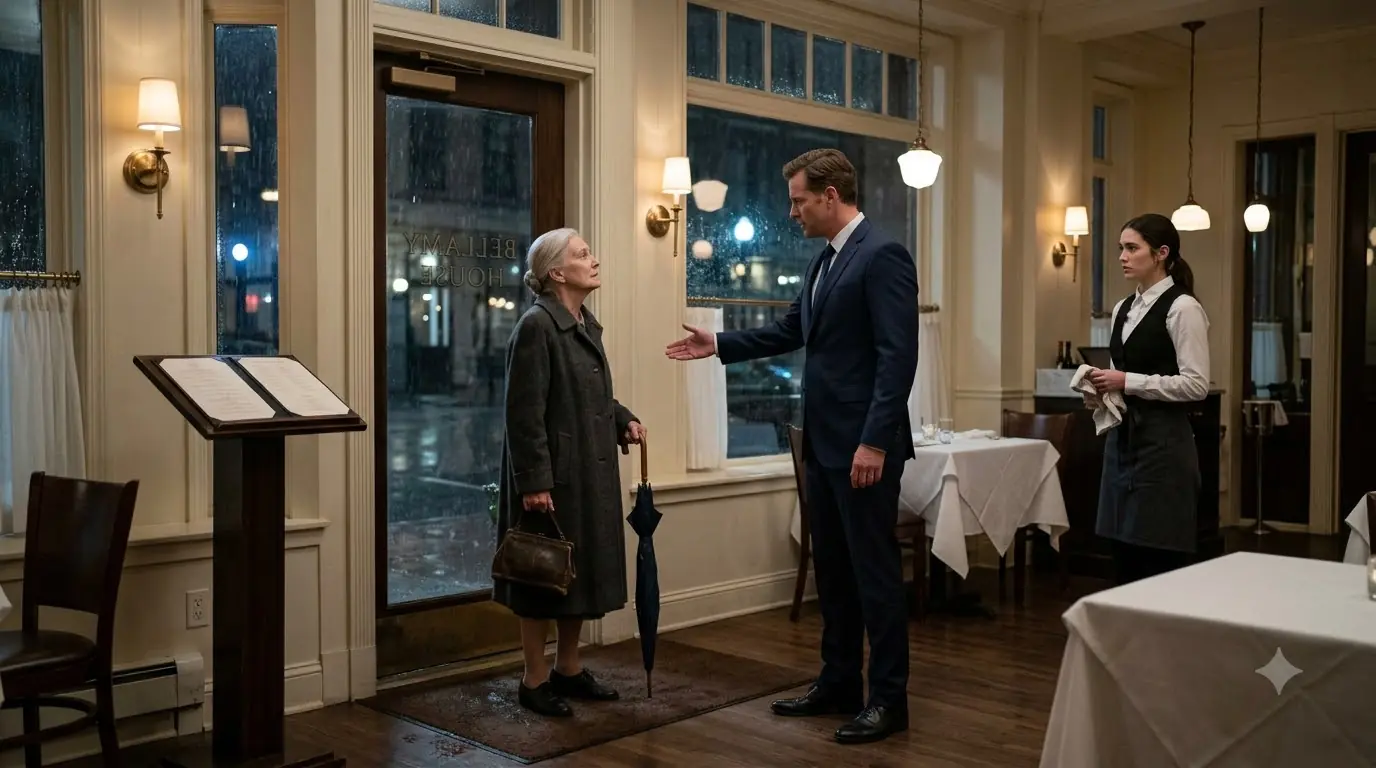
A man in a tailored navy suit approached before the host could answer. He was Bellamy House’s floor manager, Adrian Pike, forty-two years old, precise in every movement and proud of a restaurant he liked to call “the city’s dining room.” He looked Margaret up and down once, then offered a smile that reached only one side of his mouth. “I’m afraid we are fully committed tonight,” he said. Margaret looked toward three empty two-top tables along the rear wall. “Those seem open.” Adrian did not turn to look. “Reserved for later seatings.”
Margaret nodded. “I see. I don’t need a full meal. A cup of chowder would be enough, and perhaps some bread.” Adrian’s smile disappeared altogether. “Madam, Bellamy House has a minimum dining expectation in the evening. We are not a café.” His voice was quiet enough to sound polite and loud enough for the host, two servers, and a couple waiting near the door to hear. “There are several excellent places nearby that may be more appropriate for what you’re looking for.”
At the service station ten feet away, twenty-two-year-old Daniel Ruiz stopped polishing a wineglass. He had heard the entire exchange. Daniel had been working at Bellamy House for eleven months while studying hospitality management at Northeastern, taking morning classes, grabbing whatever sleep he could in the afternoon, and working dinner service until close. He needed the job badly. That afternoon he had opened an email from the bursar informing him that a remaining tuition balance of $3,840 had to be paid within twenty-two days or he would lose registration for the next term.
Daniel had stared at that number until the screen blurred. His mother cleaned offices in Chelsea and had already offered to sell the gold bracelet Daniel’s late father gave her when he was born. Daniel refused. He had picked up extra shifts, skipped meals, and agreed to work Thanksgiving, Christmas Eve, and every private event he could. Bellamy House paid well for a student job, but not well enough to erase $3,840 in three weeks. Losing the position could mean losing school.
Margaret turned toward the door. She did not argue, complain, or ask to speak with anyone else. That quietness bothered Daniel more than anger would have. He thought of his own mother, Teresa, who wore discount-store shoes because she spent money on everyone else first. He imagined her standing in a beautiful lobby like this one, being measured and dismissed before anyone asked her name. Before he could talk himself out of it, Daniel set down the wineglass and stepped forward.
“Ma’am,” he called. Margaret stopped. Adrian’s eyes snapped toward him. Daniel swallowed and pointed toward a small table near the kitchen corridor, half-hidden behind a marble column. “Table twelve is open until the late seating. I can serve you there.” Adrian’s expression hardened. “Daniel.” One word, sharp as the edge of a plate. Daniel pretended not to hear the warning inside it.
Margaret looked at the small table. “I don’t want to cause trouble.” Daniel smiled. “You’re not causing any.” Adrian moved closer. “That table is held for walk-in discretion.” Daniel knew what the phrase meant. Wealthy hotel guests. Influencers. Executives. Anyone management considered worth impressing. Daniel also knew table twelve had remained empty almost every night of the week.
“Then use my staff meal,” Daniel said. The sentence escaped before he had time to consider it. Adrian stared at him. Daniel took the meal voucher from his apron pocket and placed it on the host stand. “Kitchen meal is corn chowder and sourdough tonight. She can have mine.” Margaret shook her head immediately. “No. I can pay.” Daniel gave her a small, embarrassed smile. “I know. But I’ve already made this awkward enough. Please let me make it less awkward.”
Adrian leaned close to him. “You are crossing a line.” Daniel’s pulse began to hammer. “I’m serving a guest.” “You are giving away employee food in the dining room.” “Then deduct it from my check.” “That is not the point.” Daniel looked at Margaret, whose hands were resting lightly on the strap of her old handbag. “Maybe it should be.”
For a second, the entire entrance seemed frozen. Then Margaret stepped toward table twelve. Daniel pulled out the chair for her, poured water, and disappeared into the kitchen. He returned with a bowl of chowder, a small plate of warm bread, and a pat of butter shaped into a neat curl. It was not the restaurant’s famous duck, nor the lobster risotto guests posted online. Yet when he set it down, Margaret looked at the bowl as though it were something sacred.
“Thank you,” she said. Daniel nodded and started to turn away. “Young man.” He stopped. “What is your name?” “Daniel Ruiz.” “Are you always this reckless, Daniel Ruiz?” He laughed under his breath. “Only on Thursdays.” Margaret smiled for the first time.
She tasted the chowder slowly. Her eyes closed for just a moment. Daniel thought she was savoring the warmth after standing in the rain. He did not know the recipe had been served in the same dining room forty-one years earlier, back when the walls were painted cream and the bar was made from salvaged church pews. He did not know Margaret could identify the thyme, bay leaf, and touch of smoked haddock before the spoon reached her lips. And he did not know that the first bowl of chowder ever sold at Bellamy House had been ladled by her own hands.
After a few bites, Margaret looked toward the black-and-white photographs lining the staircase wall. Most guests barely noticed them. One showed the restaurant on opening night in 1985: mismatched wooden tables, handwritten menus, flowers in jelly jars, and a thin young couple standing in front of the door with exhausted smiles. The man wore an apron crookedly tied at his waist. The woman beside him had dark hair, bright eyes, and a flour smudge across one cheek.
Daniel saw where Margaret was looking. “That’s the founders,” he said. “Thomas and Margaret Bellamy. I think.” Margaret’s mouth moved slightly. “You think?” Daniel grimaced. “We’re supposed to know the history, but most of training was about wine pairings and table turnover.” Margaret took another spoonful. “That sounds efficient.” Something in her tone made Daniel wonder if he had disappointed her without knowing why.
Across the room, Adrian watched table twelve with increasing irritation. Bellamy House was expecting a regional banking executive at eight and a celebrity chef at eight-thirty. Every detail mattered to him. Napkins had to be aligned one inch from the table edge. Water glasses had to be filled before they fell below one-third. Servers were expected to avoid phrases like “no problem” because Adrian considered them insufficiently refined. To him, prestige required control, and control required removing anything that seemed unpredictable.
Margaret, in her wet coat and repaired shoes, was unpredictable.
Adrian approached the table after Daniel stepped away. “Madam, I hope everything is satisfactory.” Margaret looked up. “The soup is very good.” “Excellent.” He lowered his voice. “I do need to let you know that this table is required shortly. Perhaps when you’re finished, we can arrange a car to take you somewhere more comfortable.” Margaret dabbed her mouth with a linen napkin. “More comfortable for whom?” Adrian’s jaw tightened. “I simply mean Bellamy House offers a particular experience.”
“And I do not fit it.”
“I did not say that.”