The first thing Dylan Rourke noticed about Mason Cole was the mop. The second was the faded black ink climbing out of the collar of Mason's gray maintenance shirt, disappearing beneath his jaw in a pattern of wings, dates, and old road numbers that looked too deliberate to belong to a man who had spent his whole life changing lightbulbs. The third thing Dylan noticed was that Mason did not seem impressed by him. That, more than anything else, was what started the trouble.
"Hey, biker janitor," Dylan called from the edge of the cage. "Come spar with me. Just for fun." Mason kept pushing the mop across the rubber floor in long, even strokes, his broad shoulders moving beneath the cheap uniform while three younger fighters laughed beside the cage. Dylan grinned toward the camera his social-media guy was holding and added, "One minute. I'll go easy. You look like you've still got somebody at home who needs you in one piece."
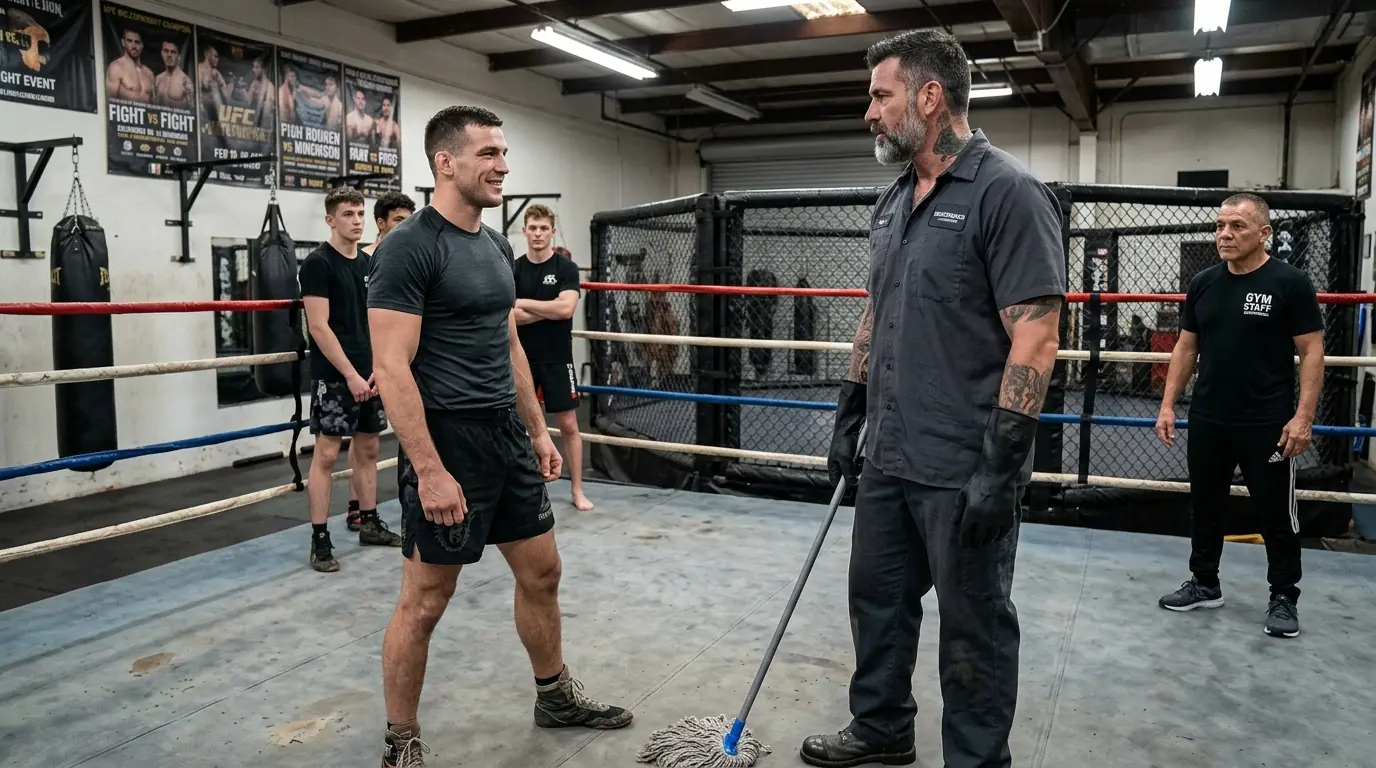
Mason stopped only long enough to look at the clock above the front desk. It was 11:37 in the morning, which meant he had three hours and eight minutes before he needed to leave Summit Fight Lab, drive across town, and be waiting outside Pine Ridge Elementary when his nine-year-old daughter came through the side gate. He did not miss pickup. Not for traffic, not for overtime, not for anybody's ego. "I still have half a shift," he said, and went back to the floor.
Dylan Rourke was the reigning UFC welterweight champion, twenty-nine years old, fast enough to make elite fighters look slow and famous enough that cameras followed him into rooms that had never asked to be filmed. He had come to Summit for a six-week training camp because the gym sat far enough from Los Angeles to feel private and close enough to an airport to keep sponsors happy. During the first week, he had been polite. By the fourth, the difference between training and performing had almost disappeared.
"Touch me once," Dylan said, raising his voice so the room would hear, "and I'll pay you a month's wages." A few people laughed again. Mason did not. He wrung out the mop, turned toward the far corner, and for a moment it looked as though the entire thing would die from lack of oxygen.
Then Dylan said, "Come on, old man. I won't hit you hard enough that your little girl forgets which tattooed fossil is her dad." The laughter changed. Some men still smiled, but uncertainly now, because there are jokes that land in a room and jokes that expose the person telling them. Mason's hand tightened once around the mop handle, then relaxed.
He leaned the mop carefully against the wall. At forty-seven, Mason was six feet three and thick through the chest, with a beard that had gone iron-gray along the chin and forearms covered in old black-and-blue tattoos: a compass rose, a raven, a row of dates, the words BLACK HARBOR in lettering faded enough to look almost like bruises beneath the skin. He wore a plain wedding band on a chain around his neck and steel-toed work boots polished only by use. Nobody in Summit had ever asked what the broken wing tattoo behind his right ear meant.
Mason pulled off his rubber work gloves one finger at a time. "You sure?" he asked.
Dylan spread his arms and laughed toward the camera. "I'm the UFC champion. You're really asking me that?"
"Just making sure this is your call."
Across the gym, Ray Moreno set down his clipboard.
Ray had owned Summit Fight Lab for fourteen years and had coached men who fought on national television, men who disappeared after one bad loss, and men who never made it farther than local cards but understood the sport better than champions did. He also knew Mason better than anyone else in the building. Not completely. Mason did not offer complete versions of himself. But Ray knew enough to recognize the slow roll of Mason's right wrist as he loosened it, and he knew that movement did not belong to a janitor who had watched a few fights on television.
Six years earlier, Mason Cole had walked into Summit at five-thirty in the morning wearing a black motorcycle jacket with the patches removed. The stitching ghosts were still visible across the back. He had asked if Ray needed anyone for maintenance, cleaning, repairs, or night work, and when Ray asked for references Mason slid over a folded list from an electrical contractor, a machine shop, and a small veteran-owned garage in Nevada. He never mentioned fighting.
Ray hired him because the man could fix almost anything and because Mason's only non-negotiable condition was simple: school days ended at two-thirty. He needed to be gone by then. Ray did not ask why until months later, when a small girl with two braids appeared in the gym office holding a science project and announced that her father had forgotten it on the kitchen table. Mason came out of the supply room looking more alarmed than Ray had ever seen him around a broken boiler or electrical short.
Her name was Ellie. She was three when her mother died and nine now, with dark brown eyes, a gap between her front teeth, and the unnerving ability to ask direct questions at the exact moment adults preferred indirect ones. Mason built his life around her with the same care other men gave to retirement accounts or careers. Breakfast at six-thirty, school by eight, Summit before nine, pickup every afternoon, homework at the kitchen table, dinner by seven, and one old Harley under a canvas cover in the garage that he started every Sunday whether he rode it or not.
The motorcycle was the one piece of his old life he had refused to sell. Everything else he had packed away after Nora died: the leather vest, the patched road maps, club photographs, trophies from regional fight cards, a pair of scarred four-ounce gloves, and a steel buckle engraved with ROAD CAPTAIN. Mason had spent nearly twenty years with the Black Harbor Riders, a motorcycle brotherhood that began among dockworkers, mechanics, and veterans and became famous across three states for long charity rides and the kind of loyalty that could feel like family if you needed one badly enough.
Mason had needed one. He joined at twenty-three, after drifting through boxing gyms and construction jobs with more anger than direction. The club did not teach him to fight; he already knew how. But years of club smokers, regional MMA events, wrestling rooms, and old-school boxing trainers sharpened something natural in him: he could read bodies before they committed. A shoulder tightening, a heel becoming light, a breath changing just before an explosion of movement—Mason noticed those things the way a mechanic noticed an engine running one degree wrong.
For seven years, under the nickname Graves, he fought on regional cards from Oregon to Nevada. He never became famous because fame required choices he did not want to make. Better managers wanted him to move south, sign contracts, and let fighting become the center of his life. Black Harbor needed a road captain, his garage job paid reliably, and eventually Nora told him she was pregnant.
He chose the life in front of him. Fighting became training, then occasional sparring, then stories told by men who grew older alongside him. The cage closed behind him for the last time when Ellie was a baby. When Nora died suddenly five years later from a cerebral aneurysm, Mason left Black Harbor too—not because the club had failed him, but because grief made every engine sound like another thing that could carry him away from his daughter.
He moved north, rented a small house near Pine Ridge, and told almost nobody where he had gone. The Riders respected his silence. His old president, Hank Vale, sent one message every Christmas: Light's on if you ever need the road. Mason never answered, but he never deleted the messages either.
At Summit, nobody knew any of that. They knew Mason could repair a speed bag swivel before the manufacturer returned an email. They knew he sometimes corrected the angle of a heavy bag with one hand while walking past. They knew he could hear when a fighter was loading power from the shoulder instead of the hip, though he almost never said anything. Mostly, they knew him as the tattooed maintenance guy who showed up early, spoke little, and left before school pickup.