Arthur Bell heard the padlock break at 2:13 on a humid Tuesday morning.
The sound was sharp and unmistakable.
Metal snapping.
Then the slow groan of the wooden garage doors opening behind his house.
Arthur lay in darkness, staring at the ceiling fan as it moved hot air from one side of the room to the other. Beside his bed, an oxygen concentrator hummed and clicked with mechanical patience.
A clear plastic tube ran beneath his nose.
At eighty-two, every breath had become a negotiation.
The coal mines of his youth had started the damage. Forty years of cigarettes had completed it.
Arthur tried to sit up.
Pain tightened around his chest before his feet touched the floor. He gripped the nightstand and forced himself to breathe slowly through the panic.
Outside, gravel shifted beneath heavy boots.
Not an animal.
Not the wind.
Two people.
Arthur looked toward the dresser across the room.
A revolver rested inside the top drawer.
It might as well have been in another county.
By the time he managed to stand, the garage hinges squealed again.
He shuffled toward the window and pulled aside the faded curtain with one trembling hand.
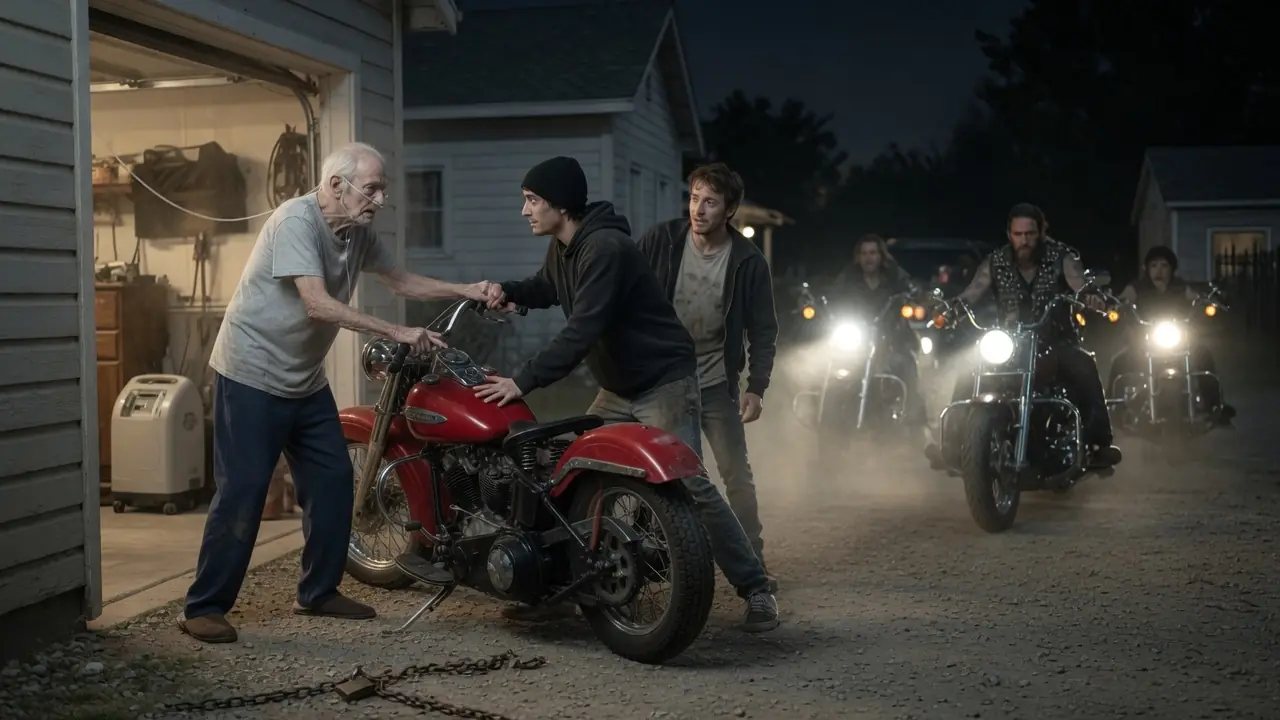
Two thin men stood inside the open garage.
Their movements were quick, nervous, and careless. Their cheeks were hollow. Their clothes hung from their bodies. Even in the darkness, Arthur recognized the restless energy of people who had not slept properly in days.
One man gripped the handlebars of Arthur’s motorcycle.
The other pushed from behind.
The machine rolled slowly into the yellow light from the street.
A 1952 Harley-Davidson Panhead.
Cherry-red paint covered the tank and fenders. Ghost flames appeared only when the light struck from the side. The black leather seat had been shaped by decades of use, and the engine cases still carried the polished marks of Arthur’s hands.
He had purchased the motorcycle in pieces from a collapsing barn in 1974.
The owner wanted two hundred dollars and a promise that Arthur would not turn it into scrap.
Arthur rebuilt the engine on a South Bend lathe inside the garage. He machined parts that no dealer carried, fitted bearings by hand, and painted the tank seven times before the red became deep enough to resemble wet glass.
His late wife, Helen, helped with the final coat.
They rode that motorcycle from California to South Dakota, through Nevada storms, Utah heat, and mountain passes where snow remained beside the road in June.
The Panhead was not simply something Arthur owned.
It was proof that he had once possessed enough air to outrun an entire horizon.
Arthur struck the glass with his fist.
The blow produced a weak thud.
The younger thief turned.
He could not have been more than twenty-five. His eyes were wide and sunken, and a thin smile moved across his mouth when he saw the old man standing behind the window with an oxygen tube beneath his nose.
He did not run.
That was the part Arthur would remember most.
The thief looked directly at him and understood that Arthur could do nothing.
Then he pushed harder.
The motorcycle disappeared down the driveway.
Arthur remained at the window until the gravel stopped moving.
He did not shout.
He could not have produced enough air.
He allowed the curtain to fall, returned to the bed, and sat beneath the slow ceiling fan.
The garage behind the house was empty.
So was something inside him.
Two miles away, Rick Foster and Nolan Price pushed the Panhead through the broken doors of an abandoned produce warehouse.
The building had been empty for twelve years. Rain entered through holes in the corrugated roof, weeds grew through cracks in the concrete, and old loading equipment rusted against the walls.
Rick leaned the motorcycle against a pillar.
He was thirty-eight and carried the restless movements of a man whose body had forgotten how to be calm.
Nolan circled the Panhead.
“This thing is perfect.”
“Don’t touch the paint.”
Nolan ran one dirty finger across the leather seat anyway.
“It has to be worth thirty grand.”
“To someone with clean paperwork.”
Rick removed a burner phone.
“We don’t have paperwork.”
“We could change the numbers.”
“You can barely change a tire.”
Nolan looked toward the warehouse entrance.
“The old man saw us.”
Rick laughed.
“What is he going to do? Chase us with his oxygen machine?”
Nolan did not answer.
The old man’s face in the window had unsettled him.
Not because Arthur looked dangerous.
Because he looked completely helpless.
Rick dialed a number.
A man in Bakersfield answered after several rings.
“I have something,” Rick said. “Old Harley. Panhead.”
The voice on the other end became interested.
“What year?”
“Fifty-two.”
“Original cases?”
“Looks like it.”
“Numbers clean?”
“Not yet.”
The buyer paused.
“Send photographs.”
Rick took several pictures.
“Three thousand cash,” the buyer said after receiving them.
Nolan turned sharply.
“Three?”
Rick held up one finger to silence him.
“Five.”
“Three and a half. I bring the van before noon.”
The call ended.
Nolan stared at Rick.
“You’re selling a thirty-thousand-dollar motorcycle for thirty-five hundred?”
“I’m selling a stolen engine before someone identifies it.”
“It belongs to a dying old man.”
Rick’s expression hardened.
“It belongs to whoever can keep it.”
Morning arrived over San Joaquin Valley beneath a dirty gray sky.
By seven, heat already rose from the pavement.
Arthur’s daughter reached the house shortly after eight.
Laura Bell was forty-nine and had learned to balance exhaustion so carefully that most people did not notice it. She worked night shifts as a hospital nurse, slept when she could, and visited her father every morning before going home.
She entered carrying coffee and groceries.
“Dad?”
Only the oxygen machine answered.
Laura found him at the kitchen table.
He was fully dressed in his old denim work shirt and heavy boots. A cold cup of coffee rested between his hands.
She immediately examined his face.
“Are you having trouble breathing?”
Arthur pointed toward the window.
Laura looked outside.
The garage doors stood open.
The rectangular oil stain where the Panhead had rested for decades was visible on the concrete.
“Oh, Dad.”
“Two of them,” Arthur said.
His voice sounded like gravel moving inside a metal pipe.
“You saw them?”
“Took it around two.”
Laura reached for her phone.
“I’m calling the police.”
Arthur closed one hand around her wrist.
The grip surprised her.
“No.”
“What do you mean, no?”
“They’ll write a report.”
“They can put out an alert.”
“By the time the alert reaches anyone, the engine will be inside a van.”
Laura pulled her wrist free.
“So we do nothing?”
Arthur looked at her.
The weakness disappeared from his eyes.
“I did not say that.”
He nodded toward the hallway.
“Red toolbox. Top drawer. Under the sockets.”
Laura found an old black address book inside the drawer.
The leather cover had cracked along the spine. Some of the names inside belonged to people who had been dead for decades.
“Back pages,” Arthur instructed. “Under D.”
Laura flipped through the yellow paper.
One entry appeared beneath the letter.
Dawson — Wade
A local number followed.
Laura knew the name.
Everyone in Briar County did.
Wade Dawson was president of the Black River Riders, a motorcycle club whose members were watched carefully by police and avoided by people who valued uncomplicated lives.
His road name was Cutter.
Laura closed the book.
“No.”
Arthur took another breath through the tube.
“Call him.”
“You promised Mom you were finished with that world.”
“I have not ridden with them in thirty years.”
“They are criminals.”
“Some are.”
“Dad.”
Arthur leaned forward.
“I built their motorcycles when nobody else would touch them. I gave men jobs after prison. I let them sleep in this house when their families threw them out.”
His breathing became rougher.
“I removed a bullet from Wade’s shoulder because he could not go to a hospital without being arrested.”
Laura stared at him.
“You performed surgery?”
“I used pliers.”
“That is not better.”
“It worked.”
Arthur rested one hand on the table.
“They understand debts.”
“The police understand laws.”
“I do not want a law explained to me.”
His voice weakened, but the determination did not.
“I want my motorcycle back while it is still a motorcycle.”
Laura looked through the kitchen window at the empty garage.
The Panhead had occupied nearly every story of her childhood.
Her mother riding behind Arthur through the Badlands.
Arthur teaching Laura to polish chrome when she was eight.
The sound of the engine waking the neighborhood every Sunday morning.
After Helen died, Arthur stopped taking long rides. As his breathing worsened, he rode only to the gas station and back.
Eventually, he could not ride at all.
But he still entered the garage each day.
He wiped dust from the tank.
Checked the oil.
Pressed one hand against the leather seat as though greeting an old friend.
The motorcycle was the final part of his life that illness had not already taken.
Laura opened her phone and dialed.
A low voice answered.
“Yeah.”
“Is this Wade Dawson?”
“Who wants to know?”
“My name is Laura Bell. I’m calling for Arthur.”
Silence.
The hostility disappeared from the man’s voice.
“Art Bell?”
“Yes.”
“How is he?”
Laura looked at her father.
“Not well.”
“What happened?”
“Someone broke into his garage last night.”
She swallowed.
“They took the Panhead.”
The line became completely silent.
Laura heard music and voices in the background.
Then a chair scraped against the floor.
“Where are you?”
“At his house.”
“Put coffee on.”
The call ended.
Laura lowered the phone.
“He hung up.”
Arthur leaned back.
A grim smile appeared.
“He’s coming.”
The Black River Riders’ clubhouse stood on the industrial edge of town behind a chain-link fence.
Wade Dawson placed his phone on the bar.
He was sixty-three, broad through the shoulders, with a steel-gray beard and heavy forearms covered in faded tattoos.
Several members were playing cards near the pool table.
Wade raised one hand.
Every conversation stopped.
“Rourke.”
A lean man stepped away from the wall.
Elias Rourke served as the club’s sergeant at arms. A scar ran from his ear to his collarbone, and he spoke only when words improved a situation.
“Someone hit Arthur Bell.”
The older members straightened.
The younger ones looked confused.
“What did they take?” Elias asked.
“The fifty-two.”
A curse came from the card table.
Everyone over forty knew the Panhead.
More importantly, they knew Arthur.
In 1987, Wade had been shot after a fight outside a roadhouse.
He reached Arthur’s garage near dawn, bleeding through his jacket.
Arthur hid the motorcycle beneath a tarp, brought Wade into the basement, and removed the bullet with sterilized pliers while police cruisers searched the county.
He asked for no money.
The following morning, he handed Wade coffee and said, “Try not to get shot again. I don’t enjoy this.”
Arthur had helped others too.
He repaired motorcycles without charging men who had just returned from prison.
He taught welding to a rider who later opened a fabrication shop.
He loaned tools, hid frightened prospects from abusive fathers, and drove injured men to hospitals when the club’s pride told them not to call ambulances.
Arthur never wore the Black River patch.
That made no difference.
He was family.
“Call church,” Wade said.
Elias removed his phone.
“Mandatory?”
“Everyone.”
Within minutes, calls and messages reached construction sites, garages, bars, warehouses, and homes across the county.
Seventy-five members and prospects gathered inside the compound.
Motorcycles filled the yard.
Wade stood on the clubhouse steps.
“Last night, two men stole Arthur Bell’s Panhead.”
Anger moved through the crowd.
“For those of you who don’t know him, learn now.”
Wade looked toward the younger members.
“Arthur is the reason some of your officers survived long enough to become old men. He taught trades to men nobody trusted. He gave shelter without asking whether it was deserved.”
He paused.
“He is dying.”
The yard became quiet.
“That motorcycle is the last thing he asked this world to leave him.”
Wade’s voice hardened.
“We bring it home whole.”
A younger member lifted his chin.
“What about the thieves?”
“We find them.”
“And then?”
Wade looked across the group.
“We do not turn Arthur’s name into an excuse for stupidity.”
The answer surprised several people.
“We are not starting a war. We are not giving police a reason to seize the motorcycle as evidence for six months.”
He pointed toward Elias.
“Check pawn shops, scrapyards, independent garages, storage yards, and known fences.”
Then toward a contractor named Malcolm Reed.
“Take the prospects through motels, abandoned properties, and dealers. Ask questions. Do not create victims.”
Malcolm nodded.
“The rest work the roads in groups of five. Watch vans, trailers, and warehouses. Anyone finds the motorcycle, nobody touches it until I arrive.”
Wade stepped down.
“We are not looking for revenge.”
His eyes swept across the riders.
“We are taking an old man’s life back from people who thought weakness meant permission.”
The motorcycles left in disciplined groups.
The noise rolled across town.
Cars pulled aside as black motorcycles divided at intersections and disappeared down county roads.
People assumed the club was hunting for blood.
In reality, the riders were hunting for information.
They visited mechanics, pawn shops, recyclers, storage facilities, and men who purchased stolen parts behind legitimate businesses.
Arthur’s Panhead was distinctive.
Cherry-red tank.
Hand-machined rocker boxes.
A small silver inlay beneath the seat containing Helen Bell’s initials.
Anyone familiar with motorcycles would recognize it.
Sheriff Daniel Mercer received the first call at 9:17.
“Black River Riders are moving all over town.”
Daniel looked at the theft report Laura had finally agreed to file after Wade arrived.
He had known Arthur since childhood.
Arthur once repaired Daniel’s father’s motorcycle for the price of a homemade pie.
The sheriff understood what the club’s movement meant.
He also understood what could happen if seventy-five angry riders reached the thieves before his deputies did.
Daniel drove to Arthur’s house.
Wade sat at the kitchen table drinking coffee.
Laura stood near the counter.
Arthur rested in a chair with the oxygen tube beneath his nose.
Daniel removed his hat.
“I’m sorry about the bike.”
Arthur nodded.
“You filed the serial number?” Daniel asked Laura.
“Yes.”
Daniel looked toward Wade.
“How many men are searching?”
“Enough.”
“I need a number.”
“Seventy-five.”
Laura closed her eyes.
Daniel pulled out a chair.
“No one is kicking down doors.”
Wade drank his coffee.
“Then your deputies should arrive first.”
“That sounds like a threat.”
“It is advice.”
Arthur lifted one hand.
Both men stopped.
“I want the motorcycle,” he said. “Not a funeral.”
Daniel looked at Wade.
“You heard him.”
“I heard him before you arrived.”
The sheriff placed a card on the table.
“You find it, call me.”
Wade picked up the card.
“You answer?”
“For Arthur, yes.”
The search tightened by noon.
A scrapyard owner remembered two men asking whether anyone purchased vintage Harley parts without paperwork.
A motel clerk saw a white cargo van heading toward the abandoned agricultural district.
A mechanic outside Bakersfield received photographs of a cherry-red Panhead from a burner phone and forwarded them to a former Black River member.
The former rider recognized Arthur’s custom intake manifold immediately.
The information reached Elias.
The buyer was named Stanley Voss.
He operated a motorcycle dismantling business from a warehouse south of Bakersfield. Publicly, he sold used parts.
Privately, he removed identification numbers from stolen engines.
Wade called Sheriff Mercer.
“Buyer is moving north in a white van.”
“Location?”
“Highway 43.”
“How do you know?”
“I asked better questions than you.”
Daniel ignored the insult.
“Where is the motorcycle?”
“Not with the buyer yet.”
“Then we find the sellers.”
Wade looked toward the map spread across the clubhouse table.
“Abandoned produce district. Five possible buildings.”
“I’m sending deputies.”
“You have twelve minutes.”
“That is not enough.”
“It is what you have.”
At the warehouse, Rick received a message from Stanley.
Ten minutes away. Have the engine ready.
Rick opened a toolbox.
Nolan watched him remove a wrench.
“What are you doing?”
“Taking the tank and seat off.”
“The buyer said complete motorcycle.”
“The buyer will pay less if he has to do the work.”
Nolan looked toward the red paint.
“Maybe we should give it back.”
Rick stared at him.
“You want to push it two miles uphill?”
“The old man saw us.”
“So?”
“He looked…”
“What?”
Nolan struggled to explain.
“Like we took the wrong thing.”
Rick laughed.
“There is no right thing to steal.”
“That’s not what I mean.”
The sound reached them before either man could continue.
Motorcycles.
Not one.
Many.
The low thunder moved through the warehouse walls.
Rick dropped the wrench.
Nolan ran toward a broken window.
Black motorcycles entered the industrial district from both directions.
“Who are they?” he whispered.
Rick’s face changed.
He recognized the patches.
“We need to go.”
They ran toward the rear exit.
Five riders appeared outside.
Rick turned back.
Another group entered through the front.
Nobody shouted.
Nobody swung weapons.
The silence frightened him more.
Wade walked into the warehouse with Elias beside him.
His eyes found the Panhead first.
The motorcycle remained intact.
Relief moved across his face for less than a second.
Then he looked at Rick and Nolan.
“Which one of you smiled at Arthur through the window?”
Nolan’s face went pale.
Rick pointed toward him immediately.
“He did.”
Nolan stared.
“You said he was practically dead.”
Wade approached.
The riders formed a quiet wall around the thieves.
“You watched him standing behind the glass?”
Nolan nodded.
“And you kept pushing?”
“Yes.”
“Why?”
Nolan looked at the floor.
“Because he couldn’t stop us.”
Wade became completely still.
“That is the answer I expected.”
Rick glanced toward the side door.
Elias moved half a step.
Rick stopped.
Wade looked toward the motorcycle again.
“You know what you stole?”
“A Harley.”
“No.”
He pointed toward the silver inlay beneath the seat.
“Arthur placed his wife’s initials there after she died.”
Nolan swallowed.
“He built this motorcycle by hand. It carried them across half the country. When his lungs failed, he stopped riding but kept the engine alive.”
Wade faced them.
“You did not choose the motorcycle because it was valuable.”
His voice remained quiet.
“You chose it because the owner looked weak.”
A siren approached outside.
Rick’s expression shifted.
“You called the police?”
Wade almost smiled.
“Arthur did not want a funeral.”
Sheriff Mercer entered with four deputies.
He examined the motorcycle.
Then the thieves.
“Hands where I can see them.”
Rick obeyed immediately.
Nolan began crying.
One deputy secured them while Daniel walked toward Wade.
“You touched them?”
“No.”
Daniel glanced at Elias.
“He?”
“No.”
“You expect me to believe seventy-five bikers found two thieves and waited politely?”
Wade looked toward the Panhead.
“We promised Arthur the motorcycle, not entertainment.”
A white cargo van appeared at the warehouse entrance.
Stanley Voss braked when he saw the motorcycles and police vehicles.
He attempted to reverse.
Two deputies blocked the road.
The buyer was arrested with equipment used to remove serial numbers, several stolen engine cases, and cash divided into envelopes.
The investigation would later connect him to more than twenty motorcycle thefts.
Nolan confessed before reaching the county jail.
Rick did not.
It did not matter.
Warehouse security footage, burner-phone records, photographs, and Arthur’s identification of Nolan provided more than enough evidence.
The Panhead returned to Elm Street on a flatbed.
Arthur sat on the porch beneath a portable oxygen tank.
Seventy-five motorcycles lined the road.
Neighbors watched from windows and driveways.
Laura stood beside her father.
When the flatbed turned the corner, Arthur’s eyes filled.
The riders unloaded the motorcycle carefully.
Wade pushed it up the driveway.
He stopped in front of Arthur.
“We found some scratches on the lower frame.”
Arthur looked at the bike.
“They are small.”
“We’ll repair them.”
“No.”
Wade frowned.
Arthur touched the tank.
“Leave them.”
“Why?”
“So I remember it came back.”
The riders remained silent.
Arthur ran one hand over the leather seat.
His breathing rattled inside his chest.
“Start it,” he said.
Wade looked toward Laura.
She nodded.
A mechanic checked the fuel, oil, ignition, and choke.
He found compression, moved the engine slightly beyond it, then committed to the kick.
The Panhead coughed once.
The second kick awakened it.
The exhaust cracked across Elm Street.
Arthur closed his eyes.
The engine settled into its deep, uneven rhythm.
The oxygen machine hummed beside him.
For one minute, the two sounds existed together.
The machine keeping him alive.
The motorcycle reminding him why life had mattered.
Arthur opened his eyes.
“Wade.”
The club president stepped closer.
“Take me around the block.”
Laura turned.
“Dad, no.”
“I am not driving.”
“You can barely walk.”
“I can sit.”
Wade looked at her.
“I will not let him fall.”
Laura stared at her father.
He had already placed one hand on the chair arm.
“Please,” he said.
It was the first time she had heard desperation in his voice.
The riders brought a sidecar from the clubhouse.
Arthur had fabricated it decades earlier for a disabled veteran who still wanted to ride. The sidecar attached to the Panhead with brackets Arthur himself had designed.
Within forty minutes, it was secure.
Laura helped her father into the seat.
The oxygen cylinder rested beside his leg.
Wade mounted the motorcycle.
“Where?”
Arthur looked toward the western road.
“The reservoir.”
The riders followed.
Seventy-five motorcycles moved behind the Panhead as Wade carried Arthur through town.
People stepped outside.
Some removed hats.
Sheriff Mercer stood beside his cruiser and saluted as they passed.
At the reservoir overlook, Wade stopped.
Arthur looked across the valley.
Helen’s ashes had been scattered from that hill.
The wind moved through the dry grass.
Arthur removed the oxygen tube briefly.
Laura immediately leaned toward him.
“Dad.”
“One second.”
He inhaled as deeply as his damaged lungs allowed.
The breath was small.
Painful.
Entirely his.
Then he replaced the tube.
“Worth it?” Wade asked.
Arthur smiled.
“Every mile.”
They remained until sunset.
The riders gave Arthur space.
Laura sat beside him on the low stone wall.
“Mom would have yelled at you,” she said.
“She yelled during most good decisions.”
“That isn’t how I remember her.”
“You were not present for the interesting years.”
Laura laughed.
Arthur looked toward the Panhead.
“When I die, do not put it in a museum.”
Her smile faded.
“Dad.”
“Listen.”
She did.
“Machines are built to move. People too.”
He looked toward Wade.
“Let someone ride it.”
“Who?”
Arthur’s eyes moved across the younger club members.
Some had jobs because he taught their fathers trades.
Some were alive because older riders had learned from him that asking for help was not weakness.
“You will know.”
Arthur died eleven weeks later inside his home.
Laura sat beside him.
Wade arrived ten minutes after the call.
He did not bring the entire club.
Only Elias.
The two men stood in Arthur’s bedroom while morning light entered through the curtains.
Wade removed his leather vest and placed it over the chair.
Then he sat beside the bed.
“You brought it home,” Arthur whispered.
“We did.”
“You kept your head.”
“Mostly.”
Arthur’s mouth moved slightly.
“That is progress.”
Wade’s eyes filled.
“I never paid you back.”
Arthur looked toward him.
“You lived.”
“That is not enough.”
“It was the point.”
Arthur’s hand rested weakly on the blanket.
“Take care of Laura.”
Wade nodded.
“And the bike?”
“It moves.”
Arthur closed his eyes.
“Good.”
His breathing slowed.
The concentrator continued humming after his chest stopped moving.
At the funeral, the road from the church to the cemetery filled with motorcycles.
Not seventy-five.
More than three hundred.
Mechanics, veterans, construction workers, club members, police officers, and people Arthur had helped without remembering their names came to say goodbye.
Sheriff Mercer walked beside Wade.
Neither man commented on the strangeness of it.
Arthur’s Panhead led the procession.
Laura rode in the sidecar.
Wade drove.
The scratches from the theft remained on the lower frame.
One year later, the Black River Riders established the Arthur Bell Workshop inside an abandoned service station.
The program taught welding, motorcycle repair, electrical work, and machining to veterans, young adults leaving prison, and teenagers who had dropped out of school.
No one was required to join the club.
No one was asked about patches.
The first rule was painted above the main workbench.
WEAKNESS IS NOT PERMISSION.
The second came from something Arthur often said.
IF YOU KNOW HOW TO FIX IT, TEACH SOMEONE.
Nolan Price served four years in prison.
During his second year, he wrote Laura a letter.
He did not ask for forgiveness.
He described the moment he saw Arthur at the window.
I knew he couldn’t stop me, and that made me feel powerful. I understand now that it only proved I was smaller than him.
Laura kept the letter for several months.
Then she sent one reply.
Be larger when you leave.
After his release, Nolan appeared at the Arthur Bell Workshop.
Wade met him at the entrance.
Several club members immediately stopped working.
Nolan remained near the door.
“I don’t want trouble.”
“That is a promising beginning,” Wade said.
“I need work.”
“You need money?”
“I need to learn how not to become who I was.”
Wade studied him.
Nolan’s face was healthier. His clothes were clean. His hands shook, but not from drugs.
“You know whose name is above that door?”
“Yes.”
“You know what happens if you steal?”
“Yes.”
“What happens?”
Nolan looked toward the Panhead resting inside the shop.
“I become smaller again.”
Wade handed him a broom.
“You start with the floor.”
Nolan swept for three weeks before anyone allowed him to touch a tool.
He later became one of the workshop’s most patient instructors.
He taught young mechanics never to place greasy fingers on painted fuel tanks.
When students asked how he learned that lesson, he told them the truth.
Every year on Arthur’s birthday, the Black River Riders took the Panhead to the reservoir.
The motorcycle was never placed behind glass.
It accumulated miles.
Stone chips appeared near the front fender.
The leather darkened beneath rain and sunlight.
The engine required repair more than once.
Each time, someone who learned from Arthur’s students helped restore it.
Laura rode in the sidecar during the first memorial run.
In later years, veterans, injured riders, elderly mechanics, and people who thought they would never sit beside a motorcycle again took her place.
Wade always drove the first mile.
At the overlook, the riders shut down their engines.
The valley became quiet.
Then Wade started the Panhead alone.
Its exhaust moved across the reservoir and returned from the hills.
Arthur had once believed the motorcycle was the final proof he had ever been strong.
He had been wrong.
His strength did not live inside the engine.
It lived inside the people who stopped their lives when his call came.
Inside the riders who chose restraint when anger would have been easier.
Inside the sheriff who understood that recovering the motorcycle mattered more than winning authority.
Inside the daughter who let her dying father feel the wind once more.
Inside the former thief who returned to sweep a workshop floor rather than continue disappearing into his worst decision.
The two men who stole Arthur Bell’s Panhead believed they had chosen an easy victim.
An old man.
A plastic oxygen tube.
A dark house.
No immediate consequence.
They never understood that helplessness and loneliness were not the same thing.
Arthur could no longer run down his driveway.
He could not fight them.
He could barely call for help himself.
But decades earlier, when he still possessed strong hands and powerful lungs, he had used them to repair people as carefully as he repaired motorcycles.
He opened his garage.
He taught.
He hid the frightened.
He helped the wounded.
He asked for nothing.
Those acts had formed a web around him.
The thieves could not see it in the darkness.
By sunrise, seventy-five motorcycles were moving through the county.
Not because Arthur Bell was feared.
Because he was loved.
And love, when built through decades of loyalty, can become a reckoning far more powerful than violence.