The heat in Atlanta had a way of making every street look like it was holding its breath.
By ten in the morning, the sidewalks shimmered. By noon, the bus stops smelled like hot concrete, car exhaust, and somebody's lunch left too long in a plastic bag. People moved slowly, with shoulders hunched and eyes narrowed against the glare, and every corner store on the south side had a line of customers reaching for cold drinks before they reached for anything else.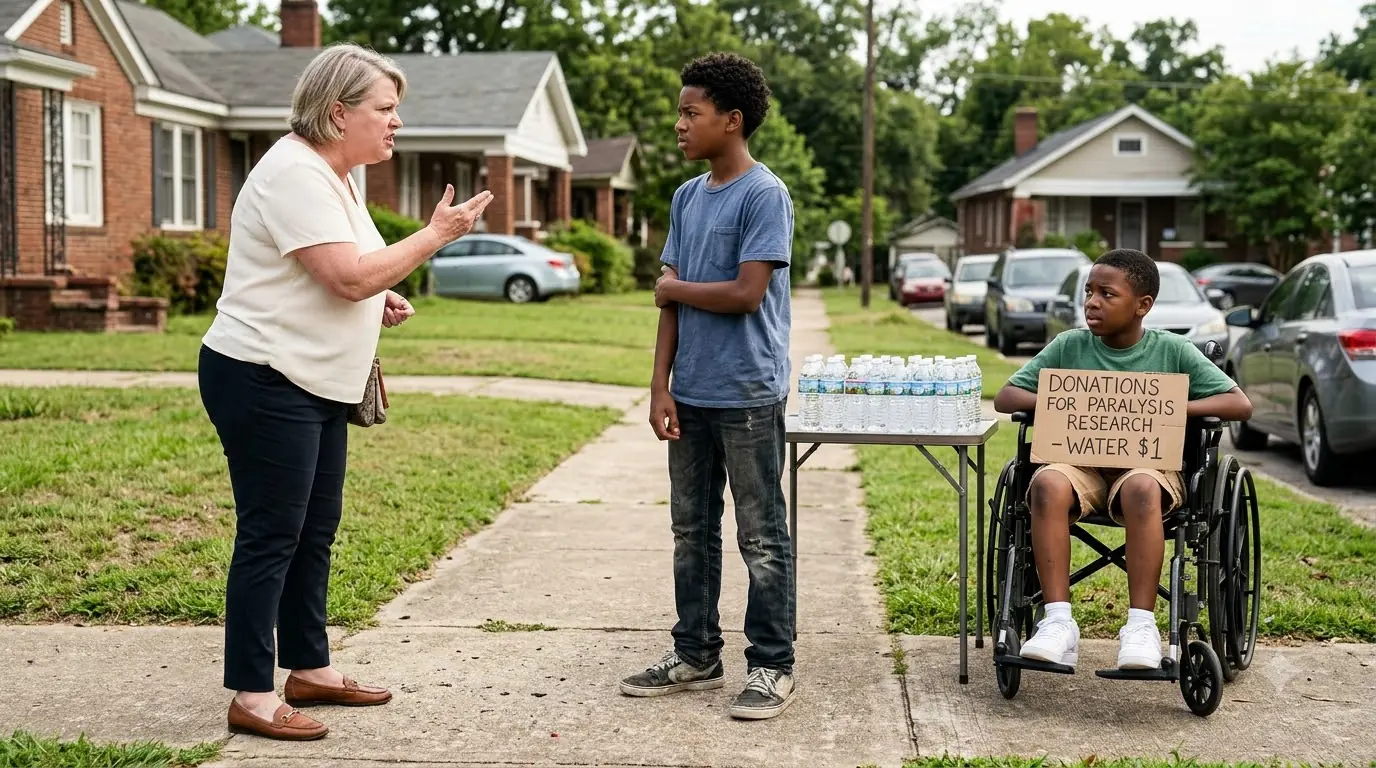
Jamal Pierce had noticed that long before anyone at the shelter believed his plan could work.
He noticed everything. That was what Sister Helen always said about him. Some boys watched the world. Jamal studied it. At fourteen, he had the narrow build of a kid who had grown too fast on too little food, dark brown eyes that rarely missed a detail, and a battered backpack stuffed with notebooks, library books, and two calculators, one of which only worked if he held the battery cover down with his thumb.
Beside him, Darnell Brooks sat in his wheelchair with a cardboard sign across his lap, carefully coloring the last letter in the word WATER with a blue marker. He was twelve, small for his age, with bright eyes, quick hands, and a smile that arrived easily until fear chased it away. His legs had not worked right since a fever when he was six, and the old wheelchair beneath him squeaked whenever the front wheels turned too sharply. The left brake was loose, the right armrest was taped twice, and Darnell treated the chair like it was both a problem and a race car, depending on the day.
"You really think we can raise three thousand dollars selling water?" Darnell asked, glancing up from the sign.
Jamal stacked the bottles in rows on the folding table they had borrowed from the church basement. "Yep. We sell one hundred bottles a day at three dollars each. That's three hundred dollars. The first cases cost us fifty, so if we keep reinvesting, we can clear around two hundred fifty a day. Twelve days if everything goes perfect. Maybe sixteen if it doesn't."
Darnell blinked at him. "How do you get so smart?"
"Books," Jamal said without looking up. "Anything you need to know is in a book. That and listening when people think you aren't listening."
Darnell smiled and held up the sign. It read: COLD WATER — HELP REBUILD OUR ORPHAN HOME.
The words looked uneven, but the meaning was clear.
Three weeks earlier, a fire had torn through the back wing of Hopewell Children's Residence, the old brick building that had housed them both since they were small. No one died, but the kitchen collapsed, the laundry room burned black, and the dormitory where the younger boys slept was ruined by smoke and water. The county placed half the children in temporary homes and sent the rest to a church gymnasium that smelled of floor wax and old hymnals. Jamal and Darnell had been lucky enough to stay together, but luck had never felt so thin.
Sister Helen had spent every night calling donors, insurance adjusters, contractors, churches, and city offices. Jamal had heard the number she whispered when she thought the boys were asleep: three thousand dollars needed before the contractor would even begin the emergency repairs insurance refused to cover. Three thousand dollars stood between them and getting the youngest kids out of cots under a basketball hoop.
So Jamal made a plan.
He found a discount warehouse willing to sell water by the case. He convinced Mr. Alvarez at the corner market to let them use ice from the back freezer. He found a wagon with one good wheel and one stubborn one. He calculated profit margins in the margin of his math homework and practiced sales lines with Darnell until Darnell could make a thirsty man feel irresponsible for not buying two bottles.
That Saturday, they rolled their small business to a busy corner near Piedmont Park where runners, dog walkers, tourists, and parents with strollers moved through the heat in a steady stream.
"Water!" Darnell called, lifting the sign. "Cold, clean, delicious water! You don't want heatstroke today!"
Jamal laughed. "Great advertising."
"Learned from the best," Darnell said.
Their first customer was an elderly man in a straw hat who walked with a cane and wore suspenders over a faded blue shirt. He stopped in front of the table, read the sign, and looked from Jamal to Darnell.
"Now that's a sales pitch," he said. "I'm too old to be out here without something to drink."
"All the proceeds go to our orphan home," Jamal explained. "The back wing burned down. We're helping rebuild it."
The man's face softened. "Nothing like young men taking matters into their own hands. How much?"
"Three dollars," Darnell said. "But you should take two. Just in case you lose one."
The old man laughed hard enough to wipe his eye. "At my age, I might forget I bought the first one before I reach the corner. You're right. Make it two."
He handed them a ten and waved away the change. Jamal put the money carefully into the lockbox Sister Helen had lent them.
By lunch, they had sold forty-three bottles. By two o'clock, they had sold seventy-one. Some people bought one. Some bought two. A woman in running shorts bought five and handed them out to her friends. A man in a delivery uniform bought a bottle, drank half of it in one breath, then bought another because, he said, the boys were better at business than half the grown folks he knew.
"Doctors recommend staying hydrated!"
"Your dog looks thirsty too!"
"This water is so cold it might hurt your feelings!"
Jamal laughed every time, but he also watched the money box with the serious focus of someone guarding more than cash. That box held repairs. It held beds. It held a kitchen where Sister Helen could cook spaghetti again instead of serving sandwiches from a church cooler. It held the possibility that Hopewell would still feel like home when they returned.
Then a white SUV rolled to the curb.
The woman who stepped out looked like she had never been hot in her life. Her hair was cut into a sharp blond bob, her sunglasses were too large for her face, and her linen pants had a crease so perfect Jamal wondered if they had been ironed while she stood in them. She carried a leather handbag against her ribs like the whole sidewalk might try to steal it.
Her eyes landed on the table. Then on Jamal. Then on Darnell's wheelchair. Her mouth tightened.
"What are those boys doing in this neighborhood?" she said, though no one had asked her anything.
Jamal had learned to identify danger by tone before it became action. He straightened, keeping his hands visible on the table.
"Good afternoon, ma'am," he said. "Would you like to buy a cold water? All proceeds help repair our children's home."
The woman recoiled as if he had offered her poison.
"Keep your drug-filled water away from me," she snapped. "I know exactly what you people do."
Darnell's smile disappeared. "Ma'am, it's just bottled water. The caps are sealed."
"Don't talk back to me, boy." She stepped closer, staring down at him. "Stand up when you're speaking to an adult."
Jamal moved before he thought. He placed himself slightly between her and Darnell. "He can't stand, ma'am. He's in a wheelchair."
Her eyes narrowed. "Are you calling me stupid?"
"No, ma'am. I'm saying he can't stand."
"Where are your parents?"
Darnell swallowed. "We're orphans."
The woman gave a cruel little laugh. "Of course you are. And now you're out here bothering decent people for money. Where's your permit?"
Jamal hesitated. "Permit?"
"Didn't anyone teach you anything in those schools I pay for with my taxes? You need a permit to sell anything. It's called living in a civilized society."
A man passing by slowed, looked at the boys, then at the woman, and kept walking. Two joggers glanced over but did not stop.
Jamal felt heat climb up his neck. "We didn't know, ma'am. We'll pack up if we're not supposed to be here."
"Oh, now you suddenly want to obey the law." She reached toward the cooler. "What's in here? More drugs?"
"Please don't touch that," Jamal said.
She flipped open the cooler lid anyway. Bottles rolled against one another in the melting ice. She grabbed one, examined it like evidence, then let it drop onto the pavement. It cracked and spilled water across the sidewalk.
"Look what you made me do," she said. "Clean that up. Littering is illegal too."
Darnell's hands trembled on the rims of his wheels. "Why are you so mean?"
The woman leaned toward him until Jamal could smell mint and expensive perfume. "You think this is mean? You're getting off easy. People like you need to learn your place."
Something cold moved through Jamal's chest. He had heard people say ugly things before. At school. On buses. Outside stores where guards followed them with bored suspicion. But Darnell had not built the same armor yet. Darnell still believed that if he explained himself clearly enough, adults would become fair.
Jamal knew better.
He closed the cooler and lifted the lockbox. "We're leaving."
"Good," the woman said. "Take your ugly little operation somewhere else."
They packed in silence. Darnell did not speak until they had pushed the wagon three blocks away and turned down a quieter street.
"Did we do something wrong?" he asked.
Jamal kept his eyes forward. "No."
"Then why did she talk like that?"
Because some people needed someone beneath them to feel tall. Because a boy in a wheelchair still had to be brave enough to hear cruelty and not believe it. Because orphan boys selling water on a hot day made some people see hope and others see invasion.
Jamal said none of that.
"Because she's wrong inside," he said. "That's all."
They moved to another corner near a MARTA station, far from the woman's street. The afternoon crowd was better there. Office workers bought bottles. A bus driver bought one and told them to keep grinding. A group of college students bought a dozen and posted the boys' sign online. By six o'clock, Jamal counted two hundred and six dollars in profit.
Darnell stared at the money like it might vanish. "We did amazing."
"Told you," Jamal said. "This is the spot. We come here every day, we hit the goal early."
Darnell looked down at his hands. "Thank you for being my big brother."
Jamal paused with the money halfway into the envelope.
"We're not related," Darnell added quickly. "I know that. But in my mind and heart, you are."
Jamal looked away, pretending to check the cooler because his throat had tightened. He had been nine when Darnell arrived at Hopewell with one plastic bag, a medical folder, and a wheelchair too big for him. Darnell had cried the first three nights without making noise. On the fourth, Jamal had dragged his mattress across the room and slept beside him on the floor.
Blood had never been the thing that made them brothers.
"You are my brother," Jamal said. "Blood doesn't mean anything when you've got a true bond."
Darnell grinned. "One day, we're both getting into great colleges."
"You engineering. Me business."
"Then we get our own place."
"Then we come back and help kids like us," Jamal said.
They were still smiling when the white SUV rolled up beside the curb.
Jamal's smile vanished first.
The blond woman stepped out slowly, as if she had been hunting them all afternoon. Her sunglasses were gone now, and her eyes were sharp with satisfaction.
"What did I tell you?" she said. "You thought you could just move your little scheme to another street?"
Darnell whispered, "Jamal."
"Ma'am, we left your neighborhood," Jamal said. "We're not bothering you."
"Don't talk back to me. These streets belong to people who built this city, not dirty brats selling poisonous bottles to decent citizens."
A few pedestrians slowed. This time, more people watched. The college students who had bought water earlier turned from the bus stop.
"We're raising money for Hopewell Children's Residence," Jamal said. "You can call Sister Helen if you want."
"I don't need to call anyone." The woman pulled out her phone. "I'm calling the authorities."
Darnell's voice broke. "Please don't. We're not doing anything."
She stepped toward the table and reached for the lockbox.
Jamal grabbed it first. "Don't touch our money."
"Your money?" she shouted. "You mean stolen money."
She shoved the table hard enough to tip one leg off the curb. Bottles spilled across the sidewalk. The sign slid from Darnell's lap and landed in a puddle of melted ice. Darnell tried to catch it, but his wheelchair jerked sideways when a bottle wedged under one front wheel. He grabbed the rim too late. The chair tipped just enough to throw him against the armrest.
"Stop!" Jamal shouted.
That was when a deep voice cut through the street.
"That's enough."
Everyone turned.
A man stood near the crosswalk holding two grocery bags, his gray beard trimmed close, his shoulders broad beneath a faded Atlanta Fire Department T-shirt. He was older, maybe sixty-five, with tired eyes that still knew how to become dangerous when necessary. His name was Arthur Johnson, though most of the neighborhood called him Mr. Johnson. He had lived on that block for forty years and had spent twenty-eight of them running into burning buildings before retirement made him slow down.
The woman stiffened. "Mr. Johnson, these boys are selling without a permit. I'm teaching them a lesson."
"You don't need a special permit to sell bottled water on a public sidewalk in this district unless you're setting up a fixed commercial stand," Mr. Johnson said calmly. "And even if they did, knocking over a child's table is not enforcement. It's harassment."
Jamal stared at him. "We don't need a permit?"
"Not for this," Mr. Johnson said. "Not the way you're doing it."
The woman flushed. "They could be selling drugs."
Mr. Johnson looked at the scattered bottles, the handwritten sign, the wheelchair, the lockbox clutched to Jamal's chest, and then back at her. "All I see is two young men working harder than most adults I know."
"People like you are the problem," she snapped. "Defending them against your own kind."
"My kind?" Mr. Johnson's voice hardened. "You mean mankind? Human beings? Because that's the only kind I recognize."
The college students had begun recording. So had a woman at the bus stop. The blonde woman noticed the phones and straightened as if dignity could be assembled quickly.
"You don't understand," she said. "I'm protecting the neighborhood."
"No," Mr. Johnson said. "You're humiliating children. There is a difference."
She looked around at the watching crowd, realized it was no longer on her side, and pointed at Jamal. "This isn't over."
"It is for today," Mr. Johnson said. "Leave before I call the police and tell them exactly what I saw."
For a moment, she looked like she might argue. Then she snatched her handbag tighter against her ribs and stormed back to her SUV. Her tires chirped as she pulled away.
Darnell exhaled like he had been holding his breath for a full hour. "Thank you, Mr. Johnson."
"You saved us," Jamal said quietly.
Mr. Johnson set down his grocery bags and began picking bottles off the sidewalk. "No. I did what the people walking by should have done earlier."
That sentence stayed with Jamal.
Together, they cleaned up the table. The college students helped. The woman from the bus stop bought four bottles and apologized for not speaking sooner. A cyclist bought one and handed Jamal a twenty. Mr. Johnson bought two and insisted on paying full price.
"You boys keep this up," he said. "And tomorrow, set up right here. This block has shade, foot traffic, and fewer fools than most places."
"What if she comes back?" Darnell asked.
Mr. Johnson looked down the street where the SUV had disappeared. "Then she'll find me here too."
The story might have ended there if cruelty knew when to quit.
But Mrs. Eleanor Whitcomb did not quit. That was her name. Jamal learned it that evening because her face appeared online in the video the college students posted. In the caption, they wrote: Woman harasses orphan boys raising money for burned children's home. Within hours, the clip had been shared hundreds of times across Atlanta community pages.
By the next morning, donations began arriving at Hopewell. Five dollars. Twenty. A hundred. A restaurant owner offered lunch for the children. A repair company offered discounted work. Sister Helen cried in the church office, then wiped her face and told Jamal not to let attention make him proud or cruelty make him bitter.
For one day, it felt like good had outrun evil.
Then Mrs. Whitcomb posted her own video.
She sat in her kitchen beneath perfect lighting, wearing pearls and speaking softly into the camera.
"Yesterday, I was attacked online for trying to protect my community," she said. "I witnessed two boys selling unregulated drinks on public streets, and when I asked reasonable questions, I was threatened and surrounded. I have nothing against charity, but our neighborhoods must remain safe."
She never mentioned tipping the table. She never mentioned Darnell's wheelchair. She never mentioned calling them criminals before asking their names.
People believed her because some people were waiting for permission.
The comments split open. Some defended the boys. Others called them scammers. Someone claimed Hopewell had probably burned for insurance money. Someone else said orphanages trained children to hustle. By noon, a rumor spread that the bottles were contaminated.
Jamal watched the comments on the church computer until Sister Helen gently closed the laptop.
"People who want to believe lies will call them caution," she said. "You keep your eyes on what is true."
"What if nobody buys water now?" Darnell asked.
Mr. Johnson answered from the doorway. "Then I'll buy the first case myself."
He was not alone.
That afternoon, when Jamal and Darnell returned to the corner, twenty people were waiting. Some came because of the first video. Some came because of Mrs. Whitcomb's. Some came because Mr. Johnson had called old firehouse friends, church members, barbershop men, and half the block.
The boys sold out in two hours.
A local reporter arrived with a camera. Jamal did not want to talk at first, but Darnell rolled forward and spoke into the microphone like he had been waiting his whole life for someone to ask the right question.
"We're not criminals," he said. "We're kids trying to go home."
The reporter's face changed. Sometimes one true sentence could cut through a whole cloud of noise.
The segment aired that night.
By morning, Hopewell's donation page had reached the three-thousand-dollar goal and kept climbing.
Jamal should have felt only joy. Instead, he felt a pressure he could not name. The money was coming, but so was attention. Attention brought help. It also brought people who wanted to own the story, bend it, use it, fight over it. Reporters called. Churches called. A podcast host offered to make the boys famous. A man from a beverage company asked if they would hold his brand on camera.
Sister Helen said no to most of it.
"You are children," she told them. "Not content."
That Friday, Mrs. Whitcomb returned.
She did not come alone. She arrived with two police officers, a city code inspector, and a smile that looked practiced in a mirror.
Jamal saw her from half a block away and felt his stomach drop.
"Mr. Johnson," Darnell whispered.
The old firefighter was already standing from the bench, his face calm.
One officer approached the table. His name tag read MARTIN. The other, a younger woman named Officer Reyes, stayed slightly behind, observing. The code inspector looked embarrassed before anyone spoke.
Mrs. Whitcomb pointed at the boys. "There. That's them. I want this shut down."
Officer Martin looked at Jamal and Darnell. "We received a complaint."
"About what?" Jamal asked.
"Unlicensed sales. Public nuisance. Possible charity fraud."
Darnell's hands tightened on his wheels. "We're not frauds."
"We have permission from the church," Jamal said quickly. "And Mr. Johnson checked the rules. We're selling sealed bottled water to raise money for Hopewell Children's Residence."
Mrs. Whitcomb laughed. "Listen to him. He sounds rehearsed."
Officer Reyes looked at her. "Ma'am, let him speak."
The code inspector unfolded a paper. "Technically, for a temporary charity sale of sealed beverages, they're not violating the vendor ordinance if they aren't obstructing pedestrian traffic and the funds are going to the stated cause."
Mrs. Whitcomb's face tightened. "That's ridiculous."
"That's the ordinance," the inspector said.
Officer Martin glanced at the cooler. "Do you have proof the money is for Hopewell?"
Jamal reached into his backpack and pulled out a folder. He had prepared it after Mr. Johnson advised him to keep documents ready. Inside were a letter from Sister Helen, Hopewell's tax information, copies of receipts for the water, a photo of the burned dormitory, and a printed donation total.
Officer Martin looked through it slowly. His posture changed.
"This is organized," he said.
"Jamal organized it," Darnell said. "He organizes everything."
Mrs. Whitcomb stepped closer. "They're manipulating you. Children like this learn early."
Mr. Johnson moved between her and the table. "Children like what?"
She looked at him with annoyance. "You know what I mean."
"Say it clearly," Mr. Johnson said.
She did not.
Officer Reyes picked up one of the bottles, checked the seal, and set it down. "There is no violation here."
Mrs. Whitcomb's smile cracked. "So you are just going to let them take over?"
"They're selling water," Reyes said. "Not taking over."
The officer's words should have ended it.
Instead, Mrs. Whitcomb reached over Mr. Johnson's arm and grabbed the lockbox.
Jamal lunged for it. "No!"
The box slipped from her hand, hit the sidewalk, and burst open. Cash scattered across the ground in the breeze.
Darnell cried out. Jamal dropped to his knees, gathering bills before they blew into the street. A passing car honked. Mr. Johnson caught a twenty with his shoe. Officer Reyes grabbed Mrs. Whitcomb's wrist before she could step away.
"Ma'am, stop," Reyes ordered.
Mrs. Whitcomb tried to pull free. "He attacked me!"
"No," Reyes said. "I am standing right here."
Officer Martin looked stunned, as if seeing the whole thing clearly for the first time.
Darnell's voice shook. "She keeps doing this. She keeps trying to make us look bad."
For once, the law did not arrive too late.
Mrs. Whitcomb was issued a citation for disorderly conduct that afternoon. It was not an arrest. It was not justice in the way movies promised justice. But it was a line on paper, and sometimes paper becomes the beginning of consequence.
The city also opened a harassment complaint after the videos and witness statements were reviewed. Her homeowners association removed her from the neighborhood safety committee. The school where she volunteered asked her not to return until the matter was resolved. The version of herself she had built in public began to collapse under the weight of recordings she could not edit.
But Jamal did not care about Mrs. Whitcomb's reputation as much as he cared about the money.
The next morning, Sister Helen gathered everyone in the church gym.
"The emergency repair fund has reached forty-two thousand dollars," she announced.
For one second, nobody moved.
Then the room exploded.
Children shouted. Volunteers hugged. Darnell covered his mouth with both hands. Jamal stood perfectly still, because big numbers sometimes frightened him more than small ones. Three thousand had been a mountain. Forty-two thousand felt like weather.
Sister Helen crossed the gym and put both hands on his shoulders.
"You helped bring us home," she said.
Jamal shook his head. "We just sold water."
"No," Mr. Johnson said from behind her. "You reminded people what water is supposed to do. It keeps people alive."
The repairs began the following week.
Contractors replaced the burned beams. Volunteers painted walls. A local furniture store donated bunk beds. A restaurant stocked the new kitchen. A music teacher offered lessons. A dentist offered free checkups. Help came in forms Jamal had not known to ask for.
Darnell became famous for approximately nine days and enjoyed every minute. He waved at strangers who recognized him, told reporters his sales pitch was protected intellectual property, and demanded that Sister Helen consider adding "hydration director" to his official chores.
Jamal stayed quieter. He kept the spreadsheets. He tracked every donation. He checked receipts twice and filed them in folders. When a local nonprofit offered to help create a youth entrepreneurship program at Hopewell, he sat in the planning meeting with adults and corrected their math twice before anyone realized he was not being rude; he was being accurate.
Mrs. Whitcomb's case moved slowly. She issued a public apology that sounded like a lawyer had sanded off every honest edge. Darnell asked if they had to accept it.
"No," Sister Helen said. "Forgiveness is not a performance someone else schedules for you."
Jamal thought about that for a long time.
On the day Hopewell reopened its repaired wing, the air smelled of fresh paint, new mattresses, and spaghetti sauce. Children ran through the halls touching walls that no longer carried smoke stains. The kitchen gleamed. The laundry machines hummed. In the dormitory, Darnell rolled slowly between the new beds and tapped each blanket like he was checking whether home was real.
Outside, under a white tent, Mr. Johnson stood at a microphone while neighbors gathered in folding chairs.
"A lot of people are calling this a story about two boys selling water," he said. "It is not. It is a story about what happens when children are forced to be braver than adults. It is a story about how cruelty survives when witnesses keep walking. And it is a story about how quickly a community can heal when people finally stop walking."
Jamal looked down at his shoes.
Darnell nudged his wheelchair against Jamal's leg. "He's talking about us."
"I noticed," Jamal muttered.
"You hate speeches."
"I hate being in them."
Darnell grinned.
Sister Helen called them to the front anyway. Darnell rolled up first, waving like a mayor. Jamal followed, uncomfortable under applause. When Sister Helen handed him the microphone, he almost refused. Then he looked at the younger children sitting cross-legged in the grass, at the volunteers, at Mr. Johnson, at the college students who had filmed the first video, at Officer Reyes standing near the back in plain clothes, and at the small folding table near the tent entrance stacked with cold water bottles.
He took a breath.
"We didn't start selling water because we wanted attention," he said. "We did it because our home burned and we wanted to help fix it. Some people saw us and thought we were trouble. Some people saw us and kept walking. Some people saw us and helped."
His eyes found Mr. Johnson.
"The difference mattered."
He paused.
"So if you see something wrong, don't just feel bad. Do something useful. Buy a bottle. Make a call. Stand beside somebody. Pick up what got knocked over. Whatever you can do, do that."
The applause this time did not feel like noise. It felt like agreement.
After the ceremony, Jamal and Darnell set up the water table one last time. Not because they needed the money now, but because children from the neighborhood had asked to help. Darnell taught them the pitch with exaggerated seriousness.
"Cold, clean, delicious water," he instructed. "You have to say delicious like you mean it."
A little girl repeated it perfectly.
Jamal watched the line form. People bought bottles for three dollars, five dollars, twenty dollars. On a fresh sign, written in Darnell's neatest letters, were the words: WATER FUND — FOR THE NEXT KID WHO NEEDS HELP.
Near sunset, Mrs. Whitcomb appeared at the edge of the sidewalk.
The talking quieted.
She looked smaller without the SUV, without the sunglasses, without the certainty that the world would arrange itself around her comfort. She held an envelope in both hands.
Officer Reyes noticed her but did not move. Mr. Johnson saw her too and stepped closer to the boys without making a scene.
Mrs. Whitcomb approached slowly.
Darnell's smile vanished. Jamal's shoulders tensed.
She stopped several feet from the table.
"I came to apologize," she said.
No one answered.
She looked at Jamal, then at Darnell. "What I did was wrong. What I said was wrong. I was cruel. I lied about you because I didn't want to admit what people had seen. I am not asking you to forgive me. I just wanted to say it where people could hear me say it."
Her voice shook near the end. Jamal did not know whether that was shame, fear, or the discomfort of finally being honest.
She placed the envelope on the table.
"This is for your fund," she said. "No conditions."
Darnell looked at Jamal.
Jamal looked at the envelope but did not touch it.
"Thank you," he said carefully.
Mrs. Whitcomb nodded. "I am sorry."
Then she left.
Darnell waited until she was across the street before whispering, "Do we forgive her?"
Jamal thought of the first bottle she had cracked on the sidewalk. He thought of Darnell's face when she told him to stand. He thought of the cash blowing into the street and the way his own hands had shaken while he gathered it. He thought of Sister Helen saying forgiveness was not a performance.
"Not today," he said. "Maybe someday."
Darnell nodded. "That feels fair."
Inside the envelope was a check for five thousand dollars.
Sister Helen deposited it into the Water Fund the next morning.
One year later, the water table became a summer tradition. Children from Hopewell and the neighborhood ran it together. The money helped pay for school supplies, bus passes, wheelchair repairs, emergency groceries, and one motel room for a family whose apartment flooded during a storm. Jamal built a real ledger. Darnell designed a logo: a blue water bottle with wings.
Mr. Johnson came every Saturday and bought two bottles, just in case he lost one.
The first time he said it, Darnell laughed so hard he nearly dropped the change.
Jamal eventually applied to college with an essay titled "Three Dollars a Bottle." He wrote about heat, humiliation, arithmetic, and the strange way a business plan became a mirror held up to a city. He wrote that poverty taught him math, but community taught him value. He wrote that people were not changed by being watched; they were changed by being responsible for what they saw.
Darnell read the essay and declared it too serious.
"You should add the line about delicious water," he said.
Jamal did.
Years later, when people asked how the Water Fund began, the story often got simplified. Two orphan boys sold water. A cruel woman harassed them. A kind neighbor defended them. Donations poured in. The home was rebuilt.
That version was true, but incomplete.
The fuller truth was that Jamal and Darnell had stood on a hot sidewalk with a cooler, a sign, and a plan no adult had made for them. They had been insulted, doubted, filmed, defended, and finally heard. They had learned that cruelty could travel fast, but so could courage when somebody was willing to begin.
And every summer, when the Atlanta heat rose off the pavement and the first child shouted, "Cold water!" from behind the folding table, Jamal remembered the day the first stranger bought two bottles and believed in them before the world had been told to.
He remembered Mr. Johnson stepping into the street.
He remembered Darnell calling him brother.
He remembered that a bottle of water could be just a bottle of water.
Or it could be a way home.