The first bottle struck the pavement hard enough to split.
Cold water burst across the sidewalk and ran between the cracks like rain.
Then came another bottle.
And another.
Within seconds, nearly two hundred bottles of water rolled into the street beneath the blazing afternoon sun.
Malik Carter stood frozen beside the overturned cooler.
Across from him, Mrs. Elaine Whitmore held her phone in one hand and pointed at him with the other.
“I warned you,” she said. “Now the police can deal with this.”
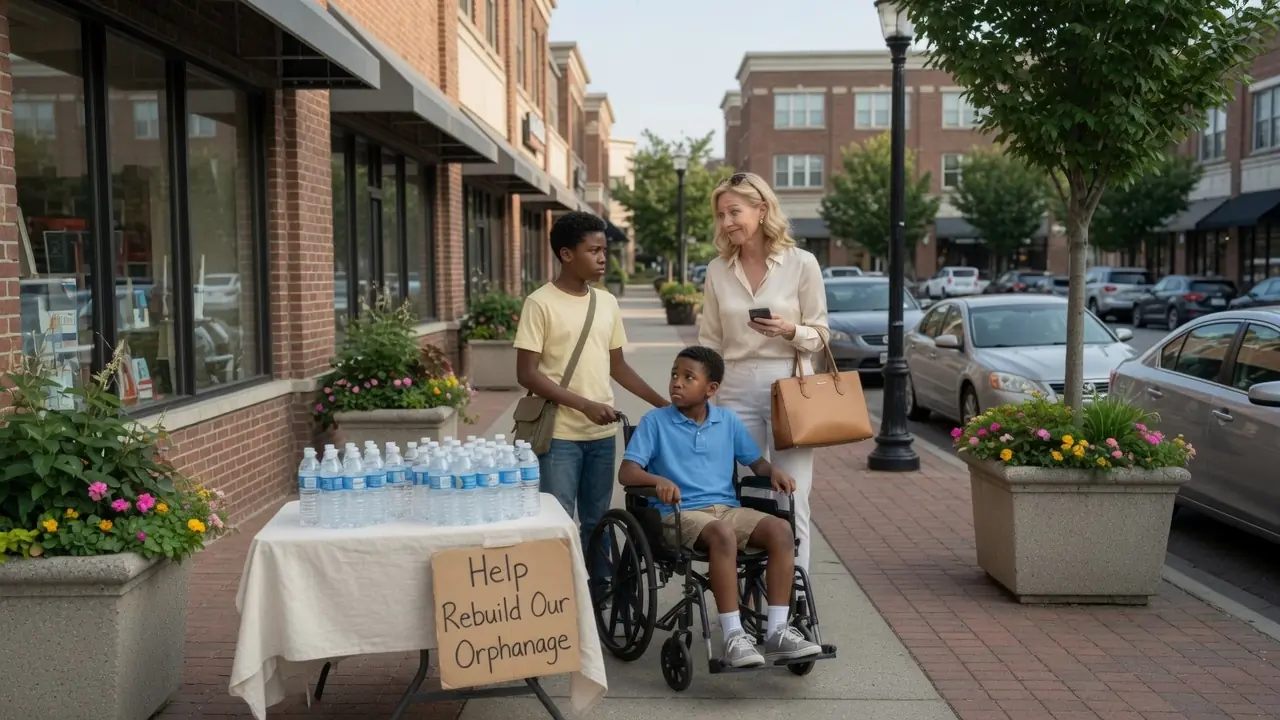
Behind Malik, twelve-year-old Isaiah Reed gripped the wheels of his chair.
His eyes followed the bottles rolling toward the gutter.
Some had taken hours to chill.
Others were dented beneath passing shoes.
One disappeared beneath the tire of a parked car and burst with a sharp crack.
“Please,” Isaiah whispered. “We paid for those.”
Elaine looked down at him.
“You should have thought of that before bringing your little operation into a respectable neighborhood.”
“We’re selling water,” Malik said.
“You’re causing a public disturbance.”
“We haven’t bothered anyone.”
“You were told to leave.”
“We did leave. This is three blocks away.”
Elaine’s expression tightened.
She had followed them.
Malik understood that now.
She had not been protecting one street or enforcing one rule. She had decided the two boys did not belong anywhere she could see them.
Sirens sounded in the distance.
Isaiah moved closer to Malik.
“Are they going to arrest us?”
Malik wanted to tell him no.
He wanted to sound certain, the way older brothers were supposed to sound.
But Malik was fifteen years old, Black, standing beside an overturned cooler while an angry woman told the police that he was dangerous.
Certainty was a luxury he did not possess.
“I don’t know,” he admitted.
Then he placed himself between Isaiah and the approaching patrol car.
Three weeks earlier, neither boy had planned to spend the summer selling bottled water.
They lived at New Horizons Children’s Residence, a redbrick group home on the south side of Bellwood, Georgia.
The building housed twenty-three children between the ages of six and seventeen. It was not luxurious, but it was safe.
There were secondhand couches in the common room, mismatched plates in the kitchen, and a basketball hoop in the parking lot with no net.
To Malik, it was home.
He arrived at New Horizons when he was eight after his mother died from complications following a long illness. His father’s name did not appear on any form that mattered.
For years, Malik moved through temporary foster homes carrying his belongings in black trash bags.
Some families were kind.
Others treated him like a monthly payment.
He learned not to unpack completely.
Then he came to New Horizons.
The director, Mrs. Evelyn Barnes, gave him a blue duffel bag on his first night.
“No child in this house carries his life in garbage bags,” she said.
Malik still owned that duffel.
Isaiah arrived four years later.
He had been nine then, newly discharged from a rehabilitation hospital after the car accident that killed both his parents and injured his spine.
He entered the group home in a borrowed wheelchair, refusing to speak to anyone.
The first night, he ate dinner alone near the window.
Malik carried his plate over and sat across from him.
Isaiah did not look up.
“You want the cornbread?” Malik asked.
No response.
“I’m going to eat it if you don’t.”
Isaiah pushed the cornbread toward him.
That was their first conversation.
Within six months, they were inseparable.
They did homework at the same table.
Shared books.
Argued over basketball teams even though neither team they supported had won anything important in years.
When Isaiah’s wheelchair caught on the cracked pavement outside the school, Malik learned how to lift the front casters without tipping him.
When Malik woke from nightmares about hospitals and his mother, Isaiah talked until he fell asleep again.
They were not related by blood.
Neither cared.
“Family is who stays,” Mrs. Barnes often told the children.
Malik and Isaiah stayed.
The fire began shortly after midnight on the first Monday in June.
An electrical wire overheated inside the western dormitory wall.
By the time the smoke alarm sounded, flames had reached the second floor.
Staff members evacuated the children through the front and rear entrances.
Malik carried a six-year-old girl outside.
Two older boys helped Isaiah down the temporary emergency ramp.
Nobody died.
But the western dormitory was destroyed.
The wheelchair-accessible van parked beside the building suffered severe heat damage. The rear lift stopped functioning. Part of the permanent entrance ramp collapsed when firefighters crossed it with heavy equipment.
Insurance would cover most structural repairs eventually.
Eventually did not help Isaiah attend school programs, therapy appointments, or summer activities.
The home needed three thousand dollars immediately to rent an accessible van and construct a safe temporary ramp.
Mrs. Barnes organized donation letters.
Local churches contributed.
Staff members donated part of their paychecks.
Still, after two weeks, the fund remained short.
Malik discovered the exact amount while helping Mrs. Barnes sort receipts.
“Three thousand?” he asked.
She turned the folder over.
“You shouldn’t be worrying about this.”
“I’m good at worrying.”
“You’re fifteen.”
“That doesn’t stop it.”
Mrs. Barnes sighed.
“We’ll find a way.”
But Malik knew what that meant.
Adults said they would find a way when they did not yet have one.
That evening, he sat beside Isaiah outside the temporary motel where the children had been placed.
“We could raise it.”
Isaiah looked up from his comic book.
“With what?”
“Water.”
Isaiah waited.
Malik opened a notebook.
“A wholesale case of forty bottles costs about ten dollars if we buy enough. We sell each bottle for three dollars.”
“People can buy water for less than that.”
“We tell them where the money goes.”
“What if they don’t care?”
“Then they don’t buy.”
Malik wrote several numbers.
“If we begin with two hundred bottles, the cost is around fifty dollars. If we sell all of them, that’s six hundred dollars.”
Isaiah leaned closer.
“Five hundred fifty profit.”
“Exactly.”
“You already calculated it?”
“I calculate everything.”
“How many days?”
“At that rate, six good days. Realistically, maybe twelve.”
Isaiah grinned.
“Books?”
“Books.”
Malik read constantly.
Business biographies.
Mathematics guides.
Novels abandoned in the group home library.
Anything he could find.
He had recently finished a book about a teenager who built a company from a neighborhood lawn service.
The lesson Malik remembered was simple.
Start with what people already need.
In July, people in Georgia needed cold water.
Mrs. Barnes resisted at first.
“You are not standing beside a highway,” she said.
“We won’t.”
“You stay together.”
“We will.”
“You keep the charity letter with you.”
Malik held up the laminated document.
“Already made a copy.”
“And you call me every hour.”
Isaiah raised one hand.
“I’ll remind him.”
Mrs. Barnes looked between them.
“You two are going to make me gray.”
“You already have gray hair,” Isaiah said.
She stared at him.
He smiled.
Their first morning began outside a city park where families gathered for a weekend arts festival.
Malik placed the cooler beside Isaiah’s chair.
A cardboard sign read:
COLD WATER — $3
HELP REBUILD NEW HORIZONS CHILDREN’S HOME
For the first fifteen minutes, nobody stopped.
Malik called out too quietly.
Isaiah watched people pass.
“You sound scared,” he said.
“I’m not scared.”
“You sound like you’re apologizing for selling it.”
Malik straightened.
“Cold water! Three dollars! Help rebuild New Horizons!”
A woman carrying two shopping bags paused.
“What happened to the home?”
“Fire damaged the dormitory and the wheelchair ramp.”
She bought four bottles.
The next customer bought one and gave them ten dollars.
A family purchased six.
By noon, the boys had sold almost half their supply.
Isaiah developed his own sales method.
“You look thirsty,” he told an elderly man in a straw hat.
The man laughed.
“Do I?”
“You also look like somebody who might forget to buy a second bottle.”
“Is that so?”
“At your age, probably.”
Malik nearly choked.
The man laughed harder and bought two.
His name was Thomas Johnson.
He was seventy-one, retired from owning a chain of neighborhood hardware stores. His wife had died the previous year, and he now spent his weekends walking through city festivals because their house felt too quiet.
Thomas read the sign carefully.
“You boys live at New Horizons?”
“Yes, sir,” Malik said.
“I know Mrs. Barnes.”
“You do?”
“She bought paint from my first store thirty years ago and argued with me until I gave her a discount.”
“That sounds like her.”
Thomas handed Malik twenty dollars.
Malik reached for change.
“Keep it.”
“We can’t charge twenty dollars for two bottles.”
“You didn’t. I bought the water and donated the rest.”
Isaiah placed the bottles into a paper bag.
“You should still take both. You might lose one.”
Thomas nodded solemnly.
“An excellent business strategy.”
Before leaving, he looked at the boys again.
“Be careful out here.”
“We will.”
Their total at the end of the first day was five hundred eighty-seven dollars.
Malik counted the cash three times.
Isaiah held up the final bottle.
“We should celebrate.”
“That belongs to inventory.”
“It’s warm.”
“Still inventory.”
Isaiah opened it.
“Now it’s a business expense.”
The second day was hotter.
They chose a shaded corner near Brookstone Square, an affluent shopping district lined with boutiques, cafés, and carefully maintained flower beds.
The public sidewalk remained busy throughout the afternoon.
Customers were friendly.
A nurse bought water for her entire family.
Two construction workers purchased six bottles.
A delivery driver gave the boys an extra bag of ice.
Then Elaine Whitmore saw them.
She lived in the neighboring subdivision and served as president of its homeowners association, though the boys were not inside the subdivision.
Elaine believed responsibility extended wherever her attention landed.
From across the street, she saw two Black boys beside a cooler.
She did not read their sign.
She did not notice Isaiah’s wheelchair or the charity letter attached to the table.
She saw what she had already decided to see.
“What are those boys doing here?” she asked the woman beside her.
The woman glanced over.
“Selling water, I think.”
Elaine’s mouth tightened.
“People like that always begin with something harmless.”
She crossed the street.
Malik saw her approaching and smiled politely.
“Good afternoon. Would you like some cold water?”
“Where is your permit?”
He blinked.
“Our what?”
“Your sales permit.”
“We didn’t know we needed one.”
“You need permission to conduct business in a civilized community.”
“We’re on a public sidewalk.”
Elaine looked at the sign.
“An orphanage?”
“Yes, ma’am. Our group home had a fire.”
“How convenient.”
Isaiah frowned.
“What does that mean?”
“It means anyone can write words on cardboard.”
Malik removed the laminated letter.
“This is from our director. Her number is at the bottom.”
Elaine did not take it.
“What is inside the bottles?”
“Water.”
“Do not be disrespectful.”
“I’m answering.”
“You expect me to believe two boys from your neighborhood came here only to sell water?”
“We came because there are more people walking here.”
Elaine leaned closer.
“Are there drugs inside that cooler?”
Isaiah’s face changed.
“No.”
Malik placed one hand on the cooler lid.
“Please don’t touch our things.”
Elaine looked down at Isaiah.
“Stand when an adult is speaking to you.”
The words seemed to stop the noise of the street.
Isaiah stared at her.
“I can’t.”
Elaine followed his gaze to the wheelchair.
For one moment, embarrassment crossed her face.
Then pride replaced it.
“You know what I meant.”
“No,” Isaiah said. “I don’t.”
Malik moved beside him.
“We’ll go somewhere else.”
“That would be best.”
Elaine raised her phone.
“If I see you bothering people again, I’ll call the police.”
“We aren’t bothering anyone.”
“Do not talk back.”
Malik closed the cooler.
They left.
Neither spoke until they reached the bus stop.
Isaiah stared at his hands.
“She thought we had drugs.”
“I know.”
“We didn’t do anything.”
“I know.”
“Why did she talk like that?”
Malik looked down the road.
Because they were Black.
Because their clothes were inexpensive.
Because people often believed poverty was evidence of criminality.
He did not know how to explain all of that without making Isaiah feel less safe in the world.
“She didn’t know us,” he said.
“That’s not an answer.”
“No.”
The bus arrived.
Malik helped secure Isaiah’s chair.
“We’ll sell somewhere else tomorrow.”
Isaiah looked through the window.
“She shouldn’t get to decide where we belong.”
“She doesn’t.”
But the next morning, Malik chose a location twenty minutes away.
He wanted distance.
The new spot stood near a community sports complex where youth baseball teams played weekend tournaments.
Business was excellent.
By two in the afternoon, they had sold almost two hundred bottles.
Isaiah’s confidence returned.
“Cold water!” he called. “Good for your health and probably your team’s terrible defense!”
A father wearing a baseball cap laughed and bought three.
Malik checked the notebook.
“We’re over sixteen hundred total.”
“Halfway?”
“More than halfway.”
Isaiah held out his hand.
Malik slapped it.
“We’re going to get the van.”
“And the ramp.”
“And maybe replace the library books.”
“First the ramp.”
“Right.”
They did not see Elaine until her shadow crossed the table.
“What did I tell you?”
Malik’s stomach dropped.
She wore sunglasses and carried the same phone.
“This isn’t your neighborhood,” he said.
Elaine removed the sunglasses.
“All of these streets belong to taxpayers.”
“We pay taxes when we buy things too,” Isaiah said.
“Do not become clever with me.”
Malik looked around.
Families moved between fields.
A concession stand operated nearby.
They were on city property, not private land.
“We’re leaving people alone.”
“You are selling without authorization.”
“We checked.”
That morning, Mrs. Barnes had called the city information office.
Sealed bottled water sold by minors for charitable fundraising did not require a street-vendor permit on that section of public property, provided they did not block pedestrian access.
Malik had written down the employee’s name and the ordinance number.
Elaine did not care.
“You expect me to take legal advice from children?”
“You can call the city.”
“I’m calling the police.”
Isaiah’s face tightened.
“Please don’t.”
Elaine began dialing.
Malik held up the charity letter.
“Look at this first.”
She slapped it from his hand.
The laminated page fell beneath the table.
When Malik bent to retrieve it, Elaine grabbed the cooler handle.
“What are you doing?” he shouted.
“I am checking what you’re actually selling.”
“Let go.”
She pulled.
The cooler tipped.
The lid opened.
Ice and bottles crashed onto the pavement.
A bottle struck Elaine’s shoe.
She stepped backward.
“Look what you did!”
“You knocked it over.”
“You attacked me.”
“I didn’t touch you.”
People began gathering.
Several parents lifted their phones.
Elaine pointed toward the boys.
“These children are operating illegally. I believe they may be selling contaminated products.”
“They’re sealed bottles,” someone said.
Elaine ignored him.
Malik began gathering the water.
Isaiah leaned from his chair to help.
Elaine kicked one bottle away.
“Leave it for the police.”
“Stop,” Malik said.
“Do not raise your voice at me.”
“You’re destroying our stuff.”
She pushed another bottle with her shoe.
Isaiah looked close to tears.
“We worked for that money.”
Elaine raised her phone.
“Yes, officer. There are two aggressive young men selling suspicious bottles near the sports complex.”
Malik stared.
Aggressive young men.
He was fifteen.
Isaiah was twelve.
Elaine continued.
“One of them confronted me physically.”
“That’s a lie,” a man in the crowd said.
Elaine turned.
Thomas Johnson stood behind her holding the same straw hat he had worn on the boys’ first day.
He had come to watch his granddaughter’s softball game.
Elaine lifted her chin.
“This does not concern you.”
“It concerns everyone who just watched you dump a charity cooler into the street.”
“These boys are breaking the law.”
Thomas looked toward Malik.
“Do you have the letter?”
Malik retrieved it.
Thomas read the document.
Then he examined the unopened bottles.
“Everything looks exactly as it did yesterday.”
“You know them?” Elaine asked.
“I bought water from them.”
“That doesn’t mean you know what they are.”
Thomas’s face hardened.
“They are children.”
The patrol car arrived.
Two officers stepped out.
Officer Dana Ruiz approached first.
“Who called?”
“I did,” Elaine said immediately. “These boys are conducting an illegal operation and became threatening when I questioned them.”
Dana looked at the bottles across the pavement.
Then at Malik and Isaiah.
“Anyone injured?”
“No,” Malik said.
Elaine touched her shoulder.
“He moved toward me aggressively.”
A woman holding a phone spoke from the crowd.
“That did not happen.”
Another parent raised his hand.
“I recorded the whole thing.”
Dana turned toward Elaine.
“You said suspicious bottles. Are any open?”
“They could contain anything.”
“They appear factory sealed.”
“These boys do not belong here.”
The second officer, Marcus Green, looked toward her.
“What do you mean by that?”
Elaine hesitated.
“I mean they are not residents.”
“This is a public sports complex.”
“They came from another part of the city.”
“That isn’t illegal.”
She pointed toward the sign.
“They need a permit.”
Malik opened his notebook with shaking hands.
“We called the city. The woman’s name was Ms. Franklin. She gave us ordinance 14-62. She said minors selling sealed water for a registered charity can do it here.”
Officer Ruiz radioed dispatch.
While waiting, she read the New Horizons letter.
Mrs. Barnes’s phone number appeared at the bottom.
Dana called.
The conversation lasted less than three minutes.
When she hung up, her expression softened toward the boys.
“Your home had a fire?”
“Yes, ma’am,” Isaiah said.
“And you’re raising money for an accessible van and temporary ramp?”
He nodded.
Dana turned toward Elaine.
“Dispatch confirmed the ordinance. They are not violating the vendor code.”
Elaine’s face reddened.
“They were causing a disturbance.”
“According to six witnesses, the disturbance began when you approached them.”
“I was protecting the community.”
“From bottled water?”
“From what this leads to.”
Officer Green looked around at the families filming.
“What does it lead to?”
Elaine had no answer she could say safely in front of cameras.
Thomas Johnson stepped beside the officers.
“I saw this same woman force them from Brookstone Square yesterday.”
“That was private property,” Elaine said.
“The sidewalk wasn’t.”
“They were making residents uncomfortable.”
“Which residents?”
Elaine folded her arms.
“People told me.”
“Names?”
“That is confidential.”
Officer Ruiz watched one of the videos.
It clearly showed Elaine striking the charity letter away, pulling the cooler, and kicking bottles into the street.
“You reported that one of these boys confronted you physically.”
“He stepped toward me.”
“He was retrieving the document you knocked away.”
“I felt threatened.”
Dana looked at Malik.
He stood with both hands visible, trying unsuccessfully to hide how frightened he was.
Isaiah remained behind him.
The officer returned the phone to its owner.
“Mrs. Whitmore, knowingly making a false statement to law enforcement is serious. So is damaging property.”
“I did not damage anything.”
“You overturned the cooler.”
“It was an accident.”
“Then why did you continue kicking the bottles?”
Elaine looked toward the crowd.
Nobody supported her.
The people she believed she was protecting had recorded her instead.
Officer Ruiz instructed her to step aside.
She received a citation for disorderly conduct and property damage. The false statement became part of the official incident report.
She was not dragged away in handcuffs.
There was no dramatic arrest.
Only the quiet collapse of the authority she believed she possessed.
Before leaving, she looked at Malik.
“This neighborhood will regret encouraging behavior like yours.”
Thomas stepped forward.
“No. This neighborhood will regret how long people like me watched behavior like yours and called it unpleasant instead of stopping it.”
Elaine walked toward her car.
The crowd remained.
For several seconds, nobody knew what to do.
Then a softball coach bent down and picked up a bottle.
“How many are still good?”
Malik looked around.
“Most of them, I think.”
The coach held up twenty dollars.
“I’ll take four.”
A mother bought six.
Another parent bought ten for her son’s team.
The concession manager brought a fresh cooler and three bags of ice.
Thomas purchased every bottle damaged in the fall so the boys would not lose money.
Within thirty minutes, no water remained.
Malik counted the cash beside Isaiah.
Their hands shook for an entirely different reason.
“We made nine hundred and twelve dollars,” he said.
Isaiah stared at him.
“Today?”
“Today.”
Thomas crouched beside the chair.
“How much do you still need?”
Malik checked the notebook.
“Four hundred and eighty-one dollars.”
Thomas reached for his wallet.
Malik shook his head.
“We can’t take all of that from one person.”
“Why not?”
“Because we started this to earn it.”
Thomas studied him.
“That is admirable and slightly inconvenient.”
Isaiah grinned.
“You could buy a lot more water.”
Thomas laughed.
“I have a better idea.”
The following morning, a long table appeared outside Johnson’s Hardware, the final store Thomas had kept after retirement.
A printed sign hung above it.
WATER FOR NEW HORIZONS
EVERY BOTTLE HELPS REBUILD A HOME
Thomas had contacted local business owners.
The bakery donated breakfast.
The supermarket provided water at cost.
A radio station mentioned the fundraiser during its morning program.
Parents from the sports complex arrived.
Officer Ruiz came during her lunch break and purchased water for the entire precinct.
No one called Malik and Isaiah heroes.
They did not want that.
They were simply two boys who saw a problem and refused to believe they were too young to help.
By noon, the fundraising total crossed three thousand dollars.
By evening, it reached more than eleven thousand.
The additional money paid for the accessible van rental, the temporary ramp, replacement library books, new bedroom furniture, and counseling for children affected by the fire.
A local contractor offered to rebuild the permanent ramp without charging for labor.
When New Horizons reopened its undamaged wing, Malik and Isaiah stood beside Mrs. Barnes at the entrance.
The new temporary ramp stretched behind them.
Isaiah rolled up it slowly.
At the top, he turned.
“It works.”
Mrs. Barnes wiped her eyes.
“It had better. Half the city helped build it.”
Thomas Johnson became a regular visitor.
He taught Malik how to write a basic business plan.
He helped Isaiah design a fundraising guide for other children’s homes.
Officer Ruiz arranged a meeting where local youth learned their rights when speaking with police and how to document harassment safely.
The woman who recorded the incident sent every video to Mrs. Barnes rather than posting the children’s faces online without permission.
People offered interviews.
Malik agreed to one local newspaper story only after the reporter promised to focus on New Horizons rather than turning their pain into entertainment.
When asked why he had protected Isaiah by standing in front of him as the police arrived, Malik looked confused.
“He’s my brother.”
The reporter glanced at the paperwork.
“You are not biologically related.”
Malik looked toward Isaiah.
“Family is who stays.”
Months later, the boys returned to Brookstone Square.
Not because they needed money.
The children’s home had organized a neighborhood appreciation event. Malik and Isaiah set up a table offering free water to volunteers.
Some people recognized them.
Others did not.
An elderly woman approached and took one bottle.
“How much?”
“Free,” Isaiah said.
She placed three dollars in the donation jar anyway.
“What are you raising money for now?”
Malik pointed toward a new sign.
EMERGENCY FUND FOR FOSTER YOUTH
The goal was to provide duffel bags, school supplies, and transportation assistance to children entering care.
No trash bags.
No missed appointments because a wheelchair van was unavailable.
No child made to believe needing help meant being helpless.
The afternoon grew hot.
Malik called to pedestrians.
“Cold water!”
Isaiah added, “You should take two. At your age, you might lose one.”
The elderly woman laughed.
Thomas, standing behind the table, shook his head.
“You’re still using that line?”
“It works,” Isaiah said.
Malik opened the notebook where he recorded every sale and donation.
The first pages contained their original calculations.
Two hundred bottles.
Three dollars each.
Fifty dollars in costs.
Twelve days to reach the goal.
The mathematics had been reasonable.
What Malik had not calculated was how one cruel encounter would force strangers to decide whether they would remain spectators.
Some people had looked away at first.
Then one spoke.
Another recorded.
Another called the city.
Another bought water.
A crowd became a community one choice at a time.
Elaine Whitmore had believed the street belonged more to her than to the two boys standing on it.
She was wrong.
It did not belong to Malik because he was clever.
It did not belong to Isaiah because he was an orphan or used a wheelchair.
It did not belong to Thomas because he owned businesses or paid more taxes.
The sidewalk belonged to all of them.
That was the part Elaine never understood.
A civilized community was not one where powerful people decided who looked respectable enough to participate.
It was one where children could work toward a hopeful future without being treated as criminals for appearing in the wrong neighborhood.
Malik and Isaiah never forgot the bottles rolling through the street.
They remembered the fear.
The humiliation.
The sound of sirens approaching while neither knew whether the truth would matter.
But that memory no longer ended with the overturned cooler.
It continued with hands reaching down to pick up the bottles.
With a police officer reading the actual law.
With strangers opening their wallets after first opening their eyes.
With a ramp rising where fire had destroyed one.
Years later, Malik would study finance in college.
Isaiah would become a disability-rights attorney.
Whenever people praised their success, they told the same story.
Not about the woman who tried to drive them away.
About the people who refused to let her.
Because cruelty had scattered two hundred bottles across a hot city sidewalk.
But kindness gathered every one it could save—
and built something strong enough for two brothers to roll forward together.