The first thing Missy asked for that morning was a donut.
Not a whole breakfast, not a hot meal, not a toy from the corner store window, just one small chocolate donut with colored sprinkles on top. She said it softly, like she already knew wanting things was dangerous when you and your mother slept in a tent behind a closed nightclub and counted empty cans the way other people counted dollars.
Laura Bennett brushed a loose strand of hair away from her daughter’s face and tried to smile. The sun had barely cleared the rooftops, and the alley still smelled like wet cardboard, spilled beer, and old trash. Their tent leaned against the brick wall behind Rocco’s Lounge, the only place where the wind did not hit them straight in the face at night. Everything they owned fit inside that tent: two blankets, one change of clothes for Missy, Laura’s old sneakers with the soles coming apart, and a plastic bag full of cans and bottles.
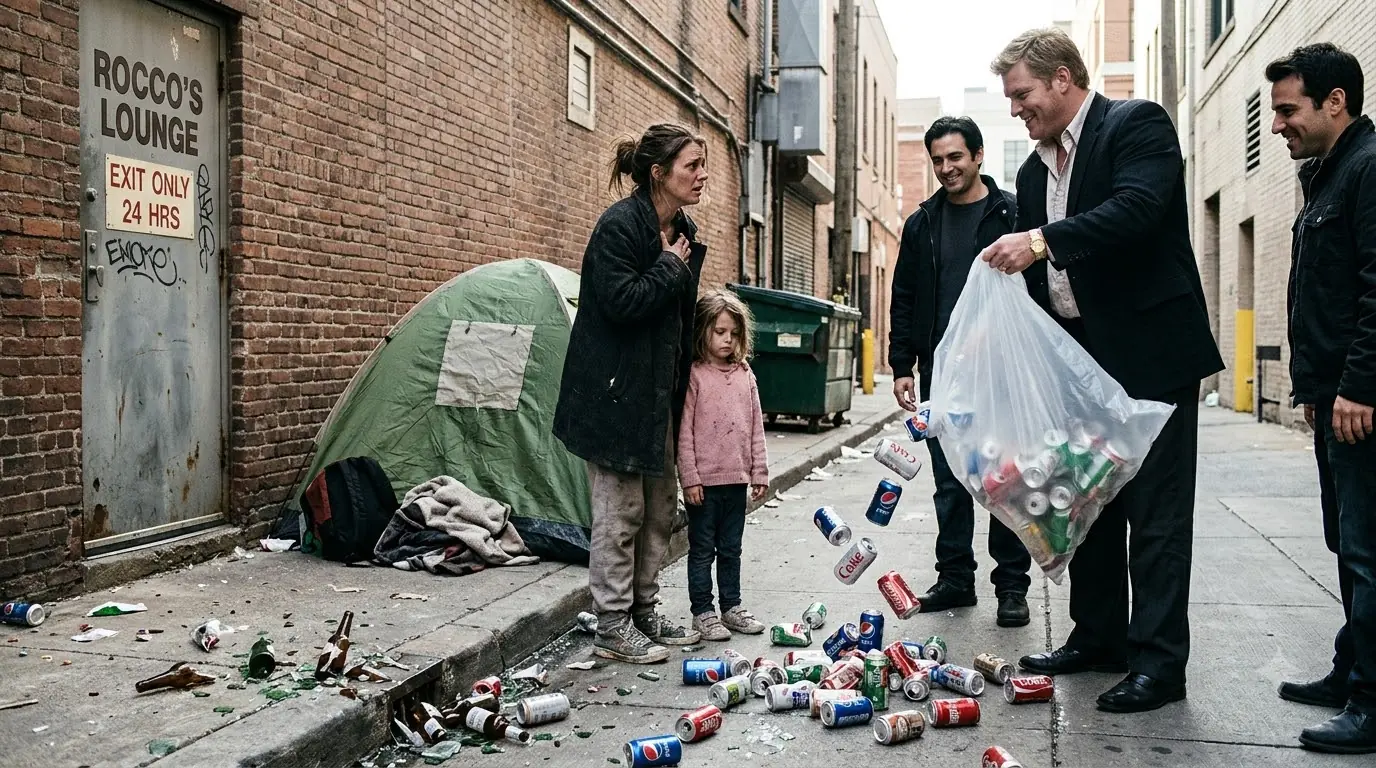
“My tummy is talking to me,” Missy whispered, pressing both hands over her stomach.
Laura swallowed the ache in her throat. “We’ll eat soon, baby. I promise.”
“Can we get donuts? The ones with chocolate and sprinkles?”
Laura looked toward the street, where morning traffic had already begun moving past the alley mouth. She knew exactly how many cans she needed to buy one donut and maybe one carton of milk if the cashier at Miller’s Market took pity on them and rounded down. She also knew she had lied to her daughter too many times already. Not big lies, never cruel ones, just the kind poor mothers told when the truth was too heavy for a five-year-old child.
“Sure,” Laura said. “We can get donuts. That sounds yummy, doesn’t it?”
Missy’s tired eyes brightened. “With sprinkles?”
“With sprinkles,” Laura promised.
She helped Missy out of the tent, shook the dust from the child’s faded pink sweater, and handed her the small cloth bag they used for bottle caps and aluminum tabs. Laura carried the bigger bag. It was almost half full, but almost did not buy breakfast. Almost did not pay for anything. Almost was the word that had followed them since Missy’s father died.
Before the hospital bills, before the eviction notice, before the funeral home called twice a week asking about the remaining balance, Laura had been a cashier at a small bakery on Jackson Street. Her husband, Daniel, had driven delivery trucks and came home every evening smelling like diesel and peppermint gum. He could make Missy laugh by pretending to lose his balance while carrying grocery bags. He used to bring home the broken donuts the bakery could not sell and tell Missy they were special because only lucky people got the ones shaped wrong.
Then he got sick. Fast, brutally, unfairly sick. The kind of sick that turned paychecks into receipts, savings into coins, and a family into a file number at the county office. When Daniel died, Laura lost more than her husband. She lost the apartment because his income had been the larger one. She lost her job because she missed too many shifts sitting beside his hospital bed. She lost the people who said they would help but stopped answering when help became more than sympathy.
Now she and Missy walked the streets before sunrise, searching for cans in public trash bins and recycling containers behind restaurants.
“Mommy, how many more cans do we have to find?” Missy asked, dragging her little feet beside her.
“Only a few more, honey. Look how many we already have.”
The lie came easier that time. The bag was not full enough, but Missy smiled anyway. That made Laura feel both grateful and ashamed.
They crossed the sidewalk near Rocco’s Lounge, where last night’s crowd had left behind crushed beer cans, plastic cups, and cigarette butts. Laura spotted a city trash can near the corner, its lid tilted open. When she looked inside, her heart lifted. There were at least a dozen aluminum cans at the bottom, plus two glass bottles that would bring in a few extra cents.
“Look, Missy,” Laura said, forcing excitement into her voice. “We hit the jackpot on this one.”
“Jackpot?” Missy gasped. “Does that mean we get our donuts now?”
“It sure does,” Laura said, reaching into the can.
She had just pulled out the first handful when a sharp burst of laughter cut through the morning air.
“Well, look at this,” a man’s voice said. “The rats are digging again.”
Laura froze.
Two men came out of the side entrance of Rocco’s Lounge, both wearing expensive jackets over wrinkled shirts, their faces puffy from drinking. One was tall and thick-necked with sandy hair, a gold watch, and the lazy confidence of someone who had never been afraid of consequences. The other was shorter, darker-haired, and grinning like cruelty was a private joke he had waited all night to tell.
Laura recognized them. They had been part of the late crowd the night before, laughing loudly near the alley while she tried to keep Missy asleep inside the tent.
The taller one, Mark, stepped closer and kicked the bottom of Laura’s recycling bag. The cans inside rattled.
“Please don’t,” Laura said quickly. “We’re not bothering anyone.”
The shorter one, Randy, leaned toward Missy and wrinkled his nose. “You smell that? Lady, you stink.”
“Don’t talk to my mommy that way,” Missy said, her voice tiny but fierce.
Randy laughed. “Feisty little rat.”
Laura moved in front of her daughter. “Leave her out of this.”
Mark gave Laura a slow, disgusted look from her tangled hair to her worn shoes. “Y’all are nothing but two pathetic homeless people. You don’t even matter.”
“We’re human beings,” Laura said, her voice shaking. “You can’t treat us this way.”
Mark’s smile vanished. He leaned close enough that she could smell alcohol on his breath. “You’re not human beings. You’re sewer rats crawling around in a neighborhood like this.”
Laura felt Missy clutch the back of her coat. She wanted to scream. She wanted to shove him away. But she had learned that poor people were not allowed to defend themselves without being called dangerous. So she stood still and tried to keep her voice low.
“I’m just trying to collect cans and bottles to recycle for money so my daughter and I can eat,” she said.
Randy snorted. “If you’re so hungry, why don’t you get a job?”
“I had one,” Laura said. “I’m trying.”
Mark suddenly grabbed the recycling bag from her hand.
“No, please,” Laura cried. “Don’t touch that. It’s all we’ve got.”
Missy burst into tears. “Please, mister, please!”
Mark lifted the bag high, then dumped it across the sidewalk. Cans bounced and rolled into the gutter. Glass bottles shattered near the curb. The sound hit Laura harder than a slap. It was breakfast spilling into the street. It was her promise to Missy breaking into pieces.
“Look at all this trash,” Mark said. “That’s where it belongs.”
Randy kicked one of the cans into traffic. “This will teach you to get a real job and stop bumming off people.”
“Why are you doing this?” Laura whispered. “You don’t have to be so cruel.”
Mark pointed toward the alley. “Now get out of here, or we’re calling the police and having you both arrested. We don’t want scum like you stinking up our streets.”
“Our tent is right over there,” Laura said, wiping her face with the back of her hand. “It’ll take hours to tear down, and it’s already getting late by the time we can move everything.”
Mark looked at Randy, then back at Laura, pretending to consider it like a generous king. “Fine. Because I’m such a nice person, I’ll let you both stay there tonight. But if we come out of that club and you’re still here tomorrow, we’re calling the police. You got it?”
Randy clapped Mark on the shoulder. “You’re such a good guy.”
“I know,” Mark said, laughing as they walked away.
Laura waited until they were gone before she bent down to gather what was left. Missy tried to help, but her small hands trembled too badly to hold anything.
“I’m sorry, Mommy,” Missy cried.
Laura pulled her into her arms. “No, baby. You didn’t do anything wrong.”
“But we don’t get donuts now.”
Laura closed her eyes. The pain in that sentence was almost too much. “Not right now,” she said. “But we will. I promise.”
That night, the alley grew cold. The sky above the buildings turned from orange to gray to black, and the city lights buzzed awake one by one. Laura tucked Missy beneath both blankets and lay beside her, listening to music thump through the back wall of the nightclub. People inside were drinking cocktails that cost more than the food Laura had eaten in two days.
Missy stared at the tent ceiling. “Mommy, why were those men mean?”
Laura brushed her daughter’s hair with her fingers. “Some people don’t like what they don’t understand.”
“But we’re nice people.”