“You’ve been hauling everybody’s garbage all summer for this?”
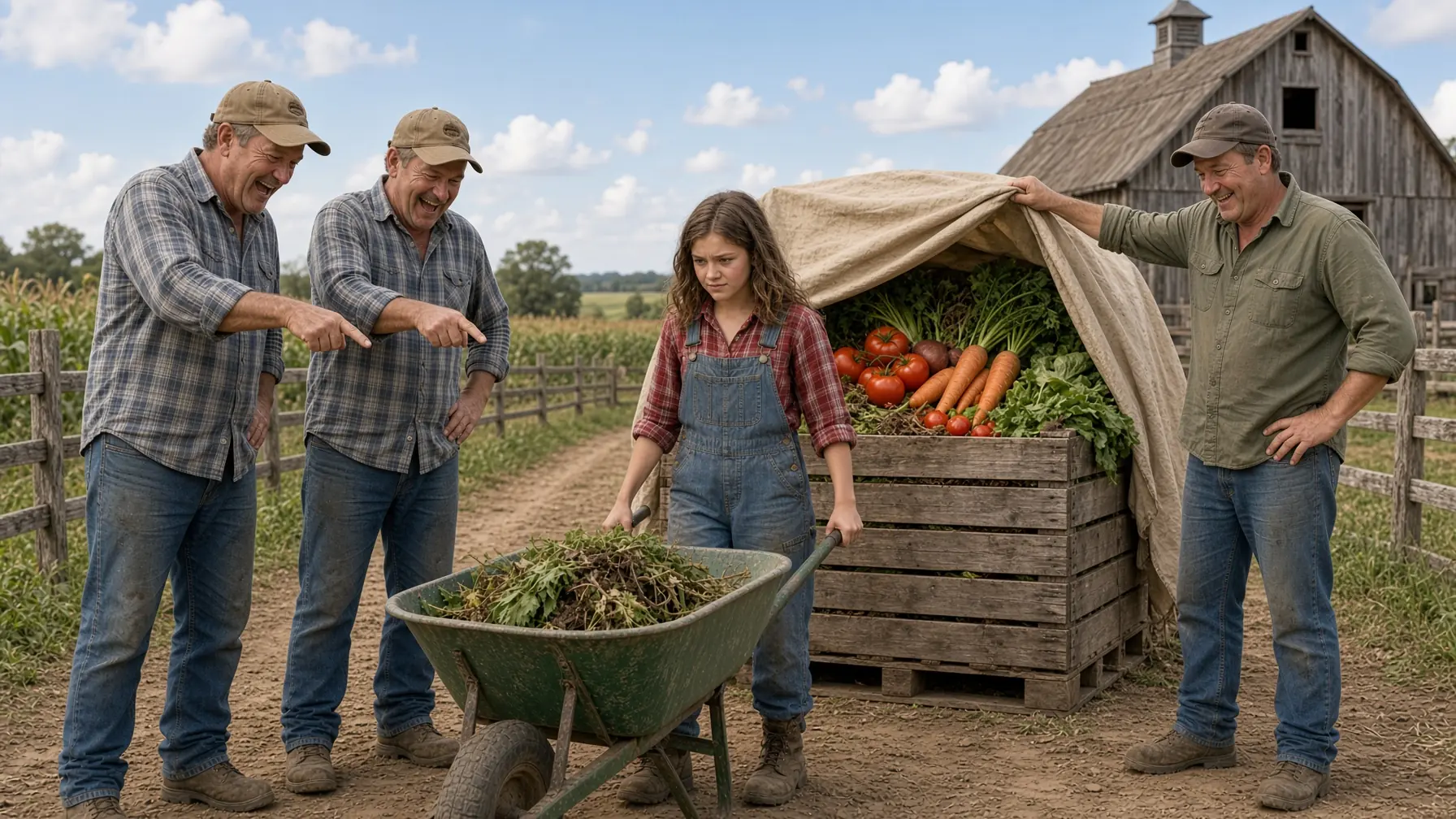
Emily Carter stopped the green wheelbarrow in the middle of the dirt farm road.
The late-August sun pressed against the back of her red plaid shirt.
Sweat had darkened the fabric between her shoulders.
Inside the wheelbarrow sat what looked like nothing worth defending.
Dark compost.
Bits of straw.
Coffee grounds.
Broken-down leaves.
Pieces of vegetable matter so decomposed that only fragments remained recognizable.
Dale Mercer leaned against Emily’s fence and laughed.
He was fifty-four, broad through the chest, permanently sunburned across the neck, and had been farming the property north of the Carters since before Emily was born.
Beside him stood Roy Harlan.
Roy shook his head.
“Girl, you can’t grow a real crop out of trash.”
Emily looked from one man to the other.
Then toward the field behind them.
Rows of vegetables stretched toward the weathered barn.
Neither man could see much from the road.
That was intentional.
The best produce had been harvested early that morning and packed into wooden crates.
Those crates now sat beneath a plain canvas tarp near the barn.
Dale pointed at the wheelbarrow.
“You know what we use that stuff for?”
Emily waited.
“Dumping.”
Roy laughed.
“All summer she’s driving around collecting rotten lettuce like she found gold.”
Emily’s hands remained on the wheelbarrow handles.
Dale stepped into her path.
“You ought to listen when people with experience tell you something.”
Emily’s hazel eyes narrowed slightly.
“You sure about that?”
Dale grinned.
“Then show us.”
Emily released the wheelbarrow.
Walked toward the barn.
The men followed, still laughing.
She stopped beside the covered crates.
Grabbed the canvas.
Roy folded his arms.
“Go ahead.”
Emily looked back at both of them.
“Take a closer look.”
Then she pulled.
Four months earlier, Emily Carter had been eighteen years old and standing in a field her father believed was finished.
Not ruined forever.
But close enough that the difference did not feel important.
Carter Farm sat on sixty-three acres in southern Indiana, eight miles outside a town called Mill Creek.
It had never been a big farm.
Emily’s grandfather raised sweet corn, beans, tomatoes, squash, and a small herd of cattle there.
Her father, David Carter, reduced the cattle and expanded vegetables because the nearby farmers market paid better than livestock did on small acreage.
For years, it worked.
Then three bad seasons arrived almost back-to-back.
One summer brought drought.
The next brought too much rain.
Then fertilizer prices climbed at the same time one of the farm’s largest restaurant customers closed.
By the spring Emily graduated from high school, the Carters were behind on equipment payments and carrying more credit-card debt than David admitted to anyone except his wife.
The land looked tired too.
Some fields crusted after heavy rain.
Others dried hard enough to crack.
Organic matter was low.
Water disappeared too quickly in July and sat too long after storms.
David Carter had always believed the answer to a weak field was more fertilizer.
Then fertilizer became one of the bills he could least afford.
Emily noticed everything.
She always had.
She had grown up carrying tomato boxes before she was strong enough to lift them properly.
At six, she followed her father through the barn asking why tractors needed different gears.
At eleven, she learned to recognize hornworms.
At fourteen, she kept handwritten records of which tomato varieties cracked after heavy rain.
Her mother, Sarah, often joked that Emily treated the farm like a science experiment.
Emily never thought that was an insult.
She loved the place.
But she was not sentimental about it.
If something failed, she wanted to know why.
That habit brought her into conflict with her father more than once.
Especially that spring.
David Carter was fifty-one.
Strong when Emily was young.
Still strong by most standards.
But years of lifting, bending, and climbing equipment had taken their price.
His right knee had been replaced the previous winter.
Recovery went badly.
By April he could walk.
By May he could drive a tractor.
What he could not do was work fifteen-hour days without pain.
That changed the farm.
For the first time, Emily was not simply helping.
She was responsible.
Her older brother lived in Indianapolis.