The red motorcycle vanished into the darkness before Deputy Daniel Mercer could finish reaching for the radio.
One moment, its taillight was visible near the convenience-store parking lot. The next, it shot across the boulevard, leaned sharply through the intersection, and accelerated hard enough to turn the engine’s growl into a high metallic scream.
Daniel’s partner, Matt Reed, twisted in the passenger seat.
“There he goes.”
Daniel pressed the accelerator.
The patrol car surged forward.
Red and blue light washed across empty storefronts, parked vehicles, and the wet-looking windows of businesses that had closed hours earlier. Traffic was light, but the motorcycle was moving too fast for the road.
“County, Unit 571,” Daniel said into the radio. “Motorcycle failing to yield. White male rider, dark jacket, red beard. Southbound on Bridgeport.”
The rider glanced backward.
For a second, Daniel saw the pale oval of his face beneath the helmet.
Then the motorcycle accelerated again.
“He’s doing sixty already,” Matt said.
Daniel watched the speed climb.
Seventy.
Eighty.
The patrol car could keep up, but the distance between them widened. A motorcycle could pass through openings a cruiser could not safely attempt, and the rider seemed determined to use every one of them.
Ahead, a traffic light turned red.
“He’s not stopping,” Matt said.
The motorcycle entered the intersection at more than one hundred miles an hour.
A pickup truck began pulling from the convenience store on the opposite corner.
The truck driver saw the lights.
He tried to stop.
The motorcycle had nowhere left to go.
The impact produced a sound Daniel would remember for years—not a single crash, but several violent noises arriving almost together.
Metal struck metal.
Glass burst.
The motorcycle broke apart and slid across the roadway.
The rider separated from it, struck the pavement, and disappeared beneath a cloud of dust and fragments.
Daniel braked hard.
“County, we have a collision,” he said. “Major injury. Start medical aid. Shut down the intersection.”
He and Matt were out of the car before it fully settled.
The rider lay motionless near the center lane.
His helmet had split.
One leg rested at an unnatural angle beneath him.
Daniel dropped beside the man.
“Sir, can you hear me?”
No response.
“Talk to me.”
Still nothing.
Matt ran toward the pickup.
“I’ll check the driver.”
Daniel placed two fingers near the rider’s neck, searching for a pulse while distant sirens began rising from different directions.
For a few seconds, he found nothing.
Then the rider gasped.
Weakly.
Barely.
But he was breathing.
“Stay with me,” Daniel said. “Medical is coming.”
Firefighters arrived first, followed by paramedics from the hospital only a few blocks away. They surrounded the rider, cut away clothing, stabilized his neck, and began the fast, controlled work that occurred when every second mattered.
Daniel stood and looked toward the pickup.
The driver was an older man named Howard Ellis. He sat behind the steering wheel, both hands trembling.
Matt stood outside his door.
“You hurt anywhere, Howard?”
“I don’t think so.”
“Any chest pain? Neck pain?”
“No. Just shaking.”
“What happened?”
Howard stared through the broken windshield.
“I was leaving the store. The light was red. I started pulling out, and then I saw him coming.”
“How fast?”
Howard shook his head.
“I don’t know. Fast enough that I knew I couldn’t get out of the way.”
“You tried?”
“I stopped. I turned a little. It happened too fast.”
Matt placed one hand on the truck door.
“You did what you could.”
Howard looked toward the paramedics.
“Is he alive?”
“They’re working on him.”
The motorcycle lay in pieces across the intersection.
Its front assembly had torn away.
Plastic and metal fragments stretched for nearly a hundred feet. The rider’s helmet rested near the curb, cracked from front to back.
Daniel found a wallet among the debris.
The driver’s license belonged to thirty-two-year-old Ryan Keller.
The card had been punched by the state after a prior suspension.
A computer check showed three outstanding misdemeanor warrants—one connected to driving while suspended, another related to a previous alcohol offense, and a third traffic matter.
Matt looked at the information on the screen.
“All this over warrants.”
Daniel watched the paramedics load Ryan onto a stretcher.
“He may have thought he was running from jail.”
“Now he’s fighting to stay alive.”
A helicopter was requested to transport Ryan to the regional trauma center in Seattle, but weather and timing complicated the plan. Doctors at the nearby hospital would stabilize him first.
As the ambulance pulled away, Daniel remained beside the destroyed motorcycle.
The adrenaline began leaving his body, replaced by the heavy awareness of what had almost happened.
The intersection had been nearly empty.
Had a family been crossing, had another vehicle entered from the opposite direction, or had Howard’s truck carried children, the night could have ended with several bodies instead of one critically injured rider.
Matt approached.
“Howard checks out. Medical says he’s shaken but doesn’t appear injured.”
Daniel nodded.
“Good.”
The two deputies looked at the scattered wreckage.
Neither spoke for a moment.
The pursuit had lasted only minutes.
The consequences could last forever.
It was the most violent call of their shift, but it had not been the first time that night someone turned a manageable problem into something much worse by running.
Hours earlier, Daniel had been driving alone through a residential neighborhood when dispatch broadcast a hit-and-run complaint.
A pedestrian had been struck near Agra Street.
Witnesses provided a partial plate number and a vehicle description.
Daniel entered the information into his patrol computer.
The registered address appeared less than a mile away.
He recognized the name immediately.
Lawrence Cole.
Thirty-four years old.
Suspended driver’s license.
Several previous contacts with police, mostly traffic-related.
Daniel turned onto Lawrence’s street.
A dark sedan matching the witness description sat in the driveway.
Fresh damage marked one corner of the front bumper.
“County, Unit 941,” Daniel said. “I have the suspected hit-and-run vehicle at the registered residence. Start another unit.”
The front curtain moved.
Daniel saw a face disappear.
He parked near the house and stepped out.
“Lawrence?”
No answer.
The residence was small, with a narrow side yard and a low rear fence. Daniel moved toward the eastern side while another officer approached from the street.
A noise came from behind the house.
Wood scraped.
Something struck the fence.
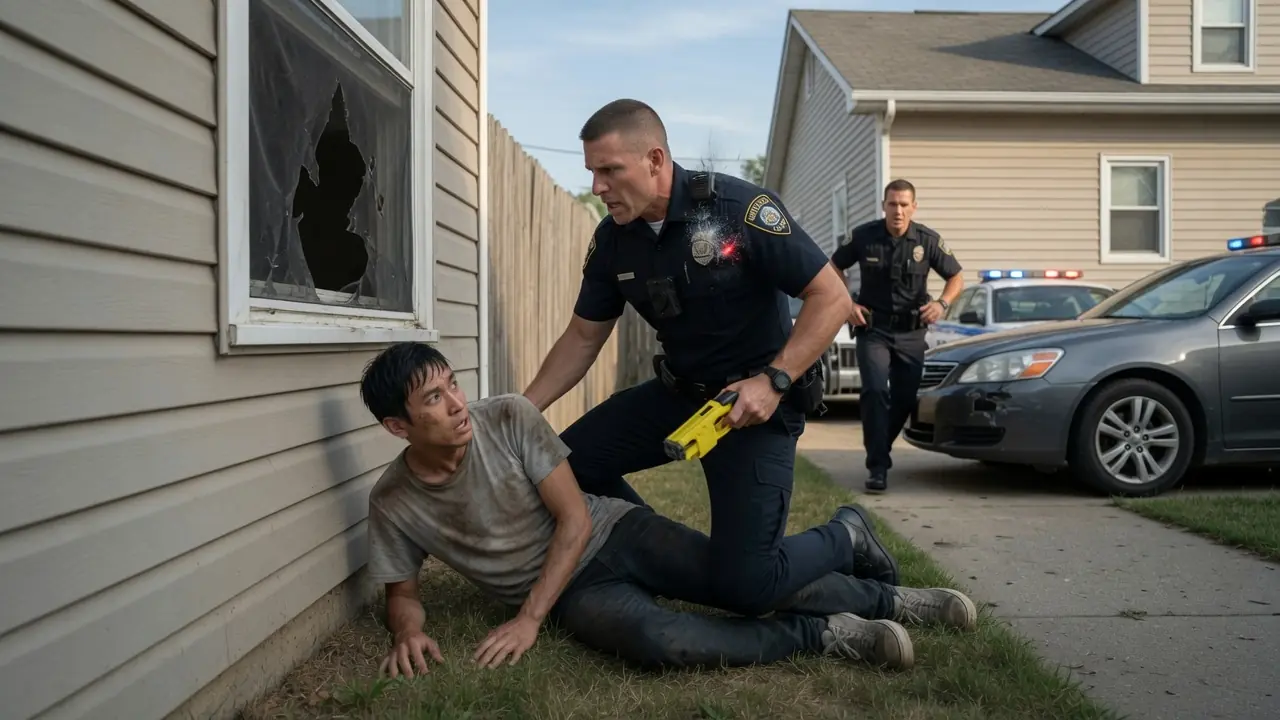
Daniel rounded the corner and saw Lawrence climbing through a side window, one leg already outside.
“Stop.”
Lawrence dropped into the yard.
“Stay where you are.”
Instead, he ran.
Daniel chased him between the house and the fence.
“Stop. Police.”
Lawrence reached the corner of the yard and looked for somewhere to go. The second officer was approaching from the front. The rear fence was too high to cross quickly.
Daniel drew his conducted-energy device.
“Do not move.”
Lawrence turned and took another step.
Daniel fired.
The probes struck Lawrence’s clothing.
His muscles locked, and he fell into the grass.
“Stay on the ground,” Daniel ordered. “Put your hands behind your back.”
Lawrence groaned.
“What did I do?”
“Roll over.”
“What did I do, man?”
“Roll onto your right side.”
Lawrence resisted for several seconds, more from panic than strength. Once the electrical cycle ended, the officers secured his wrists.
Daniel read him his rights while Lawrence tried to look back toward the house.
“You understand those rights?”
“Yes.”
“This concerns the vehicle in your driveway and the pedestrian struck on Agra Street.”
Lawrence’s expression changed.
“That boy walked into my car.”
Daniel helped him sit up.
“Tell me what happened.”
Lawrence took several breaths.
“I was driving north. Or maybe south—I don’t know. There were boys walking in the street.”
“How fast were you moving?”
“Slow. Almost stopped.”
“Then what?”
“One of them stepped right into the car. I wasn’t even moving when he hit it.”
Daniel looked toward the sedan.
Witnesses had described the vehicle backing after impact.
“Did you reverse?”
“They told me to back up, so I backed up a little.”
“Why?”
“I thought maybe his foot was under the car.”
“And then?”
“He got up. His friend found his shoe. They walked back across the street.”
“Why did you leave?”
Lawrence looked down.
“I thought he was okay.”
“Did you call for help?”
“I don’t have a phone.”
“Did you wait for somebody else to call?”
“Nobody said they were calling police.”
Daniel studied him.
“Your license is suspended.”
Lawrence gave a tired nod.
“That too.”
“So you left because you were afraid of getting a ticket.”
“I thought everything was all right.”
“And when we came to your house?”
“I saw you pulling up.”
“Why did you climb out a window?”
Lawrence’s answer came so quickly it sounded rehearsed even though it probably was not.
“I needed cigarettes.”
The second officer stared at him.
“You climbed through a window to buy cigarettes?”
“I was going to the store.”
“Why not use the door?”
“You were in front of the house.”
“That was the point. We wanted to speak with you.”
Lawrence shook his head.
“I was going to walk back after.”
Daniel had heard many explanations during his years on patrol. Some were carefully planned. Others were assembled one piece at a time while the speaker listened to himself and hoped the story would eventually sound possible.
Lawrence’s belonged to the second category.
“If you had remained at the crash,” Daniel said, “the investigation could have been handled there.”
“I didn’t know you were coming.”
“You struck a person with a car.”
“He walked into me.”
“That still requires you to stay.”
Lawrence leaned back against the fence.
“What happens now?”
“The other officer is confirming the crash details.”
A few minutes later, the investigating officer returned.
Witness statements indicated that Lawrence had not caused the initial collision. The pedestrian had entered the roadway unexpectedly and walked into the side-front area of the slowly moving vehicle.
Lawrence stared at Daniel when he heard the result.
“So I wasn’t at fault?”
“Not for the crash.”
“Then take these cuffs off.”
“You still left the scene, drove while suspended, fled from officers, and resisted detention.”
Lawrence closed his eyes.
Had he remained beside the road, he probably would have received a citation for driving under suspension and been allowed to arrange transportation home.
Instead, he had abandoned the scene, hidden inside his house, climbed out a window, and forced police into a foot chase.
Daniel guided him toward the patrol car.
“You turned a ticket into a trip to jail.”
Lawrence lowered himself into the rear seat.
“I just didn’t want trouble.”
Daniel closed the door.
Running had created the trouble he feared.
Later that evening, Daniel joined Matt for crime-suppression patrol in the Parkway Motel district.
The area contained aging motels, convenience stores, empty lots, and bars that remained open until dawn. Police regularly received complaints about narcotics, robberies, street-level prostitution, and assaults.
Daniel and Matt had worked together for several years.
Graveyard shift suited them.
The hours were difficult, but partners shared the car, the strange calls, the dark humor, and the long silent periods between emergencies.
Shortly after midnight, Matt pointed toward a sedan stopped awkwardly near the curb.
“Look at that.”
A woman stood beside the passenger door.
Daniel recognized her.
Her name was Charlene Vega, a transgender woman known to officers because she frequently worked as a street-level sex worker in the district.
She climbed into the sedan.
The vehicle moved less than a block before stopping again in a dim parking area between two motels.
Daniel parked behind it.
The driver looked into the mirror.
Charlene turned in her seat.
Daniel approached the driver’s side while Matt went toward the passenger door.
“Evening,” Daniel said. “Turn off the engine.”
The driver complied.
He was a middle-aged man named Arthur Benson.
His hands moved nervously near his pockets.
“Keep your hands where I can see them,” Daniel said. “Any weapons?”
“No.”
“Step out.”
Arthur exited slowly.
Matt opened the passenger door.
“Charlene, come speak with me.”
She smiled.
“You know my name.”
“I’ve met you before.”
“You can call me Delicious Charlene.”
“Charlene works.”
Arthur leaned against the sedan.
“I was only giving her a ride.”
“Where did you meet?”
“Near the bridge.”
Matt asked Charlene the same question.
“The gas station,” she said.
Daniel looked toward Arthur.
“You said the bridge.”
“It’s near the gas station.”
“Where were you taking her?”
“To her sister’s house.”
Matt asked Charlene.
“My son’s.”
Their stories did not match.
That was common when strangers had only a few seconds to invent a shared explanation.
Arthur tried again.
“She waved at me. I thought she needed help.”
Charlene laughed softly.
“He offered me a ride.”
“Did you know she was working?” Daniel asked.
Arthur hesitated.
“I thought maybe.”
“Maybe what?”
“That she might be a prostitute.”
“Did you discuss money?”
“No.”
“Any sexual act?”
“No.”
“Was that possibility on your mind when you stopped?”
Arthur looked toward the ground.
“She looked like a woman standing alone.”
“That doesn’t answer the question.”
Arthur exhaled.
“Yes. Maybe.”
“Have you paid for sex before?”
“Yes.”
Matt brought Charlene toward the patrol car.
She continued smiling, but Daniel could see caution behind it.
The district could be dangerous for anyone engaged in sex work. It was especially dangerous for transgender workers because customers sometimes reacted violently after discovering facts they had failed to ask about or refused to understand.
Officers had investigated such assaults before.
One had become a homicide only a month earlier.
Daniel asked Arthur for consent to search the vehicle.
Arthur agreed.
“Is there anything illegal inside?”
“A little marijuana.”
“How much is a little?”
“A joint. Maybe some more under the seat.”
Daniel found a rolled joint near the gear selector, a small bag beneath the driver’s seat, rolling papers, and a pipe.
A folding knife was also inside the vehicle.
The knife itself was not necessarily illegal, but its presence reminded Daniel how quickly the encounter could have changed.
Arthur admitted he had stopped because he believed Charlene might exchange sex for money.
Charlene denied a completed agreement but had been observed soliciting vehicles in an area known for repeated prostitution complaints.
Both were placed under arrest on separate charges.
Matt guided Charlene toward the rear seat.
She adjusted her clothing and sat sideways.
“If we leave you out here,” Matt said quietly, “someone may hurt you.”
Charlene looked away.
“They’ll be surprised.”
“That surprise may make someone violent.”
“I can take care of myself.”
“Everybody says that before the one person they can’t handle arrives.”
She did not answer.
Daniel spoke to Arthur before placing him into another unit.
“You understood what you were looking for when you stopped.”
Arthur nodded reluctantly.
“You also understood you might not know everything about the person you picked up.”
“Yes.”
“How would you have reacted if the encounter progressed and you discovered something unexpected?”
“I wouldn’t have done anything.”
“You’re certain?”
“Yes.”
Daniel could not know whether that was true.
Many violent incidents began with someone believing his own tolerance was greater than it actually was.
“Do you plan to return to Parkway after tonight?”
“No.”
“Did you learn anything?”
Arthur looked toward his car being inventoried.
“Probably.”
“Probably?”
“Yes. I learned.”
The arrests were routine compared with what came later.
No one was injured.
No one ran.
Arthur’s marijuana possession and the suspected solicitation complicated what might otherwise have been an embarrassing conversation, but everyone would leave the scene alive.
Hours later, when Daniel saw the motorcycle, he did not yet know how sharply the night would turn.
Ryan Keller had been parked outside a convenience store when the deputies first noticed him.
He revved the engine unnecessarily, accelerated through the lot, and nearly struck a parked vehicle while turning onto the boulevard.
Daniel intended to make a traffic stop.
Nothing more.
There had been no report of a violent crime.
No known weapon.
No reason for Ryan to believe he faced a serious sentence.
When the emergency lights activated, he initially slowed.
For a moment, it appeared he would stop.
Then he looked backward and accelerated.
After the crash, Daniel found the explanation in the records.
Three misdemeanor warrants.
A suspended license.
A previous alcohol-related driving conviction.
Ryan had probably calculated that stopping would mean handcuffs, towing fees, court dates, and perhaps several days in jail.
So he ran.
The decision lasted seconds.
Its consequences unfolded across an intersection filled with shattered metal and medical equipment.
The helicopter ultimately transported Ryan to the trauma center.
Doctors performed emergency surgery.
For several days, his survival remained uncertain.
Howard Ellis, the pickup driver, went home with bruising from the seat belt and a memory that woke him repeatedly during the night.
He had done nothing wrong.
He had entered an intersection on a green light and nearly become responsible, in his own mind, for another man’s death.
Daniel visited him two days later.
Howard stood in his driveway beside the damaged pickup.
“I keep seeing the light,” he said.
“What light?”
“The motorcycle headlight coming toward me.”
“You couldn’t have avoided him.”
“I could have waited another second before pulling out.”
“You had the right of way.”
“That doesn’t stop the thinking.”
Daniel understood.
Police officers did the same thing after bad calls.
They examined fractions of seconds and imagined alternate decisions.
“What if I had turned farther?”
“What if I had seen him sooner?”
“What if I had waited?”
Sometimes those questions revealed mistakes.
Sometimes they only punished the person asking them.
“You stopped as soon as you saw him,” Daniel said. “The evidence shows that.”
Howard looked toward the dented truck.
“Will he live?”
“We don’t know yet.”
Ryan survived.
His recovery was long.
He suffered fractures, internal injuries, and permanent damage to one leg. He faced new charges after leaving the hospital, but the court considered his medical condition during the proceedings.
Daniel saw him months later.
Ryan used crutches.
The red beard remained, though his face looked thinner.
For the first time, the two men spoke without engines, sirens, or commands between them.
“Why did you run?” Daniel asked.
Ryan looked toward the courthouse hallway.
“I didn’t want to go to jail.”
“You had misdemeanor warrants.”
“I know.”
“You risked your life over them.”
“I didn’t think I’d crash.”
“No one does.”
Ryan rubbed one hand across the top of the crutch.
“I thought if I got far enough ahead, you’d stop.”
“We nearly did.”
Ryan looked up.
“What?”
“You were pulling away. We could not safely match your speed through that intersection.”
“Then why were you still there?”
“We were slowing when you entered against the light.”
Ryan stared at the floor.
“The truck came out of nowhere.”
“No. It came out of a parking lot on a green light.”
Ryan did not argue.
For months, he had probably replayed the crash in a version where the truck appeared unexpectedly and the pursuit left him no choice.
Reality was less comforting.
He had passed the patrol car recklessly.
He had ignored the stop.
He had accelerated through a red light.
The truck driver had no chance.
Daniel thought about Lawrence Cole climbing through his window for cigarettes he did not have.
He thought about Arthur Benson claiming he picked up a stranger out of kindness while admitting the truth one question at a time.
He thought about Charlene smiling inside the patrol car while danger remained waiting somewhere beyond the next motel.
Every person that night had carried a story explaining why his or her decision made sense.
Some stories were partly true.
Lawrence had not caused the collision.
Arthur had not completed an agreement for sex.
Charlene understood the street better than the deputies did.
Ryan had feared jail.
But fear and partial truth did not erase consequences.
The simplest decision had been available to Lawrence.
Stay beside the car.
Explain what happened.
Accept the citation.
He ran and went to jail.
Arthur could have continued driving past the woman near the bridge.
Instead, he stopped with one intention, claimed another, and left in handcuffs for a separate offense found beneath his seat.
Ryan could have stopped beside the curb.
He might have spent a short period in custody.
Instead, he spent weeks in a hospital and years learning to walk without pain.
Months after the graveyard shift, Daniel sat with Matt inside their patrol car overlooking the Parkway district.
The motels remained.
Cars entered and left.
Streetlights flickered above cracked sidewalks.
“You ever think about that night?” Matt asked.
“Which part?”
“The motorcycle.”
“Sometimes.”
“I keep thinking how routine it started.”
“Most bad calls do.”
Matt looked toward the boulevard.
“We were going to give him a ticket.”
“Probably arrest him on the warrants.”
“Still better than what happened.”
Daniel nodded.
The work rarely offered clean lessons.
People did not always become grateful.
They did not always understand that an officer had prevented something worse.
Some cursed.
Some lied.
Some fought.
Some remembered the arrest as the injustice and forgot every decision that came before it.
Yet there were other moments.
A mother thanking Daniel after he found her missing child.
An elderly man shaking Matt’s hand after deputies stopped a fraud scheme.
A frightened driver hearing that he had not caused a fatal crash.
Those moments carried officers through the nights when nothing ended well.
Daniel had once believed police work was about catching dangerous people.
Experience taught him that much of it involved meeting ordinary people during the worst decision of their day.
Lawrence was not a violent criminal.
He was a frightened suspended driver who panicked.
Arthur was not a hardened trafficker.
He was a lonely man who placed himself and another person in danger because desire overruled judgment.
Ryan was not fleeing a murder charge.
He was running from misdemeanor warrants.
That was what made the consequences harder to accept.
The disasters had not begun with enormous crimes.
They began with embarrassment.
Fear.
Pride.
The wish to avoid one uncomfortable conversation.
Near dawn, Daniel and Matt drove through the same intersection where the motorcycle crashed.
The road had been repaired.
No fragments remained.
Vehicles passed through normally.
A driver stopped at the red light, waited, and continued when it turned green.
Nothing happened.
Daniel watched the car disappear.
The ordinary nature of the moment felt important.
Most nights, people stopped when officers activated their lights.
Most drivers remained after minor crashes.
Most strangers avoided situations they knew could become dangerous.
Those decisions never appeared on television.
Nobody told stories about the man who accepted a ticket and went home.
But Daniel had seen the alternative.
He had seen a man climb through his own window to avoid speaking with police.
He had seen another man admit the truth only after drugs were found beneath his seat.
He had watched a motorcycle enter a red-light intersection at more than one hundred miles an hour.
The distance between going home and going to jail could be one decision.
The distance between jail and a trauma helicopter could be another.
As the sky brightened above the city, Daniel turned the patrol car toward the station.
The shift was ending.
Reports remained to be written.
Evidence had to be logged.
The crash diagram would take hours.
But the streets behind them were quiet.
For that moment, no one was running.
And sometimes, after a night like that, quiet was the closest thing to a victory an officer could expect.