The first thing sixteen-year-old Darius Coleman lost that Saturday afternoon was not his freedom.
It was his phone.
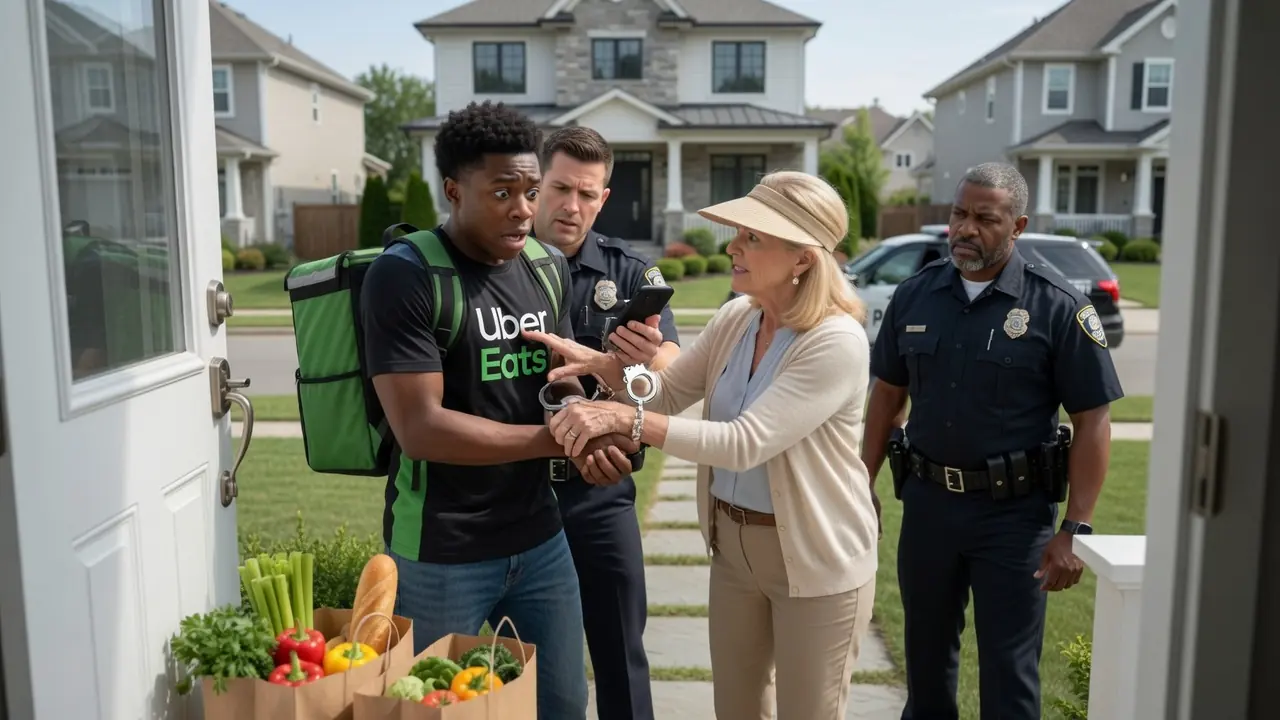
He was standing on the front porch of a large brick house in a quiet suburban neighborhood outside Milwaukee, one arm wrapped around two paper grocery bags, when a woman came marching across the lawn.
Darius barely had time to look up.
“Hey!”
She pointed at him.
“What are you doing?”
Darius glanced behind himself, thinking she might be speaking to someone else.
Nobody.
“I’m making a delivery.”
The woman stopped at the bottom of the porch steps.
Her name was Denise Porter.
Fifty-eight.
Retired insurance administrator.
Neighborhood-watch volunteer.
And, at least in her own mind, someone personally responsible for knowing who belonged on every sidewalk around her.
She looked Darius up and down.
Black teenager.
Blue delivery-company T-shirt.
Jeans.
Phone in one hand.
Groceries beside the door.
None of that seemed to matter.
“You were trying to get inside.”
“No.”
“I saw you.”
“I was trying to call the customer.”
Darius lifted his phone.
“The instructions say leave the bags inside the side entry if the door is unlocked, but I wanted to make sure first.”
Denise climbed the steps.
“Give me that.”
Before Darius understood what she meant, she snatched the phone from his hand.
“Ma’am.”
His body went rigid.
“Give me my phone.”
“I’m calling police.”
“I already told you what I’m doing.”
“You do not live here.”
“I never said I did.”
“I know everyone in this neighborhood.”
“That doesn’t mean you know everybody who comes here.”
Denise’s face changed.
Not fear.
Offense.
As though the boy had violated some unspoken rule merely by answering her.
“You need to watch your attitude.”
Darius stared at her.
“You took my phone.”
“I’m protecting these homeowners.”
“They ordered groceries.”
“Prove it.”
“The proof is on the phone you just took.”
For one second, Denise had nothing to say.
Then she pressed the emergency-call button.
Darius stepped toward her.
“Please just give it back.”
She recoiled dramatically.
“Stay away from me!”
“I’m not touching you.”
“Help!”
Darius stopped.
That word frightened him more than the police call.
Because now curtains were moving.
A garage door opened across the street.
An older man stepped onto his driveway.
Another neighbor lifted a phone and began recording.
Denise spoke loudly.
“This boy is threatening me!”
Darius looked around.
“I’m literally standing here.”
“Back away.”
“I just want my phone.”
“You were trying to break into this house.”
“No, I wasn’t.”
Denise pointed toward the front door.
“I caught him.”
The sentence traveled faster than the truth.
By the time the patrol car turned onto the street, three neighbors had come outside.
Darius’s hands were shaking.
Officers Peter Lang and Aaron Bell arrived first.
Both were young.
Both saw the scene before they heard the facts.
Upset older woman.
Black teenage boy.
Groceries on porch.
Several people watching.
Officer Lang stepped out.
“What’s going on?”
Denise answered immediately.
“I caught him trying to break in.”
Darius opened his mouth.
Lang held up a hand.
“Hold on.”
Darius closed it.
“What’s your name?”
“Darius.”
“Last name?”
“Coleman.”
“ID?”
“It’s in my phone.”
Denise held it against her chest.
Officer Bell looked at her.
“That his?”
“He was using it while he was trying to enter the house.”
Darius stared.
“That doesn’t even make sense.”
Lang looked at him.
“Do you live here?”
“No.”
“Then why are you at the door?”
“I’m delivering the groceries.”
Denise laughed.
“He’s changing his story.”
“No, I’m not.”
Darius pointed toward his shirt.
“I’m working.”
Officer Lang glanced at the delivery logo.
Then toward the grocery bags.
It should have slowed him down.
It did not.
“Turn around.”
Darius froze.
“What?”
“Turn around for me.”
“Why?”
“Because I’m giving you an instruction.”
“I didn’t do anything.”
“Turn around.”
Darius’s breathing became shallow.
His mother had talked to him about encounters like this.
Keep your hands visible.
Do not make sudden movements.
Do not argue with an officer on the street even if the officer is wrong.
Get home.
Then deal with wrong.
But knowing instructions and living them were different things.
“I’m not resisting,” Darius said quickly.
“Then turn around.”
He did.
Cold metal closed around one wrist.
Then the other.
The sound changed something inside him.
His breath disappeared.
“I didn’t do anything.”
“Relax.”
“I am trying.”
“Relax.”
“I can’t.”
His shoulders began trembling.
Officer Bell looked uncomfortable.
“Pete, maybe we should check the delivery app first.”
Lang ignored him.
“Where’s the homeowner?”
Denise answered.
“Probably inside terrified.”
Darius turned his head.
“The customer messaged me that she’s upstairs with a baby. She said just leave the groceries.”
Lang tightened his grip on Darius’s arm.
“Face forward.”
A second patrol vehicle arrived.
Then a third.
Lieutenant Daniel Cho stepped out.
He was forty-six and had been with the department twenty-two years.
Darius knew him.
Not personally.
But enough.
The previous summer, Lieutenant Cho had spoken at a youth mentoring program Darius attended through his high school.
The program brought teenagers into police headquarters to learn about emergency dispatch, community policing, and careers in public service.
Cho looked toward Darius.
Then stopped.
“Darius?”
Darius turned.
His face was wet.
He had not realized he was crying.
“Lieutenant.”
Cho’s expression changed.
He looked at the cuffs.
At the groceries.
At Denise holding a phone.
At his officers.
“What happened?”
Lang answered.
“Possible residential burglary.”
“Evidence?”
“Reporting party witnessed him trying to enter.”
Cho looked toward Denise.
“You saw him force the door?”
“Well, no.”
“Break a window?”
“No.”
“Use a tool?”
“No.”
“Try the lock?”
“He was standing there suspiciously.”
Cho looked at the bags.
“He’s wearing a delivery shirt.”
“That could be fake.”
“Whose groceries?”
Denise hesitated.
Cho walked to the porch.
A receipt was stapled to one bag.
Delivery address.
Customer name.
Time.
He read it.
Then looked toward Darius.
“Take those cuffs off.”
Officer Lang stiffened.
“Lieutenant—”
“Now.”
Bell immediately stepped forward and removed them.
Darius pulled his hands against his chest.
Cho watched his breathing.
Too fast.
“Darius.”
The teenager looked at him.
“You’re safe right now.”
Darius tried to answer.
Nothing came.
“Bell, get him water.”
“Yes, sir.”
Cho looked toward Lang.
“Why was he cuffed?”
“He didn’t live here.”
“That’s not a crime.”
“He was accused of burglary.”
“An accusation is information.”
Cho pointed toward the porch.
“It is not automatic proof.”
Lang looked toward Denise.
“She was scared.”
“And your job is to determine whether the fear matches the facts.”
Denise stepped forward.
“I cannot believe this.”
Cho turned.
“What?”
“You’re taking his side.”
“I’m asking what occurred.”
“These officers were doing their jobs.”
“They work for me.”
Her face changed.
Cho continued.
“And right now I’m trying to determine whether they did that job correctly.”
Denise pointed toward Darius.
“He came at me.”
Darius looked up sharply.
“No, I didn’t.”
Cho raised his hand.
“Denise, did he strike you?”
“No.”
“Push you?”
“No.”
“Grab you?”
“He could have.”
“That isn’t the question.”
She flushed.
“He frightened me.”
“What did he do?”
“He didn’t belong here.”
There it was.
The sentence everyone around them heard.
Cho looked at her for a long moment.
“You keep saying that.”
“Because it’s true.”
“Delivery workers come into neighborhoods.”
“I didn’t know he was delivering.”
“The bags are here.”
“I thought it could be a cover.”
“The shirt?”
“You never know anymore.”
Darius finally spoke.
“She took my phone.”
Cho looked toward Denise’s hand.
“Is that his phone?”
Her fingers tightened.
“I took it so I could call you.”
“Did he give you permission?”
“No, because he was—”
“Give it back.”
She hesitated.
Cho’s voice hardened.
“Now.”
Denise handed the phone to Officer Bell.
Bell returned it to Darius.
The screen showed the open delivery application.
Customer name.
Address.
Order.
Messages.
One message from the homeowner read:
Baby finally asleep. If I don’t answer, please leave bags inside screen door. Thank you!
Cho showed it to Lang.
Nobody spoke.
Then the front door opened.
A tired-looking woman appeared holding an infant against her shoulder.
“Oh my God.”
She saw Darius.
“You’re the grocery driver.”
“Yes, ma’am.”
“What happened?”
Denise immediately said:
“I protected your home.”
The homeowner stared at her.
“From the person I paid to bring my food?”
Denise looked offended.
“I didn’t know.”
“You could have asked me.”
“You didn’t answer.”
“My baby was sleeping.”
Darius sat slowly on the edge of the porch.
His hands were still shaking.
Another car pulled up.
A white woman in hospital scrubs jumped out before the engine fully stopped.
“Darius!”
He looked up.
“Mom.”
Laura Coleman ran toward him.
She had seen the livestream from one of Darius’s coworkers, who recognized him in a neighbor’s video circulating online.
She knelt in front of him.
“Are you hurt?”
“No.”
“Did anyone hit you?”
“No.”
She looked at his wrists.
Red marks.
Then at the officers.
“What happened?”
Lieutenant Cho introduced himself.
“I know you.”
Laura looked at him.
“You spoke at his mentoring program.”
“Yes, ma’am.”
Darius looked embarrassed.
“I’m okay.”
Laura stood.
“No.”
She looked at him.
“You don’t have to protect everyone else from how this felt.”
Darius stared at the ground.
Laura turned toward Denise.
“You took his phone?”
Denise crossed her arms.
“I made a mistake.”
“You accused him of burglary.”
“I was trying to help.”
“You told police he attacked you.”
“I said I felt threatened.”
“No.”
The homeowner interrupted.
“I heard you say he tried to attack you.”
Several neighbors nodded.
One held up her phone.
“I recorded it.”
Denise’s face changed.
For the first time, she understood the afternoon had produced witnesses she could not control.
Laura looked toward Cho.
“What happens now?”
Cho answered carefully.
“The reporting issue will be documented. The phone being taken will also be documented. You and Darius will have the option to speak with an investigator about whether any criminal complaint is appropriate.”
Darius shook his head.
“I just want to work.”
Laura looked at him.
“I know.”
“I need to finish my deliveries.”
“You don’t need to decide anything right now.”
Denise stepped closer.
“I said I’m sorry.”
Laura turned.
“Because you understand what you did?”
“Yes.”
“Or because police stopped believing you?”
Denise looked away.
That was answer enough.
Darius did not become famous.
He did not want to.
His mother declined interview requests.
The homeowner paid him for the damaged delivery and left a large tip he initially tried to refuse.
The police department opened an internal review.
Officer Bell was cleared of misconduct but received counseling on intervening earlier when he believed a detention lacked support.
Officer Lang received formal retraining and supervisory monitoring for escalating before verifying readily available evidence.
Lieutenant Cho told both men:
“The problem isn’t that you asked the teenager questions.”
He placed a still image from the neighbor’s video on the table.
Darius in handcuffs.
Groceries three feet away.
“The problem is how quickly your investigation stopped once one person’s fear matched an assumption you were already prepared to make.”
Denise ultimately faced misdemeanor charges related to taking Darius’s phone and knowingly providing materially false information during the encounter.
The case ended with probation, restitution, and court-ordered community service rather than prison.
Six months later, she reported for her first shift at the Northside Community Center.
Darius happened to be there helping younger students with a summer job program.
Denise stopped when she saw him.
He looked older somehow.
Not because he was.
Because she was finally seeing him without the story she had invented first.
“You work here?” she asked.
“Volunteer sometimes.”
Denise nodded.
For several seconds, neither spoke.
Then Darius said:
“You don’t have to avoid me.”
She looked surprised.
“I thought you hated me.”
“I don’t know you well enough to hate you.”
That landed harder than anger.
He picked up a box of notebooks.
Then stopped.
“You want advice?”
Denise almost smiled.
“From you?”
“Yes.”
“Okay.”
“Next time you think someone doesn’t belong somewhere…”
He looked at her.
“Ask before you decide what crime they’re committing.”
Then he walked away.
Denise stood in the hallway holding a stack of volunteer forms.
For once, she had nothing to say.
The second story began three months later in another part of the state.
Different neighborhood.
Different police department.
Same dangerous shortcut.
A man named Andre Wallace stood beside a silver sedan in a hotel parking garage trying to open the driver’s door with a small plastic wedge.
Two officers saw him.
Sergeant Victor Raines and Officer Owen Harris.
Andre had spent twenty minutes searching the hotel room for his rental-car key.
Nothing.
He finally remembered placing the key fob on the roof while unloading luggage the previous evening.
It was gone.
His wallet was inside the center console.
So was the rental agreement.
His phone battery was dead.
He had asked hotel maintenance for help, but nobody had the tools to open the car.
Andre had borrowed a plastic wedge and was attempting to create enough space in the door frame to pull the interior handle with a coat hanger.
That was when the patrol car stopped.
Sergeant Raines got out first.
“Hands where I can see them.”
Andre froze.
“Officer, this is my rental.”
“Hands on the car.”
“I lost the keys.”
“Of course you did.”
“I can show you the contract.”
“Where?”
“Inside.”
Raines laughed.
“That’s convenient.”
Officer Harris remained near the cruiser.
He was twenty-seven and had been on the force only eighteen months.
He watched Andre put his hands on the roof.
No running.
No aggression.
No obvious burglary tools beyond a plastic wedge and wire.
“Sergeant,” Harris said, “maybe we should verify the plate.”
Raines ignored him.
He cuffed Andre.
“You’re under arrest for attempted vehicle theft.”
Andre turned his head.
“Based on what?”
“Based on me watching you break into a car.”
“My car.”
“Rental car.”
“Yes.”
“You have ID?”
“Inside the console.”
“Sure.”
“The agreement is in there too.”
Raines tightened the cuffs.
“You people always have a story.”
Andre went still.
Officer Harris heard it.
“Sergeant.”
“What?”
“What do you mean, ‘you people’?”
Raines looked at him.
“I mean thieves.”
That was not what he meant.
Both men knew it.
Andre knew it too.
“Just check the console,” he said.
Raines pushed him toward the patrol vehicle.
“You can explain it downtown.”
At the station, Andre repeated the story.
Silver sedan.
Rental from Lakeview Auto.
Wallet in console.
Agreement inside.
Officer Harris could not let it go.
He checked the plate.
The registration came back to the rental company.
That proved neither innocence nor guilt.
He called Lakeview Auto.
After a long hold, an employee confirmed the vehicle was currently rented.
“Name?”
The employee hesitated.
“We can only release customer details to authorized law enforcement through records.”
Harris gave the required information.
The employee said they would respond through formal channels.
Sergeant Raines appeared in the doorway.
“You still working his fairy tale?”
“I’m verifying.”
“Why?”
“Because if it’s his rental—”
“It isn’t.”
“How do you know?”
Raines folded his arms.
“Experience.”
Harris thought about the word.
Experience could mean wisdom.
It could also mean a belief repeated so often nobody remembered when evidence had stopped being required.
“The console would settle it.”
“No search without the proper paperwork.”
“We can inventory the vehicle before tow.”
“The tow’s already coming.”
“Then we should inventory.”
Raines stepped closer.
“Drop it.”
Harris stared at him.
“That’s an order.”
The sedan entered the department impound lot that evening.
Harris contacted Detective Mariah Foster, someone he trusted from a previous assignment.
“I need advice.”
She listened.
Then said:
“If the car’s being held as evidence or inventoried under policy, document exactly what authority you have before opening anything.”
“I just want to verify the suspect’s story.”
“That isn’t enough by itself.”
Harris nodded.
“So what can I do?”
“Check the towing paperwork.”
They did.
The vehicle had been entered for an inventory search under standardized impound procedure.
That allowed officers to document property inside, provided the search followed policy rather than becoming an excuse to hunt for evidence.
Detective Foster agreed to witness.
They opened the vehicle.
Center console.
Empty.
No wallet.
No rental agreement.
Harris stared.
“Nothing.”
Foster looked at him.
“You sure he said console?”
“Three times.”
They checked only the areas authorized by the inventory policy.
Still nothing.
Harris felt foolish.
Sergeant Raines appeared twenty minutes later.
He looked furious.
“You went behind my back?”
Harris stood.
“The vehicle required inventory.”
“And?”
“Nothing.”
Raines smiled.
“Told you.”
Harris looked toward the empty console.
Maybe he had been wrong.
That bothered him.
But something else bothered him more.
The console was unusually clean.
No receipts.
No loose change.
No charging cable.
Nothing.
For a rental car used several days, that was possible.
Still.
Harris looked at the passenger seat.
A faint rectangular dust outline showed where something had recently rested.
He took a photograph.
He did not know why.
The following morning began with a command briefing.
Chief Eleanor Bishop stood at the front.
Forty officers filled the room.
Sergeant Raines sat in the first row wearing a fresh uniform.
Everyone knew he was seeking promotion to lieutenant.
The chief began with routine announcements.
Staffing.
Training.
Community complaints.
Then:
“One final matter.”
The room settled.
“We have received multiple allegations over the past year concerning race-based enforcement decisions within this district.”
Raines shifted.
Chief Bishop continued.
“Complaints are not proof.”
She looked around.
“But patterns require examination.”
She turned toward Raines.
“Sergeant, you made an arrest yesterday?”
“Yes, Chief.”
“Attempted vehicle theft?”
“Yes.”
“You confident?”
“Completely.”
“What evidence established the vehicle was stolen?”
Raines hesitated.
“We observed the suspect attempting forced entry.”
“Did you verify ownership or rental status before arrest?”
“He claimed it was a rental.”
“That wasn’t my question.”
“No.”
Officer Harris slowly looked up.
Chief Bishop turned toward him.
“Officer Harris.”
“Yes, ma’am.”
“Did you attempt verification?”
“Yes.”
“Why?”
“His explanation was plausible.”
Raines shook his head.
“He went outside chain of command.”
Harris stood.
“That’s true.”
The room became quiet.
“I disagreed with my supervisor and pursued the inventory process after tow.”
“Did you find proof?”
Harris swallowed.
“No, ma’am.”
Raines smiled.
Chief Bishop looked at Harris.
“Do you regret checking?”
He thought carefully.
“No.”
Several people shifted.
“I regret that I didn’t find what he said would be there.”
He continued.
“But if I’m arresting somebody, I’d rather spend ten minutes testing a plausible explanation than ten years wondering whether we ignored one.”
Chief Bishop nodded.
Then:
“Detective Foster?”
The rear door opened.
Detective Mariah Foster entered.
And behind her walked Andre Wallace.
No cuffs.
Dark blazer.
Badge clipped at his belt.
Sergeant Raines turned white.
Chief Bishop said:
“For those who have not met him, this is Detective Andre Wallace of the Long Beach Police Department.”
The room erupted in whispers.
Raines stood.
“What?”
Andre looked at him.
“You never asked long enough to find out.”
The operation had been authorized by internal affairs after multiple complaints against the district.
Andre had volunteered while visiting the region for a joint investigative course.
The car was a legitimate rental.
The lost-key scenario had been staged.
The wallet and rental paperwork had initially been placed exactly where Andre said.
Chief Bishop turned toward Officer Harris.
“You found nothing.”
“Yes, ma’am.”
“Because sometime between the arrest and the authorized inventory, those items were removed.”
Harris’s face changed.
Chief Bishop continued.
“The rental vehicle was equipped with covert cameras pursuant to the internal investigation.”
Sergeant Raines stepped backward.
“No.”
A screen activated.
Video.
The impound lot.
Late evening.
Sergeant Raines approaching the silver sedan alone.
Opening it with a key recovered during booking.
Reaching into the center console.
Removing a wallet.
Removing folded documents.
Placing both inside an evidence envelope.
Then walking away.
Nobody spoke.
Raines looked toward the chief.
“You set me up.”
Chief Bishop’s expression hardened.
“We created a situation where the correct response was to investigate before arresting.”
“You targeted me.”
“We investigated complaints.”
“You used a Black detective to bait me.”
Andre answered this time.
“No.”
He stepped forward.
“You had dozens of choices.”
“Run the plate.”
“Call the rental company.”
“Look inside.”
“Ask the hotel.”
“Wait for records.”
“Listen to your partner.”
He looked directly at Raines.
“You chose the one explanation that confirmed what you decided about me in the first ten seconds.”
Raines pointed toward Harris.
“He broke chain of command!”
Chief Bishop nodded.
“That will be reviewed separately.”
Harris lowered his head.
“But refusing an improper directive and then acting within documented inventory policy is not the issue that should concern you right now.”
Two internal-affairs investigators entered.
Raines looked toward the door.
Then toward the screen.
For the first time, he seemed to understand that promotion was no longer the question.
Evidence tampering was.
Raines was not arrested theatrically during the briefing.
He was relieved of duty.
His badge and weapon were collected.
He was interviewed with counsel present.
The evidence was referred for independent criminal review.
Investigators also reopened prior complaints.
Traffic stops.
Searches.
Arrests.
Reports where stated reasons did not match body-camera footage.
Some complaints remained inconclusive.
Others did not.
The pattern mattered.
Officer Harris also faced review.
Not for believing Andre.
For how he responded when ordered to stop.
Chief Bishop told him:
“Being right about the citizen does not automatically make every procedural choice right.”
Harris nodded.
“I understand.”
“You must.”
She leaned forward.
“A department cannot survive officers ignoring lawful supervision whenever they believe they are morally correct.”
“Yes, ma’am.”
“But neither can it survive supervisors using rank to shut down basic fact-checking.”
Harris looked at her.
“That tension is the job.”
Months later, the department announced changes.
No quota-based arrest expectations.
Mandatory documentation when officers rejected easily available exculpatory information.
Supervisor review for certain discretionary arrests.
More body-camera audits.
Training based on actual department incidents rather than fictional scenarios where bias was always obvious.
Officer Harris was not instantly promoted.
He had not earned that simply by doing one courageous thing.
He remained a patrol officer.
He completed additional training.
Received strong evaluations.
Two years later, after passing the normal promotional process, he became a sergeant.
At his first briefing, he told younger officers something Chief Bishop had once told him.
“Suspicion is where an investigation begins.”
He looked around the room.
“It is not where thinking ends.”
Darius Coleman and Andre Wallace never met.
They lived in different cities.
Were different ages.
Had different lives.
Darius was a teenager trying to deliver groceries.
Andre was a detective participating in an internal investigation.
One had no power in the situation.
The other secretly had plenty.
That difference was precisely why their stories belonged together.
People loved the Andre Wallace story because of the reveal.
The supposed car thief was actually a detective.
The officer who dismissed him was exposed.
The evidence had been recorded.
There was satisfaction in that.
But Andre himself disliked that version.
During a training conference the following year, someone introduced him by saying:
“This is the detective who taught a racist sergeant a lesson.”
Andre corrected the speaker.
“No.”
The room became quiet.
“I was useful because I had a badge waiting outside the frame.”
He paused.
“The citizens who filed the original complaints didn’t.”
He looked around.
“They were the ones you should remember.”
Because that was the dangerous lesson hidden inside reveal stories.
A Black teenager should not need a white adoptive mother to arrive before adults believe he deserves dignity.
A Black motorist should not need to turn out to be a police detective before officers check whether the car is actually his.
A woman accused of trespassing should not need to be wealthy.
A man treated suspiciously should not need to be famous.
Respect could not depend on discovering that the person being mistreated was secretly connected, powerful, accomplished, or important.
Darius deserved an investigation before handcuffs because he was a citizen.
Andre deserved verification before arrest because he was a citizen.
Nothing more impressive should have been required.
Years later, Darius became a youth-employment coordinator at the same community center where Denise completed her service.
One summer, he stood in front of twenty teenagers preparing for their first jobs.
Some would stock shelves.
Some work landscaping.
Some deliver food.
Some help at summer camps.
Darius told them:
“People are going to make assumptions about you.”
The room grew quiet.
“Sometimes good ones.”
“Sometimes bad ones.”
“You cannot control every assumption.”
He looked toward the window.
“What you can control is knowing your rights, staying aware, documenting what you can, and getting home safe when possible.”
A boy in front raised his hand.
“What if somebody treats you like a criminal anyway?”
Darius thought about a porch.
Cold handcuffs.
His own phone in another person’s hand.
Then Lieutenant Cho telling the officers to slow down and investigate.
“You remember that somebody else being certain doesn’t automatically make them correct.”
The teenager nodded.
“And you don’t let their mistake become your definition of yourself.”
Across the state, Sergeant Owen Harris gave young officers a different version of the same lesson.
He showed a photograph of a silver rental car.
No race visible.
No suspect visible.
Just a vehicle with a slightly separated window seal.
“What do you know?” he asked.
One recruit said:
“Someone may be trying to break in.”
Harris nodded.
“May be.”
Another said:
“Could be owner locked out.”
“Could be.”
“Roadside assistance?”
“Could be.”
“Car thief?”
“Could be.”
Harris smiled.
“Good.”
The recruits looked confused.
“That uncertainty you feel?”
He pointed toward the screen.
“Keep it until evidence earns you certainty.”
Because both stories had begun with the same mistake.
Not hatred alone.
Not cruelty alone.
Certainty.
Denise Porter saw Darius and decided he was an intruder before asking why grocery bags were sitting beside him.
Sergeant Victor Raines saw Andre opening a vehicle and decided he was a thief before checking the rental agreement.
After that first conclusion, every new fact became something to force into the existing story.
Delivery uniform?
Disguise.
Groceries?
Cover.
Rental claim?
Lie.
Identification inside the vehicle?
Another lie.
That was how bias often protected itself.
Contradictory evidence did not correct the assumption.
It was reinterpreted to preserve it.
The better officers in both stories did something less dramatic.
They asked one more question.
They looked at one more piece of evidence.
They allowed the possibility that their first impression might be wrong.
There was nothing heroic about that.
It was simply the job.
And perhaps that was the point.
Justice should not depend on a heroic lieutenant appearing at exactly the right moment.
It should not require a secret detective behind the handcuffs.
It should exist in ordinary encounters.
Before humiliation.
Before panic.
Before an innocent person has to prove they are exceptional just to be treated as ordinary.
Darius had grocery bags beside him.
Andre had a rental agreement waiting to be checked.
The truth was never especially well hidden.
The hardest part was convincing people to look for it before deciding they already knew.