The fifteen-ton coach was not falling quickly, and that was what frightened Captain Derek Holt most.
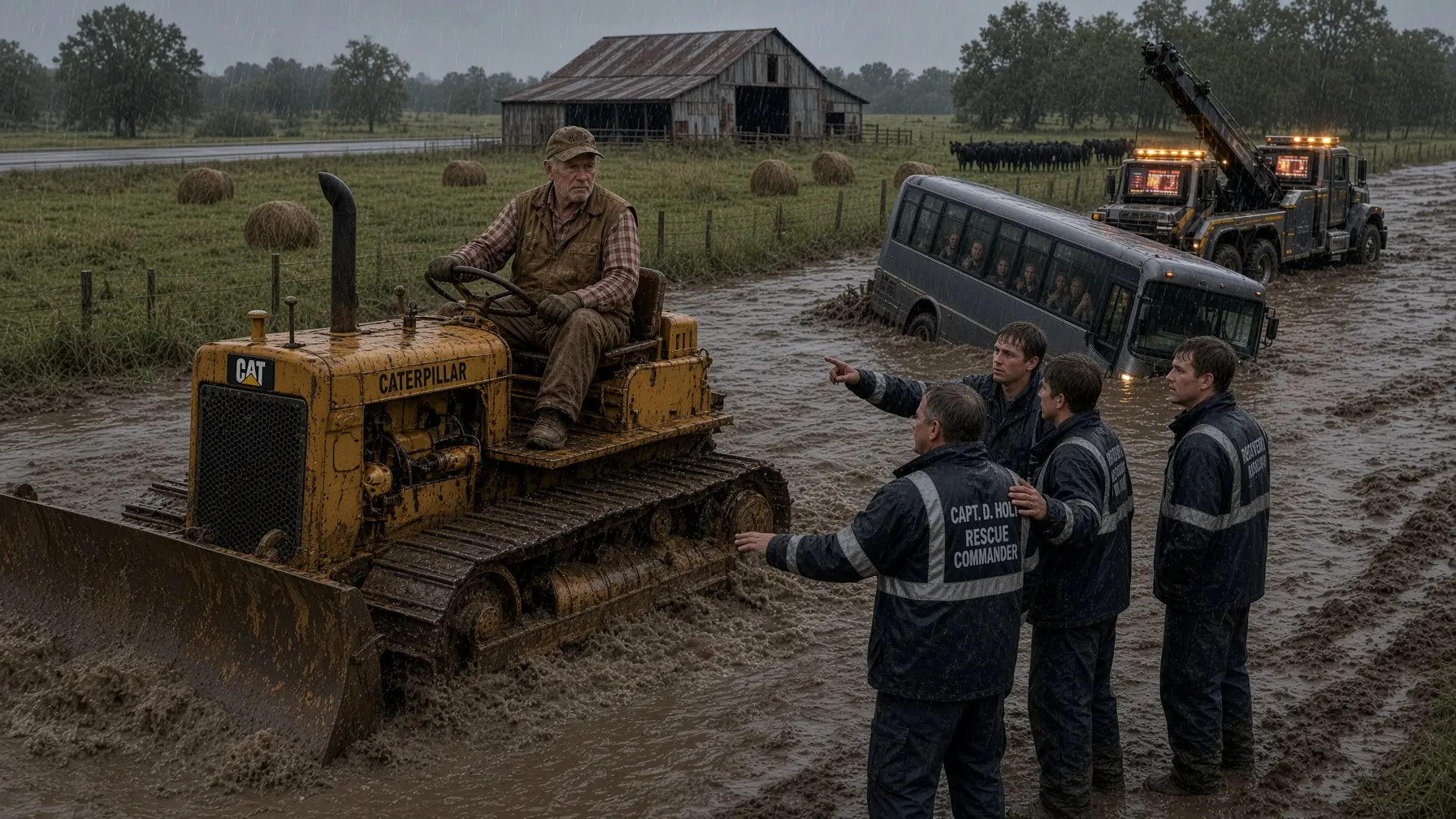
Fast disasters announced themselves. A bridge failed, a vehicle rolled, a tree came through a roof, and the entire world changed in a second. People could react to violence. They could run toward it, away from it, or around it. The bus beside Highway 9 was doing something worse. It was moving by inches. The right rear corner of Lone Star Regional Lines coach 4471B would settle, stop for forty seconds, then slide another fraction toward the flooded drainage basin below the road. Every pause created hope. Every new movement destroyed it.
Thirty-four passengers remained inside.
Rain swept sideways across Polk County, Texas, flattening the grass and reducing the afternoon to shades of gray and brown. The drainage basin beside the highway had become a moving sheet of muddy water. Fence posts, branches, an empty propane cylinder, and pieces of somebody’s shed passed beneath the leaning coach. Holt could see frightened faces through the rain-streaked windows, all of them looking toward the rescue crews as though reflective jackets came with certainty.
They did not.
Two heavy recovery trucks stood less than sixty yards away. Together they represented nearly half a million dollars in equipment, training, hydraulics, computerized load management, winches, stabilizers, boom controls, and enough rated recovery capacity to right loaded tractor-trailers under normal conditions.
Normal conditions had left Polk County hours ago.
The first wrecker had entered the shoulder cautiously. The operator never intended to drive into deep water, but the asphalt edge had concealed how badly the ground underneath had been undermined. Its right tires sank farther than expected. Water reached wiring and control modules that were designed to survive rain and spray, not prolonged immersion in brown floodwater. The truck remained mobile, but a protective hydraulic-control fault locked out several recovery functions until the system could be inspected and reset safely.
The second wrecker stayed on pavement.
Its winch worked.
That should have been the solution.
It was not.
The available angle from the road pulled too far across the bus instead of up the slope. To achieve the direction Marcus Webb wanted, the truck needed either a safe off-road position or an anchor point across the pasture that could redirect the line through a rated block. The saturated shoulder would not support the machine. Attempts to reposition only carved the roadway edge deeper. Pull harder from the wrong angle and they risked rotating the bus toward the basin instead of bringing it back.
They had plenty of power.
They had nowhere safe to put it.
Captain Holt stood beside the command vehicle while the rain drummed against his helmet.
“What about the helicopter?”
Marcus checked his radio.
“Still grounded.”
“Wind?”
“Thirty-one sustained. Higher gusts.”
Holt looked toward the bus.
A helicopter extraction had never been the preferred option, but he wanted every possibility left on the board. The weather had removed that one.
“Third wrecker?”
“Highway 146 is cut at the creek. They can’t get through.”
“State team?”
“Tied up south of us. Earliest estimate over an hour.”
The bus moved again.
Someone inside screamed.
Holt swore quietly.
Marcus Webb watched the rear wheel disappear another inch into brown slurry. At twenty-eight, he was the youngest heavy-recovery specialist working the scene, though the title sounded more impressive than the actual job. Much of his work involved calculations, rigging plans, load paths, accident reconstruction, and telling people why the enormous machine they had already paid to bring could not safely perform the miracle they imagined.
Marcus had a mechanical-engineering degree.
He understood exactly what had happened to the first wrecker.
He understood why the second could not generate the pull vector he wanted.
He understood the designed safety logic inside both machines.
None of that knowledge moved the bus.
Captain Holt looked toward him.
“We start taking passengers out.”
Marcus followed his eyes to the coach.
“Front-left exit?”
“Unless you’ve got something better.”
“The bus is still settling.”
“I know.”
“Thirty-four people shifting toward one door changes the load.”
“I know that too.”
Marcus hesitated.
Holt’s voice hardened.
“Do you have something better?”
Marcus looked at the wreckers.
Then the water.
Then the bus.
“No.”
Holt lifted his radio.
“Rescue Group, prepare for controlled passenger evacuation. Driver maintains seating until your team is in position. We’ll move them by row, left side first. No mass movement.”
Behind the command post, on the other side of a damaged barbed-wire fence, a seventy-six-year-old farmer named Walter Briggs had been watching for almost half an hour.
No one had asked him what he thought.
Walter did not take offense.
Thirty-four lives were hanging above a flooded ditch. Nobody had time to interview the old man whose pasture happened to border the accident.
He stood with both hands resting on the top fence wire, rain running off the brim of his faded cap. His brown work jacket had gone dark across the shoulders. He had watched the first wrecker sink. Watched the second crew reposition twice. Watched Marcus walk the roadside with a laser range finder and a notebook. Watched Captain Holt point toward the front of the coach when the recovery plan began turning into an evacuation plan.
Most of all, Walter watched the ground.
The recovery trucks kept looking at the road.
Walter looked behind them.
He studied the flooded pasture.
The shallow ridge running parallel to the highway.
The old drainage cut his father had filled with rock in 1963.
The darker strip where clay became sandy loam.
The depression near the sycamore tree that no heavy machine should enter after rain.
He knew that ground because he had spent seventy-two years discovering where it lied.
Walter watched the bus settle once more.
Then he turned away from the fence.
He walked toward his barn.
Nobody noticed.
Three hours earlier, Lone Star coach 4471B had been carrying thirty-four passengers south toward Livingston. Its driver, Diane Cho, had run the route for eleven years. She knew Highway 9 well enough to identify locations by sensation through the steering wheel. There was the rough expansion joint near the old Baptist church. The dip before Miller Creek. The long bend where deer appeared most often after sunset. The section beside the Briggs property where rainwater normally entered a deep roadside basin before passing through a concrete culvert.
At 2:17 p.m., Diane saw standing water at the edge of the roadway and slowed.
What she could not see was the void beneath the shoulder.
Six hours of intense rain had pushed water through layers below the asphalt. A section of fill material had washed into the basin, leaving the surface intact enough to resemble ground but weak enough to collapse when the rear axle of a forty-foot coach reached it.
The right rear wheels sank.
Diane felt the bus move sideways.
She did not jerk the steering wheel.
That probably mattered.
A panicked correction could have pushed the front axle toward the weakened shoulder too. Instead she held the front tires close to the pavement, reduced throttle, and allowed the vehicle to settle until it stopped moving.
The bus leaned sharply right.
Passengers screamed.
Diane immediately used the intercom.
“Everyone stay seated. Listen to me. Stay seated and move your upper body toward the left side. Slowly. Do not stand.”
People obeyed because her voice sounded like someone who had already decided what to do.
The weight shift helped slightly.
Diane called dispatch.
Then she counted everyone.
Thirty-four.
She counted again.
Thirty-four.
She identified three passengers who would need extra assistance if they evacuated: an elderly man with a damaged knee, a woman traveling with a toddler, and a passenger recovering from hip surgery.
Then she shut down the engine.
Not because she knew it would save the bus.
Because exhaust, vibration, and unnecessary mechanical movement offered nothing useful while the vehicle sat half-supported by questionable ground.
Sixty-seven-year-old Ray Sutton occupied seat 14A.
He had repaired diesel engines for thirty-one years before arthritis persuaded him retirement was less humiliating than pretending his hands still worked the way they once had. He did not know buses well enough to help Diane. He knew enough machinery to recognize that her calm was not luck.
Ray watched the water rise outside his window.
Every few minutes he looked at the same bolt head near the lower body panel.
Water had been below it.
Then level with it.
Then above.
He stopped mentioning that observation after the woman beside him noticed what he was doing.
Some measurements were useful.
Others merely frightened people who could do nothing with the answer.
When the first recovery truck arrived, the bus erupted in nervous conversation.
“They got us.”
“Look at the size of that thing.”
“We’re okay now.”
Ray said nothing.
Machines were not outcomes.
They were options.
He watched the huge wrecker edge toward the shoulder. Watched it stop. Watched three technicians gather around the cab. Then another recovery truck arrived and positioned farther back.
Twenty minutes passed.
Then thirty.
The bus moved again.
Diane’s voice came over the intercom immediately.
“We’re still stable. Stay where you are.”
Ray looked toward the embankment.
An old man stood beside a fence.
Rain blowing across him.
Not an emergency worker.
Just watching.
Then the old man disappeared toward a barn.
Ray forgot about him.
Walter Briggs reached the equipment shed and pulled open the side door.
The building had been constructed by his father in 1948. The main beams were thick pine, rough-cut and darkened by decades of oil smoke, dust, hay, welding, and weather. Some tools hanging on the wall had belonged to Walter’s grandfather. Others had arrived last year from a hardware store.
Walter did not divide equipment into noble old tools and soulless modern ones.
That was a luxury for people who made videos.
A tool worked.
Or it did not.
His cordless impact wrench was modern and excellent.
His smartphone was useful.
His 2019 pickup started more reliably than the truck he owned in 1971.
He had sold an old baler because repairing nostalgia every weekend was still repairing a bad baler.
But underneath a heavy canvas tarp at the rear of the barn sat one machine he had never sold.
Walter pulled away the cover.
The paint had once been Caterpillar yellow.
Seventy years of sun, heat, grease, mud, repairs, and repainting had turned it into a color somewhere between faded mustard and rust.
A 1952 Caterpillar D6 crawler tractor.
His father purchased it used when Walter was a boy.
The machine had pushed pond banks, cleared timber, dragged loaded farm trucks from mud, moved equipment buildings, built terraces, and once recovered Walter’s brother’s tractor from a creek after everyone told the man not to cross it.
The D6 had been rebuilt so many times that the phrase “original condition” had no useful meaning. The engine had been overhauled. Track components replaced. Hydraulic hoses modernized where possible. The rear logging winch had been rebuilt twice.
Walter walked around it.
He did not hurry.
First oil.
Then coolant.
Fuel.
Winch brake.
Track tension.
Final-drive leaks.
He opened a toolbox and removed a flashlight.
The old winch cable was serviceable for farm use.
Walter looked at it.
Then shook his head.
Not for thirty-four passengers.
He would not offer seventy-year-old rigging to a professional rescue crew.
They could supply rated lines.
What he had was the tractor.
And the ground.
He climbed onto the seat.
His father’s voice returned with perfect clarity from half a century ago.
Never ask a machine to prove how strong it is. Give it a job it can do.
Walter started the diesel.
The starter labored.
The engine fired roughly, coughed once, then settled into a heavy mechanical rhythm that filled the barn.
Walter let it warm.
One minute.
Two.
Three.
Outside, rain hammered the roof.
Then he eased the D6 forward.
At the highway, Captain Holt was assigning firefighters to evacuation positions when Marcus felt the vibration through his boots.
He turned.
At first he thought another county truck was arriving.
Then the sound became distinct.
Slow.
Hard.
Mechanical combustion pulses separated enough that each one seemed to occupy its own space.
A technician beside him looked toward the Briggs property.
“What the hell is that?”
A yellow crawler emerged from the rain.
Marcus stared.
“No way.”
“You know it?”
“Old D6, I think.”
“How old?”
Marcus watched the machine descending slowly toward the fence opening.
“Older than everybody here.”
Walter guided the tractor onto the pasture.
The wide tracks flattened wet grass instead of cutting deep wheel channels. He stayed well away from the dark depression near the roadside and approached along the slightly raised strip he had been studying earlier.
Captain Holt walked toward him waving both hands.
“Stop!”
Walter stopped.
The D6 idled.
Holt stepped close enough to be heard over the engine.
“Sir, you cannot enter an active recovery zone.”
Walter nodded.
“I know.”
“Then shut this down and back away.”
Walter looked toward the bus.
“Planning to unload them?”
“Yes.”
“Bus still settling?”
“We are monitoring that.”
Walter looked toward the two wreckers.
“Neither truck can establish the pull?”
Holt stared.
“You need to leave.”
Walter nodded toward Marcus.
“Who’s your recovery specialist?”
Marcus stepped forward.