Daniel Mercer noticed the rope only because the drought had taken almost six feet of water from the pond.
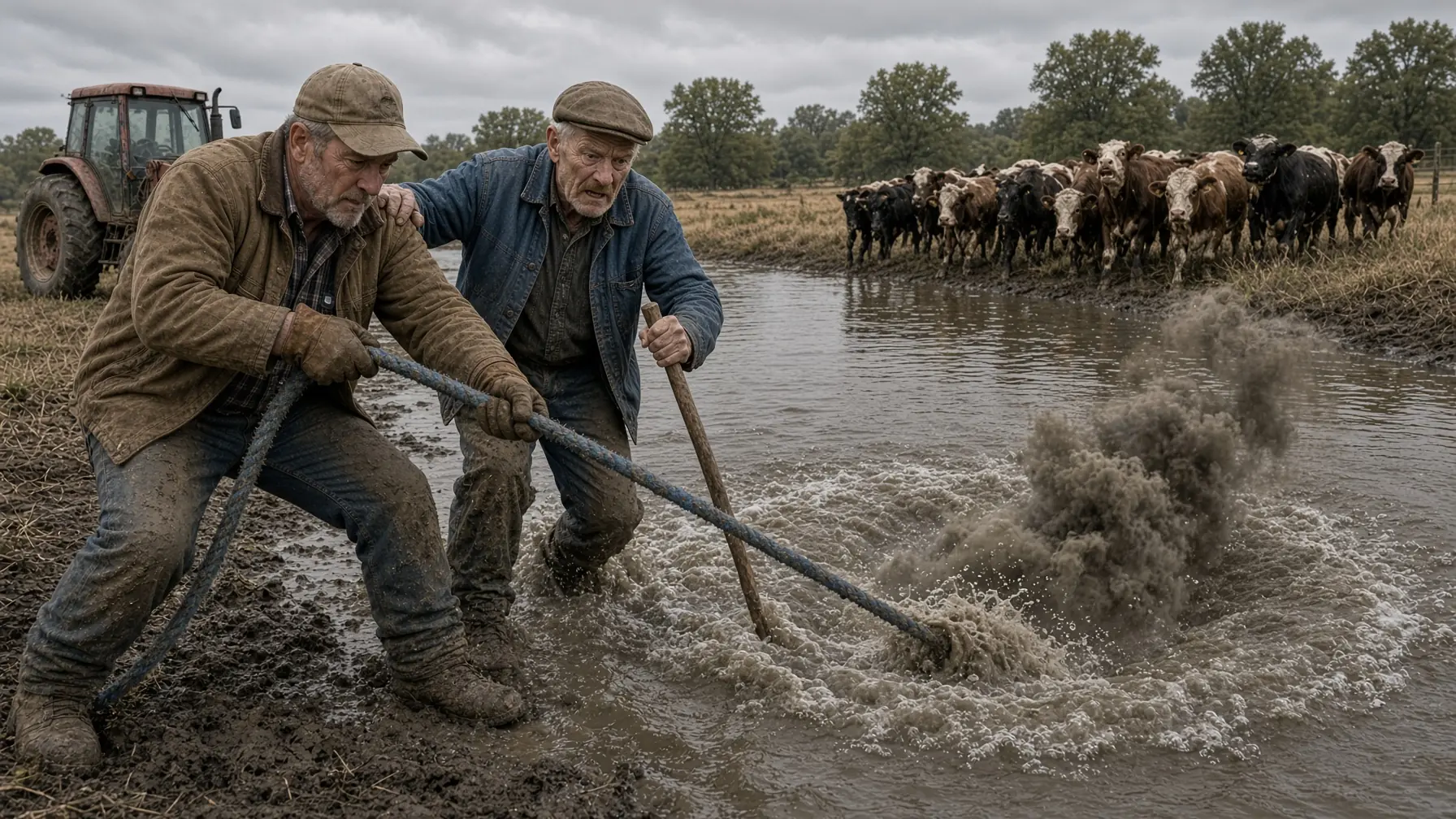
If the summer had been normal, he never would have seen it.
By the first week of September, the western shoreline had pulled so far back that cottonwood roots normally hidden beneath brown water stood exposed like knotted fingers. Dead reeds lay flat against cracked mud. Frogs had abandoned the shallows. A dark stain circled the bank, marking where the pond had been in June.
But none of that was what finally made Daniel walk down there.
It was the cattle.
Twenty-three red Angus cows had access to nearly the entire pond, yet for three mornings they had crowded themselves into one narrow drinking area on the eastern bank.
The same place.
The same pattern.
They pushed shoulder against shoulder, churned the soil into black mud, drank, then backed away to make room for the next animal.
The western side remained empty.
Daniel had watched them from the barn.
The first morning, he blamed habit.
The second, heat.
The third, he stopped making excuses.
Cattle did stupid things sometimes.
But twenty-three animals did not usually agree on the same stupid thing without a reason.
So a little after seven that morning, Daniel climbed through the fence and walked toward the abandoned side of the pond.
He was sixty-one years old and had spent nearly his entire life on that farm in eastern Kansas. His father, Thomas Mercer, had bought the property before Daniel was born, back when the farmhouse still had one bathroom and the road in front was gravel.
Daniel had grown up knowing every useless detail of the place.
Which field held water after a hard spring rain.
Where his father had buried the remains of an old disc harrow.
Which fence posts had cedar heartwood and would probably still be standing after Daniel himself was gone.
He knew where two wells had failed.
Where a drainage tile crossed the south pasture.
Where an old manure pit had once been.
He knew the pond.
Or at least he thought he did.
He was halfway down the western bank when something blue showed beneath a clump of dead reeds.
Daniel stopped.
At first he thought it was baling twine.
He reached down and pulled the reeds aside.
Not twine.
Rope.
Old polypropylene, maybe half an inch thick, faded almost gray except where mud had protected a strip of blue.
One end disappeared beneath the pond.
The other vanished beneath roots farther uphill.
Daniel crouched.
Wrapped his hand around it.
Pulled gently.
Nothing.
He pulled harder.
The rope tightened.
Something far below resisted.
Daniel shifted his boots backward and leaned.
Then the weight moved.
Barely.
Maybe an inch.
But he felt it in both hands.
A deep scrape traveled through the rope.
Ten feet offshore, the pond surface bulged.
A wide circle of bubbles rose through the brown-green water.
Daniel stopped pulling.
A second later came a sound from below.
A heavy, dull thud.
Whatever he had moved had dropped back into place.
Behind him, several cows lifted their heads at the same time.
One yearling actually backed away.
Daniel slowly let go of the rope.
The bubbles stopped.
He stared at the water.
His first thought was machinery.
Old farms accumulated buried machinery the way houses accumulated junk drawers.
A wheel.
A wagon frame.
A piece of pump equipment.
Maybe his father had sunk something there decades earlier.
But then Daniel pulled the rope only three inches.
Again, something shifted.
This time dark sediment rolled upward from beneath the water.
And through the mud came a narrow plume that looked different.
Clearer.
For one moment, the surface shimmered where colder water pushed upward.
Daniel touched it.
The water around his fingers was noticeably cool.
Then the object settled again.
The plume disappeared.
Daniel released the rope.
For several seconds he did nothing.
Then he looked across the pond.
Every animal on the east bank appeared to be staring back at him.
He had walked down there because the cattle were avoiding one half of their water source.
Instead, he had found a rope tied to something heavy beneath the pond.
Something that could still move.
And something under it appeared to be releasing water.
Daniel tied a strip of orange marking tape to the nearest cottonwood branch.
Then he walked away.
He did not pull the rope again.
That restraint may have saved him from making the worst mistake of the entire drought.
The Mercer farm was not large by Kansas standards.
Two hundred sixty acres.
Twenty-three brood cows.
Some hay ground.
Enough wheat and soybeans to keep equipment payments irritating.
It was not a place where one catastrophic year could be shrugged off.
And 2018 had become one of those years.
The rains quit in June.
By July, pasture ponds across the county were visibly shrinking.
By August, livestock auctions were crowded with cattle people had not planned to sell until winter or later.
Hay prices climbed.
Water-hauling companies began quoting wait times.
Daniel’s house well still worked, but he did not trust it to carry the herd.
Every morning, he looked at the pressure gauge in the pump house.
Every evening, he checked the pond.
On the kitchen table was a yellow legal pad filled with numbers.
If the pond lost another foot and the drought continued six more weeks, Daniel had two realistic choices.
Haul water.
Or reduce cattle.
The hauling estimates made him swear.
So he had started deciding which cows might go.
That felt worse.
Some of his cattle came from bloodlines his father had worked on twenty years earlier. Thomas had never had money for expensive breeding programs. He simply kept records, selected carefully, and improved the herd one calf at a time.
Daniel had continued it.
Now drought was turning those years into numbers.
Six cows.
Maybe eight.
Number 14 would stay.
She was a six-year-old red cow with a white patch over her left eye and had raised a good calf every year.
The older black cow with the weak hip probably would not.
Daniel hated thinking that way.
But agriculture punished sentiment when bills came due.
His father used to call the pond the farm’s savings account.
“You ignore it when times are good,” Thomas would say. “Then one year it’s the thing keeping you alive.”
Daniel had not thought about that sentence in a decade.
Now he heard it every time he looked at the exposed mud.
And somewhere on the western bank, beneath the orange tape, an old blue rope had moved something under the water.
That afternoon Daniel returned with gloves, a fiberglass probing pole, and enough caution to annoy himself.
The cattle were drinking again.
Same side.
Same crowding.
When Daniel approached the west, not one followed.
He knelt beside the rope.
Then pushed the fiberglass pole into the water where the line disappeared.
Mud.
More mud.
Then—
Clink.
Daniel pulled the pole up.
Moved eighteen inches.
Pushed again.
Clink.
Metal.
He probed sideways.
The hard surface continued.
Three feet.
Four.
Too broad for a bucket.
Too flat for old machinery he recognized.
He lifted the rope only enough to tighten it.
A few bubbles appeared.
Then that cold thread rose again through the sediment.
Daniel dipped two fingers into it.
Cold.
Much colder than the sun-warmed pond.
He smelled his hand.
Earth.
Iron.
Something mineral.
Nothing rotten.
Nothing oily.
That relieved him only slightly.
Old farms could hide ugly things.
Fuel tanks.
Chemical drums.
Pits somebody filled before environmental regulations existed.
The thought that his father might have buried something under the pond was uncomfortable.
Thomas Mercer had been a decent man.
He had also come from a generation whose approved disposal method for many objects was “put it somewhere no one trips over it.”
Daniel needed to know what he was looking at before he opened anything.
He was about to leave when Number 14 approached.
She stopped fifteen feet from the western water.
Stretched her neck.
Sniffed.
Then turned sharply away.