Twenty Bikers Mocked an 82-Year-Old Woman’s Leather Jacket — Then Their Vice President Saw the Patch on Her Back
The highway diner smelled of burned coffee, old grease, and hot dust.
When twenty bikers pushed through the front door, every conversation stopped.
The trucker near the window lowered his eyes.
The young couple in the corner booth went silent.
The waitress froze with a coffee pot suspended above an empty mug.
Everyone looked away.
Everyone except the eighty-two-year-old woman sitting at the far end of the counter.
She wore a leather jacket three sizes too large and continued sipping her tea as though the men had entered at her invitation.
Outside, the August heat along Route 66 warped the horizon. The asphalt shimmered beneath the Arizona sun, and the gravel parking lot seemed to radiate heat through the diner’s thin walls.
Rusty’s Highway Grill had been standing outside Kingman since 1957.
Very little had improved since then.
The red vinyl booths were cracked.
Several floor tiles had lifted at the corners.
The air conditioner had stopped producing cold air sometime during the previous century, though the owner still insisted it worked “when the wind was right.”
Three ceiling fans turned lazily overhead, moving thick, fryer-scented air in slow circles.
It was a Tuesday afternoon.
The lunch crowd had passed.
Only a few people remained.
A long-haul trucker sat beside the window nursing black coffee.
A young couple whispered over a shared plate of fries.
Behind the counter, Brenda Shaw refilled sugar dispensers while watching the clock.
And at the last stool sat Martha Hayes.
Martha was eighty-two.
Time had curved her spine slightly and thinned her silver hair, which she wore pinned neatly behind her head. Her hands were marked with age spots and fine blue veins. A small tremor appeared whenever she lifted her china cup.
But she sat upright.
There was still a steadiness in her posture that age had not taken.
The black leather jacket draped around her seemed almost absurdly large.
Its shoulders hung past her narrow arms.
The sleeves had been rolled several times to expose her hands.
The leather was deeply cracked, pale at the elbows, and scarred by years of sun, rain, and road grit.
On someone else, it might have looked like a costume.
On Martha, it looked like a burden she had chosen to carry.
She raised her Earl Grey tea.
The cup tapped softly against the saucer.
Then the vibration began.
At first, it was felt rather than heard.
The spoon inside the trucker’s mug trembled.
The windows hummed in their frames.
Brenda stopped pouring coffee.
The low vibration became a mechanical rumble, then a wall of sound.
Outside, a long line of motorcycles turned into the gravel lot.
Chrome reflected the sunlight in sharp bursts.
Heavy engines cracked and thundered against the aluminum siding.
The riders parked in two uneven rows.
Their engines shut down one after another.
The silence that followed felt heavier than the noise.
The front door swung open.
Men in denim, boots, and road-worn leather entered in a dense wave.
They belonged to the Red Valley Riders, one of the oldest and most feared motorcycle clubs in the Southwest.
Their back patches showed a red-winged skull above a desert highway.
Most people along Route 66 knew the colors.
Most knew enough not to stare.
Leading the group was Cole Mercer.
Cole was fifty-eight, broad through the shoulders, with a thick gray beard and a pale scar cutting through his left eyebrow. A VICE PRESIDENT patch sat above the pocket of his leather vest.
He did not need to raise his voice to command attention.
His presence did the work for him.
Behind Cole walked Jax Turner.
Jax was twenty-two.
He had received his full club patch three months earlier and wore it with the desperate pride of a young man who feared someone might discover he had not yet earned the respect he demanded.
His vest was newer than the others.
The leather remained stiff.
The embroidery was bright.
His boots struck the linoleum harder than necessary.
He laughed loudly at comments no one had made and scanned the diner as though searching for witnesses to his importance.
“Take the back booths,” Cole said.
The riders spread through the rear half of the diner.
The trucker beside the window placed a five-dollar bill beneath his mug and hurried toward the exit.
The young couple remained seated but moved closer together.
Brenda gripped her order pad.
Her hands trembled.
She had served bikers before, but never twenty at once.
Jax slapped one palm against the nearest table.
“Coffee, sweetheart. Black. Keep it coming until the pot melts.”
Brenda flinched.
Cole looked toward him.
“Lower your voice.”
Jax smiled.
“We’re here for ten minutes.”
Jax leaned back in his chair.
“Relax, Cole.”
He looked around the diner.
“Everyone’s acting like we came to rob the place.”
No one laughed except two of the younger members.
The tension spread across the room.
The bikers had not threatened anyone directly, but they occupied the diner as though it belonged to them.
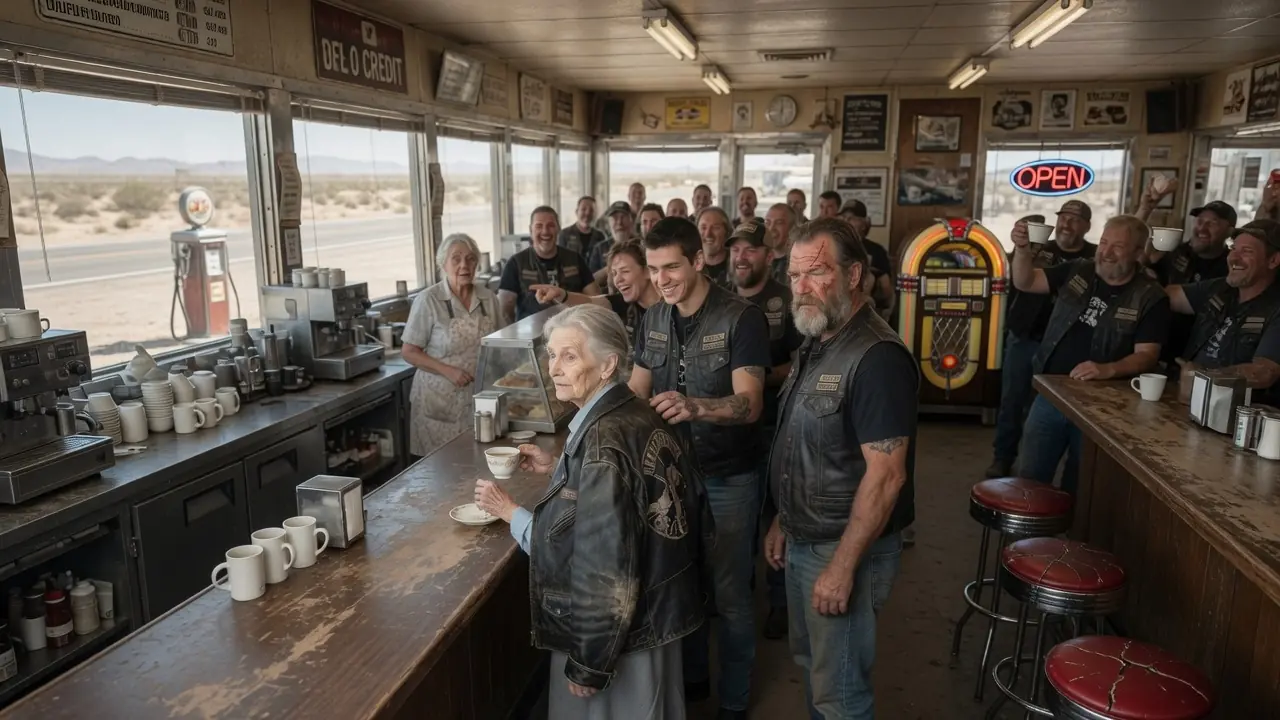
Boots filled the aisles.
Leather vests covered the booths.
The smell of road dust, exhaust, and tobacco pushed aside the scent of burned coffee.
Then Jax noticed Martha.
She had not turned around when they entered.
She had not lowered her eyes.
She continued drinking tea.
The enormous jacket around her small body caught his attention.
He nudged the rider beside him, a silent, broad man called Miller.
“Look at that.”
Miller glanced toward the counter.
Then he looked away.
Jax did not.
He leaned forward.
“That jacket weighs more than she does.”
A few riders turned.
One laughed.
Another said, “Probably found it in a thrift store.”
“Maybe her husband left it behind before he died,” someone added.
The laughter that followed was low and sharp.
Martha set down her teacup.
Clink.
She pulled one paper napkin from the dispenser, folded it neatly, and touched it to the corner of her mouth.
She did not look toward the bikers.
Jax rose.
“I’m going to ask what chapter she rides with.”
Cole’s eyes narrowed.
“Sit down.”
“I’m only being friendly.”
“Leave her alone.”
Jax was already walking.
The heavy rhythm of his boots crossed the diner.
The young couple stopped breathing.
Brenda looked toward Cole, silently hoping he would intervene.
Martha placed her spoon on the saucer.
Jax stopped behind her stool.
Standing beside Martha made the contrast almost ridiculous.
He was six feet two and broad through the chest.
She was barely five feet tall.
His leather vest looked new and carefully maintained.
Her jacket looked as though it had survived weather, blood, and decades of neglect.
“Nice jacket,” Jax said.
His voice carried across the diner.
Martha continued facing the counter.
“It serves its purpose.”
Her voice was quiet but firm.
There was no fear in it.
Jax leaned one elbow against the counter, moving unnecessarily close.
“What purpose is that?”
“Keeping the dust off.”
A few bikers laughed.
Jax smiled.
“It looks like you stole it from a scarecrow.”
Martha lifted her tea again.
Jax continued.
“People who don’t ride shouldn’t wear club-style leather. It gives people the wrong idea.”
“Jax.”
Cole’s voice cut across the room.
“I told you to leave her alone.”
Jax lifted one hand.
“I’m helping her.”
He looked down at Martha.
“You should take it off before someone less patient sees you in it.”
Martha finally turned her head.
Her eyes were pale blue.
Faded by age, perhaps, but still sharp enough to make the young biker pause.
She studied his new vest.
The clean stitching.
The bright patch.
The expression of a boy pretending arrogance was experience.
“You’re standing in my light,” she said.
The diner went silent.
Brenda stopped breathing.
Even the bikers in the rear booths stopped smiling.
Color rose into Jax’s face.
He had expected fear.
Perhaps confusion.
Not dismissal.
“Listen, old lady—”
He reached toward her shoulder.
“Don’t touch me.”
Martha did not raise her voice.
The command was absolute.
Jax hesitated.
Only briefly.
Then pride forced his hand forward.
His fingers brushed the worn leather.
Before he could close his grip, a massive hand locked around his wrist.
Cole had crossed the diner faster than anyone expected.
He twisted Jax’s arm away from Martha and pulled him back.
“I told you to sit down.”
“She was disrespecting me.”
“She was drinking tea.”
Cole shoved him away.
Jax stumbled against a stool.
Cole turned back toward Martha.
“Ma’am, I apologize for—”
The sentence stopped.
Martha had risen.
The movement was slow because of her knees, but she stood without asking for assistance.
As she turned fully toward them, the jacket shifted.
The back became visible.
Cole stopped breathing.
There were no upper or lower location rockers.
No modern chapter lettering.
Only one enormous center patch sewn by hand with thick, fading thread.
A red-winged skull rode above a narrow desert highway.
The original emblem of the Red Valley Riders.
But it was not the patch itself that made Cole’s face lose color.
It was the name beneath it.
FRANK “IRON” HAYES
FOUNDING PRESIDENT
Below the name sat a smaller patch, its letters worn but still legible.
MOTHER OF THE VALLEY
The diner became completely still.
Only the ceiling fans continued rattling above them.
Cole removed his cap.
He did not seem aware he was doing it.
Thirty years earlier, when he was still a prospect cleaning floors and motorcycles at the club’s first permanent headquarters, older members had told stories about Frank Hayes.
Iron Hayes.
A mechanic, Korean War veteran, and one of seven men who founded the Red Valley Riders in 1962.
He had built the first club motorcycles from military surplus and junkyard parts.
He had given stranded riders a place to sleep.
He had taken in veterans who could not adjust to ordinary life.
And in 1973, outside a roadside bar near Needles, Frank had stepped between five club members and three armed men.
He was shot twice.
The others survived.
Frank did not.
Cole had heard the story so often that it had become legend.
A name on photographs.
A patch behind glass at the clubhouse.
A toast spoken on the anniversary of his death.
Now the leather from those photographs hung across the shoulders of a small elderly woman.
Cole took one step backward.
Miller rose from the booth.
He removed his sunglasses.
His eyes moved slowly across the old patch, then settled on Frank Hayes’s name.
He lowered his head.
“Mrs. Hayes.”
His deep voice held genuine reverence.
Jax had recovered from being pushed aside.
He saw the ancient patch but did not understand it.
His anger remained louder than his judgment.
“What is that?”
He pointed toward Martha’s back.
“You can’t wear our colors.”
Cole turned sharply.
Jax continued.
“I’ll take that jacket off her myself.”
The slap echoed through the diner.
Cole’s open hand struck Jax across the jaw.
The younger man crashed against a stool and fell to the floor.
Several riders jumped to their feet.
Chairs scraped backward.
Cole faced them.
“Sit down!”
His roar shook the front windows.
The riders froze.
Cole pointed toward the booths.
“Now.”
One by one, the men sat.
Their eyes shifted from Jax to Martha.
Miller remained standing.
He lowered his head again.
“Ma’am, it is an honor.”
Martha looked at him.
Her expression was calm, but tired.
“You ride a Panhead?”
Miller blinked.
“Yes, ma’am. Sixty-two engine.”
“Frank rode a sixty-two.”
A faint memory passed across her face.
“Leaked oil everywhere. Broke down outside Barstow in August of sixty-nine.”
Miller’s mouth moved into a small smile.
“They still leak.”
“Some things don’t improve.”
Her gaze moved through the diner.
She looked at Brenda, who still held the coffee pot against her chest.
At the frightened young couple.
At the empty stool the trucker had abandoned.
Then at the bikers occupying half the restaurant.
“No,” Martha said. “Some things don’t.”
Cole lowered his head.
“We disturbed the room.”
“You frightened everyone in it.”
“Yes, ma’am.”
Martha touched the collar of the jacket.
The leather creaked beneath her fingers.
Cole noticed a repaired tear near the lower left side.
The hole was round and uneven.
Dark stitching crossed it.
A bullet hole.
The stories were real.
The blood once soaked into the jacket had not been part of a club myth.
Martha looked down at Jax.
The young biker groaned and moved one hand toward his jaw.
“He doesn’t understand what he’s wearing,” she said.
Cole’s expression tightened.
“No.”
“Most young men don’t.”
She turned toward him.
“They think the patch makes them dangerous.”
Her hands closed around the jacket’s lapels.
“Frank thought that too, once.”
Cole listened without moving.
“He believed being feared meant being respected.”
Martha looked toward the old emblem on her shoulder.
“Then people started dying.”
No one in the diner made a sound.
“Frank helped form that club because men came home from war and had nowhere they belonged.”
Her voice remained low.
“They shared tools. Food. Beds. Gasoline. If one man broke down, nobody left him behind.”
She looked toward the rear booths.
“They were loud. They fought. They made terrible choices.”
A faint sadness entered her face.
“But they did not walk into restaurants to frighten waitresses and old people.”
Cole’s shoulders lowered.
“We lost our discipline today.”
“You lost your memory.”
The correction struck harder.
Cole nodded.
“Yes, ma’am.”
She opened a small coin purse with stiff fingers.
Cole almost reached forward to assist her but stopped himself.
She counted three crumpled dollar bills and several quarters.
Then she placed them beside her cup.
“Tell the boy on the floor something for me.”
Cole waited.
“This jacket is not a costume.”
Her fingers rested on the cracked leather.
“It is a tombstone.”
Several riders lowered their eyes.
“Every time I wear it, I carry a dead man on my back.”
Martha closed the purse.
“If he wants to wear a patch, he should understand the price.”
Cole swallowed.
“Yes, ma’am.”
“It isn’t permission to scare people.”
She looked directly at him.
“It is a promise that when the noise stops and the trouble becomes real, you will not leave your brothers standing alone.”
Her voice softened.
“Teach them that.”
She glanced toward Jax.
“Or take the patches away.”
Cole lowered his head.
“Yes, Mom.”
The word changed the room.
It was not casual.
It was an old title passed through generations of club members.
A recognition of a woman who had fed them, hidden them, buried them, and endured the consequences of their choices.
Jax opened his eyes.
The fluorescent lights seemed painfully bright.
His jaw throbbed.
He rolled onto one elbow and saw boots surrounding him.
He expected laughter.
Instead, every rider had risen.
The men formed two lines stretching from the counter to the front entrance.
An honor guard.
Jax pushed himself upright.
Cole stood at the beginning of the line.
“Get up.”
Jax leaned against the counter.
“What’s happening?”
“Stand.”
Jax obeyed.
Cole stepped closer.
“You do not speak to her.”
He pointed toward Martha.
“You do not look at her unless she addresses you.”
Jax stared at the old patch.
This time he read the name.
Frank Hayes.
The founding president whose photograph hung above the main bar in every chapter clubhouse across Arizona.
The man prospects were required to study before receiving club colors.
Jax’s face emptied.
He looked at Martha.
Then at Cole.
“I didn’t know.”
“That is not your defense.”
Jax lowered his eyes.
Martha lifted her purse and moved toward the door.
The enormous jacket shifted with every slow step.
The first two riders bowed their heads.
“Mom.”
The next two did the same.
“Mom.”
She passed each pair.
Men who argued with police officers, judges, and rival clubs stood silently in a greasy diner with their heads lowered before an eighty-two-year-old woman.
Jax watched in disbelief.
Martha reached the end of the line.
Cole opened the door.
Sunlight flooded across the floor.
She paused at the threshold.
“Keep the rubber side down, boys.”
Twenty voices answered together.
“Yes, ma’am.”
Martha stepped into the desert heat.
Inside, no one moved.
Through the greasy window, they watched her cross the gravel parking lot.
She did not walk toward the motorcycles.
She passed them and stopped beside a faded green Ford Taurus beneath a dying cottonwood tree.
The driver’s door groaned when she opened it.
She placed her purse on the passenger seat and carefully climbed behind the wheel.
The old jacket made the movement difficult.
The engine turned over twice before starting with a rough mechanical cough.
Martha pulled slowly onto Route 66.
Cole watched until the car disappeared beyond a bend in the shimmering highway.
Only then did he release the door.
He turned back into the diner.
Brenda remained behind the counter.
The young couple stared from their booth.
The trucker had returned and now stood near the entrance, too curious to remain gone.
Cole ignored them.
He walked toward Jax.
The young biker raised his hands slightly.
“Cole, I swear I didn’t know.”
Cole grabbed the front of Jax’s new vest and pulled him close.
“You think not knowing makes it better?”
Jax said nothing.
“You walked into this room believing that patch made you more important than everyone else.”
Cole’s voice remained quiet.
That made it more frightening.
“You made a waitress afraid to approach the table.”
He pointed toward the empty stool.
“You drove a customer out of the diner.”
Then he pointed toward the door Martha had used.
“And you threatened to tear history off an old woman’s shoulders because you were too ignorant to recognize it.”
Jax’s face reddened.
“I was trying to protect the colors.”
“No.”
Cole shoved him backward.
“You were protecting your pride.”
He faced the younger members.
Several immediately lowered their eyes.
“Frank Hayes did not build this club so boys could wear leather and terrorize strangers.”
Cole’s gaze moved from rider to rider.
“He built it because men had returned from war with nowhere to go.”
He pointed toward Jax.
“That woman buried him when she was thirty-two.”
The diner remained silent.
“She raised three children alone.”
Cole continued.
“She worked two jobs while federal agents searched her home, creditors took their property, and men who called themselves Frank’s brothers disappeared because grief made them uncomfortable.”
Miller lowered his head.
Cole’s voice grew rougher.
“She paid for this club.”
He struck his own chest above the patch.
“We inherited it.”
No one moved.
“We do not frighten civilians for entertainment.”
He looked toward Brenda.
“We do not treat service workers like servants.”
Then toward Jax.
“And we never touch an elder after being told to step away.”
“Yes, Vice President,” someone said quietly.
Cole’s eyes hardened.
“Do we understand?”
“Yes, Vice President.”
The answer came louder.
Jax stood against the counter.
Cole looked at his vest.
“Take it off.”
Jax froze.
“Cole—”
“Take off the cut.”
Fear entered the younger man’s face.
“Are you stripping my patch?”
“I haven’t decided.”
Jax slowly removed the vest.
Without it, he appeared younger.
Smaller.
Cole took the leather from him.
“You’ll ride in the rear on the way home.”
Jax nodded.
“You will clean the clubhouse every day for the next month.”
“Yes.”
“You will read every page of the chapter history instead of memorizing the names that make you sound important.”
Jax lowered his eyes.
“Yes.”
“And tomorrow, you are driving back here.”
Jax looked confused.
“For what?”
“To apologize to the waitress.”
Brenda’s eyes widened.
“And every customer whose meal you ruined.”
Jax swallowed.
“Yes.”
Cole folded the vest over one arm.
“You will earn the right to put this back on.”
Jax looked at the patch.
“What if I can’t?”
“Then you never understood it.”
Cole dismissed him with a movement of his head.
Jax walked outside without argument.
The other riders waited.
Cole turned toward Brenda.
He removed a thick wallet from his pocket and peeled several bills from it.
He placed one hundred dollars beside Martha’s crumpled bills.
“For the tea.”
Brenda stared at the money.
“And for the trouble.”
“You don’t have to—”
“We do.”
Miller approached and added another fifty.
Then Thomas, an older rider near the rear, placed twenty dollars beside it.
One by one, members of the club walked forward.
Some left twenties.
Others left fives or tens.
No one made a show of it.
By the time the last rider passed the counter, several hundred dollars sat beside Martha’s teacup.
Cole looked toward the young couple.
“I apologize.”
They did not respond.
He turned toward the trucker.
“Your coffee’s on us.”
The trucker gave a cautious nod.
Cole faced Brenda again.
“What was her total?”
“Three dollars and seventy-five cents.”
He looked at Martha’s payment.
“She always leaves exactly what she owes?”
“Every Tuesday.”
“You know her?”
“She’s been coming here for years.”
“Did you know about the jacket?”
Brenda shook her head.
“She only wears it once a year.”
Cole looked toward the highway.
“What day is today?”
“August twelfth.”
His expression changed.
Frank Hayes had died on August twelfth, 1973.
Martha had not worn the jacket to intimidate anyone.
She had worn it because she was remembering her husband.
Cole closed his eyes briefly.
Then he placed another hundred-dollar bill on the counter.
“For her next visits.”
Brenda looked at him.
“She’ll refuse.”
“Then keep charging her and put the money aside.”
Cole gave a sharp whistle.
“Let’s go.”
The bikers filed out quietly.
The swagger had disappeared.
No one shouted.
No one struck the door.
Their boots crossed the linoleum with measured steps.
Outside, engines started one after another.
This time, there was no unnecessary revving.
No aggressive cracking of throttles.
The motorcycles idled low.
Cole climbed onto his bike and looked down Route 66 in the direction Martha had gone.
He touched two fingers to the patch above his heart.
A silent salute to the dead man whose jacket still traveled the highway.
Then he led the riders away.
The sound faded into the desert.
Inside, Brenda stood beside the counter.
She gathered the money the riders had left.
Then she looked at Martha’s three worn dollar bills and handful of quarters.
She placed the quarters in a small envelope rather than the register.
On the front, she wrote:
MARTHA HAYES — TEA FUND.
The trucker returned to his stool.
“That really happen?”
Brenda looked toward the empty place at the end of the counter.
“I think so.”
The young woman from the corner booth stood.
“Who was she?”
Brenda picked up the teacup.
“Apparently, someone they should have remembered.”
The diner gradually returned to normal.
Coffee poured.
The ceiling fans rattled.
The smell of exhaust disappeared, replaced once again by burned coffee and fryer grease.
But the room felt different.
Lighter.
As if the riders had taken something ugly with them when they left.
The following afternoon, Jax returned.
He arrived alone in an old pickup truck.
No motorcycle.
No leather vest.
He wore a plain black shirt and jeans.
Brenda watched him enter.
The confidence from the previous day was gone.
He carried a bucket, cleaning supplies, and a new glass coffee pot.
“I’m here to apologize.”
Brenda folded her arms.
“To me?”
“To everyone.”
“The couple lives in Flagstaff.”
Jax lowered his head.
“I’ll write something.”
“The trucker comes through every few weeks.”
“I’ll wait.”
Brenda studied him.
“Did Cole make you come?”
“Yes.”
“Would you have come otherwise?”
Jax took a long time to answer.
“No.”
The honesty surprised her.
He placed the cleaning supplies on the counter.
“He said an apology without work is just noise.”
Brenda nodded toward the ceiling fans.
“Bathroom needs cleaning.”
Jax looked toward the back hall.
“I figured it might.”
He cleaned for nearly four hours.
He scrubbed the bathrooms.
Degreased the floor.
Repaired the loose stool beside the counter.
Replaced the cracked strip of rubber beneath the entrance door.
He did not complain.
Before leaving, he placed a folded letter near Martha’s usual seat.
“What’s that?”
“An apology.”
“Do you know where she lives?”
“No.”
Brenda placed the letter beneath the counter.
“She comes every Tuesday.”
Jax looked at the stool.
“Will you give it to her?”
“I’ll ask whether she wants it.”
He nodded.
The next Tuesday, Martha returned.
She wore a light blue cardigan.
The leather jacket was nowhere in sight.
Brenda poured Earl Grey tea and placed the envelope beside the cup.
“The young man left this.”
Martha looked at it.
“Which young man?”
“The noisy one.”
She opened the letter.
The handwriting was uneven.
Mrs. Hayes,
I was disrespectful to you before I knew who you were. Cole told me that is not the real apology.
The real apology is that I should not have needed your name or your husband’s patch to treat you with respect.
I thought people being afraid of me meant they respected me. Yesterday, I learned the difference.
I am sorry I touched your jacket after you told me not to.
I am sorry I frightened the people in the diner.
I do not know whether I deserve to wear my patch again. Cole says that is something I will have to prove.
Jax Turner
Martha read it twice.
Then she folded the paper.
“What do you think?” Brenda asked.
“He has better handwriting than Frank.”
Brenda smiled.
“Will you forgive him?”
Martha looked through the window toward the highway.
“Forgiveness is not a letter.”
“No.”
“But a letter may be a beginning.”
She placed it inside her purse.
Two months later, Jax returned with Cole.
He still did not wear his club vest.
The two men entered quietly and sat near Martha’s usual place.
She arrived shortly afterward.
Jax stood.
“Mrs. Hayes.”
Martha looked him over.
He appeared thinner.
Less polished.
More settled.
“I wanted to apologize in person.”
“You already wrote.”
“I needed to say it.”
Martha sat.
Jax remained standing.
“I mocked you because I thought you were weak.”
She removed her gloves.
“I touched you after you told me not to.”
“Yes.”
“I embarrassed my club.”
“Yes.”
He swallowed.
“I’m sorry.”
Martha studied him.
“What did you learn?”
“That I was wrong.”
“That is a conclusion.”
She placed her purse on the counter.
“I asked what you learned.”
Jax looked toward Cole.
Cole gave him nothing.
The young man thought carefully.
“I learned that respect given only after discovering someone’s power isn’t respect.”
Martha’s expression softened slightly.
“What else?”
“That a patch can tell people who I ride with.”
He looked down.
“But it can’t tell them whether I’m worth riding beside.”
Cole lowered his eyes, hiding the hint of approval on his face.
Martha nodded toward the stool beside her.
“Sit.”
Jax sat.
Brenda poured three cups of tea.
Jax looked at his.
“I don’t usually drink tea.”
Martha lifted her cup.
“You usually talk too much.”
Cole laughed.
Jax smiled carefully.
Then he drank.
For the next hour, Martha told stories about the early days of the club.
Not the legends repeated at parties.
The real stories.
Frank working nights at a garage because the clubhouse rent was overdue.
Members repairing farmers’ trucks for food.
Men arriving at Martha’s house after midnight because they were too ashamed to tell anyone they had nowhere to sleep.
She spoke of funerals.
Widows.
Children who grew up angry because their fathers believed the road mattered more than coming home.
Jax listened.
For once, he did not interrupt.
Before leaving, Martha looked toward Cole.
“Give him the vest back when he learns to serve coffee without being asked.”
Cole smiled.
“That could take years.”
“Then he’ll have plenty of time to learn.”
Jax received his vest again six months later.
The first place he wore it was Rusty’s Diner.
He entered quietly, held the door for a retired couple, and waited near the counter until Brenda finished serving another table.
Martha sat in her usual place.
Jax approached.
“May I sit?”
She looked at the patch.
Then at him.
“You may.”
He took the stool beside her.
The jacket no longer appeared on Martha’s shoulders except every August twelfth.
But no one at the Red Valley Riders forgot what it meant.
Cole had a photograph of Frank and Martha placed beside the clubhouse entrance.
Beneath it, a brass plaque carried Martha’s words:
THE PATCH IS NOT PERMISSION TO BE FEARED.
IT IS A PROMISE THAT NO ONE STANDS ALONE.
New members were required to read the story before earning full colors.
Not because Martha demanded it.
She never entered the clubhouse again.
But because Cole understood that a brotherhood without memory eventually became nothing more than men wearing matching leather.
Martha died peacefully four years later.
She was eighty-six.
At her funeral, more than two hundred riders arrived from across the Southwest.
They shut off their motorcycles a mile from the church and pushed them the remaining distance so the engines would not disturb the service.
Jax walked near the front.
His hair was longer.
His face had matured.
The arrogance was gone.
Frank’s jacket lay across Martha’s coffin.
The old leather remained cracked.
The repaired bullet hole was still visible.
But the patch had been cleaned carefully.
After the service, Cole asked Martha’s daughter what the family wished to do with it.
She looked toward the riders.
“My mother left instructions.”
The jacket was placed inside a glass case at the Red Valley clubhouse.
Not above the bar.
Not among trophies.
It hung near the entrance where every rider had to pass it before entering.
Below it was a small card written in Martha’s hand.
If this jacket makes you feel powerful, you have misunderstood it.
If it reminds you who paid the price before you arrived, then you may be ready to wear your own.
Years later, travelers still stopped at Rusty’s Diner.
The air conditioner was eventually replaced.
The floor was repaired.
The burned coffee remained unchanged.
At the end of the counter, Brenda kept one old stool slightly cleaner than the others.
Above it hung a photograph of Martha in the enormous leather jacket, holding her teacup and looking toward the camera with complete disinterest.
Visitors often asked who she was.
Brenda always gave the same answer.
“She was the only person in the room who knew she didn’t have anything to prove.”
The twenty bikers had entered the diner believing noise made them powerful.
They owned the parking lot.
They controlled the room.
People lowered their heads when they passed.
Then an eighty-two-year-old woman turned around.
She did not raise her voice.
She did not threaten anyone.
She simply revealed the history resting on her shoulders.
And the men who bowed to no one formed a silent honor guard before her.
Not because she was dangerous.
Not because she frightened them.
But because real respect had entered the room long before they did.
It had been sitting quietly at the counter, wrapped in old leather, sipping tea.