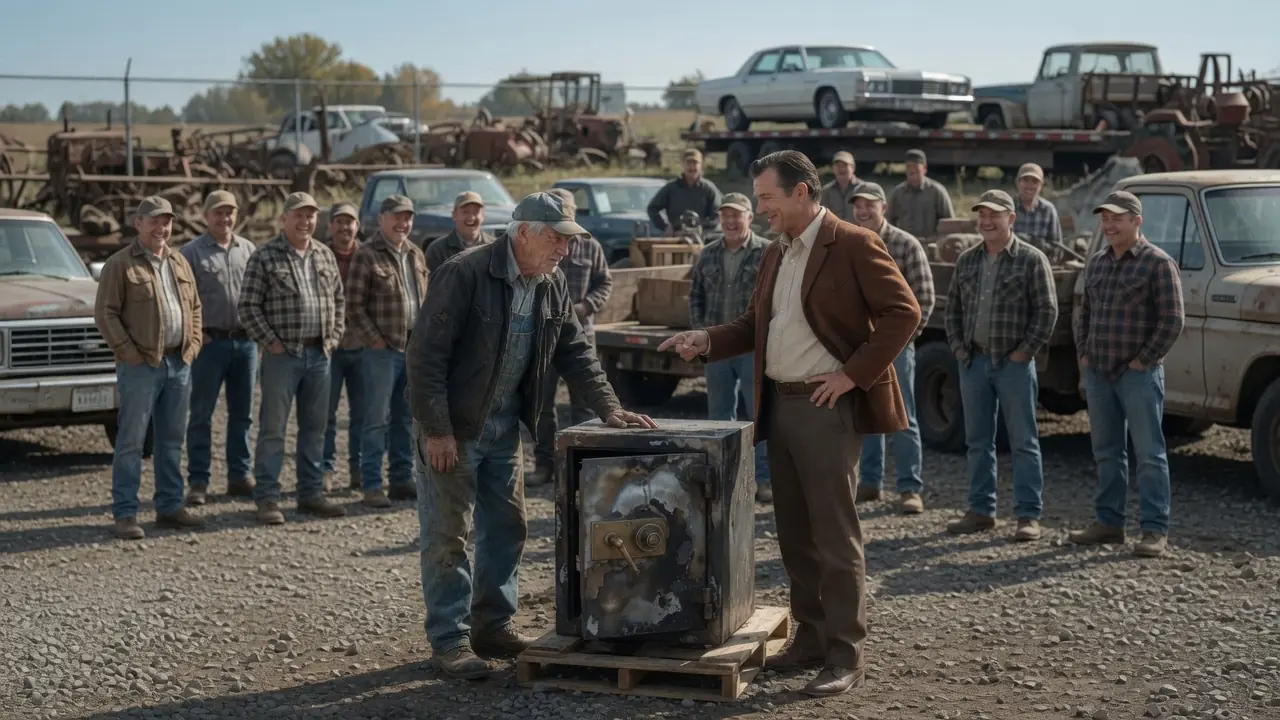
The auctioneer’s gavel came down at ninety dollars, and half the county laughed like Earl Tasker had just bought a hole in the ground. The burned hotel safe sat on a wooden pallet behind the old fairgrounds outside Mercer, Kentucky, its scorched green paint peeled down to gray metal and its door bent from a fire that had burned sixteen years earlier. The brass dial sat crooked on the front like a blind eye, and the whole thing looked too heavy to move and too ruined to matter. Earl stood beside the auction rail in his faded denim work cap and canvas farm jacket, saying nothing while the laughter rolled over him.
Earl was seventy-one years old, a white American farmer with a tall, slightly stooped frame, broad shoulders, sun-browned skin, and hands that had spent most of their life repairing what younger men threw away. He still worked a small farm outside Mercer, raising a few cattle, cutting hay, fixing old equipment, and making do with machinery that should have retired before some of the bidders were born. But before he was known as a farmer, he had been apprenticed to a German locksmith named Otto Vanoi when he was fourteen years old. Earl knew locks, dials, tumblers, rusted hinges, and stubborn steel the way other men knew their own prayers.
The loudest laugh came from Dale Coburn, a heavy-set estate dealer in a rust-brown sport coat and polished shoes that had never met honest mud. Dale ran the biggest clearing business between Lexington and the Tennessee line, and he liked being the kind of man everyone watched at an auction. He stood near his white Lincoln with one hand on his hip and the other pointing at Earl’s purchase. “Ninety dollars for that burned junk?” Dale called. “Old farmer, you just bought yourself the heaviest mistake in Kentucky.”
The crowd chuckled because Dale laughed first. Men along the chain-link fence turned to each other, grinning into their coffee cups, already enjoying the story they would tell at the feed store on Monday. Earl did not answer. He had learned long ago that a lock does not open faster because someone talks loud near it.
Dale stepped closer, enjoying himself now. “That thing don’t even open. You could tie a rope to it and use it for a boat anchor.” A few men repeated the phrase, and within minutes, the safe had a name: Earl’s boat anchor. Earl only lifted his pale steady eyes toward Dale for a moment, then looked back at the safe.
The safe had come from the Bowmont Hotel, once the finest red-brick building on Main and Depot. It had burned to its foundation on a cold December night in 1968, when a cracked furnace flue filled the old walls with flame. Harold Bowmont, the hotel’s seventy-nine-year-old owner, had gone back inside after every guest was out. The town found him the next morning in what had been the manager’s office and spent the next sixteen years calling him a foolish old man who died for brick and wallpaper.
Earl had never believed that story. He had known Harold Bowmont well enough to know the man was not careless, not dramatic, and not the sort to run into fire for furniture. Harold had built the hotel from nothing, watched over it for decades, and treated traveling salesmen, farm families, judges, and newlyweds like they were all worth a clean bed and a hot meal. If Harold went back into that fire, Earl believed he had gone back for something specific. When he saw the burned safe at the auction, the old question rose again.
It took two younger men, a come-along, and a lot of muttered effort to load the safe into Earl’s half-ton pickup. The truck settled hard on its springs when the four-hundred-pound box finally landed in the bed. Dale watched from beside his Lincoln and shook his head, grinning like a man who believed the world had just proven him smarter. Earl tied the safe down with three straps, checked each one twice, and drove the eleven miles home at thirty miles an hour with his hazard lights blinking.
Before sunset, the story had already reached Mercer. By Monday morning, men who had not visited Earl’s farm in years came by pretending to need small favors. One needed a padlock looked at, another claimed a key was sticking, and one simply leaned against the barn door while Earl fed the cattle, hoping to glimpse the burned safe sitting on the workshop floor. Earl knew what they wanted, and he gave them nothing more than polite silence.
Roy Picket, who ran the hardware store on Main Street, finally said what the others only hinted at. “Earl, you gave ninety dollars for a thing that will never open. What got into you?” Earl was cleaning dirt from a tractor part and did not look up. “It’ll open,” he said. That was all.
By Wednesday, Dale Coburn had told the story twice at the diner and once at the feed store. Each telling made Earl look older, poorer, and more foolish. Dale said the old farmer had paid good money for scrap metal because he was too stubborn to admit the world had passed him by. The men laughed because it was easier to laugh with Dale than to wonder whether Earl had seen something they had not.
Earl heard about it from Tommy Bell, a young farmhand who sometimes helped him stack hay. Tommy was angry on his behalf, the way young men are angry before life teaches them how much foolishness can be ignored. “You ought to go down there and tell Dale to mind his mouth,” Tommy said. Earl scraped grease from under one thumbnail with a small knife. “Boy, a safe either opens or it doesn’t. Dale Coburn’s mouth has no bearing on the matter.”
That evening, Earl closed the barn early and moved the safe into his workshop. The shop was attached to the side of his old farmhouse, a clean but cluttered room full of tools, tractor parts, key blanks, files, jars of screws, and one heavy wooden bench he had built in 1956. A bare bulb hung over the center of the room. The safe squatted beneath it like a burned black animal waiting to be understood.
Earl pulled a stool up to the front of the safe and sat down slowly. His knees hurt, his back hurt, and his fingers were swollen with arthritis from decades of work. He placed his hands on the crooked brass dial and remembered Otto Vanoi’s voice from 1927. “A lock is not a wall, Earl. It is a conversation. You put your fingers on it and wait until it tells you where it is.”
He cleaned the dial with oil and a cotton rag, working soot from the grooves and brushing grit away from the spindle. The maker’s name had been burned off, but the body told him enough. It was an old commercial floor safe with a three-wheel combination lock, the kind built for hotel offices and cash drawers before men trusted paper filing cabinets. A fire had warped the door, but the frame still held square enough to give him hope.
At six o’clock, Earl turned off the radio. No music, no news, no voices. Just the workshop, the safe, the soft sound of wind against the farmhouse, and his own breath slowing as his fingers settled on the dial. A man does not crack a safe with strength. He cracks it with patience, memory, and the willingness to feel what others are too busy to notice.
The first hour gave him almost nothing. Heat had stiffened the spindle, and every turn fought him. Twice he stopped to work penetrating oil down the shaft and wait while it settled into places too narrow to see. Earl did not curse the delay. He had farmed long enough to know that waiting is work when it is done correctly.
At eight o’clock, Martha Simmons from the neighboring farm knocked on the shop door with a covered bowl of stew. Earl thanked her, took it, and told her he would return the dish in the morning. Her eyes moved to the safe, but she did not ask. She had known Earl since they were children and understood when he was listening to something no one else could hear.
By nine-thirty, he found the first wheel. It was not a sound exactly, more like a faint change under the side of his finger. The dial seemed to breathe differently at twenty-two, then again just past nine, and Earl wrote the number on the back of a feed store envelope. He sat back, flexed his aching hands, and let the quiet settle again.
Outside, Mercer went to sleep. Lights went out in houses, trucks stopped passing on the road, and the town that had laughed at Earl’s ninety-dollar safe settled comfortably into its own certainty. Inside the workshop, Earl kept turning the dial. He did not think about Dale Coburn, the auction crowd, or the men at the diner. He thought only about wheels and gates and the patient language of old metal.
The second wheel came near eleven. Earl felt it more clearly this time, a soft catch beneath the dial that made his fingertips pause before his mind confirmed why. He wrote the second number and warmed his hands around a cup of coffee that had gone cold an hour earlier. Then he returned to the dial and began again.
The third wheel fought him. The warped door pinched the lockwork, and more than once the pressure vanished just when he thought he had found it. At midnight, he stood, stretched his back, and walked once around the shop. The safe waited without opinion. Earl smiled faintly because that was what he liked about machines. They were stubborn, but never dishonest.
By two in the morning, his fingers were numb. By four, his knuckles burned. He wrapped a strip of cloth around two fingers to steady the pressure and kept working. Most men would have drilled the lock, cut the hinges, or taken a sledgehammer to the damaged door, but Earl would not. Harold Bowmont had locked something inside this safe, and Earl felt it deserved to be opened clean.
At seven minutes after five, with the first gray hint of morning still far from the window, Earl felt all three gates line up. The sensation moved through his hand before it reached his thoughts. He stopped breathing, held the position, and turned the handle. For one terrible second, nothing happened.
Then the bolts drew back. The sound was deep, stiff, and tired, like a held breath finally released after sixteen years. Earl pulled gently, and the buckled door swung open on scorched hinges. He did not reach inside at first. He sat there on the stool, staring into the cool clean interior where the fire had never touched.
Inside the safe were three things, placed by a careful hand. Earl removed them one by one and laid them on his bench beneath the bulb. The first was a leather folder, cracked but whole. Inside were the deed to the Bowmont Hotel and the land it had stood on, free and clear, along with a fire indemnity policy taken out six weeks before the blaze.
Earl adjusted his glasses and read the beneficiary line twice. The policy did not name Harold Bowmont. It named the town of Mercer. Earl sat very still, his hand resting flat on the paper. The old man everyone called foolish had insured the hotel not for himself, but for the place that had raised him.
The second item was a felt roll, heavy and soft with age. Earl opened it carefully and found forty Saint-Gaudens double eagle gold coins, twenty-dollar pieces from before the Depression. Beside them sat a stack of United States savings bonds and war bonds bought across many years and never cashed. Earl was no appraiser, but he had opened enough bank boxes for grieving families to know he was looking at a fortune.
The third item was a sealed envelope. Written across it in Harold Bowmont’s steady hand were the words: To whoever cared enough to open this. Earl’s throat tightened. He put the coins down, wiped his hands on his trousers though they were not dirty, and opened the letter.
“If you are reading this,” Harold had written, “then you had the patience to do what no one else would, and that tells me I can trust you with the rest.” Earl read slowly, each word landing heavier than the last. Harold wrote that the hotel was failing, that he was old and could not save it from being sold for parts, and that what remained in the safe belonged to the town, not his name.
He had wanted Mercer to build something lasting: a library, a clinic, a school, anything that would help ordinary people after the hotel was gone. He explained that he ran back into the fire not for the building, but for the safe, hoping to move it before the flames reached the office. He did not make it out. “A man’s worth is not the noise he makes leaving,” the letter ended. “It is what he troubled to leave behind where the right person would find it.”
Earl read the letter twice. Then he sat in the quiet until sunrise came pale through the workshop window. He thought about Dale laughing, about the auction crowd calling the safe a boat anchor, about how easily people decided value when something looked burned, old, or useless. Then he looked at the gold, the bonds, the policy, and Harold Bowmont’s final words.
He could have kept it. Earl knew that, and the knowledge sat plainly in the room. A man living alone on a small farm, with equipment held together by wire and habit, could have taken the coins, hidden the bonds, and told the town the safe held soot. No one would have known.
But Earl had not spent his life repairing locks, fences, engines, and old promises just to become the wrong man in the final turn of a dial. At nine o’clock that Monday morning, he carried the leather folder, the felt roll of coins, the bonds, and the letter in a feed sack into the office of the Mercer town attorney. He set the sack on the desk and said, “This was Harold Bowmont’s. It was never mine.”
Then he went back to his farm because a neighbor had asked him to repair a broken hay rake, and Earl had said Monday. By noon, the news had already begun moving through Mercer. By supper, it was everywhere. The safe was real, the deed was real, the policy was real, and the gold and bonds were worth more than anyone at the auction had imagined.
The county paper ran the story two days later. Harold Bowmont had not died because he loved bricks more than life. He had gone back into the burning hotel for the one box that could still help his town. The story Mercer had told for sixteen years came apart in a single morning, replaced by something quieter and more honorable.
Dale Coburn heard the news the way everyone did. He had stood eight feet from that safe and seen only ruined steel because Dale measured things by resale price. Earl had seen a lock that still spoke because he measured things by what patience might reveal. For once, Dale said very little, and the men at the diner did not laugh quite so loudly when Earl’s name came up.
The town used the money to build a clinic on the corner of Main and Depot, where the Bowmont Hotel had once stood. It took planning, arguments, permits, more arguments, and nearly two years, but by the spring of 1986, the Bowmont Community Clinic opened its doors. Red brick honored the old hotel. Harold Bowmont’s name sat above the entrance in clean letters.
In the lobby, behind glass, stood the fire-warped hotel safe. Its scorched door remained open exactly as Earl had left it that night. Children waiting for the doctor pressed their hands to the glass and asked their mothers what it was. The mothers told them it was the safe that held a dead man’s gift and the old farmer who listened when everyone else laughed.
Earl did not take a cent. He refused a ceremony at first, but the town insisted on placing a small plaque near the safe. It read: Opened by Earl Tasker, whose patience restored Harold Bowmont’s final gift to Mercer. Earl thought the wording was too much, but he said nothing because fighting a plaque seemed like wasted energy. He went back to farming, fixing, and cutting keys for anyone who still needed them.
On a warm summer evening, Earl walked to the clinic after closing his workshop early. The sun had turned Water Street gold, and swallows worked the eaves above the red brick. He stood outside the lobby window with his cap in his hands, looking at the safe behind the glass. The buckled door, the crooked brass dial, the scorched metal, all of it looked different now because the town finally knew what it had carried.
He did not go inside. He only stood there for a while, remembering the auction laughter, Dale’s grin, the weight of the dial under his fingertips, and the sound of the bolts drawing back before dawn. Then he put his cap on and started home. His boots moved slowly along the sidewalk, but there was nothing weak in his pace.
A safe only keeps what someone trusts it to hold. The hard part was never the lock. The hard part was becoming the kind of man who deserved what waited inside. And Earl Tasker, the old farmer they laughed at for spending ninety dollars on burned steel, had proved before sunrise that patience can hear treasure where pride hears only junk.