Ray Donovan did not move when the stranger kicked his dog’s bowl across Rosie’s Diner.
The stainless-steel dish spun beneath the counter stools, scattering pieces of boiled chicken and dry food across the black-and-white tile. It struck the leg of an empty booth with a sharp metallic clang.
Every conversation in the diner stopped.
Rain tapped against the windows. The old refrigerator behind the counter hummed. Somewhere in the kitchen, grease hissed around a hamburger that no one remembered to turn.
The stranger looked down at the dog curled beside Ray’s boots.
“Disgusting old mutt,” he said. “Animals shouldn’t be allowed where people eat.”
The dog’s name was Roscoe.
He was a thirteen-year-old German shepherd mix with a graying muzzle, a torn left ear, and back legs that had begun to weaken. He wore a wide brown collar marked by years of rain, road dust, and long rides in the sidecar of Ray’s motorcycle.
Roscoe looked toward the scattered food.
Then he lowered his head again.
He did not bark.
He did not growl.
He seemed almost embarrassed.
Ray’s right hand tightened around his coffee cup.
At sixty-two, he was no longer the largest man in any room. Age had narrowed his shoulders and added silver to his beard, but the leather vest hanging over the back of his chair still carried the red-and-white winged skull patch that made people look twice.
The stranger noticed it.
He smiled anyway.
“What?” he asked. “You going to do something, old man?”
Two younger men stood behind him near the entrance.
One wore a red jacket and had a shaved head. The other kept both hands inside the pockets of a gray sweatshirt. They laughed, but their laughter sounded forced.
Everyone inside Rosie’s knew the three men.
The one who had kicked the bowl was Mason Rourke.
He ran a towing company on the edge of Millstone, Ohio, though towing was only part of the business. Mason and his younger brother, Wade, had spent the past year collecting protection money from small shops, bars, food trucks, and anyone else they believed would rather pay than call the police.
The third man was Cody Bell, a nervous twenty-three-year-old who followed the Rourke brothers because fear often disguised itself as loyalty.
They called themselves the River Kings.
There were only seven of them.
Mason behaved as though there were seventy.
Rosie stood behind the counter with one hand gripping a dish towel.
She was fifty-seven, broad-shouldered, and normally capable of silencing an entire breakfast crowd with one look. That night, the color had drained from her face.
“Mason,” she said, “leave the dog alone.”
He turned toward her.
“You got my envelope?”
Rosie looked toward the cash register.
“It’s been a slow week.”
“That wasn’t my question.”
“I can have part of it Monday.”
Mason smiled.
“Monday was three days ago.”
Ray finally placed his coffee on the table.
The ceramic touched the saucer without a sound.
He leaned down and rested one hand on Roscoe’s neck.
The old dog trembled.
Not from fear of Mason.
From pain.
The kick had not struck him directly. Mason’s boot had caught the edge of the bowl, but the heavy dish had slammed against Roscoe’s front paw before sliding away.
Ray examined the paw.
A thin line of blood appeared beside one nail.
“Rosie,” he said quietly, “do you have a clean towel?”
Mason frowned.
“I’m talking here.”
Ray did not look at him.
Rosie reached beneath the counter, found a small white towel, and carried it around. She knelt beside Roscoe while Ray wrapped the injured paw.
Mason stepped closer.
“I asked if you were going to do something.”
Ray tied the towel gently.
Then he stood.
The diner seemed to shrink around him.
Mason was thirty-eight and nearly six feet four. His arms filled the sleeves of his black work shirt, and a long scar cut through one eyebrow. He had built his reputation by making people react too quickly.
A shove became an assault charge.
A raised fist became proof that he had acted in self-defense.
A frightened business owner became another person willing to pay.
Ray looked at him without anger.
That bothered Mason more than a threat would have.
“You kicked an old dog’s food,” Ray said.
Mason laughed.
“I kicked a bowl.”
“You hurt his paw.”
“Send me the bill.”
Rosie stood beside Ray.
“Mason, go.”
He ignored her.
“What are you supposed to be?” he asked Ray. “Some retired outlaw?”
Ray glanced toward the patch on his vest.
“I’m retired from very little.”
“You think that costume scares me?”
“No.”
“Good.”
Mason moved close enough that Ray could smell beer beneath his breath.
“Because this town belongs to people who actually live here. Not old bikers passing through and bringing filthy animals into restaurants.”
Ray looked toward the rain beyond the window.
“I’ve lived twelve miles from here for thirty-one years.”
Mason’s smile weakened.
“Then you should know how things work.”
“I do.”
Ray returned to his booth and removed an old flip phone from the inside pocket of his vest.
Mason laughed again.
“That your emergency plan?”
Ray opened the phone.
He dialed from memory.
The call connected after two rings.
A man answered.
“Yeah?”
Ray looked at Roscoe.
The old dog remained beneath the table with the towel around his paw.
“It’s Ray.”
The voice on the other end changed immediately.
“What happened?”
“I’m at Rosie’s.”
A pause.
“Roscoe?”
“He’s breathing. One paw’s bleeding.”
The man stopped speaking for several seconds.
Then his voice became lower.
“Who?”
“Rourke.”
“Both brothers?”
“Mason’s here. Wade’s near the door.”
“What do you need?”
Ray looked across the diner.
Rosie stood behind the counter trying not to cry. The cook watched through the service window. A truck driver had lowered his eyes to his plate. An elderly couple sat frozen inside a booth.
Mason folded his arms, still smiling.
Ray returned his attention to the phone.
“Bring everyone.”
He ended the call.
Mason stared at him.
“That’s it?”
“That’s it.”
“You called your little motorcycle friends?”
Ray closed the phone.
“Yes.”
“How many?”
“I didn’t ask.”
Wade Rourke shifted near the door.
“Mason, maybe we should—”
“Shut up.”
Mason pulled out a chair and sat across from Ray.
He leaned back and spread his arms.
“Fine. We’ll wait.”
Rosie stepped closer.
“Ray, I don’t want trouble here.”
“Neither do I.”
“You just called a motorcycle club.”
“I called friends.”
Mason laughed.
“You hear that? Friends.”
He looked around the room.
“Fifteen minutes. Then we’ll see how many old men still remember where they left their motorcycles.”
Ray lowered himself beside Roscoe.
The dog placed his chin across Ray’s boot.
“You’re all right,” Ray whispered.
Roscoe’s tail moved once.
Mason watched them.
“Pathetic.”
Ray looked up.
For the first time, something cold appeared in his expression.
“You have no idea which mistake you made.”
Mason’s smile returned.
“I kicked a food bowl.”
“No.”
Ray touched Roscoe’s collar.
“You assumed he was only my dog.”
Outside, the rain intensified.
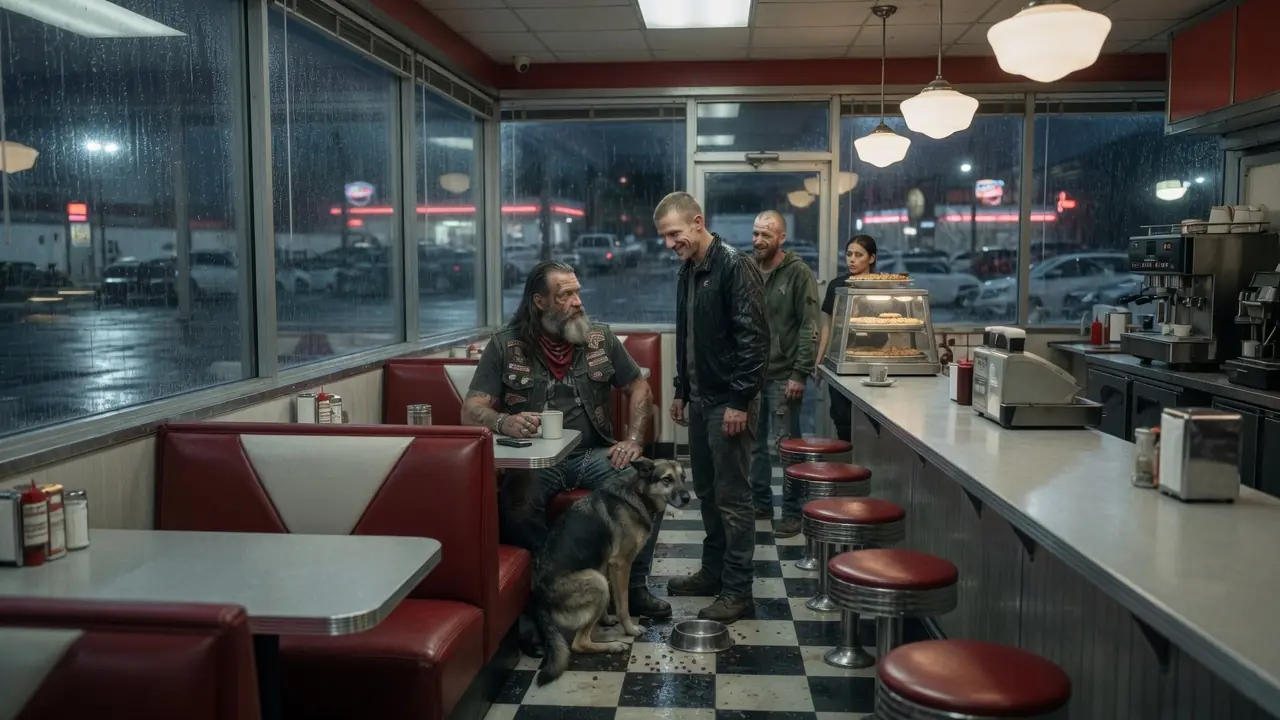
Water ran through the gutters and spread across Main Street in silver sheets. The diner’s neon sign blinked above the front window, turning the wet pavement red, then dark, then red again.
Twelve minutes passed.
Nothing happened.
Mason checked his watch.
“Three minutes.”
Ray did not respond.
Rosie began gathering the scattered food. Ray stopped her with a slight movement of his hand.
“Leave it.”
“Why?”
“So they can see.”
At fourteen minutes, Wade looked outside.
The street remained empty.
He smiled nervously.
“Told you.”
Then a sound moved through the rain.
Low at first.
Too distant to identify.
It grew beneath the storm like thunder trapped near the ground.
The truck driver raised his head.
Rosie stepped toward the window.
The sound multiplied.
One engine became ten.
Ten became fifty.
The windows began to vibrate.
Coffee trembled inside cups.
Mason stood.
Headlights appeared at the far end of Main Street.
They came through the rain in two long rows, white beams cutting across the darkness. Motorcycle engines filled the narrow downtown blocks, echoing from brick storefronts and closed offices.
Wade moved away from the door.
The first motorcycles passed the courthouse.
Then the old pharmacy.
Then Miller’s Hardware.
They did not accelerate.
They approached slowly, deliberately, filling the road from curb to curb.
Mason stared through the glass.
“How many did you call?”
Ray remained beside Roscoe.
“I called one.”
Motorcycles continued arriving.
Some riders wore full-face helmets. Others wore bandannas beneath the rain. Their leather vests carried chapter names from Cleveland, Dayton, Cincinnati, West Virginia, Pennsylvania, and Kentucky.
Several trucks followed behind them.
By the time the first motorcycle stopped in front of Rosie’s, the end of the procession could not be seen.
The engines shut off one by one.
The sudden silence was heavier than the noise.
A man dismounted from the lead motorcycle.
He was in his late sixties, tall and thick through the chest, with a white beard braided beneath his chin. His name was Thomas “Bear” Dalton, president of Ray’s chapter and a man who had known Roscoe longer than most members knew one another.
Bear removed his gloves.
He looked through the window.
His eyes found Roscoe immediately.
Then they moved to the blood on the towel, the overturned bowl, and Mason Rourke standing beside the booth.
Bear entered alone.
The bell above the diner door gave a cheerful ring that did not belong to the moment.
Rainwater ran from his boots.
He ignored Mason and went directly to Roscoe.
The old dog tried to stand.
His back legs slipped.
Bear dropped to one knee.
“Easy, Sergeant.”
Roscoe lifted his head.
His tail struck the tile once.
Bear placed both hands around the dog’s face and pressed his forehead against the gray muzzle.
“You stubborn old soldier.”
Roscoe licked the rain from his beard.
Mason glanced toward the motorcycles outside.
Riders continued parking along both sides of the street. Some remained on their machines. Others stood beneath awnings or formed quiet groups near the diner.
No one entered.
They waited.
Bear examined the wrapped paw.
“How bad?”
“Split nail,” Ray said. “Maybe bruised.”
“Did he kick him?”
“He kicked the bowl into him.”
Bear slowly looked over his shoulder.
Mason tried to recover his expression.
“This is ridiculous.”
Bear stood.
“You’re Mason Rourke.”
“You know me?”
“I know enough.”
“This is my town.”
Bear looked through the diner window at the hundreds of motorcycles filling Main Street.
“Not tonight.”
Wade backed into the door.
A rider outside placed one hand against the glass.
Not threatening.
Simply there.
Mason raised his chin.
“What do you want?”
Bear looked toward Ray.
Ray answered.
“Rosie’s money returned.”
Rosie froze.
Mason laughed.
“I don’t have her money.”
Ray looked toward the envelope protruding from Mason’s jacket pocket.
Mason tucked it deeper.
“That’s mine.”
Rosie’s voice shook.
“He took nine hundred dollars last month.”
Mason turned toward her.
“You should be careful.”
Ray rose.
Roscoe remained beside the booth.
“No one here is touching you,” Ray said. “No one is threatening you. You are going to sit down and listen.”
Mason looked from Ray to Bear.
“Or what?”
Bear pulled a chair away from the nearest table and placed it upright.
“Or you can walk outside and explain yourself to everyone who came for that dog.”
Mason sat.
Wade remained standing near the door.
Bear pointed toward another chair.
“You too.”
Wade obeyed.
Cody Bell had been silent since the motorcycles arrived. He moved to the wall, his face pale.
Ray looked at Rosie.
“How long?”
She stared at the counter.
“About a year.”
“How much?”
“I don’t know.”
“Estimate.”
“Twenty-three thousand.”
The cook swore beneath his breath.
Rosie wiped both hands against her apron.
“They started with three hundred a month. Said it was for parking-lot security. Then five hundred. Then extra payments when they said vandalism was increasing.”
“Was there vandalism?”
“After I refused the first increase, someone broke every window along the east side.”
Mason smiled.
“Crime happens.”
Bear pulled out his phone.
He did not dial.
He placed it on the table with the screen facing down.
Ray looked around the diner.
“How many other businesses?”
No one answered.
The truck driver slowly raised one hand.
“My sister runs the flower shop.”
Ray turned toward him.
“They collect from her?”
“Four hundred a month.”
The elderly man in the corner spoke next.
“My son owns Miller’s Hardware.”
Rosie closed her eyes.
“They’ve been paying too.”
The cook stepped through the kitchen door.
“My cousin’s food truck was burned after he stopped.”
Mason leaned back.
“People are saying a lot of things because they think these costumes protect them.”
Bear looked toward the riders outside.
“They aren’t costumes.”
“You think surrounding the street makes you law enforcement?”
“No.”
“Then what exactly is this?”
Ray moved toward the front window.
He looked at the motorcycles.
“Witnesses.”
Mason’s expression changed.
The riders had not arrived to fight.
Many held phones.
Several had cameras mounted on their helmets.
Two men stood beside a white van marked with the logo of a regional news station.
Another vehicle had parked near the courthouse.
It belonged to the county sheriff’s department.
Mason looked toward Ray.
“You called the police?”
“No.”
Bear answered.
“We called everyone.”
The diner door opened again.
Sheriff Daniel Mercer entered with two deputies.
He was fifty-one, tired-looking, and visibly unhappy to find hundreds of motorcycle riders occupying Main Street.
He removed his rain hat.
“Ray.”
“Sheriff.”
“Bear.”
“Daniel.”
Mercer looked at Mason and Wade.
“What happened?”
Mason stood quickly.
“These men surrounded us. I want them arrested.”
Mercer surveyed the diner.
“No one is preventing you from leaving.”
Mason pointed through the window.
“Look outside.”
“I did.”
“They threatened me.”
“What words did they use?”
Mason opened his mouth.
Nothing came.
Mercer looked toward Rosie.
“Did someone call about an injured animal?”
Rosie nodded.
“Mason kicked the dog’s bowl.”
“It was an accident,” Mason said.
Rosie looked directly at him.
“No, it wasn’t.”
The sheriff saw the envelope inside Mason’s pocket.
“What’s that?”
“Personal property.”
Rosie’s hands tightened.
“That’s my money.”
Mercer held out his hand.
Mason did not move.
“Give me the envelope.”
“You need a warrant.”
“Then I’ll ask Rosie whether she wishes to file a theft and extortion complaint. After that, I can detain you while we determine whether the money in your pocket came from her register.”
Mason glanced at Wade.
Wade looked away.
Slowly, Mason removed the envelope and placed it on the table.
Rosie counted the money.
Seven hundred dollars.
The exact amount Mason had demanded that night.
Mercer took out a notebook.
“Rosie, do you want to make a statement?”
She looked toward the motorcycles outside.
For years, she had imagined what would happen if she spoke.
Windows broken.
Kitchen fire.
An employee followed home.
The police had taken reports but found no witnesses willing to confirm anything.
Now hundreds of people waited beyond the glass.
Not to attack.
To remain visible.
“Yes,” she said.
The word came quietly.
Mason stared at her.
“Think carefully.”
Rosie’s fear flickered.
Then Roscoe struggled to rise.
His front paw slipped.
Ray supported him beneath the chest.
The old dog looked toward Rosie.
She began crying.
“Yes,” she repeated. “I want to make a statement.”
The truck driver stood.
“So do I.”
The elderly couple followed.
Then the cook.
One by one, customers admitted what they knew.
The River Kings had collected money from eleven businesses.
They had damaged property when people refused.
They had threatened families.
They had stolen motorcycles, stripped them for parts, and used Mason’s towing yard to store what remained.
Cody Bell slid down the wall into a chair.
“I’ll talk.”
Mason turned on him.
“Cody.”
“I’m done.”
“You open your mouth and—”
A deputy stepped between them.
Cody looked at the sheriff.
“I know where the bikes are.”
The room changed.
Bear’s face became still.
“How many?” Mercer asked.
“Seventeen.”
“Stolen?”
“Most.”
“Where?”
“Warehouse behind the towing yard. False wall. Mason has keys.”
Mason lunged toward Cody.
Ray caught his wrist.
The movement was quick.
Ray turned Mason’s arm and placed him face down against the table without striking him.
The biker’s age disappeared for one second.
Training, memory, and old strength returned together.
A deputy secured Mason’s hands.
Wade stepped toward the door.
Two riders outside moved aside, giving him a clear path.
He stopped anyway.
The second deputy handcuffed him.
Sheriff Mercer looked toward Ray.
“You planned this.”
Ray released Mason.
“I planned for people to feel safe enough to speak.”
“You could have called me directly.”
“We did before.”
Mercer’s expression tightened.
Rosie spoke from behind the counter.
“Three times.”
The sheriff looked at her.
She continued.
“After the windows. After my cook was followed. After they left a dead cat in the alley.”
Mercer lowered his eyes.
“We had no evidence.”
“You had fear,” Ray said. “You treated it like silence.”
No one answered.
Outside, reporters began gathering beneath the awning.
The story would move through Millstone before midnight.
But the reason so many riders had come was still not clear to Mason.
He struggled against the cuffs.
“All this for a dog?”
Bear turned.
“Yes.”
Mason laughed bitterly.
“He’s half dead.”
Every rider visible through the window seemed to become motionless.
Ray placed one hand on Roscoe’s back.
“Eight years ago, Bear’s granddaughter disappeared.”
Mason stopped smiling.
Ray looked toward the old dog.
“She was six.”
Bear stared at the floor.
The memory remained difficult, even after years.
“Her mother stopped at a highway rest area,” Ray continued. “The girl wandered through a broken section of fence while her mother was helping her younger brother.”
A storm arrived.
Temperatures dropped.
Police searched until morning.
Roscoe had been trained for wilderness tracking before age and injury ended that work. Ray and several club members joined the search.
“Roscoe followed her scent for nine miles,” Bear said.
His voice became rough.
“Across wet fields, through a drainage tunnel, and into an abandoned quarry.”
They found the girl beneath an overturned aluminum boat.
She was suffering from hypothermia.
Roscoe crawled beneath the edge of the boat and lay against her until rescuers arrived.
“She was alive because he would not leave her,” Bear said.
Mason looked toward the old shepherd.
The diner remained silent.
Ray continued.
“Two years later, Roscoe found one of our members after his motorcycle went over a ravine.”
A rider outside removed his hat.
A long scar crossed his forehead.
“Three years ago, he woke Bear when the clubhouse furnace began leaking carbon monoxide.”
Bear placed a hand on the dog’s neck.
“Twenty-seven people were sleeping inside.”
Roscoe looked up at him.
His cloudy eyes carried no understanding of the story being told.
He knew only the people around him.
The smells.
The voices.
The old bonds that remained familiar even as sight and hearing faded.
Ray looked at Mason.
“That dog has brought more people home than you have ever frightened.”
Sheriff Mercer cleared his throat.
“We need to move the prisoners.”
Bear stepped aside.
Every rider outside created a wide path from the diner to the patrol vehicles.
No one shouted.
No one touched Mason or Wade.
The silence followed them.
For the first time, the Rourke brothers walked through Millstone without fear protecting them.
Cody rode with a deputy.
Search warrants were obtained before dawn.
Police entered Mason’s towing yard and found seventeen motorcycles behind the false wall.
They also found stolen tools, vehicle parts, cash envelopes marked with business names, gasoline containers, and photographs of properties the River Kings had targeted.
One photograph showed Rosie’s Diner.
Another showed Ray’s house.
Roscoe was visible lying on the front porch.
The date had been written across the bottom.
They had been watching Ray before the confrontation.
Mason knew who he was.
He had kicked the bowl deliberately, hoping to provoke an assault and use it to pressure Ray’s chapter.
Instead, he had created the one thing he could not control.
A reason for everyone to gather.
By sunrise, five additional River Kings had been arrested.
The county prosecutor opened an organized extortion case.
Business owners who had remained silent for months began providing statements, payment records, camera footage, and threatening messages.
The case grew larger with every hour.
Roscoe never saw most of it.
Ray and Bear carried him to a veterinary clinic while the arrests continued.
Dr. Hannah Lee examined the injured paw.
The nail had split, but the bone was intact.
That should have been good news.
Then she listened to his heart.
Her expression changed.
“How long has he been coughing?”
Ray looked at Bear.
“A few weeks.”
“Eating normally?”
“Less.”
Dr. Lee ran tests.
The results showed an enlarged heart and fluid beginning to collect around Roscoe’s lungs.
His body had been failing quietly.
The diner incident had not caused it.
It had only revealed how little time remained.
“Medication may make him comfortable,” she said. “Weeks, possibly a few months. I cannot promise more.”
Ray sat on the clinic floor beside Roscoe.
The old dog placed his head across Ray’s thigh.
Bear stood near the wall.
For the first time that night, the chapter president looked frightened.
“He saved my granddaughter.”
“I know.”
“We can take him to Columbus. Cleveland. Anywhere.”
Ray stroked Roscoe’s ear.
“Some things can’t be fixed by riding farther.”
Bear looked away.
The next morning, Rosie opened the diner at six.
She expected a quiet day after the arrests.
Instead, forty motorcycles waited outside.
The riders did not enter all at once.
They came in small groups, ordered breakfast, paid for their meals, and placed extra money inside a glass jar near the register.
The jar was labeled:
ROSCOE’S MEDICAL FUND
By noon, it contained more than twelve thousand dollars.
Ray tried to refuse it.
Bear would not listen.
“Use what he needs. The rest goes to the county rescue.”
Rosie replaced Roscoe’s old food bowl with a heavy ceramic one painted blue.
His name appeared across the side.
She placed it beside Ray’s regular booth.
For several weeks, Roscoe continued coming to the diner.
He walked more slowly.
Ray lifted him into the motorcycle sidecar and secured a padded harness around his chest.
The old dog wore protective goggles because he always had.
Children waited outside to see him arrive.
Business owners came to thank him as though he understood the investigation.
Perhaps he did.
Roscoe recognized fear.
He recognized relief.
He recognized the way people touched his head after believing they would never feel safe again.
The Rourke brothers remained in jail awaiting trial.
Cody entered witness protection after agreeing to testify.
The River Kings’ property was seized.
Money recovered from the towing yard was returned to local businesses.
Sheriff Mercer created a direct reporting program for extortion victims and publicly admitted that his department had failed to understand the pattern.
Rosie forgave him eventually.
Not quickly.
Millstone changed.
Stores stayed open later.
The flower shop replaced its broken sign.
Miller’s Hardware repainted the windows that had remained boarded for six months.
Rosie hired another waitress and began serving dinner again.
People stopped lowering their voices when unfamiliar trucks passed.
The riders did not remain in town.
They did not need to.
Their visit had made one thing clear.
The frightened people of Millstone had never truly been alone.
They had only been separated.
Roscoe declined as winter approached.
His breathing became shallow.
The medication helped for a while, then less.
One cold November morning, he refused breakfast.
Ray found him lying beside the sidecar with his nose resting against the tire.
“You want a ride?”
Roscoe’s tail moved.
Ray called Bear.
Then he called Rosie.
Within an hour, motorcycles began arriving at Ray’s small house.
Not hundreds.
Only those closest to Roscoe.
Bear.
The rider Roscoe had found in the ravine.
The twenty-seven people who had been sleeping inside the clubhouse during the furnace leak.
Bear’s granddaughter, now fourteen, arrived with her mother.
She knelt beside the old dog and removed a faded red scarf from her neck.
“You remember this?”
Roscoe smelled it.
His ears lifted slightly.
The scarf had been wrapped around the girl when rescuers carried her from the quarry.
She tied it gently around Roscoe’s collar.
“Good boy.”
Ray lifted Roscoe into the sidecar.
The dog no longer had strength to stand, but his eyes opened when the motorcycle started.
They rode slowly.
Bear led.
The others followed.
The route passed Rosie’s Diner.
Rosie stood outside holding the blue food bowl.
Every employee lined the sidewalk.
Then the riders continued beyond town toward the hill overlooking the Ohio River.
Ray and Roscoe had visited that place hundreds of times.
The sidecar remained warm beneath blankets.
Cold air moved through Roscoe’s fur.
His nose lifted toward it.
For several miles, he looked younger.
At the hilltop, the motorcycles stopped.
Ray carried Roscoe beneath a large oak tree.
The old dog rested on a blanket while the riders formed a quiet circle.
No speeches were planned.
Ray had never trusted speeches.
Bear sat beside him.
“You made the call for us that night.”
Ray looked at Roscoe.
“I made it for him.”
Bear shook his head.
“You made it because Rosie needed witnesses.”
“She needed help.”
“So did the town.”
Ray continued stroking the dog’s neck.
Bear looked toward the river.
“You always pretend you only care about the dog.”
“Dogs are easier.”
“They don’t ask questions.”
“They ask better ones.”
Roscoe’s breathing became uneven.
Ray bent closer.
“I’m here.”
The old shepherd opened his eyes.
Ray removed one glove and rested his palm against the dog’s chest.
“You did enough.”
Roscoe looked toward Bear’s granddaughter.
Then toward Bear.
Finally, his eyes returned to Ray.
His tail moved once across the blanket.
Ray lowered his forehead to Roscoe’s.
“You brought everyone home.”
The dog released a long breath.
Then another.
The next one did not come.
No one moved.
The river continued beneath them.
Wind shifted through the bare branches.
A motorcycle engine ticked softly as it cooled.
Ray remained with his forehead against Roscoe’s muzzle.
Bear placed one hand on his shoulder.
The other riders lowered their heads.
They buried Roscoe beneath the oak tree with the red scarf around his collar.
Bear’s granddaughter placed the blue food bowl beside the grave for several minutes before taking it back to the diner.
Ray stood last.
He removed the old identification tag from Roscoe’s collar and closed it inside his fist.
For thirteen years, the dog had slept beside his bed, ridden in the sidecar, waited outside hospital rooms, and followed him through every season after Ray’s wife died.
Roscoe had been the only presence in Ray’s house that never treated silence like a problem requiring a solution.
Now the quiet waiting at home would be different.
Empty.
Bear seemed to understand.
“You’re staying at the clubhouse tonight.”
“No.”
“That wasn’t a question.”
Ray looked toward the riders.
“I don’t need babysitting.”
“Neither did Roscoe.”
Bear’s voice softened.
“He stayed anyway.”
Ray did not argue.
The Rourke trial began the following spring.
Rosie testified first.
Then the hardware-store owner.
The florist.
The food-truck operator.
Cody Bell described how the group selected businesses and created damage after owners refused payment.
Security footage from the diner showed Mason kicking the bowl and stepping toward Ray.
It also showed something prosecutors considered important.
Ray’s restraint.
He made the phone call.
He did not attack.
The riders arrived.
They did not assault anyone.
They created witnesses, preserved the scene, and made frightened people feel safe enough to tell the truth.
Mason Rourke was convicted of extortion, conspiracy, arson, theft, witness intimidation, and several additional charges.
Wade accepted a plea agreement and received a shorter sentence.
The towing yard was sold.
Part of the proceeds went to victims.
Rosie used her compensation to replace the diner’s roof.
She refused to change anything else.
The cracked tiles remained.
The counter stools still squeaked.
Ray’s booth stayed near the back wall.
The blue bowl sat beside it.
Rosie never moved the bowl, although no dog used it again.
Above the booth hung a framed photograph.
Roscoe wore his goggles inside the sidecar, ears raised as Ray’s motorcycle traveled beneath a wide summer sky.
A small plaque beneath it read:
ROSCOE DONOVAN
HE BROUGHT US HOME
One year after the night the motorcycles filled Main Street, Rosie held a fundraiser for the county animal rescue.
She expected perhaps fifty people.
More than three hundred arrived.
Some came on motorcycles.
Others came with children, rescue dogs, or photographs of animals they had lost.
The event raised enough money to build a new senior-dog wing at the shelter.
It was named Roscoe House.
Ray visited the week it opened.
He walked slowly past kennels containing dogs with white muzzles, stiff legs, cloudy eyes, and histories no one completely knew.
Near the end of the corridor, a shepherd mix lay with his back against the wall.
The dog had one torn ear.
He watched Ray without approaching.
A volunteer stood nearby.
“His name is Henry. Eleven years old. Owner died. Family couldn’t keep him.”
Ray looked at the dog.
“I’m not adopting.”
“Of course.”
“I mean it.”
“I didn’t ask.”
Ray sat on a bench outside the kennel.
Henry remained against the wall.
After several minutes, Ray placed Roscoe’s old identification tag on the floor near the gate.
The dog lifted his head.
He approached slowly.
He smelled the tag.
Then he lay down beside it.
Ray stayed for an hour.
He returned two days later.
Then again the following week.
A month after that, Henry rode away from the shelter inside a padded sidecar.
He did not wear Roscoe’s collar.
Ray bought him a new one.
Some things could be passed forward.
Others belonged only to the one who had carried them.
On Saturday mornings, Ray and Henry visited Rosie’s.
The blue bowl remained on display.
Rosie provided a different dish for Henry and placed it beside Ray’s booth.
No one ever kicked it.
The diner became louder after the Rourke brothers fell.
People argued about football.
Children laughed.
Truck drivers told stories across tables.
Business owners who once avoided one another began sharing information and watching each other’s buildings at night.
The silence created by fear had disappeared.
Ray occasionally missed the older quiet.
Then he remembered what it had hidden.
Years later, people in Millstone still told the story of the rainy night when a stranger kicked a Hells Angel’s old dog and hundreds of motorcycles arrived fifteen minutes later.
The number changed depending on who told it.
Some said two hundred.
Some said five hundred.
Children insisted there had been a thousand.
The story usually focused on the motorcycles.
The noise.
The leather vests.
The moment Mason Rourke realized how badly he had miscalculated.
Ray always corrected one part.
“They didn’t come because Roscoe belonged to a Hells Angel.”
People would wait.
“They came because, at one time or another, we belonged to Roscoe.”
The dog had found missing children.
Injured riders.
Poisoned air.
Lonely men who did not know how to return to the world after loss.
He had spent his life noticing when someone was missing.
That rainy night at Rosie’s, when Mason kicked the old dog’s bowl and mocked the only family Ray believed he had left, Ray made one telephone call.
He did not call for revenge.
He called the people Roscoe had saved.
They came through the rain because loyalty was not something they wore across their backs.
It was something they practiced.
They arrived quietly enough to let the truth speak.
They stood outside until frightened people found their voices.
And when the last motorcycle left Millstone, the town understood what Mason Rourke never had.
The old dog beneath Ray Donovan’s table was not weak because his legs had slowed.
He was not worthless because his muzzle had turned gray.
He carried thirteen years of courage inside a failing body.
He had protected children, riders, strangers, and one grieving man who might never have survived losing his wife without him.
Mason saw an old animal and believed no one would care.
Fifteen minutes later, hundreds of headlights came through the rain to prove him wrong.