The bell above Rosie’s Diner had rung a thousand times that winter, but it had never sounded as sharp as it did when Duke lifted his head from beneath the corner booth and growled at the door. Outside, the rain came down in hard silver needles across the cracked parking lot, washing cigarette ash, gravel, and spilled motor oil toward the gutter. Inside, the old neon pie sign blinked against the window, the radio behind the counter hissed between country songs, and the smell of burnt coffee clung to the walls like a memory nobody could scrub off. Ray Donovan sat alone in the back booth with one gloved hand resting near his coffee cup and the other hanging low, close enough for Duke to nudge whenever the old dog needed reminding that he was still there.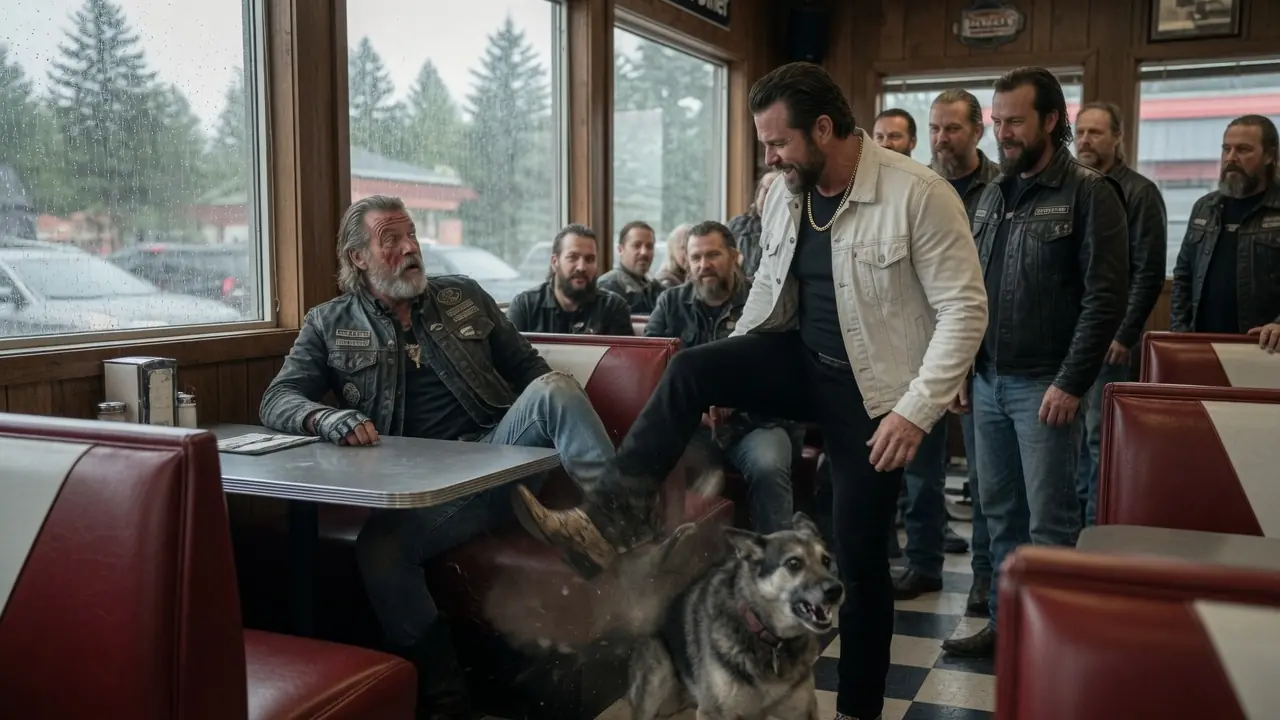
Duke was a big shepherd mix with a graying muzzle, one torn ear, and the careful eyes of an animal who had learned human pain before human kindness. He wore a faded red collar with a brass tag shaped like a small guitar pick, scratched nearly smooth except for one word stamped across it: GRACE. Ray had polished that tag every Sunday night for seven years, even when he had nothing else clean in his motel room. People saw the black leather vest, the scar across his jaw, the heavy boots, the knuckles that had healed wrong, and they decided Ray was the kind of man trouble followed. They never understood that trouble had already found him long ago and left him with a dog, a collar tag, and a phone number he had promised himself he would never dial again.
Rosie Harper understood more than most. She had owned the diner for twenty-two years, long enough to know the difference between a dangerous man and a damaged one. Ray had started coming in two months earlier, always after the dinner rush, always taking the back booth where Duke could lie against the wall, always paying in cash and leaving too much for a tip. He ordered black coffee, scrambled eggs, dry toast, and one plain hamburger patty cooled on a saucer for Duke, who never begged and never wandered. Rosie had a strict no-dogs rule taped near the register, but Duke had once sat so quietly beside a trembling little girl during a snowstorm that Rosie had taken the sign down and pretended she had forgotten where she put it.
That night, only three other customers sat inside: a truck driver half-asleep over chili, a nursing student with textbooks spread near the pie case, and a young mother warming her hands around a mug while her toddler slept against her coat. Rosie was wiping down the counter, her bad wrist aching from the damp, when the bell rang again and five men stepped in from the rain. They were too loud before they even spoke, the way men are loud when they want a room to shrink around them. Their leader, Vance Ketter, wore a white denim jacket despite the weather, pale snakeskin boots, and a grin so clean and cruel it looked practiced in mirrors. Two of his men carried themselves like bouncers, one had a shaved head tattooed with crooked symbols, and the last kept looking around as if measuring what could be broken.
Rosie felt the temperature in the diner change. Everyone in Mason Creek knew Vance, though few said his name with any volume. His family owned the scrapyard outside town, but his real business moved at night, through back roads and storage units and men too frightened to testify. He called his crew the Kings of Mercy, which would have been funny if they had not put two brothers in the hospital the previous spring for refusing to sell their garage. They did not wear biker colors, but they hated anyone who did, especially the old riding clubs that still came through Colorado in the summer. To Vance, every patch was a challenge, every engine was disrespect, and every quiet man was an invitation to perform cruelty.
“Well, look at this,” Vance said, shaking rain from his jacket onto the floor Rosie had just mopped. His eyes landed on Ray’s vest first, then on Duke. “Rosie, you running a kennel now, or did the health department finally stop caring about this dump?”
Rosie set the rag down. “Duke doesn’t bother anybody.”
“Duke.” Vance tasted the name and laughed. “The mutt gets a name. That’s sweet.”
Ray did not look up from his coffee. His face stayed still, but Duke’s ears flattened. The dog knew the shape of a room before most people knew their own fear, and he edged closer to Ray’s boot. Rosie saw Ray’s fingers curl once against the vinyl seat, then relax. He had the kind of restraint that did not come from softness. It came from knowing exactly how much damage a man could do and choosing not to start.
Vance took three steps toward the booth. “You deaf, biker?”
Ray raised his eyes. He was fifty-eight, broad-shouldered, with shoulder-length iron-gray hair tied at the nape and a beard trimmed rough around a mouth that rarely smiled. Rain glistened on the sleeves of his worn black leather jacket, and the patch on his vest was old enough that the stitching had faded at the edges. Iron Shepherds MC. Beneath it, in smaller letters, was a memorial rocker that read Grace Road. Vance noticed it, and something mean brightened in his expression.
“I’m eating,” Ray said.
“You’re taking up space.” Vance leaned close enough that Rosie smelled whiskey and peppermint gum. “And your dog is making decent people uncomfortable.”
The truck driver lowered his spoon. The nursing student stopped pretending to read. The young mother pulled her sleeping toddler closer. Rosie moved around the counter, already angry, already afraid, but before she could reach the aisle, Vance’s boot snapped forward under the table. Duke yelped and scrambled sideways, knocking the saucer against the floor. The sound was small, terrible, and final. Coffee trembled in Ray’s cup, but Ray himself went perfectly still.
For one breath, the whole diner vanished around him. There was only that yelp, the red collar, and a hospital room seven years ago where his daughter’s hand had been cooling in his. Grace had been twenty-six when a drunk driver crossed the center line on Highway 17. Duke had been in the back seat then, younger, bleeding from one ear, pressed against Grace’s body until the firefighters pulled him away. Ray had arrived too late for goodbye, but not too late to hear Duke howling behind the ambulance, a sound that had followed him into every sleepless night since.
Rosie’s voice cracked across the diner. “Vance, get out.”
“Easy, boy,” Ray whispered. “I’ve got you.”
Vance laughed loudly enough to wake the toddler, who began crying against his mother’s chest. “That’s it? Big bad biker talks baby talk to his flea bag?”
Ray slowly reached into the inside pocket of his jacket. Vance’s men shifted, expecting a weapon. Rosie’s breath caught. Ray pulled out an old flip phone held together with black tape. The thing looked absurd in his hand, small and battered, its screen scratched from years of being carried through storms and funerals and nights nobody wanted to remember. He opened it, pressed one number, and waited.
When someone answered, Ray said only four words. “Grace Road is closed.”
Then he hung up.
The silence that followed was not empty. It was loaded. Vance smiled at first, but the smile thinned when he saw Rosie’s face. She had heard of Grace Road, though she had never understood what it meant. Everyone in the county had heard rumors about the Iron Shepherds after the old quarry fire, after the child trafficking arrests, after the missing girl found safe at a truck stop two states away. They were called criminals by people who feared them and angels by people they had saved. The truth, Ray had once told Rosie after two coffees and a long night, was that labels were easier than grief.
Vance slapped the phone from Ray’s hand. It hit the floor and skidded beneath the booth. Duke growled through pain, and Ray leaned down, not to pick up the phone, but to keep the dog still. That seemed to irritate Vance more than anger would have. “Who did you call? Your little old motorcycle choir?”
Ray looked up. “You should leave.”
“Or what?” Vance spread his arms. “You going to sic Grandpa Dog on me?”
Ray’s eyes moved, briefly, to the window. Beyond the rain, the parking lot lay nearly empty except for his black Harley under the flickering diner sign and Vance’s two pickups parked sideways across three spaces. The highway beyond was a wet black ribbon running toward the mountains. Fifteen minutes was not long in a town like Mason Creek. It was long enough for regret to arrive, if a man had the sense to recognize it.
Rosie stepped between them, a fifty-four-year-old woman with gray in her braid, flour on her sleeve, and more courage than money. “You kicked an animal in my diner. You’re done here.”
Vance turned on her so fast the young mother flinched. “Careful, Rosie. You owe people all over this town. I hear the bank’s not feeling patient.”
Rosie’s face went pale. Ray saw it and understood at once that Vance had not come in by accident. Mason Creek had only one main road, two churches, three bars, and a hundred ways for gossip to become leverage. Rosie was behind on payments; anyone could see that from the cracked booths and the repair notices taped behind the register. But Vance knowing it meant he was circling. Men like him always found women tired enough to corner.
“My bills aren’t your business,” Rosie said.
“They could be.” Vance smiled again. “I buy businesses in distress. I’m civic-minded like that.”
“You burn them down when people say no,” the truck driver muttered.
One of Vance’s men moved toward him, but Vance lifted a finger and stopped him. “Not yet.”
Ray heard that clearly. Not yet. The words tucked themselves into the room like a match laid beside gasoline. Duke leaned heavier against Ray’s boot, and Ray slipped his hand beneath the dog’s chest, testing ribs with careful pressure. Duke gave a soft whine, then licked Ray’s wrist. That nearly undid him more than the kick had. Pain did not surprise Ray anymore; forgiveness still did.
Rosie knelt beside Duke despite Vance’s glare. “He needs a vet.”
“He’ll have one,” Ray said.
Vance snorted. “Maybe he needs a lesson more than a vet.”
Ray stood then, slowly. He was not taller than Vance, but something changed in how much room he seemed to occupy. His knees were stiff from old wrecks, and his right shoulder clicked when he moved, but there was an old storm behind his calm. Vance’s men sensed it before Vance did. One of them shifted back half a step. Ray leaned forward just enough for Vance to hear him without the rest of the diner needing to.
“You kicked my daughter’s dog,” he said.
For the first time, Vance’s expression flickered. Not with guilt, but with calculation. “Daughter?”
“She’s dead.” Ray’s voice did not break. That made it worse. “That dog rode home with her blood on his coat. He has slept beside my bed every night since because I couldn’t. So I’m going to say this once in a way even you can understand. Walk out while the rain is still the loudest thing you hear.”
The nursing student pressed a hand over her mouth. Rosie stared at Ray with tears she would deny later. Vance, however, heard only a challenge. He smiled, wider and uglier, and looked around the diner as if inviting everyone to witness his bravery. “Your dead girl had bad taste in pets.”
Ray’s fist clenched once. Every muscle in his body wanted the old answer. The quick answer. The one that left teeth on tile and silence afterward. For twenty years, violence had been the language other men expected from him, and for ten of those years he had spoken it fluently. But Grace had asked him to stop before she died. Not because she believed the world was gentle, but because she believed he could be more than what the world kept demanding.
So Ray did not hit Vance. He picked up Duke with both arms, careful of the dog’s side, and placed him on the booth seat. Then he slid out of his jacket and folded it beneath Duke’s body like a blanket. The gesture was quiet, almost tender, and it made Vance look smaller. Cruelty hates tenderness because it cannot understand why it fails to break.
“You’re boring me,” Vance said, though his jaw worked tight. “Boys, maybe we help Rosie redecorate.”
The men moved. One swept an arm across the counter, sending a stack of plates crashing to the floor. Another kicked over a chair. The shaved-headed man yanked the jukebox plug from the wall, killing the song mid-verse and leaving only rain and the toddler’s sobs. Rosie shouted, but one man shoved past her, not hard enough to injure, just hard enough to tell her what he could do if he wanted. Ray took one step, then stopped because Duke tried to follow and whined.
That was when the first engine sounded outside.
It was distant at first, buried beneath rain, a low pulse rolling off the highway. Vance did not notice immediately. He was busy picking up Ray’s phone from beneath the booth and turning it over in his hand. “This thing belongs in a museum.”
The pulse became two engines, then five, then a layered thunder that made the windows tremble in their frames. The truck driver stood and looked through the glass. His face changed before he spoke. “Oh, hell.”
Headlights appeared beyond the curtain of rain. Not one pair. Not ten. A long, winding river of them bent off the highway and poured into the road leading to Rosie’s Diner. Chrome flashed under the streetlights. Tires hissed through puddles. The sound grew until the cups on the tables rattled, until the neon sign flickered, until every man in Vance’s crew turned toward the windows with the same dawning fear. Fifteen minutes after Ray’s phone call, the first Harley rolled into the parking lot, then the second, then the twentieth, then more than anyone could count through the rain.
They did not arrive like a mob. That was what frightened Vance most. They arrived with order. Two lines of motorcycles swept into the lot and formed a half circle around the diner, leaving the entrance clear but every exit watched. Riders in black leather cut their engines one wave at a time, and the sudden quiet after the thunder was worse than the noise. Their patches were not all the same. Iron Shepherds, Devil’s Mercy, Red River Nomads, Saint Jude Riders, Widow Sons, clubs that had not shared tables in years stood shoulder to shoulder in the rain. Older men with white beards. Women with silver braids under helmets. Young riders with hard eyes and steady hands. Nearly two hundred Harleys filled the parking lot, and every head turned toward the diner.
Vance swallowed. “This some kind of joke?”
Ray did not answer. He was watching the front row of riders dismount. A tall Black woman in a rain-spattered leather coat walked first, her helmet tucked beneath one arm, her long gray-streaked hair braided down her back. Her name was Marla Bishop, though most clubs called her Bishop because she moved like a verdict and spoke like a prayer that had learned to fight. Beside her walked Tommy Vale, a one-legged mechanic with a cane made from an old handlebar, and behind them came Doc Alvarez, the veterinarian who had patched more bullet wounds in dogs and more broken ribs in riders than he ever mentioned on licensing forms.
Rosie unlocked the door before anyone knocked. Marla stepped inside and took in the broken plates, the frightened customers, Vance’s men, Ray without his jacket, and Duke curled on the booth seat. Her face changed only when she saw the dog. She removed her gloves slowly.
“Who touched Grace’s dog?” she asked.
Nobody moved. Outside, nearly two hundred riders stood in the rain without speaking. The question did not need volume. It carried the way certain names carry when enough grief has been tied to them.
Vance tried to laugh, but it came out thin. “Lady, this is private business.”
Marla looked at him as if he were furniture blocking a doorway. “Your name is Vance Ketter. You run stolen bikes through the old feed mill, collect debt for three men in Denver, and pay two deputies to look away when trucks move through county roads after midnight.”
Vance’s face drained of color. Rosie stared at Marla. Ray closed his eyes for half a second because now he understood why the call had brought so many. Grace Road is closed had never been just a distress code. It was the old emergency phrase for a network Grace herself had helped build before she died, a quiet chain of riders who moved missing women, scared kids, abused spouses, and desperate families to safety when official systems were too slow or too bought. Ray had left that life after burying Grace, but the road had not forgotten him. More importantly, it had not forgotten her.
Doc Alvarez pushed past Vance without asking permission. He was a compact man in his sixties with a brown medical bag, rain dripping from the brim of his cap. He knelt beside Duke, speaking Spanish under his breath the way he always did to scared animals. Duke wagged once when he smelled him, then winced. Ray crouched beside them, one hand on Duke’s head.
“Bruised ribs, maybe a cracked one,” Doc said after a careful check. “No internal signs from what I can tell here, but I want him at my clinic.”
Ray nodded. “Take him.”
Duke tried to lift his head when Ray said it. Ray leaned close and pressed his forehead to the dog’s muzzle. “I’m right behind you, boy.”
Vance backed toward the door, but two riders outside shifted into view, not touching him, not blocking him with weapons, simply existing in his path with the immovable patience of old mountains. He turned back, angry because fear had nowhere to go. “You can’t hold me here.”
“No one is holding you,” Marla said. “We’re waiting for the sheriff.”
Vance barked a laugh. “Sheriff owes my uncle.”
“Not this sheriff,” Rosie said softly.
Everyone turned. Rosie’s hands were shaking, but her voice had found something steady. She reached under the register and pulled out a small digital recorder no bigger than a pack of gum. Ray remembered the way she had been wiping the counter when Vance threatened her, the way she had not flinched from certain words. She had been recording before the kick. Maybe before Vance even walked in.
Vance’s eyes narrowed. “You stupid old woman.”
Rosie held the recorder to her chest. “You came here three nights ago and told me if I didn’t sign my diner over, I’d lose more than the building. Tonight you said enough to prove it wasn’t a misunderstanding.”
“You think a toy recorder saves you?” Vance stepped toward her, and for the first time Ray moved faster than age should have allowed. He placed himself between Vance and Rosie. Not touching. Not striking. Just there.
Marla’s voice lowered. “Try him.”
Vance stopped. Outside, the riders watched through rain and glass. Inside, the toddler had stopped crying, as if even the child understood the room had shifted. The nursing student was quietly filming on her phone now. The truck driver held his own phone at chest height. Fear, once shared, can become evidence.
Sirens finally cut through the rain. Two county cruisers pulled in at the far edge of the lot, then a state police SUV behind them. Vance’s confidence twitched back for a second when he saw Deputy Lyle step out, a heavy man with a wet hat and a reputation for losing paperwork. But the second cruiser opened and Sheriff Elena Brooks emerged, tall, Black, mid-forties, with her raincoat flapping and no patience in her stride. She had taken office six months earlier after the last sheriff resigned under investigation. Half the town had voted for her because they wanted clean roads. The other half had voted against her because clean roads reveal what has been buried.
Sheriff Brooks entered the diner and looked once at the riders, once at Vance, once at Rosie. “Somebody better explain why my dispatcher got seventeen calls saying there were two hundred motorcycles outside Rosie’s and one call from the state attorney’s office telling me to bring evidence bags.”
Marla held out a folded envelope sealed in plastic. “You’ll want this too.”
Vance stared at the envelope. “What is that?”
“Insurance,” Marla said. “And old grief finally becoming useful.”
Ray looked sharply at her. Marla did not meet his eyes. The sheriff took the envelope, opened it, and scanned the first page. Her expression hardened line by line. “Vance Ketter, I’m going to advise you not to say anything else without counsel.”
Deputy Lyle shifted. “Sheriff, maybe we should take this down to the station and sort it out quiet.”
Brooks turned on him. “Deputy, step outside and wait by your cruiser.”
He flushed. “Ma’am?”
“Now.”
The word cracked through the diner. Deputy Lyle went out, and several riders turned their heads to watch him pass. Vance’s crew looked at one another. Their world had rules, and one of them had just failed. The sheriff motioned to a state trooper, who began taking statements. Rosie handed over the recorder. The nursing student offered her video. The young mother, still shaking, described the kick, the threat, the broken dishes. The truck driver gave his name and said he had seen the shove and heard the feed mill mentioned on other nights.
Ray did not speak until Doc carefully lifted Duke into his arms with a blanket from Rosie’s storage closet. The dog’s brass tag swung once, catching the fluorescent light. Sheriff Brooks saw it and froze.
“Grace,” she said.
Ray looked at her. “You knew my daughter?”
Marla finally turned to him. “Ray, we need to talk.”
“After Duke.”
“Now,” she said gently. “Because this is about Duke too.”
Doc carried the dog toward the door, and Ray started to follow, but Marla touched his sleeve. Outside, riders parted to let Doc through. Someone opened the back of a van that had a mobile veterinary setup inside, better equipped than half the county clinics. Duke looked back once, and Ray lifted a hand. It took everything in him not to go with the dog immediately.
Marla led him to the quiet end of the counter. “Grace kept files.”
Ray’s jaw tightened. “She told me she stopped all that before she died.”
“She told you what you needed to hear because you were terrified every time she left town.”
Ray looked away. Rain streaked down the window, breaking the reflection of the riders into ghostly lines. “She promised me.”
“She promised to be careful. She didn’t promise to stop caring.” Marla’s voice softened. “Grace was building cases against men like Ketter. Not just him. A route. Stolen bikes, stolen parts, women moved under debt, kids used as leverage. She had names, dates, plates. After the crash, we thought the files were gone.”
Ray felt cold move through him. “The crash wasn’t random.”
“We couldn’t prove otherwise.”
He heard the kindness in that answer and hated it. Couldn’t prove otherwise meant they had suspected. It meant the road that took Grace might not have simply been wet and unlucky. It meant the anger he had buried because there was nowhere to place it suddenly had a shape, and that shape stood ten feet away in snakeskin boots, sweating under fluorescent light.
Marla reached into her coat and pulled out a familiar object: a small leather notebook, dark brown, swollen at the edges from old water damage. Ray recognized it before his mind allowed him to. Grace had carried it everywhere, tucked into the back pocket of her riding jeans. She wrote names in it, song lyrics, grocery lists, phone numbers for women who were scared to save contacts under real labels. Ray had found everything else from the crash returned in a plastic hospital bag, but not that notebook.
“Where did you get that?” he whispered.
“Duke found it.”
Ray stared at her.
“Three weeks after the funeral, he kept digging behind your garage. You thought he was looking for bones. He wasn’t. Grace had trained him to hide things when she said a word. We didn’t know the word. We only knew he had buried this in a coffee can wrapped in cloth.” Marla placed the notebook in his hand. “You were in no condition to be told then. Maybe that was wrong. But we used copies of what we could read to keep Grace Road alive.”
Ray opened the notebook with fingers that felt too large. Inside, Grace’s handwriting leaned across the pages, quick and alive. There were names, arrows, license plates, diner napkin sketches, and in the margin of one page, a small drawing of Duke wearing a crown. Near the middle, written in heavier ink, was a line Ray had not heard in seven years: If I don’t come home, Dad will need Duke more than the truth. Beneath it, another line: But someday, give him both.
The diner blurred. Ray pressed the heel of his hand against his eyes, but the tears came anyway, hot and humiliating and overdue. He had not cried at the funeral. He had not cried when he sold Grace’s little blue truck. He had not cried when Duke slept outside her bedroom door for six months. Grief had made him stone because stone does not have to choose. But Grace, even dead, had left him a choice.
Vance’s voice cut across the room. “This is crazy. You’re all standing around because of a dog and some dead biker girl’s diary.”
Ray closed the notebook. The room went quiet again, but this quiet was different. It was not fear now. It was restraint shared by many people who knew what violence could cost. Ray walked toward Vance. Sheriff Brooks moved as if to stop him, but Marla lifted one hand. Ray stopped an arm’s length away from the man who might have been connected to the worst night of his life.
“You want me to hit you,” Ray said.
Vance’s nostrils flared. “I want you to realize your circus doesn’t scare me.”
“It does.” Ray’s voice was almost kind. “That’s why you keep talking.”
Vance lunged then, not at Ray’s face, but for the notebook in his hand. Ray twisted aside, and Vance stumbled into the booth. A state trooper grabbed one arm, Sheriff Brooks the other. Vance fought hard enough to make it official, cursing, spitting, promising lawsuits, calling Rosie a liar and Marla worse. Outside, the riders did not move. No one gave him the riot he wanted. No one gave him the war story he could use. He was simply handcuffed under the buzzing lights of a diner where he had expected everyone to be too afraid.
As they pulled Vance toward the door, he twisted his head toward Ray. “You think this ends anything? You think you’re clean because you hide behind old women and dogs?”
Ray held the notebook against his chest. “No. I know exactly what I’ve been.”
That answer stayed with him longer than Vance’s insults. He had been violent. He had been useful. He had been absent when Grace was young and waiting on porches for a father who kept choosing other people’s emergencies over his own child. He had been proud when she followed him onto the road and furious when that road took her. For years, he had blamed the world because blaming himself would have required surviving a different kind of pain.
At Doc’s clinic, X-rays showed two bruised ribs and one hairline fracture, painful but not life-threatening. Duke would heal with rest, medication, and the kind of stubborn devotion Ray already possessed in embarrassing amounts. When Doc finally said the dog would be okay, Ray sat down on the clinic floor because his knees stopped pretending. Duke, still groggy, opened one eye and thumped his tail once against the blanket.
“You old fool,” Ray whispered, stroking his head. “Scared me half to death.”
Marla stood in the doorway. “He did his job.”
Ray looked at her. “What job?”
“Kept Grace’s road open until you were ready to come back.”
He almost told her he was not coming back. The words rose automatically, worn smooth from years of refusal. He was too old. Too tired. Too full of ghosts. But then he looked at Duke’s collar tag, at the word Grace catching the clinic light, and he remembered the line in the notebook: Someday, give him both. The truth had arrived ugly and wet and fifteen minutes after cruelty, but it had arrived. Maybe readiness was not a feeling. Maybe it was only the moment when running out of excuses hurt worse than staying gone.
One rainy Thursday, almost exactly six weeks after the diner incident, Sheriff Brooks walked into Rosie’s during the lunch rush and asked for Ray. By then Duke was moving slowly but well, wearing a soft wrap beneath his collar and accepting hamburger patties from half the town like a wounded dignitary. Ray sat in the back booth with Grace’s notebook open and a legal pad beside it. He had been sketching routes, names, and possible safe stops, though he still felt foolish whenever he imagined himself organizing anything more complicated than a ride.
Sheriff Brooks slid into the seat across from him. She looked tired, which in her line of work meant she had been winning just enough to make enemies. “We found something in Ketter’s office.”
Ray closed the notebook. “About Grace?”
“Yes.”
Rosie, passing with a coffee pot, stopped so abruptly coffee splashed over the rim. The sheriff glanced at her, then nodded that she could stay. Ray felt Duke press against his leg under the table.
Brooks placed a clear evidence photo on the table. It showed a bent piece of chrome, rusted at one edge, stamped with a partial serial number. “This came from the front bumper of a truck registered to Ketter’s scrapyard seven years ago. It was reported dismantled two days after Grace’s crash. We matched paint transfer from old evidence storage.”
Ray stared at the photo until the numbers blurred. “He killed her.”
“We believe someone driving that truck forced her off the road. Whether Vance was behind the wheel or ordered it, we’re building that case.” Brooks’s voice was careful but not cold. “There’s more. Grace had arranged to meet a witness that night. A young woman from Mason Creek. The witness never showed because she was intercepted.”
Rosie set the coffee pot down with a soft clink. “Who?”
The sheriff looked at her. “Your niece, Carly.”
Rosie sat down as if her legs had been cut. Carly had disappeared eight years ago at nineteen, leaving behind rumors and a mother who drank herself quiet. Rosie had kept a photo of her niece taped behind the register until the sun faded it almost white. Most people said Carly had run off. Some said worse. Rosie had never believed either version fully, but grief without facts becomes a room you cannot leave.
“She’s alive?” Rosie whispered.
Brooks nodded. “She is. She’s in witness protection under another name. She saw the news from the diner and contacted us through an attorney. She said Grace tried to save her, and Ketter’s people went after Grace because of it.”
Ray felt the major shape of the truth settle over all of them. Duke had not been kicked in a diner by random cruelty alone. That cruelty had struck a match near a trail Grace left behind, and suddenly old secrets were burning in the open. Rosie covered her mouth, sobbing without sound. Ray reached across the table and took her hand, awkwardly at first, then firmly. He had no words that would not be too small.
“Carly wants to come home for the trial,” Brooks said. “But she’s scared. She asked if Grace Road still exists.”
Rosie looked at Ray through tears. Ray looked at the notebook, then at Duke’s tag, then at the diner around him. The pie case hummed. The bell over the door rang as two construction workers came in laughing about the rain. Coffee steamed in chipped mugs. Life kept moving in its ordinary, breakable way, waiting for someone to decide whether ordinary places were worth defending.
“Yes,” Ray said. “It exists.”
Carly came home on a clear Saturday morning under a sky scrubbed clean by days of rain. She arrived in a plain gray sedan with state plates, wearing sunglasses and holding the hand of a teenage daughter Rosie had never met. Ray stood beside Duke near the diner door, his heart banging against his ribs as if he were the one returning from exile. Rosie waited on the sidewalk, both hands pressed to her apron. For a moment, nobody moved. Then Carly removed her sunglasses, and Rosie made a sound that seemed pulled from the deepest room of grief.
They met halfway across the parking lot. Rosie held her niece so tightly Ray had to look away. Carly’s daughter stood uncertainly beside them until Rosie opened one arm and pulled her in too. Around the lot, riders pretended to check straps and mirrors, giving the family the dignity of not being stared at. Duke, however, had no such manners. He limped forward, sniffed Carly’s hand, and leaned his head against her knee.
Carly sank down, crying. “I remember you.”
Ray’s breath caught. “You saw Duke?”
“At the bus station. Grace had him with her. She told me he could tell good people from bad ones.” Carly stroked Duke’s ears. “He sat against my feet until I stopped shaking.”
Duke wagged like this confirmed a long-standing professional record. Ray laughed, and the laugh broke into something dangerously close to a sob. Carly looked up at him. “You’re her father.”
“I am.”
“She talked about you.”
Ray braced himself. “Did she?”
Carly nodded. “She said you were stubborn, impossible, too proud, and the reason she knew scared people could still be brave.”
Ray looked down at Duke because the world had gone blurry again. There are sentences a person waits a lifetime to hear without knowing they are waiting. That one entered him quietly and found the locked room where he kept his worst self. It did not erase anything. It opened a window.
The jury convicted Vance on enough counts to take most of his life apart. More charges were still coming. Deputy Lyle accepted a plea. The scrapyard went into seizure. The feed mill was locked behind federal tape, its broken windows staring out at fields like blind eyes. Mason Creek did not become perfect because no town does, but people began telling the truth louder. That was a start.
The first anniversary of the diner incident arrived with rain, as if the sky had a sense of structure. Rosie’s Diner had a new sign by then, painted red and cream, with the old neon pie restored above the door. The bank no longer owned her sleep. A small brass plaque beside the entrance read: Grace Road Stop 1, Open Coffee, Open Door. Rosie had argued against the plaque until Carly told her some doors need labels for the people too scared to knock.
Inside, the back storage room had become a real safe room with soft lamps, clean blankets, phone chargers, and a shelf of children’s books donated by the nursing student who had filmed the first video. The truck driver stopped by every Friday with grocery cards collected from other drivers. Sheriff Brooks kept a direct line posted behind the counter. Riders came through often, not in overwhelming numbers, but enough that anyone watching the place understood Rosie was no longer alone.
Ray arrived that evening with Duke walking slowly beside him, older now, muzzle almost white, red collar shining with the restored brass tag. The diner was full but not crowded. Marla sat near the counter with Tommy and Doc. Carly and her daughter were helping Rosie serve pie, both laughing like the sound still surprised them. On the wall above the pie case hung a framed copy of one page from Grace’s notebook, the one that said how to feed someone without making them feel small. Ray had resisted displaying it until Rosie said the world needed instructions.
When the bell rang again, everyone turned by habit. A young man stood in the doorway, soaked through, maybe nineteen, with a split lip, a backpack clutched to his chest, and fear so naked it silenced the nearest table. Behind him, the rain smelled of gasoline and cold pavement. He looked at the room full of leather vests, uniforms, trucker caps, aprons, and ordinary people who had learned how to notice. His eyes landed on the plaque by the door.
“Is this Grace Road?” he asked.
Ray felt the old ache and the new answer rise together. Duke stepped forward first, limping slightly, and pressed his gray muzzle against the boy’s hand. The young man began to cry. Rosie was already reaching for a towel. Marla stood. Sheriff Brooks, off duty in the corner, set down her coffee. No one asked the boy to explain before he was warm.
Ray opened the back room door and looked at the photograph on the wall inside: Grace at twenty-six, wind-tangled hair, crooked smile, one hand on Duke’s head, the other raised like she was waving someone home. For years, Ray had thought legacy meant what the dead left behind. Now he understood it was also what the living agreed to carry without being asked. He touched the brass tag at Duke’s collar, then stepped aside so the boy could enter.
“Come on in,” Ray said. “Eat before you decide the world is over.”