By the time the first brick came through the front window of Grace’s Table, the lunch rush had been over for twenty-seven minutes, the coffee in the last pot had gone bitter, and Jonah Vale was standing in the kitchen with his dead wife’s apron folded against his chest like it was something alive. The crash tore through the old roadside restaurant with a sound that was too sharp to belong to an ordinary afternoon. Glass burst across the black-and-white floor tiles, skipped beneath the red vinyl booths, and glittered under the counter where Grace had once kept a jar of free peppermints for children who counted their change twice before ordering pie. Jonah did not move at first. He stood between the prep table and the stove, the apron pressed to his ribs, listening to the laughter outside like he was hearing ghosts laugh from the mouth of a grave.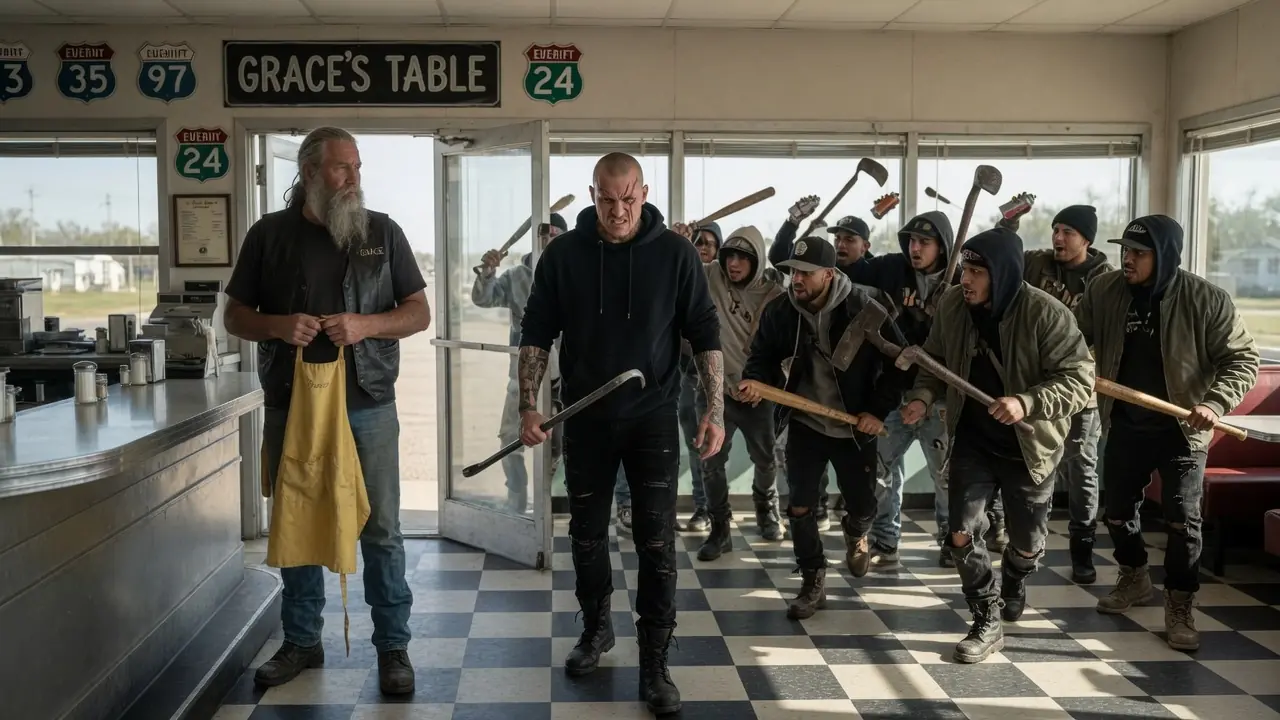
A second brick followed, then a bottle, then the hard metallic crack of a crowbar against the neon sign in the front window. The sign had been Grace’s favorite thing in the world after Jonah’s motorcycle and the battered cast-iron skillet her grandmother had carried from Mississippi to Kansas in the 1950s. It said OPEN in red and blue tubing, but the O had flickered for years, making it blink PEN, PEN, PEN, like the place was forever asking someone to write down what happened there. Now it sparked once, twice, and went dead. Outside, young voices whooped and cursed, drunk on their own power, and one of them shouted, “Old man biker should’ve sold when he had the chance.”
Jonah unfolded the apron slowly. The cotton was faded yellow, stitched with tiny blue flowers, and in the hem Grace had sewn a dime from 1978, the year her father had bought the building when it was still called Miller’s Highway Grill. She said every good place needed an old coin hidden in it, something small to remind the walls what they were worth. The dime pressed against Jonah’s thumb now, round and hard, as if Grace herself were touching him from the other side of the years. He set the apron on the prep table with care, walked through the kitchen door, and stepped into the dining room just as the front door was kicked open.
There were eleven of them, maybe twelve if he counted the boy hanging back near the curb with his hood pulled low and his hands jammed into the pouch of his sweatshirt. The others poured inside with bats, tire irons, and spray cans, all skinny elbows and cheap chains and faces still soft enough to belong at graduation parties instead of crime scenes. They had painted white skulls on the backs of their jackets, ugly little symbols made uglier by how proud they looked wearing them. Their leader was a pale young man with a shaved head, a red scar splitting one eyebrow, and a grin Jonah had seen before in men twice his age who mistook cruelty for courage. His name was Cody Bell, though the boys around him called him King.
Cody swung the crowbar into the gumball machine near the door. The glass cracked, and colored candy scattered like beads from a broken rosary. “Place smells like old grease and biker sweat,” he said, turning in a slow circle. “Hard to believe a woman died over this dump.”
Jonah stood beside the counter. He was sixty-three years old, six feet two in his boots, with a gray beard that reached the top of his chest and shoulder-length silver hair tied at the back of his neck with a leather cord Grace had made from scraps left over after sewing motorcycle patches. He wore a plain black T-shirt, faded jeans, and a worn leather vest with no club colors on it anymore, only a single stitched name over the heart: GRACE. His hands were large and scarred from thirty years of machine work and a lifetime of engines, but they hung open at his sides. The boys had expected shouting. They had expected a fight. Jonah gave them only silence, and that bothered them more than rage would have.
Cody’s grin thinned. “You deaf, old man?”
Jonah looked at the broken neon sign, then at the peppermint jar lying shattered beneath a booth, then at the table by the window where Grace had served those same boys chili and cornbread six years earlier on a night cold enough to freeze the highway ditches solid. “No,” he said. “I hear you.”
One of the younger thugs, a lanky kid with acne along his jaw and a nervous twitch in his left eye, raised a spray can and painted a crooked white skull across the wall behind the counter. It ran down over Grace’s framed photograph, the one taken the summer she reopened the restaurant after her father’s stroke. In the picture she was laughing, one hand on her hip, a smear of flour on her cheek, sunlight falling across the front window behind her. The white paint crawled over her face like sickness. Something inside Jonah tightened so hard he could barely breathe.
Cody noticed. Men like Cody always noticed the exact place to press. “That her?” he asked, nodding toward the photograph. “The dead wife?”
Jonah’s eyes returned to him. “Her name was Grace.”
“Yeah,” Cody said. “I heard she fed everybody. Even garbage.” He walked toward the counter, the crowbar loose in his hand, and leaned close enough for Jonah to smell stale beer and mint gum. “My brother said she was always handing out food to boys who didn’t pay. Guess that didn’t work out so good for her.”
The restaurant became very still. Even the younger boys stopped laughing. The boy near the door, the one with the hood, looked down at the floor. Jonah remembered another boy’s face six years ago, blue with cold, trying not to cry while Grace set bowls of stew in front of him and his friends. He remembered warning her after closing, telling her the boys were trouble, telling her they had eyes like stray dogs who had learned to bite before anyone ever taught them to trust. Grace had kissed the scar on his cheek and said, “Stray dogs bite because nobody fed them right.” Two weeks later, three of those boys came back for money. One carried a knife. Grace had reached for the register key and told them they did not have to do this. By morning, she was gone.
Jonah had spent six years turning his grief into work. He fixed the roof, paid the taxes, kept the menu exactly as Grace had written it in her looping hand, and served breakfast to truckers who still lowered their voices when they saw her picture. He never joined another club after leaving the Iron Psalm Riders, though bikers from every state still stopped by to sit in the booth she had reserved for “road-worn people with good hearts.” He never carried a weapon. He never went looking for the boys who had killed her, partly because the court had found two and lost one, and partly because Grace’s last note to him, written on the back of a supplier invoice, had asked him not to become a man she would not recognize.
Jonah reached into his pocket. Every thug in the room flinched, but he only pulled out a small black phone with cracks across the screen. His thumb paused over the contacts. He had not called the number in six years, not since the funeral when four hundred motorcycles rolled behind Grace’s hearse and the sheriff shut down two counties because there were too many engines to count. The contact had no name, only a dime emoji Grace had once added as a joke after she met the club president and decided a man that hard needed something foolish in his phone. Jonah pressed call.
Cody laughed. “Who you calling? The cops?”
Jonah listened to the ring. Once. Twice. On the third, a gravelly voice answered with no greeting, only the sound of wind and an idling motor behind it.
“It’s Jonah,” he said.
The voice went quiet. “You hurt?”
“No.” Jonah looked at the white paint sliding down Grace’s smile. “Grace’s place is.”
There was a pause so heavy it seemed to pass through the walls. Then the voice said, “How bad?”
Jonah looked at the broken glass, the crowbar, the boys, the leader who did not yet understand the size of the name he had mocked. “Bad enough.”
“Stay standing,” the voice said. “We’re already moving.”
Jonah ended the call and slid the phone back into his pocket. Cody’s grin returned, but it had less certainty in it now. “That supposed to scare me?”
“No,” Jonah said. “It’s supposed to give you fifteen minutes to decide whether you want to be remembered as stupid or sorry.”
The boys stared at him, then broke into laughter because laughter was easier than fear. Cody swung the crowbar into the pie display, and the glass exploded over lemon meringue, apple crumble, and the last slice of chocolate silk Grace had taught Jonah to make for birthdays. Someone flipped a booth table. Someone else yanked the old jukebox away from the wall and kicked the speaker until it groaned with static. Jonah stayed where he was, jaw clenched, counting his breaths the way a prison therapist had once taught him after Grace’s murder trial ended without the third boy being found.
He had never told anyone the whole truth about that trial. Not the sheriff. Not the bikers. Not even the pastor who had sat with him in the empty restaurant afterward while rain tapped the roof and Grace’s apron hung from a hook in the kitchen. The third boy had not vanished. Jonah had found him three nights later sleeping behind the restaurant dumpster with blood on his sleeve, a stolen wallet in his shoe, and a fever burning through his thin body. His name had been Eli Mercer, fifteen years old, terrified, and convinced Jonah had come to kill him. Jonah had seen the knife wound in the boy’s side, seen the panic, seen the way Grace’s name shattered him. Then Jonah had heard Grace’s voice in his memory, not as forgiveness but as instruction. Feed him first.
So he had. He had fed the boy soup, called an old medic instead of the police, and listened to Eli confess through fever and tears that he had not stabbed Grace, that he had run when Cody’s older brother pulled the knife, that he had tried to stop him and got cut for it. Jonah had wanted to hate him anyway. He had wanted it so badly his teeth hurt. But Eli had known something only Grace would have noticed: before she died, she shoved the smallest boy behind her and told him, “You are not what they made you.” Those were not the kind of words a liar invented to save himself. They were the kind of words that ruined revenge.
For six years, Jonah had hidden Eli three states away with a cousin from the old club who ran a mechanic’s shop and knew how to teach boys to rebuild engines instead of stealing them. Eli wrote letters every month at first, then every week after he got sober, then every Christmas after he turned twenty-one. Each letter came with a dime taped inside, because Jonah had told him about Grace’s hem and the coin in the apron. Jonah kept every letter in a recipe box beneath the counter. He had never opened the newest one. It had arrived that morning, postmarked Tulsa, and he had been holding Grace’s apron when the brick came through because he had finally decided to read it.
Cody climbed onto the counter and kicked the recipe box to the floor. The lid popped off. Letters spilled out like bones.
“Look at this,” he said, crouching to grab one. “Old man keeps love notes.”
Jonah moved before he could stop himself. He crossed the room in three strides and caught Cody’s wrist. Not hard enough to break it, not even hard enough to leave a mark, but enough to stop the paper from tearing. The room froze again. Cody’s eyes widened, and in them Jonah saw the sudden awareness that the old biker had been choosing stillness, not weakness.
“Put it down,” Jonah said.
Cody’s mouth twisted. “Make me.”
The crowbar came up from another boy’s hand, and Jonah took the blow across his shoulder instead of stepping back. Pain flashed white through his arm. A younger version of him would have broken the kid’s jaw without thinking. This version of him tasted blood in his mouth, held Cody’s wrist a moment longer, then released it and bent to pick up the letter himself. The room erupted in jeers. They called him coward, fossil, dead man, widow’s pet. Jonah gathered the letters one by one while they mocked him, because some things were worth protecting even when protection looked like humiliation.
The boy in the hood near the door had not moved. Jonah noticed him watching the letters with a face gone pale under the fluorescent lights. He was maybe seventeen, thin as a fence rail, with brown skin, dark curls, and a bruise fading green along one cheekbone. He looked nothing like the white skull gang around him, and everything about the way he held himself said he wanted to disappear. When Cody turned and snapped, “Luis, grab the register,” the boy flinched before obeying.
Jonah’s attention sharpened. Grace had always caught the quietest person in a room first. She said silence was where hunger hid.
Luis stepped behind the counter and pulled at the old register, but it was bolted down. His fingers shook. Jonah saw him glance at Grace’s painted photograph, then at the broken pie case, then at Cody, whose impatience was turning ugly. “It’s stuck,” Luis said.
“Then hit it,” Cody barked.
Luis lifted a small hammer from the tool belt of another boy and brought it down weakly on the side of the drawer. The register clanged but did not open. Cody jumped down from the counter and shoved him hard into the coffee station. Mugs rattled. One fell and shattered near Luis’s feet.
“You useless little charity case,” Cody hissed. “My brother should’ve left you under that bridge.”
The words hit Jonah with a cold precision. My brother. He looked at Cody’s scarred eyebrow, the shape of his mouth, the dead-eyed cruelty he had been trying not to recognize. Cody Bell was not merely some young thug who had heard an old story about Grace. He was the younger brother of Travis Bell, the man who had killed her, the man serving life two counties over after the jury saw the security footage and Grace’s blood on his jacket. Cody had been thirteen then, small enough to be kept out of the reports, old enough to remember. Now he had come not by accident, not for money, but for inheritance of hatred.
Outside, far down the highway, an engine sounded. Then another. Then a low tremor that did not belong to any one vehicle.
Cody heard it too. He turned toward the broken windows. “What is that?”
Jonah did not answer. He picked up the final letter and slipped it into the recipe box. His shoulder throbbed. Blood from a cut near his temple slid into his beard, warm and sticky, but he barely felt it. The tremor grew, rolling beneath the floorboards, rattling the forks in their bins and the broken neon tubes in the window. It came from the east first, then the west, then from the frontage road behind the restaurant, a layered thunder of engines gathering from every direction until the air itself seemed to pulse.
The boys stopped laughing. One of them whispered, “No way.”
Cody stepped outside, and Jonah followed him to the doorway. The parking lot of Grace’s Table sat beside a two-lane Kansas highway that ran through wheat fields and small towns with water towers painted in fading school colors. On most days, it held ten cars if breakfast was good and fifteen if the Friday fish special sold out. Now motorcycles were arriving in waves, headlights bright in the afternoon haze, chrome flashing, engines snarling and settling into a rhythm so deep it made the broken glass tremble. Harleys lined the shoulder, filled the lot, spilled onto the gravel access road, and kept coming until the highway patrol blocked traffic half a mile in each direction.
Jonah had expected the Iron Psalm Riders. He had expected maybe fifty, maybe a hundred if word traveled fast. He had not expected thousands. They came in black vests and denim jackets, with gray beards and young faces, veterans and mechanics, nurses and truckers, mothers with braids beneath their helmets, fathers with wedding rings taped under gloves, men and women carrying road dust from Colorado, Oklahoma, Nebraska, Missouri, Texas, and places farther than Jonah could understand in fifteen minutes. Some wore club patches he knew. Some wore patches he had only heard of in old arguments over coffee. Some wore no patches at all. Every one of them rolled in and shut off their engine with a discipline so complete that the final silence felt larger than the sound.
Cody’s face emptied. “You called a club?”
A woman stepped from the front row of bikes. She was in her late fifties, tall, Black, broad-shouldered, with silver locs pulled back under a helmet and a black leather vest marked with the Iron Psalm Riders crest. Her name was Marlene “Mama Rev” Doucet, and she had once ridden through a hailstorm to bring Grace insulin for a diabetic trucker stranded in the restaurant during a blizzard. Behind her came Bear, the old president whose voice had answered Jonah’s phone, walking with a cane but still built like a courthouse. Beside him was a young man Jonah did not recognize at first because memory kept him fifteen, feverish, and shaking behind a dumpster.
Eli Mercer was twenty-one now. He wore a mechanic’s shirt beneath his vest, his hair tied back, his face leaner and older than it should have been. A small scar cut the line of his jaw. He looked at Jonah, then at the broken windows, then at Grace’s photograph smeared white on the wall, and pain crossed him so openly that Jonah had to look away.
Cody noticed Eli and stared. “No,” he said. “No, you don’t get to stand with them.”
Eli stepped forward. “I get to stand where Grace told me I could.”
The crowd behind him did not move, but the words carried. Cody’s boys began backing toward the side lot. Everywhere they turned, bikers stood shoulder to shoulder, not attacking, not yelling, simply present. The pressure of that presence was more frightening than violence. It gave the young men nowhere to pretend they were kings.
Bear stopped beside Jonah and looked him over. “You should’ve called sooner.”
Jonah swallowed. “I didn’t want to bring war to her door.”
Mama Rev looked past him into the wrecked restaurant. “Baby, war already came. We brought witnesses.”
Sirens rose in the distance, thin at first, then closer. Cody seized on the sound like a drowning man grabbing a branch. “Good,” he said loudly. “Cops can see this illegal blockade. See all these gang freaks threatening minors.”
Jonah turned to him. “You brought crowbars into my wife’s restaurant.”
“My boys were just messing around,” Cody snapped. “You bikers surrounded us.”
“Thousands of phones are recording,” Mama Rev said. She lifted her own, screen facing him. “Smile pretty.”
Cody’s confidence flickered, but hatred rushed in to replace it. He pointed at Eli. “Ask him what happened to your wife. Ask him why he ran. He was there.”
The words cut through the parking lot. A murmur passed among the bikers. Jonah felt Eli go still beside him. This was the secret Jonah had kept, the wound he had covered with silence and good intentions. He had told himself protecting Eli honored Grace. He had also used that protection to avoid standing in front of the world and saying he had chosen mercy when everyone expected vengeance. Now Cody had dragged the secret into daylight with broken glass underfoot and Grace’s ruined sign above them.
Eli’s voice shook. “I was there.”
Cody smiled, cruel and triumphant. “Say it louder.”
Eli looked at Jonah, not asking permission, only checking whether the truth would destroy him. Jonah thought of Grace’s last note. Do not become a man I would not recognize. He thought of the dime in her apron, the letters in the recipe box, the boy she had pushed behind her while a knife flashed. He nodded once.
“I was fifteen,” Eli said to the crowd. “I was hungry. Travis Bell brought us here because he knew Mrs. Grace fed kids after closing. He said we were going to scare her into giving cash. I thought that meant yelling. Maybe breaking something. I was stupid enough to think there were rules in a robbery.” He stopped, breath catching. “When Travis pulled the knife, she stepped in front of me. Not behind the counter. In front of me. She told him to take the money and leave us boys alone.”
Cody shouted, “Liar.”
Eli did not look at him. “I tried to grab Travis’s arm. He cut me and knocked me down. Mrs. Grace hit the alarm. Travis stabbed her because he panicked and because he was a coward. I ran because I was a coward too.” His hands trembled, but he kept speaking. “Mr. Jonah found me three nights later. He could’ve turned me in. He could’ve killed me and half the county would’ve bought him dinner for it. Instead he fed me soup because his wife had asked him, without knowing it, to save what was left of me.”
The sirens arrived then. Sheriff Lena Ortiz stepped out of the first cruiser with two deputies behind her, one hand resting near her belt and her eyes already taking in the broken windows, the spray paint, the crowbars, the thousands of bikers, and Jonah’s bleeding temple. She was forty-six, sharp-eyed, and too honest for most town council meetings. Six years ago, she had been the detective who sat with Jonah after Grace died and told him the case would not feel like justice even if they won. Now she looked at Cody Bell and did not bother hiding her disgust.
“Hands where I can see them,” she called.
Cody lifted his hands slowly, but his mouth kept working. “You see this? They trapped us here. That old biker called an army.”
Lena glanced at Mama Rev’s phone, then at the security camera above the diner door, then at the white skulls spray-painted across the wall inside. “Cody, I’ve known you since you were stealing cigarettes behind the bowling alley. Don’t insult my afternoon.”
The deputies began separating the young men. Some surrendered immediately. Others tried to talk, blame, bargain, or cry. Luis stood near the register with his hands up and tears running down his face. When a deputy moved toward him, he whispered, “I didn’t want to. I didn’t know they were going to break everything.”
Cody twisted around. “Shut your mouth.”
Jonah stepped between Cody and the boy before anyone else could. It was not a grand movement. It was just one old man, injured and tired, placing his body in the path of a younger man’s threat. But something changed in the faces watching. Grace had stepped in front of Eli six years ago. Jonah stepped in front of Luis now. The past did not vanish, but it bent, just slightly, toward a different ending.
Lena saw it. So did Eli. So did Mama Rev, whose eyes softened for half a second before hardening again.
Cody laughed once, bitter and wild. “There it is. The widow’s curse. Feed every stray until one bites your throat out.”
Jonah looked at him with a sadness that surprised them both. “Your brother killed my wife. You came here hoping I’d become him.”
Cody’s laugh stopped.
“I won’t,” Jonah said.
For the first time that day, Cody had no answer. The deputies cuffed him in the wide silence of thousands of witnesses. As they led him toward the cruiser, he turned his head and spat on the gravel near Jonah’s boots. A younger Jonah would have made him regret even that. The man Grace had left behind simply watched him go, then bent and picked up the dime that had fallen from the apron hem when he carried it outside without realizing. It lay half-buried in dust and shattered safety glass, tiny and bright.
Eli came to his side. “I’m sorry,” he said.
Jonah closed his fist around the dime. “You’ve said that in every letter.”
“Not here.” Eli’s voice broke. “Not standing where it happened.”
Jonah looked through the broken doorway into the restaurant. The place was ruined. The pie case was gone. The wall was defaced. The neon sign was dead, and the smell of spray paint drowned the old comfort of coffee and fried onions. Yet beneath it all, he could still smell Grace’s cinnamon in the wood, still hear her laugh in the clatter of plates, still feel the way she had turned a roadside diner into a harbor for people who did not know they were drowning.
“I read your letter this morning,” Jonah lied.
Eli gave a wet laugh. “No, you didn’t.”
Jonah almost smiled. “No, I didn’t.”
“I asked if I could come home,” Eli said quietly. “Not to live off you. To work. To fix what I can.”
Jonah’s first instinct was fear. Not anger, not anymore, but fear of reopening a room in his heart he had kept locked because some griefs were easier to polish from a distance than to sit beside at breakfast. Eli was not his son. Grace was not coming back. Mercy did not erase consequence, and rebuilding a restaurant did not raise the dead. But Grace had believed a table could be a beginning. She had believed that food placed in front of the right person at the right time could interrupt a curse.
Behind them, Bear raised his voice. “All right, listen up.”
Thousands of bikers turned toward him. Bear leaned on his cane and pointed at the wrecked restaurant. “This place fed us when banks wouldn’t cash our checks, when motels wouldn’t rent us rooms, when some of us were one bad night from sleeping in ditches. Grace Vale never asked what patch you wore before she poured coffee. Today her house got hurt. We don’t leave until it’s whole.”
A roar rose from the crowd, not of engines but of human voices, rough and deep and full of promise. Someone opened a trailer and began unloading plywood. Someone else brought toolboxes. A woman from Nebraska who owned a glass company started measuring windows before Lena finished taking statements. Men with tattoos carried broken booth tables outside. A retired electrician knelt under the neon sign and whistled through his teeth. A nurse cleaned Jonah’s cut while scolding him for pretending head wounds were decorative.
By sunset, Grace’s Table looked less like a crime scene and more like the first day after a storm. Plywood covered the windows, but bikers had signed it with names and hometowns until it resembled a guest book. The spray paint over Grace’s photograph was carefully removed by a quiet man with a restoration kit he kept in his saddlebag for reasons nobody questioned. The recipe box sat behind the counter again, dented but intact. Luis, released into temporary protective custody after telling Lena everything he knew about Cody’s extortion ring, sat in the back booth with a blanket around his shoulders and a bowl of soup in front of him.
Jonah made the soup himself. Tomato basil, Grace’s recipe, extra pepper because she said sadness needed spice. He set it down without a word, and Luis stared at it like it might accuse him.
“I don’t deserve this,” the boy whispered.
Jonah was so tired his bones felt hollow. “Probably not.”
Luis flinched.
Jonah slid a spoon beside the bowl. “Eat anyway.”
Across the room, Eli watched from beside the broken pie case. The look on his face was unbearable because Jonah recognized it. It was the face of someone seeing his own life from the outside, seeing the mercy that had saved him offered to another boy and realizing mercy was not a debt you repaid once. It was a road you stayed on until your feet gave out.
When the last statement was signed and the last cruiser pulled away, Bear found Jonah in the kitchen washing blood from his hands. “You know there are more riders coming tomorrow,” he said.
Jonah dried his hands on a towel. “There’s no room.”
Bear snorted. “Never stopped us.”
“They shouldn’t have to fix my mess.”
Bear’s expression changed. He looked older suddenly, not weaker, just more honest about the weight he carried. “Grace wasn’t your mess. What happened to her wasn’t your shame. And that place out there was never only yours, brother. She made sure of that.”
Jonah looked toward the hook where her apron usually hung. It was gone. Panic moved through him before he saw it folded on the prep table, the dime-sized tear in the hem visible where the coin had slipped free. He picked it up and ran his thumb over the stitches Grace had made. He had spent six years keeping everything the way she left it because change felt like betrayal. But the restaurant had changed anyway. Boys had grown into men. Wounds had grown into choices. Mercy had grown teeth and boundaries and a crowd of motorcycles large enough to shake the highway.
Eli entered the kitchen and stopped at the doorway. “I can sew that,” he said.
Jonah looked up.
Eli rubbed the back of his neck. “Shop owner’s wife taught me. I’m not good, but I can keep a dime in a hem.”
Jonah handed him the apron before he could think himself out of it. Eli took it with both hands, reverent as a flag. For a long moment neither of them spoke. Then Jonah opened the recipe box, pulled out the newest letter, and set it on the table between them.
“You can read it to me,” Jonah said.
Eli’s eyes filled. He sat at the little kitchen table where Grace used to do invoices and unfolded the letter with shaking fingers. His voice was rough at first, then steadier. He read about Tulsa, about the mechanic’s shop, about three years sober, about a kid named Mateo he had stopped from stealing a customer’s bike by buying him a sandwich and making him sweep floors until the hunger left his hands. He read the last line twice because the first time it broke apart in his mouth. If Grace’s Table ever needs hands, I have two, and I owe them both to her.
Jonah sat across from him and listened. Outside, thousands of bikers worked under portable lights, hammering, sweeping, lifting, laughing softly, telling Grace stories to people who had never met her. Someone found the old radio under the counter and coaxed it back to life. Static crackled, then a song Grace used to hum while rolling biscuit dough drifted through the ruined dining room. Jonah closed his eyes. For the first time in six years, the sound did not cut him open. It entered, found the empty places, and sat down gently.
The next morning, Grace’s Table did not open at six. It opened at noon because nobody had slept and because the county health inspector, who had once proposed to Grace in high school and been turned down with a slice of peach pie, insisted on checking every surface twice. By noon, the front windows were temporary but clean, the broken booths replaced by folding tables, and the dead neon sign had been taken down for repair. In its place, Mama Rev hung a hand-painted board that said STILL OPEN in blue letters with a red dime for the O. Jonah pretended not to cry when he saw it. Nobody believed him.
The first customer was Sheriff Lena Ortiz, who ordered black coffee and toast because she claimed sentiment gave her indigestion. The second was a trucker from Wichita who had eaten Grace’s meatloaf every Thursday for twenty years and brought a box of plates from his late mother’s kitchen. The third was Luis, escorted by a social worker, asking if he could wash dishes after school until the damage he caused was paid back. Jonah almost said no because responsibility mattered. Then he looked at Eli behind the grill, wearing one of Grace’s spare aprons with the dime sewn back into the hem, and understood that no could sometimes be fear dressed as wisdom.
“You can wash,” Jonah told Luis. “You break anything, you learn to fix it.”
Luis nodded like he had been handed a sentence and a blessing at the same time.
News crews came by three o’clock. Jonah refused interviews until a local reporter asked what made thousands of bikers appear for one roadside restaurant in fifteen minutes. He looked past her camera at the parking lot, where Harleys still filled every available inch and riders ate pie from paper plates on tailgates, curbs, and the hoods of trucks. He thought of Grace feeding hungry boys. He thought of Travis Bell choosing violence, Eli choosing confession, Cody choosing hate, Luis standing at the edge of a different road. He thought of the dime hidden in an apron so the walls would remember what they were worth.
“My wife built a table bigger than this building,” he said finally. “Yesterday people came to protect it.”
The reporter waited for more, but Jonah was done. He had never trusted speeches. Grace had believed in actions that smelled like coffee and soup, in forgiveness that did not excuse harm, in doors that opened with rules strong enough to keep people safe. That evening, after the cameras left and the last riders began heading home in waves of rolling thunder, Jonah stood under the repaired frame where the neon sign would return and watched Eli show Luis how to stack clean plates without chipping them.
Mama Rev came to stand beside him. “You know what we raised today?”
Jonah sighed. “Please tell me it’s not bail money for somebody.”
She laughed. “A restoration fund. Enough to fix the windows, replace the booths, upgrade the kitchen, and put in that community pantry Grace always wanted.”
Jonah turned. “She told you about that?”
“Baby, Grace told everybody about that. You were just the only one pretending not to hear.” Mama Rev pulled an envelope from her vest and handed it to him. Inside was a check large enough to make his vision blur. Written in the memo line were five words: For the strays fed right.
Jonah sat down hard on the nearest chair. For a moment, grief and gratitude tangled so tightly he could not separate them. The restaurant around him was noisy with repair, with dishes, with tired laughter, with the small clatter of life insisting on continuing. Grace was not there. Grace would never again lean through the kitchen window and call him handsome when he burned pancakes. But her kindness had not died with her. It had traveled into letters, engines, soup bowls, patched jackets, and boys who might yet become men worth knowing.
Months later, when the new sign went up, it did not say Grace’s Table anymore. Jonah had argued against changing it until Eli quietly showed him the sketch Grace had drawn years earlier on the back of a napkin, the one he had found tucked inside an old recipe book while repairing the pantry shelves. In Grace’s looping hand, beneath a drawing of a bigger dining room with a free pantry and a row of motorcycle helmets on hooks, she had written a name Jonah had never seen: Grace’s Roadhouse Table. Under it was a line that made him sit down before his knees gave way. For anyone who still needs a way home.
So that became the name. The repaired neon glowed blue and red over the highway, and the O in Roadhouse was shaped like a dime. The community pantry opened every Friday evening, stocked by bikers, farmers, church ladies, truckers, and people who had once eaten there for free and returned years later with grocery bags in both hands. Luis washed dishes until he learned the grill, then the books, then how to look customers in the eye without expecting to be struck. Eli became manager by accident, which was how Jonah described the slow process of trusting him with keys, suppliers, and eventually the cast-iron skillet Grace loved most.
On the first anniversary of the vandalism, motorcycles came again, not thousands this time, but enough to fill the lot and line the shoulder beneath the summer sky. There were speeches despite Jonah’s objections, and a plaque near the pantry door with Grace’s photograph restored and framed in oak. It told the truth without turning it into legend: Grace Vale, who fed the hungry, protected the vulnerable, and believed no one should be judged by the worst road they had taken. Beneath the plaque hung her yellow apron, sealed behind glass, with the 1978 dime visible in the hem. Children liked to press their fingers to the glass and ask why a coin was there.
Jonah always gave them the same answer. “So the walls remember what they’re worth.”
Late that night, after the last bike rolled away and the highway settled into cricket song and passing tires, Jonah found Eli and Luis in the dining room stacking chairs. Eli was telling Luis how Grace used to put extra cornbread in takeout bags and pretend she had miscounted. Luis laughed, a real laugh this time, not the nervous sound of a boy waiting for punishment. Jonah stood in the doorway and watched them under the clean light, two young men on opposite sides of a story that could have ended in blood but had somehow ended with soup, work, and a key hanging by the register.
He stepped outside alone and sat on the bench beside the front door. The night smelled of rain on hot pavement, coffee grounds cooling in the trash, and the faint gasoline scent left behind by a hundred departing motorcycles. In his pocket was the dime Mama Rev had found in the gravel that day, polished now by Jonah’s thumb until it shone. He rolled it over his knuckles and looked up at the glowing sign, at Grace’s name, at the road stretching black and silver beneath the stars.
“I didn’t become him,” he said softly.
The wind moved through the wheat beyond the highway. Somewhere inside, the radio crackled and found Grace’s song again, the one about coming home by morning. Jonah closed his fist around the dime and felt, not peace exactly, but something close enough to let him breathe. The restaurant behind him was no longer a shrine to what he had lost. It was a promise still being kept, one plate, one boy, one broken traveler at a time.