Walter Reed had spent most of his life being underestimated from above.
At five-foot-five, that happened naturally.
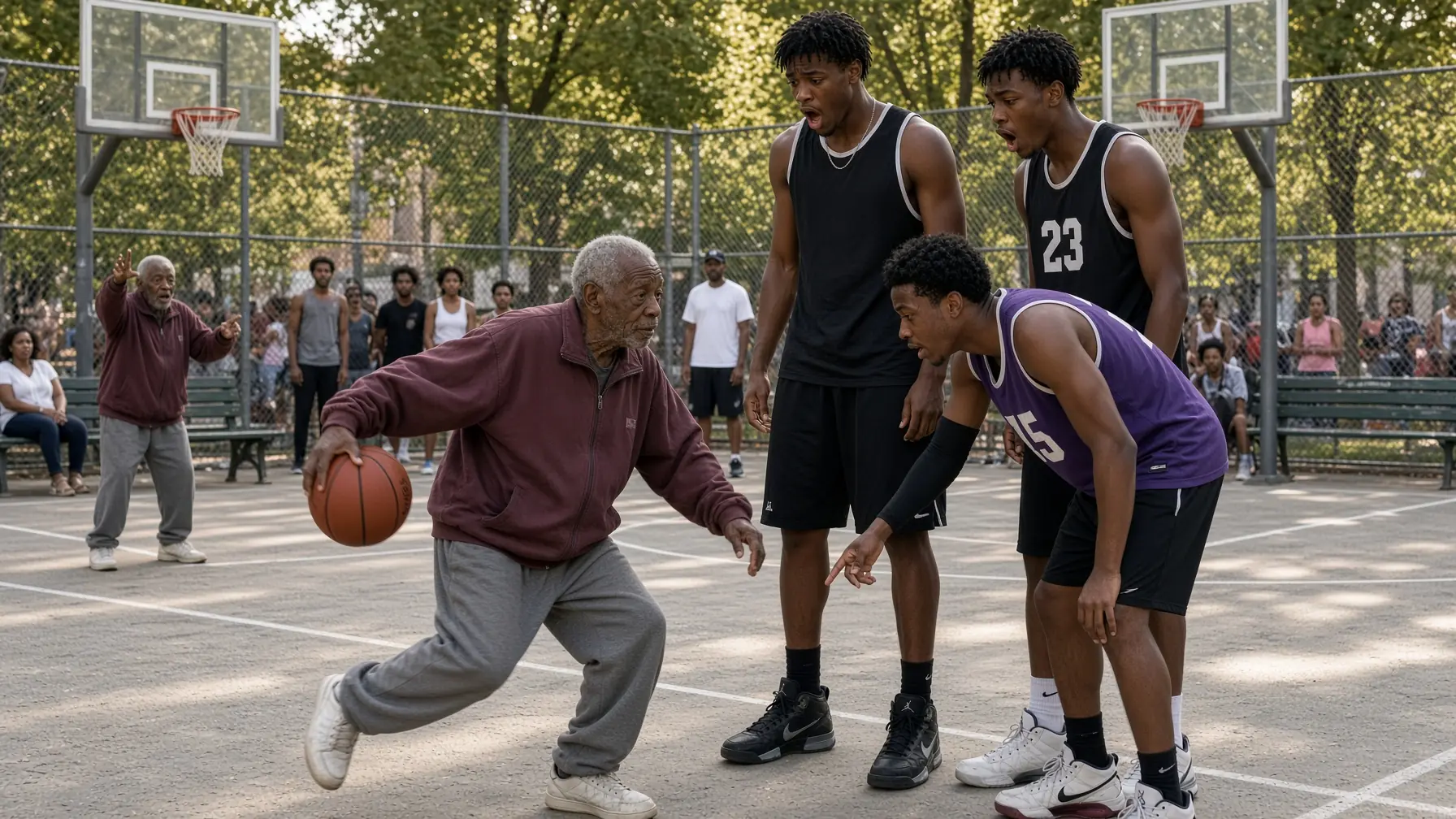
It happened when he was sixteen and trying to make the varsity basketball team.
It happened when he was twenty-three and walking onto outdoor courts where everyone else looked built for a different sport.
And it was happening again at seventy-four, except now the people looking down at him had another reason to laugh.
The cane.
Walter stood beside the concrete sideline of Franklin Park in Baltimore on a bright Saturday afternoon, one thin hand wrapped around the polished wooden handle.
He looked small even when nobody was standing near him.
Beside Marcus Hill, he looked almost fragile.
Marcus was twenty-one, six-foot-five, broad across the shoulders, with muscular arms exposed beneath a sleeveless black jersey. He wore expensive high-top sneakers, a silver chain, and the relaxed grin of someone accustomed to being the biggest personality on whatever court he entered.
Two friends stood beside him.
Darius Coleman, twenty-two, six-foot-four.
Andre Lewis, twenty, closer to six-six.
All three looked as though they had been assembled specifically to make Walter appear smaller.
Marcus held the basketball above Walter’s head with one hand.
Not high enough to be accidental.
High enough to make a point.
Walter looked up at the ball.
Then at Marcus.
Marcus smiled.
“Careful, Grandpa. That ball might weigh more than you.”
Darius bent over laughing.
Andre pointed toward Walter’s worn white basketball shoes.
“Somebody get him a chair before he falls over.”
Walter said nothing.
Around them, the park remained loud.
Two half-court games were running simultaneously.
Sneakers squeaked against concrete.
A portable speaker near the fence played bass-heavy music.
Kids chased a loose ball near the benches.
A few older men sat beneath the trees arguing about whether modern basketball had become too soft.
Nobody paid much attention to Walter yet.
Marcus lowered the ball slightly.
Then raised it again before Walter could touch it.
“Come on, old man.”
Walter’s eyes stayed on him.
“You boys finished?”
Marcus laughed.
“Finished?”
He looked toward his friends.
“He wants the ball.”
Darius grinned.
“Give it to him.”
“Nah,” Marcus said. “I don’t want a lawsuit when he falls.”
Walter shifted the cane from one hand to the other.
Marcus finally dropped the basketball toward him.
Not gently.
More like someone tossing a toy to a child.
Walter caught it cleanly with both hands.
The laughter continued for another second.
Then Walter looked down at the ball.
Something changed.
It was small.
Almost invisible.
His shoulders straightened.
The slight stoop disappeared.
His fingers spread across the leather.
And before Marcus could make another joke, Walter bounced the ball once.
Low.
Hard.
The second dribble crossed beneath his left leg.
The third snapped behind his back.
Then came a crossover so quick Marcus’s eyes moved in the wrong direction.
Walter never looked down.
Left hand.
Right.
Between the legs again.
Behind the back.
Low enough that the ball barely rose above his knees.
Fast enough that Darius stopped laughing halfway through a breath.
Walter shifted the ball around his body.
One hand guided it behind his waist.
The other received it without looking.
He brought it forward, rolled it across one shoulder, caught it behind his back, and resumed the dribble as if the interruption had never occurred.
Andre’s mouth opened slightly.
Marcus’s grin disappeared.
Walter stopped the ball beneath his palm.
Then spun it onto one finger.
Perfectly centered.
The basketball rotated above his hand.
Walter looked at Marcus.
“You wanted it back?”
Nobody answered.
Near the park bench, an older man in a faded Orioles cap stood up so quickly that the newspaper on his lap fell to the ground.
He stared at Walter.
Then whispered:
“No way.”
Walter heard him.
His expression tightened slightly.
Marcus glanced toward the man.
“What?”
The older spectator stepped closer.
“You seriously don’t know Walter Reed?”
Marcus looked from him to the little old man with the basketball spinning above one bony finger.
“No.”
The spectator laughed once.
Not because it was funny.
Because he could not believe what he was seeing.
“Oh, boy.”
Walter stopped the ball.
“Frank.”
The spectator grinned.
“Been about thirty years and that's all I get?”
Walter sighed.
“I was hoping nobody recognized me.”
Marcus frowned.
“Recognized you from what?”
Walter bounced the ball once.
Then handed it back.
“You’ve got a game.”
He reached for his cane.
Marcus did not take the ball.
“Hold up.”
Walter looked at him.
“Who are you?”
The older spectator answered before Walter could.
“Ask your father.”
Walter Reed had not come to Franklin Park to play basketball.
That was important.
His daughter had asked him three times before he left the house.
“You’re not playing, right?”
Walter had been tying his old white sneakers.
“No.”
“Dad.”
“No.”
“Promise.”
Walter looked up.
“I’m seventy-four.”
“That has never prevented you from making bad decisions.”
Walter smiled.
“That is an unfairly accurate statement.”
His daughter Denise crossed her arms.
“You had knee surgery.”
“Nine years ago.”
“Your back hurts.”
“Everybody’s back hurts.”
“You use a cane.”
“For distance.”
“You are going to a basketball court.”
“To watch.”
Denise stared at him.
Walter tied the second shoe.
“Your mother used to make the same face.”
“That’s because Mom understood you.”
Walter looked toward the framed photograph on the dresser.
Lillian Reed had been gone six years.
He still spoke about her in the present tense sometimes.
Not because he forgot.
Because forty-seven years of marriage did not disappear cleanly from grammar.
“I’m watching,” Walter repeated.
Denise pointed at him.
“If I see you on somebody’s video trying to dunk—”
Walter laughed.
“I couldn't dunk when I was twenty.”
“That isn’t comforting.”
He picked up his cane.
Franklin Park was holding a neighborhood basketball fundraiser that afternoon.
A local nonprofit wanted to rebuild two badly damaged courts on the east side.
Walter had donated quietly.
He had also been asked to attend.
He almost declined.
Then he learned the event was honoring Coach Henry Lawson.
That changed things.
Henry had coached generations of Baltimore kids.
Including Walter.
So Walter went.
He arrived early.
Too early.
The formal event had not started.
The organizers were still unfolding tables near the recreation center.
Walter decided to walk toward the courts.
That was when Marcus Hill noticed him.
Franklin Park had always produced two kinds of basketball players.
The ones who wanted to win.
And the ones who wanted everyone watching to know they were winning.
Marcus belonged to the second group.
He was good.
Very good by neighborhood standards.
Strong first step.
Excellent vertical leap.
Quick hands.
A jump shot that became dangerous when he stopped admiring it.
He played for a junior college two counties away and dreamed of transferring to a Division I program.
Walter watched him for six minutes before Marcus approached.
Six minutes was enough.
Marcus had talent.
He also wasted motion.
He dribbled high.
Crossed over three times when one would work.
Looked at the crowd after every made shot.
And whenever someone smaller guarded him, Marcus immediately tried to embarrass them instead of simply scoring.
Walter had seen players like that for sixty years.
Athletic enough to dominate until the game introduced someone smarter.
He said none of this.
Marcus said enough for both of them.