The semi had been stuck in Elden Croft’s north field since Tuesday afternoon, sunk so deep into the wet harvest ground that its rear axles looked swallowed by the earth. It was no ordinary truck, but a fully loaded grain semi weighing close to 80,000 pounds, sitting at an ugly angle with mud packed around the tires like hardened hands refusing to let go. By Thursday morning, three machines had tried to pull it free, and three machines had failed in front of twelve tired men. The only thing that had moved in that field was the mud, and it had moved downward.
The first crew had brought in a massive John Deere tractor with more horsepower than Elden’s old barn had ever seen in its life. The operator had hooked a heavy chain to the truck frame, eased forward once, then lost patience and gave it throttle. The tires spun almost immediately, cutting two new trenches into the soft ground and spraying wet clay across the field. By the time the engine was killed, the tractor had not pulled the truck free; it had only made the field worse.
The second crew arrived with a wrecker big enough to make the younger workers whistle under their breath. Its operator dropped the outriggers, ran the cable, and promised Garrett Doyle the semi would be out before lunch. But when the winch tightened, the wrecker’s steel pads slid straight down into the mud instead of holding firm. The rear end lifted, the machine tilted, and the operator cut power with a curse before the wrecker became the next thing needing rescue.
The third attempt came with a bulldozer, brought in after Garrett Doyle made two angry phone calls to Cresthaven Energy’s regional office. The bulldozer operator studied the ruts, the angle, and the soaked ground on both sides of the semi. He refused to pull. He told Garrett that if they chained his machine to that truck and dragged straight back, they might bury both of them, and he was not losing a dozer because some executive could not wait for dry weather.
Garrett Doyle did not like being told no, especially in front of workers wearing muddy boots and tired expressions. He stood beside the semi in a pressed jacket that had no business in a harvest field, gripping a leather folder beneath one arm as though paperwork could command the ground to behave. He had come to Elden Croft’s farm representing Cresthaven Energy, and he carried himself like a man used to doors opening before he knocked. The problem was that fields had no doors, and this one had already shut itself around his truck.
The truck should not have been there in the first place. Two days earlier, Cresthaven’s survey crew had cut across Elden’s north field without asking permission, staking out a pipeline corridor as if lines drawn on an office map were stronger than fence posts in the ground. The semi had followed the survey truck across wet soil that every farmer in the county knew to avoid after a hard rain. The driver had tried to push through when the back wheels started sinking, and that single mistake had seated the load deeper than any storm could have done alone.
That same evening, Elden found a white envelope taped to his front gate. It was crisp, clean, and insulting in the way legal paper often is when it expects to frighten someone. The letter inside informed him that Cresthaven Energy held historic corridor rights across his property and intended to begin pipeline development before winter. It gave him ten days to sign a new access agreement, and it warned that if he refused, the company would pursue alternative acquisition methods.
Elden read the letter twice beside the gate, standing beneath a sky still heavy from rain. He did not curse, shout, or call anyone that night. He folded the paper along its original creases and placed it in his shirt pocket. Then he walked back to the barn and finished cleaning mud from the water trough, because cattle did not care what an energy company believed it owned.
Elden Croft was seventy-four years old, with hands bent by six decades of work and shoulders that had learned long ago not to waste motion. His father had farmed that ground before him, and his grandfather had cleared the first acres with a team and a stone boat. Elden knew every old lane, every low place, every tile line that still worked, and every ditch that failed if the rain came from the west. He did not think of the farm as acreage; he thought of it as memory with roots.
On Thursday morning, when Elden drove up to the stuck semi, he came pulling his 1948 Farmall H behind a soft coughing engine that sounded too small for the problem waiting in the field. The old tractor’s red paint had faded to rust in places, and its tires looked like they belonged to another century. One of the younger workers laughed before he could stop himself. Garrett’s mouth did not laugh, but his eyes did.
Elden climbed down slowly and walked toward the truck without acknowledging either man. He looked at the semi, then at the ruts, then at the disturbed strips where the failed machines had carved fresh wounds into the field. Garrett straightened his jacket and stepped forward as though he were greeting a minor inconvenience. “You the neighbor with the tractor?” he asked.
Elden did not answer the question. He crouched at the edge of the rut, picked up a handful of mud, and let it fall from his fingers. Then he looked toward the truck driver, who sat in the cab with both hands on the wheel and defeat written across his face. “Which direction did it drive in from?” Elden asked.
No one answered right away. The crew chief looked around, and Garrett glanced at his folder as if the field’s memory might be listed inside a company report. Finally, one of the workers pointed toward the north edge of the field, where a faint track cut through the weeds before disappearing into the deeper ruts. Elden nodded once. It was the kind of nod a man gives when the ground has confirmed what his eyes already knew.
Garrett shifted his weight. “We have already used proper towing procedure,” he said, his voice smooth but sharp beneath the polish. “This is an 80,000-pound load, Mr. Croft. That old machine is not going to do what industrial equipment couldn’t.” Elden looked at Garrett for the first time, not angry, not impressed, only measuring him the way he had measured the mud. “Industrial equipment failed because nobody read the ground,” he said.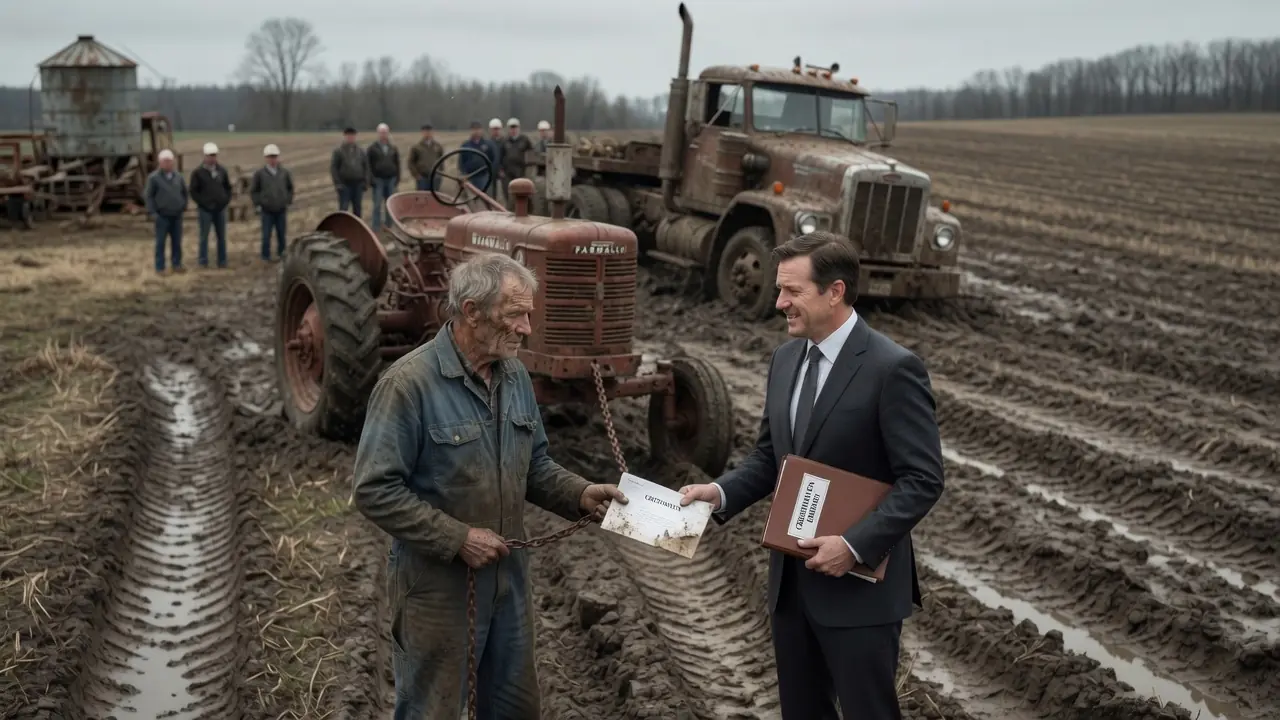
A few workers looked down. Garrett’s jaw tightened, but Elden had already turned away. He walked back to the Farmall and lifted the chain from its mount, checking each link with his thumb as if greeting an old friend. He did not hurry, because hurry had already ruined enough of the field. Garrett watched with folded arms, wearing the expression of a man waiting for foolishness to finish embarrassing itself.
Elden backed the Farmall not into the ruts, but onto a narrow strip of ground fifty feet off to the side. To most of the crew, that strip looked no different from the rest of the muddy field. Elden knew better. Beneath one inch of soil lay an old limestone farm lane his grandfather had laid down when wagons still hauled grain to the county road, forgotten by everyone except the man whose boots had crossed it since boyhood.
He did not hook the chain where the others had hooked it. Instead, he crawled beneath the lower frame of the trailer, working slowly on his knees while the mud soaked into his coveralls. One young worker stepped forward to help, then stopped when Elden raised one hand without looking back. The old farmer fastened the chain low and off-center, then came out from under the trailer with mud on his sleeves and calm in his eyes.
Garrett gave a short breath that was almost a laugh. “You’re pulling from the wrong angle.” Elden climbed onto the Farmall seat and settled his hand on the gear lever. “That’s what makes it right.” Garrett’s face cooled, and he stepped closer to the tractor. “You are delaying company work on our corridor.”
Elden turned the key, and the Farmall caught on the second try, its four-cylinder engine settling into a steady, stubborn rhythm. “Your corridor sank the moment it trespassed my field,” he said. The words were not loud, but every man close enough to hear them went still. Garrett’s fingers tightened around the legal folder until the leather bent at the corners.
Elden eased the tractor forward just enough to take slack out of the chain. The chain tightened, sang once, and held. Nothing moved. Garrett’s mouth began to form a smile again, as if the field were proving his point.
Then Elden backed the Farmall half a breath, eased forward again, and stopped before the tires spun. Forward, back, forward, back. Not a pull, not yet, but a rhythm. He was not trying to overpower the mud; he was making it release its grip one inch at a time.
The first minute passed with no visible change. The second minute brought a faint wet sound from beneath the rear axle. Elden kept the rhythm exactly the same, patient as rain gathering on a roof edge. The Farmall’s tires bit into the hidden limestone strip, never spinning, never wasting strength, while the chain worked at an angle against the suction around the buried tires.
Garrett stepped forward, anger rising now because the old tractor had not failed quickly enough to satisfy him. “You are going to damage that truck,” he snapped. Elden did not look at him. “Your men already damaged my field.” Garrett’s face flushed. “Cresthaven has legal rights here.”
Elden eased the tractor forward again, and this time the nearest rear tire lifted with a loud sucking tear that made every worker turn toward the semi. Mud broke loose around the axle in a heavy wet slump. The truck rose a few inches, not free yet, but alive for the first time in two days. Garrett’s confident expression vanished so completely it was as if someone had wiped it from his face.
Elden backed again, then pulled, slow and angled. The second axle shifted, the trailer groaned, and the driver in the cab looked out the window with wide eyes. “Easy,” Elden called, finally raising his voice. “When she lifts, don’t punch it. Let her breathe.”
The driver nodded like a boy receiving instruction from his grandfather. Elden worked the Farmall once more, forward and back, and the semi gave another deep, ugly groan as the mud released it. Then the tires touched firmer ground beneath the surface and found just enough bite to help themselves. The driver eased the semi forward, not fast, not hard, and the giant truck rolled out of the rut onto higher ground.
For a moment, nobody spoke. Twelve men who had spent two days watching expensive machines fail stood in the mud while an old tractor idled on a forgotten strip of gravel. The Farmall looked smaller than ever beside the freed semi, yet every eye in the field rested on it as though it had become something close to myth. Elden shut off the engine and climbed down without ceremony.
Garrett stood frozen with his phone in one hand and his legal folder in the other. Elden unhooked the chain, coiled it carefully, and hung it back on the Farmall mount. Only after the chain was settled did he walk toward Garrett. The old farmer reached into his shirt pocket and pulled out the white Cresthaven letter.
Garrett’s face tightened. “That agreement is standard procedure,” he said quickly. Elden held the letter between them, still folded along the creases from the front gate. “This is the second thing you buried on my farm,” he said. Garrett’s eyes flicked toward the workers, embarrassed by the audience even though Elden’s voice remained quiet. “And it will come out just like the truck.”
That evening, after the Cresthaven crew limped their semi back toward the county road, Elden walked to the equipment shed behind his house. The sky was turning pale over the fields, and the Farmall sat in the yard with fresh mud on its tires. Elden did not wash it yet. Some mud was worth leaving until morning.
At the back of the shed, behind old harness racks his father had never taken down, Elden pulled a metal box from beneath a canvas tarp. The lock had rusted useless years earlier, but the lid still opened with a groan. Inside lay yellowed papers tied with twine, the kind of papers a family keeps because someone once said they might matter. On top, in his father’s handwriting, was one line: In case they ever forget what they signed.
Elden carried the box to the workbench and unfolded the oldest document beneath the hanging bulb. It was a 1961 covenant between his father and Northgate Timber Company, long before Cresthaven Energy existed in the county. The language was thick with old legal phrases, but Elden had read it before, and he knew which sentence mattered. Any corridor crossing the north property required fresh written consent from the Croft family for each specific use.
One phrase had been underlined in pencil by Elden’s father decades earlier. Non-transferable to successive owners without renegotiation of terms. That meant whatever rights Northgate once held had not passed automatically to Cresthaven when the company bought old assets and digital maps. Cresthaven had inherited assumptions, but not permission.
The next morning, Elden drove into town with the metal box on the passenger seat of his pickup. He went to Ruth Calloway, the family lawyer, a woman with silver hair, sharp eyes, and a memory longer than most county records. Ruth read the covenant once in silence, then read the underlined sentence again out loud. When she finished, she leaned back and smiled in a way that would have made Garrett Doyle nervous.
“They bought a filing cabinet,” Ruth said, tapping the paper, “and assumed it came with the keys.” Elden sat across from her, hat in his hands. “Can they still force it?” Ruth shook her head slowly. “Not without asking properly, and after yesterday, we will decide what properly costs.”
Two days later, Garrett Doyle sat at Elden’s kitchen table on a wooden stool that wobbled under him. Ruth had insisted the meeting happen on Elden’s land, not inside Cresthaven’s glass office. Garrett arrived with the same polished folder and the same trained voice, but his eyes had changed since the field. He had seen what happened when he underestimated an old farmer once already.
“Our position remains strong,” Garrett began. Ruth placed the 1961 covenant on the table before he finished the sentence. She did not slam it down. She set it gently, like a winning card. Garrett glanced at it, then looked harder, and the color began to drain from his face.
“This predates Cresthaven’s acquisition,” he said, though it sounded less like an argument than a man reading bad news aloud. Ruth nodded. “By forty-two years.” Garrett flipped pages, found the underlined sentence, and stopped moving. Elden watched him quietly, the same way he had watched mud release a tire.
Garrett stepped outside to make a phone call that lasted nearly twenty minutes. When he returned, he did not sit back down on the wobbly stool. He stood near the door with his folder pressed against his chest, no longer wearing the expression of a man delivering instructions. “We may need to reconsider terms,” he said.
Ruth smiled politely. “You may need to ask for permission first.” Elden looked through the kitchen window toward the north field, where the survey stakes still stood crooked in the ground. “And pay for the damage,” he said. Garrett looked down at his polished shoes. For once, he did not answer quickly.
The negotiations lasted three weeks. Cresthaven had built its timeline around the belief that Elden’s land was already theirs to cross, and now their entire project sat on the edge of delay. Rerouting the pipeline would cost millions and push work into winter, which head office did not want. So the company did what powerful people often do after discovering they cannot force a door open: they knocked and pretended that had been their plan all along.
The settlement amount was never printed in the paper. Ruth made sure of that. But it was enough for Elden to repair the equipment shed roof, settle future farm expenses, and create a scholarship in his father’s name for students from farming families. When Ruth suggested a public announcement, Elden said fixing the shed roof before snow was announcement enough.
On the morning after the final papers were signed, Elden drove the Farmall into the north field before sunrise. The old tractor moved steadily over the ground where the semi had been stuck, now scarred but already drying. A neighbor boy followed on his bicycle and stopped at the fence, watching with open curiosity. “Mr. Croft,” the boy called, “are you rich now?”
Elden looked across the field his grandfather had cleared, his father had guarded, and he had refused to surrender. He thought of the semi sunk to its axles, Garrett’s polished folder, the hidden limestone lane, and the papers waiting in the metal box for the day arrogance forgot to read the past. Then he put the Farmall in gear. “Same as I was Monday,” he said.
The boy frowned, not understanding. Elden did not explain, because some lessons needed years of weather before they made sense. He eased the tractor forward, feeling the old engine answer beneath him. The Farmall had not won because it was powerful, and Elden had not won because he was loud.
They had won because power without understanding sinks itself. They had won because old ground remembers what careless men forget. And they had won because Elden Croft knew two truths Garrett Doyle had learned too late: mud lets go when handled right, but land never does. It holds the names, the work, the promises, and the people stubborn enough to stand on it.