Three heavy-recovery trucks were already under load when the first one began sliding backward toward the extraction pit. Diesel engines hammered against the granite walls of Coldridge Quarry, steel winch lines pulled straight enough to hum, and nearly forty workers watched the rear tires of the lead truck move six inches downhill instead of forward. At the bottom of the slope, the three-hundred-and-forty-ton Titan X9 rock crusher remained buried in wet gray material as though someone had poured concrete around its tracks. That was the moment site engineer Preston Lyle lowered his radio and realized the problem was no longer how much pulling power they possessed.
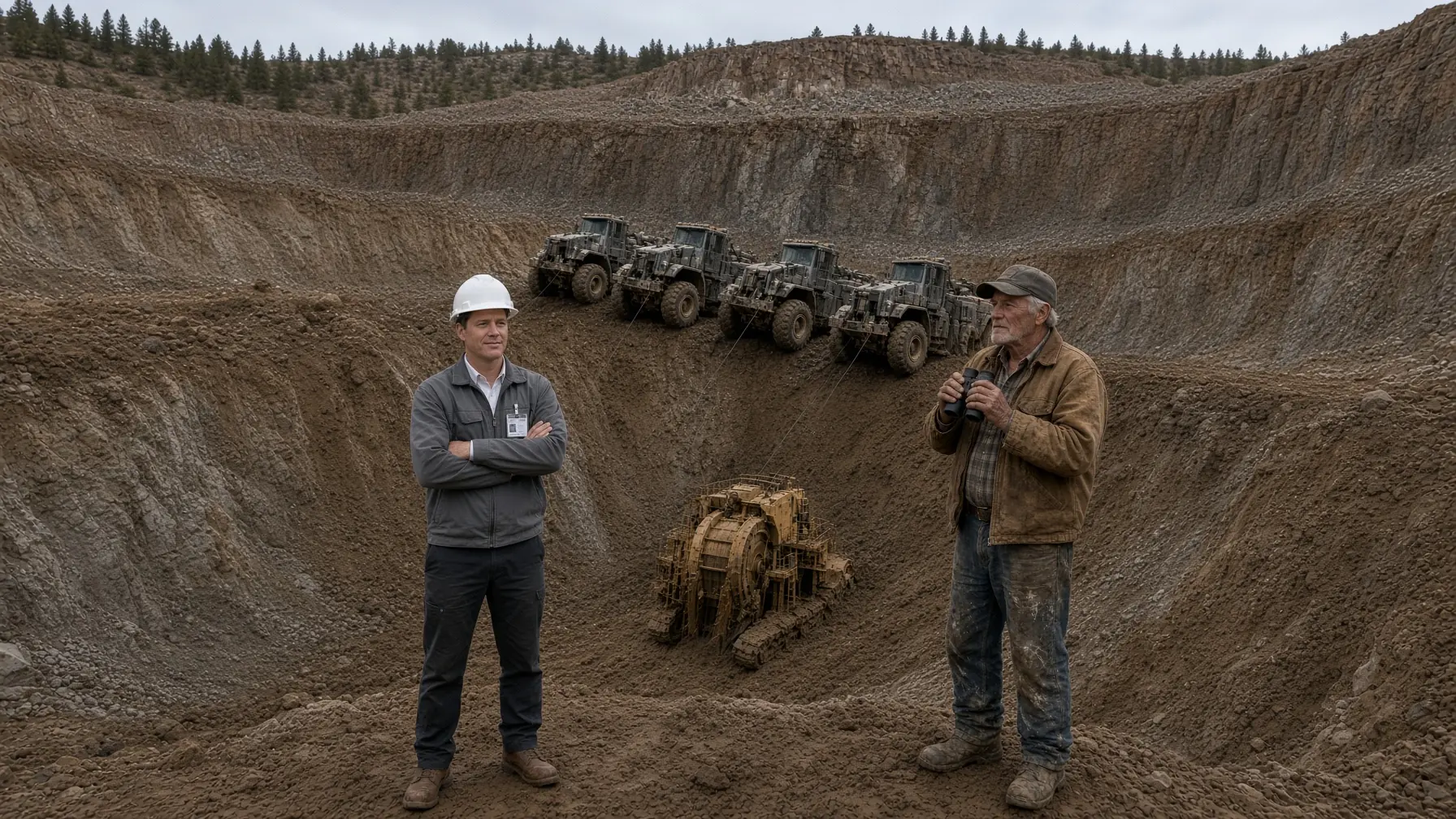
Iron Wall Recovery’s supervisor, Dean Fletcher, killed the pull before the first truck moved another foot. His operators released tension gradually while spotters backed everyone farther from the line path, and a silence settled over the quarry that seemed louder than the engines had been seconds earlier. Nobody had been injured, nothing had snapped, and the trucks had not gone over the edge, but the failure had exposed something every experienced man at the site could understand immediately. The recovery equipment was powerful enough to pull almost anything if the ground beneath it agreed to remain where it was.
Preston stood twenty yards behind Dean with his hard hat streaked by rain and a laminated safety credential hanging from his chest. At forty-one, he held graduate degrees in geotechnical and mechanical engineering, had been licensed in two states, and had spent months designing the operational layout for Vorax Mining Corporation’s newest Wyoming granite project. His calculations were not fraudulent, his education was not decorative, and he had not built the quarry by guessing. Yet the slope beneath the recovery fleet was telling him that a variable they believed controlled had changed after the drawings were finished.
Cormac Dunfield walked toward him from the site office without saying anything. As regional operations director, Cormac had presented the Coldridge expansion to Vorax executives as the operation that would transform their western division, and the Titan X9 had occupied twelve slides of the presentation that won final funding. The machine had cost close to eight million dollars before transport, assembly, commissioning, and site preparation, while every idle day now pushed lost production, contractor standby, equipment rental, and schedule penalties deeper into six figures. Cormac stopped beside Preston, looked down at the immovable crusher, and asked the question everyone else had stopped asking aloud: “What now?”
Less than twenty-four hours earlier, the Titan had been the most admired machine at Coldridge. It had arrived over two days in several oversized transport sections, escorted through the county by pilot vehicles with warning lights while residents stood beside gas stations and intersections to watch the convoy crawl past. Men who had worked around mining equipment for twenty years took photographs of the components because scale did strange things to people, and even experienced operators seemed briefly reduced to children when the final assembly stood complete. Cormac had filmed the first engine start for Vorax’s internal communications team and joked that the quarry finally possessed a machine expensive enough to frighten the accountants.
The Titan was a mobile primary crusher designed to process enormous volumes of hard rock close to the extraction face. Its tracked undercarriage allowed relocation between working areas, but nobody confused mobility with agility because moving several hundred tons required a route prepared with far more care than the word “mobile” suggested. Sensors monitored pressures, temperatures, feed characteristics, load distribution, and dozens of other values that operators decades earlier could only infer through sound and vibration. Vorax expected the crusher to become the heart of a production system capable of feeding downstream conveyors and stockpiles at rates the old arrangement could never sustain.
Preston had helped build that system on paper before the first major machine arrived. He laid out haul routes, crusher positions, drainage paths, maintenance access, emergency egress, and staging areas while coordinating with geologists, surveyors, contractors, safety personnel, and equipment manufacturers. The temporary relocation road from the assembly pad to the first production bench had received particular attention because of the Titan’s weight. Density testing, compaction records, drainage assumptions, grade calculations, and crawler loading all supported the route when it was approved.
Then three days of slow groundwater seepage changed the site beneath the surface. A fractured section of rock high on the northern wall began feeding water into older quarry fill after persistent rain, but much of that movement remained hidden below a gravel surface that still looked firm enough to support normal traffic. Light trucks crossed without obvious trouble, a loader used part of the route, and nothing visible suggested that strength several feet down had begun deteriorating. By the time the Titan started its move, the road was carrying a secret nobody standing above it could see.
Neil Parker was operating the crusher when he felt the first lateral shift at 9:14 that morning. He had twenty-seven years around tracked mining equipment and knew immediately that the sensation was wrong because heavy machines were supposed to move when their controls told them to move, not when the ground made the decision. Neil stopped, kept the tracks neutral, and radioed that the downhill side appeared to have displaced several inches. He was still speaking when the slope beneath the left track moved again.
The Titan began sliding so slowly at first that Neil believed it might settle after a few feet. Instead, a broad section of saturated material lost strength and the machine started moving sideways under gravity while the gravel surface peeled beneath it in long slabs. Neil followed emergency procedure rather than trying to drive out of a movement he did not control, and he remained inside until a safer exit route became available after the crusher stopped. Thirty-eight seconds after his first radio call, the Titan sat at the bottom of the lower excavation area with mud packed around its tracks.
Cormac reached the scene before anyone had enough information to invent blame accurately. He looked down at the machine, looked at Preston, and asked whether they had lost eight million dollars. Preston answered that nobody knew yet and ordered the area isolated until geotechnical staff confirmed the slope had stabilized. Cormac hated the uncertainty but respected the answer because pretending certainty during an unstable-ground event was one way to create a second emergency.
The first inspection brought cautious relief. The Titan remained mostly upright, there was no visible catastrophic deformation of the main frame, and several critical assemblies appeared intact despite the slide. One service platform had twisted, guardrails were damaged, and hydraulic lines required inspection, but the crusher had not rolled or struck exposed bedrock at high speed. Its immediate problem was that hundreds of tons of machinery had settled into saturated material at the bottom of a slope no one trusted enough to approach casually.
By noon, Preston understood the likely mechanism. Water had migrated through fractures and entered the road base below the elevation where their routine inspections were most likely to detect it, reducing strength in a zone that appeared acceptable at the surface. The design had accounted for drainage based on the geotechnical information available at the time, but nobody had recognized the localized seepage path created by previous excavation and recent weather. Preston wrote that distinction into his notes even though he knew a perfect description of failure would not move one pound of steel.
Iron Wall Recovery was contacted before lunch. They were one of the largest heavy-equipment recovery contractors operating across the mountain west and had handled overturned haul trucks, disabled drilling equipment, cranes, excavators, and machinery stranded in locations most ordinary towing companies would never approach. Dean Fletcher asked for photographs, machine drawings, slope information, soil observations, weather history, and manufacturer recovery-point data before agreeing to mobilize. He did not ask only how much the Titan weighed.
The first Iron Wall convoy reached Coldridge late that afternoon. Two large recovery trucks arrived initially, followed by a third configured for additional anchoring and controlled side pull once Dean saw the geometry of the pit. Their combined winching systems looked overwhelming, and men who had spent the day worrying began talking again as if the crisis might end before dinner. Cormac allowed himself to believe that possibility for nearly fifteen minutes.
Dean did not share the optimism. He walked the upper slope repeatedly, drove steel probes into suspicious areas, watched how water moved from the road cut, and asked Preston whether heavier equipment had been parked near the rim since the slide. When one superintendent tried explaining the advertised pulling capacity of the recovery trucks, Dean said, “The winches aren’t what I’m worried about,” and kept looking at the ground. Preston understood the concern but still believed the first approach could work if loads remained controlled.
Crews spent hours preparing the Titan rather than simply attaching cables and pulling. Mud was removed around accessible sections, the manufacturer verified approved recovery points, and damaged components that could create additional hazards were secured. Survey targets were placed so movement could be measured more accurately than by eye, while exclusion zones kept anyone not required for the operation away from loaded lines. Dean insisted that every person understand where to stand before anybody discussed how hard to pull.
The initial plan used the same broad slope the Titan had descended because it offered the most direct route back toward prepared working ground. Three recovery units would share the load through engineered rigging, while line tension would increase gradually so the team could stop at the first sign of unexpected movement. Preston reviewed the calculations with Iron Wall’s engineers and believed the approach remained within acceptable limits if the upper bench performed as expected. The phrase if the upper bench performed as expected would bother him for years.
The first controlled pull barely moved the Titan. Mud released around one track, the survey crew recorded displacement smaller than an inch, and tension was reduced while Dean evaluated what the system had learned. A second pull increased force gradually, and for several seconds the crusher appeared to shift enough that Cormac felt hope return. Then a spotter shouted through the radio that the lead recovery truck was moving.
It did not roll backward because its brakes failed. The ground beneath the rear tires was deforming as load transferred through the vehicle, and the truck’s enormous weight was beginning to creep downhill with the saturated layer beneath it. A second unit moved several inches moments later, proving the problem belonged to the platform rather than one truck. Dean stopped the operation before momentum could turn a recovery attempt into another recovery problem.
Preston walked toward the pit edge after every line was unloaded. Cormac followed and asked whether they needed larger trucks, but Preston shook his head before the sentence finished. They could bring more winch force to Coldridge, yet every additional machine placed on questionable ground would become another mass demanding support from the same slope. “We need a different anchor,” Preston said.
Dean heard him and nodded. “Or better ground.” Cormac looked from one man to the other and asked whether better ground could be delivered before morning. Neither answered.
The failed pull changed the mood of the entire operation. Workers who had spent the afternoon taking photographs now put their phones away, and conversations inside the maintenance trailer became quieter because nobody wanted to be the person making jokes while the company’s most expensive machine sat at the bottom of a hole. Neil Parker remained near the site even though his shift had ended, unable to make himself drive home while the machine he had been operating sat motionless below. He had followed procedure, but procedure did not prevent a man from replaying thirty-eight seconds repeatedly and asking what he might have done one second earlier.
Preston found Neil beside a pickup after dark. “You didn’t put it there,” Preston said, and Neil stared toward the pit without answering. Preston repeated that the initial information showed ground failure rather than operator error. Neil finally said, “Doesn’t change the view from my seat.”
Preston understood more than he admitted. Engineers could tell themselves systems failed collectively, but responsibility had a way of becoming personal when someone’s name appeared on the approval sheet. Preston had signed the route package. The road had carried his calculations long before it carried the Titan.
Cormac received the first call from corporate headquarters at 8:20 that evening. His supervisor asked whether the crusher was damaged, when production would begin, whether insurance had been notified, and whether the failure threatened the forty-million-dollar Coldridge contract. Cormac answered each question as carefully as he could, then listened while a finance vice president asked why an eight-million-dollar machine had been allowed onto an unstable slope. Cormac said, “Because we did not know the slope was unstable.”
The answer was accurate and unsatisfying. Corporate officers wanted a cause, a corrective action, a recovery timeline, and someone accountable before the site had enough data to provide any of them. Cormac promised an updated plan by the following morning and ended the call after twenty-three minutes. When he left the office, Preston was still outside reviewing contour maps beneath portable lights.
“What are you looking for?” Cormac asked. Preston said, “Somewhere that stays put.” Cormac almost smiled because the sentence sounded like something Dean would say, not the engineer who normally answered with numbers. Then both men looked toward the dark outline of the Titan and stopped smiling.
Several recovery alternatives were discussed before midnight. One involved constructing a new working pad farther back from the failed slope using large quantities of crushed rock, geotextile, mats, and carefully compacted material before repositioning the trucks. Another required mobilizing heavy crawler tractors from a neighboring operation and using them on a different alignment after additional ground preparation. Both options were possible, but neither promised the speed Cormac wanted.
The most dramatic suggestion involved aircraft. Somebody had heard about mining equipment being lifted by heavy helicopters and asked whether the Titan could be flown out. Preston explained that no available aircraft was simply going to pick up an intact three-hundred-and-forty-ton crusher like a shipping container, and any aviation-supported solution would require significant disassembly into liftable components. The specialist contractor they contacted estimated that mobilization, engineering, dismantling, rigging, aircraft time, and reassembly could begin around six hundred thousand dollars before weather delays or complications were considered.
Cormac did not reject it. That was how desperate the economics had become. Every day without the Titan disrupted the sequence of drilling, blasting, hauling, and crushing that Vorax had promised its customer, and equipment sitting idle accumulated costs even when nothing visibly happened. If an expensive recovery prevented a longer shutdown, expensive could still become cheaper.
Then the weather forecast worsened. A low-pressure system moving south was expected to bring rain across Dunmore County within forty-eight hours, followed by colder temperatures that could complicate both drainage and equipment access. Nobody predicted the Titan would sink out of sight, but additional water would increase the amount of saturated material crews needed to manage. The clock became part of every conversation.
At seven the next morning, twelve people crowded around a folding table inside the site office. Cormac stood at one end, Preston beside a wall map, Dean Fletcher near the door, and operations supervisors filled the remaining chairs with paper cups of coffee nobody seemed to finish. Preston reviewed four formal recovery paths and the assumptions behind each.
Gus Merritt listened from the back of the room. At fifty-eight, Gus had worked at Coldridge before Vorax owned it, operating loaders, dozers, excavators, and whatever else happened to need an operator when someone failed to report for work. He was not part of the engineering team and had no desire to become part of it. After twenty minutes, he said, “Hector might know that north shelf.”
Preston looked up. “Hector Grail?” Gus nodded.
Hector operated the old Benedict claim beyond the quarry’s northern boundary. He had worked there with his father, then his brothers, then mostly alone after the operation shrank into a small family aggregate business serving local contractors. His most recognizable machine was a 1955 Bucyrus dragline that had been rebuilt so many times that arguing about which parts remained original could consume an afternoon. Hector was seventy-four and still climbed into its cab often enough that people stopped predicting retirement.
Preston knew the dragline by reputation. “If you mean using that machine to lift the Titan, no,” he said, because the idea failed before numbers needed much discussion. The crusher’s weight exceeded anything the old Bucyrus should be asked to suspend, and no responsible plan would transform an elderly dragline into a heroic crane simply because the story sounded good. Gus answered, “I didn’t say lift it.”
Cormac leaned forward. “Then what are you saying?” Gus pointed toward the north side of the map. “Hector stripped that ridge for eleven years, and he knows where the granite sits under the overburden.”
Preston followed his finger. The northern wall rose sharply above the lower pit and ended in an exposed bench that had not been included in ordinary haul routing because it terminated near the Benedict boundary. Old survey information showed competent rock, but the bench had never mattered enough to the current production layout to become part of Preston’s daily thinking. Gus said, “That shelf doesn’t move.”
Preston answered that rock quality still had to be verified. Gus shrugged and said that was why engineers existed. Dean Fletcher smiled into his coffee.
Cormac looked toward Preston. “Is there any downside to asking him what he sees?” Preston hesitated because every large incident attracted suggestions from people whose confidence grew in proportion to their distance from responsibility. Then he looked at the three recovery trucks sitting useless on compromised ground. “No,” he said.
Gus tried calling the Benedict office. Nobody answered. Hector rarely carried a phone when working and considered voicemail an invention that allowed people to assign him tasks without his consent.
The call became unnecessary at 8:40. A mustard-colored 1987 Ford pickup stopped at the Coldridge gate, and the security attendant called Cormac because an old man named Hector Grail said he had come to look at the crusher. Hector had heard about the failed recovery from Gus at the county fuel station the previous evening and apparently decided curiosity justified the drive.
Cormac met him near the office. Hector was thinner than Preston expected, with a white mustache, hearing aids, a faded canvas coat, and fingers enlarged at the joints by age and years of work. He shook hands once, asked where he was allowed to stand, and did not mention the Bucyrus.
Preston introduced himself as the site engineer. Hector nodded and looked toward the failed road. “Road fooled you,” he said.
Preston waited for criticism. Hector added, “Ground does that.” The lack of accusation unsettled Preston more effectively than mockery would have.
He explained the seepage, the slide, Iron Wall’s pull, and the backward movement of the recovery trucks. Hector listened without interrupting, occasionally looking toward the north ridge rather than the Titan. When Preston finished, Hector asked for binoculars.
Cormac handed him a pair from a survey vehicle. Hector stood near the marked safe boundary for almost five minutes, studying the crusher only briefly before tracing the wall, the exposed granite shelf, old haul cuts, drainage paths, and positions of the recovery fleet. Nobody spoke because his silence made questions feel premature.
Hector lowered the binoculars. “Where’s your sump?” Preston pointed.
“How deep around the downhill track?” Hector asked. Preston said excavation indicated roughly twenty inches of saturated material in the worst area. Hector asked how much had been removed from beneath the frame, whether the tracks were mechanically free to rotate, whether the manufacturer allowed controlled towing without power, and whether the north shelf had been drilled recently.
Preston answered what he knew. Hector nodded and returned the binoculars. Cormac finally asked, “Can your dragline help?”
“Maybe,” Hector said. Preston immediately added, “Not as a lift.” Hector looked at him. “Why does everybody think I’m trying to pick that thing up?”
Gus laughed from several yards away. Preston almost did too.
Hector pointed toward the north ridge. “Put your pull up there.” Preston said the recovery trucks could not operate at the cliff edge safely, and Hector replied, “Then don’t put them at the edge.”
Cormac asked what he meant. Hector wanted to see the available rigging equipment, the Titan recovery manual, and the old upper access route connecting toward the ridge. He did not offer a complete plan because he had not inspected enough information to deserve one.
Dean Fletcher joined them. Unlike people who later retold the story, Dean did not feel threatened by Hector’s presence because recovery specialists made careers from learning that unusual sites punished ego. He walked Hector through the available equipment and listened as the older man asked about rated redirect hardware, available line length, anchor systems, and whether additional equipment could arrive that afternoon. Dean answered each question without pretending Hector’s age made the questions automatically wise.
They drove to the north ridge in Cormac’s truck. The shelf extended farther from the rim than it appeared from below, with exposed granite visible across a broad area before disappearing beneath shallow soil and pine. Hector walked slowly because one knee bothered him, stopping twice to scrape dirt from cracks with the heel of his boot. Preston followed with a geologist.
“This is what you were looking at,” Preston said. Hector nodded. “This is what doesn’t slide.”
The sentence was an observation, not a design. Preston understood that immediately. The challenge was turning stable geography into a recovery system that respected equipment ratings, line loads, machine integrity, and worker safety.
Hector knelt beside a section of exposed rock. “When the Benedict pit was deeper, we used this shelf for the dragline because the crawler stayed flat and the ground never pumped after rain.” Preston asked how he knew water had not undermined fractures farther back. Hector answered, “I don’t, so you check.”
That answer mattered. Hector never pretended experience was a substitute for verification when failure consequences became serious. He knew the shelf because he had worked on it, but he wanted current information before trusting forty-year memories with somebody else’s machine and crew.
They returned to the site office. Hector drew on the back of a work-order form while Preston, Dean, and the geologist watched. The first lines were crude, but the idea became clear within minutes.
The recovery trucks had failed because they tried to create reaction force on compromised ground near the same slope that had already failed. Hector proposed moving the primary pulling equipment onto the northern granite shelf and using professionally engineered redirects and temporary rock anchors so the pull could be transferred toward the Titan without placing wheeled trucks near the unstable edge. The Bucyrus would help manage line geometry, provide controlled tension within its limits, and position heavy rigging where the trucks could not operate conveniently.
Preston looked at the sketch. “You’re not using the dragline as the anchor.” Hector answered, “Not by itself.”
“What is the anchor?” Cormac asked. Hector tapped the drawing of the ridge. “That.”
The simplicity was almost insulting. Preston stared at the granite line as though the map had hidden it intentionally. He had spent most of the previous day asking how much pulling force they could bring to the Titan, while Hector had arrived asking where that force could be resisted.
Dean immediately started identifying complications. The Titan still had to travel toward an exit route rather than simply toward the cliff, line angles needed professional analysis, mud resistance remained uncertain, and temporary anchors had to be designed rather than improvised. Hector agreed with every objection.
Then he added one more idea. “Dig it loose before you ask the cables to do all the work.” Dean nodded. “Reduce resistance first.”
Hector shrugged. “Seems cheaper.”
That phrase became the beginning of the real plan. Excavators could safely remove more saturated material from selected areas around the tracks, pumps could control water entering the working zone, and crews could construct a crushed-rock path that gradually gave the Titan somewhere firmer to move as recovery progressed. Rather than demanding that winches overcome every source of resistance simultaneously, the team would remove as many of those sources as practical.
Preston began calculating. The solution was not a revelation that made engineering unnecessary; it created a more complicated engineering problem. Redirect systems introduced their own loads, anchors required design and verification, the Titan’s recovery lugs had finite limits, and the old Bucyrus could not be treated as indestructible merely because Hector knew it well.
Dean contacted Iron Wall’s engineering office. Additional rated hardware, load monitoring, and drilling support could reach Coldridge by afternoon. The geologist began checking the granite shelf and locating suitable areas for temporary anchoring based on actual rock condition rather than Hector’s memory alone.
Cormac asked when they could pull. Dean answered, “Tomorrow morning if everything checks.” Cormac stared at him.
“That’s almost another full day.”
Hector looked at Cormac. “Crusher already spent one day going nowhere because people were in a hurry.”
Cormac’s face tightened. Preston expected an argument, but Cormac looked toward the window where the Titan remained motionless below. “Tomorrow morning,” he said.
Corporate headquarters did not appreciate the delay. Cormac spent forty minutes explaining that the old dragline operator had not replaced Vorax’s engineers with a napkin sketch, and that the revised recovery would undergo proper review before anyone touched a line. His supervisor asked why an external operator had found an option the site team had not.
Cormac answered more honestly than he intended. “Because he was looking at the ridge while we were looking at the machine.” The line produced several seconds of silence on the conference call.
One executive asked whether that constituted an engineering failure. Cormac said it constituted a recovery insight that still needed engineers before it could become a recovery plan. “If you want someone to blame before we get the Titan out, I can schedule that meeting after the storm,” he added.
The call ended shortly afterward. Preston looked at him. “That was bold.”
Cormac poured cold coffee into the sink. “I’m already the man who bought the crusher sitting in the pit.”
By noon, Hector drove back toward the Benedict claim. Preston watched the mustard-colored pickup leave and assumed he wanted tools. Gus told him Hector was going to move the Bucyrus.
Preston checked the route distance. “That could take three hours.” Gus nodded.
“He knows.”
“Why didn’t he bring it this morning?”
“Because he didn’t know if anyone needed it.”
Preston smiled reluctantly. “Reasonable.”
The 1955 Bucyrus moved out of the Benedict yard shortly after one. It did not roar like a machine awakening from legend, and nobody nearby mistook age for mechanical perfection. Its diesel engine had been replaced once, electrical systems upgraded in stages, braking components renewed, wire rope replaced multiple times, and structural repairs documented by professionals when required.
Hector maintained the dragline because machines that old survived only when owners refused to confuse familiarity with invincibility. The engine leaked slightly, one cab window had been replaced with mismatched glass, and the operator’s seat contained more patches than original upholstery. Hector trusted it because he knew where trust ended.
A spotter walked ahead while the Bucyrus crawled toward Coldridge over an inspected route. Its speed was barely faster than a person could walk comfortably, making the journey less dramatic and more tedious than stories later suggested. Workers on the north perimeter cleared equipment and watched the machine approach with the slow mechanical rhythm of another era.
Lucas Renn, a twenty-two-year-old maintenance apprentice, filmed thirty seconds on his phone. The clip showed the old dragline appearing between pine trees while modern recovery trucks sat in the distance. Within an hour the video had moved through half the quarry.
Somebody added the caption GRANDPA’S HERE. Hector never saw it.
Preston was too busy to care. He worked with Dean and the geotechnical team to convert Hector’s concept into something everyone could sign their names beneath. Temporary rock anchors were specified based on actual conditions, load paths were checked repeatedly, and the arrangement deliberately prevented the Bucyrus from carrying loads beyond approved limits.
The Titan manufacturer joined by video conference. Their engineer wanted confirmation that towing forces would remain within recovery-point limits and that the machine would be monitored for frame distortion while moving. Preston agreed.
The manufacturer also asked whether the crusher’s tracks could be freed mechanically before the primary pull. Crews had already begun that work. Hector’s advice to reduce resistance before adding force had become everyone’s advice because it made sense regardless of who said it first.
Excavators worked from stable positions. Mud was removed in controlled stages rather than creating unsupported voids beneath the machine. Pumps reduced water locally while geotechnical staff watched for any change in the surrounding slope.
The Titan looked less buried by late afternoon. It was still nowhere close to free. That distinction kept everyone cautious.
The Bucyrus reached the northern bench shortly before four. Workers stopped briefly as the old machine crawled onto exposed granite, its wide crawler pads settling across a surface that showed none of the pumping or deformation seen beneath the recovery trucks the previous day. Hector positioned the machine farther from the edge than several observers expected.
“Thought you wanted it over the crusher,” Cormac said. Hector looked at him. “I want it safe.”
The dragline’s excavation bucket was removed from the active setup because it served no purpose in the recovery arrangement. Hector and Iron Wall crews prepared the machine only for the controlled role engineering had approved. Nobody asked the boom to suspend the Titan.
Rock-drilling crews worked behind the dragline. Rated temporary anchors became part of the system so the granite shelf, not Hector’s machine alone, resisted the most important loads. The Bucyrus contributed mass, line control, mechanical handling, and positioning from a location unavailable to the wheeled trucks.
Dean walked every element repeatedly. “Nobody cares what this looks like on camera,” he told the crews. “We care what stays attached.”
Lucas quietly stopped filming.
By sunset, the north ridge looked like a complicated web of heavy equipment rather than a duel between old and new machinery. Two Iron Wall trucks sat well back on prepared rock, the Bucyrus occupied a stable central position, and another recovery unit remained configured to control the Titan’s orientation during movement. Survey equipment, pumps, excavators, drilling rigs, and safety barriers surrounded the operation.
Cormac stared at it from the site office. “This is more equipment than yesterday.” Preston replied, “Yes.”
“I thought Hector’s idea was supposed to simplify things.”
“It simplifies the problem.”
Cormac looked at him.
“Not the preparation.”
The distinction was expensive but important. A good solution did not always contain fewer components. Sometimes it made sure every component was doing a job it could actually perform.
The weather worsened after dark. Wind pushed against the site trailers, and the first scattered drops of rain hit the windows before nine. Cormac asked whether they could perform a preliminary pull under lights.
Dean refused immediately. Crews had been working since before sunrise, the new setup had never been loaded, and visibility across the pit was inferior to daylight. “We pull at first light,” he said.
Cormac argued that another twelve hours could put them into heavier rain. Dean answered that fatigue could put someone into a hospital before weather did.
Preston surprised Cormac by siding with Dean. “We already watched hidden conditions beat our assumptions once,” he said. “We don’t create another hidden condition by working exhausted.”
Cormac paced the office. Then he nodded. “First light.”
Hector slept in his pickup. Cormac offered him a room at the contractor lodge, but Hector said his truck seat reclined and the lodge was fifteen minutes away. Preston found that absurd until Hector pointed out that accepting the room would require driving thirty minutes round trip for a bed he would use less than five hours.
“Logistics,” Hector said. Preston laughed.
At five-thirty the next morning, rain had stopped temporarily. Clouds hung low over the quarry, and the temperature had fallen enough that everyone’s breath showed under the portable lights. Hector drank coffee from a steel thermos while Preston reviewed load limits one final time.
“You nervous?” Preston asked. Hector looked toward the Titan. “Ask me when the cable tightens.”
Preston sat on the crawler pad beside him. For the first time since the accident, neither man had an immediate task.
“You saw the footing problem from Gus telling you the trucks slid,” Preston said. Hector nodded.
“That was enough?”
“Enough to look somewhere else.”
Preston waited.
Hector finally said, “If the thing doing the pulling moves before the thing being pulled, you don’t start by asking for a bigger puller.” Preston smiled because the sentence was basic mechanics.
“That’s statics.”
Hector sipped coffee. “Then why’d everyone keep talking about bigger trucks?”
Preston laughed. “Because big problems make people want bigger equipment.”
“Sometimes that works.”
“On good ground.”
Hector nodded.
“Now you’re learning.”
At 6:45, Dean assembled every crew involved in the recovery. He reviewed communication channels, stop commands, exclusion areas, emergency procedures, and the sequence of loading. No one would improvise because the machine moved differently than expected.
Neil Parker watched from outside the Titan. He had asked to sit inside during recovery because he knew the controls better than anyone, but the plan did not require the machine powered for the first phase and management preferred nobody inside until necessary. Neil accepted that reluctantly.
“I hate watching someone else move my machine,” he told Preston. Preston answered, “Today it isn’t your machine.”
Neil looked at him.
“It’s the rigging team’s problem until they hand it back.”
That helped.
At 7:16, Dean ordered the system brought under initial tension. Engines rose from idle, lines straightened through the engineered redirects, and load monitors began reporting values to the recovery team. The Bucyrus settled slightly as components took their share of the system load, but the granite beneath the setup remained unchanged.
Preston watched numbers. Hector watched the mud around the Titan.
Dean increased tension gradually. Nothing moved.
Cormac shifted his weight from one foot to the other. Hector raised one hand.
“Hold.”
Dean stopped increasing load. Hector pointed toward the uphill side of the Titan and asked whether the excavation crew could remove another pocket of saturated material while the system remained safely stabilized.
Dean assessed the request and approved a controlled adjustment. The excavator worked carefully. Water seeped back into the newly opened space almost immediately.
Pumps caught part of it. The rest turned the mud darker.
“Again,” Hector said when the area was ready. Dean gave him a look. “I give the pull commands.”
Hector nodded. “Then tell them again.”
Dean smiled despite himself.
The second loading cycle moved the Titan nine millimeters. Cormac saw nothing.
Hector did. A stripe of dried mud along the lower track guard shifted relative to a survey reference.
“There,” he said. Preston looked at the surveyor.
“Nine millimeters.”
Cormac stared. “We’re celebrating less than half an inch?”
Hector answered, “You wanted it unstuck.”
The next pull gained almost two inches before resistance increased again. Dean released part of the tension rather than adding force.
Crews excavated. Pumps ran. More crushed rock entered the developing path.
The process became repetitive enough that spectators lost interest. That was probably good.
Pull. Stop. Inspect. Remove resistance.
Build support. Check lines. Pull again.
Nobody screamed. Nobody pushed machinery to heroic limits.
The recovery worked because dozens of people repeatedly chose patience over spectacle.
At 8:02, the first large section of suction released. A wet tearing sound came from beneath the downhill track, followed by a sudden movement large enough that every spotter called distance simultaneously. The Titan shifted nearly a foot.
Dean stopped everything. Preston checked survey readings and asked the manufacturer’s engineer to review the movement. Hector wanted to know whether the machine had rotated.
“Less than predicted,” the surveyor said. Hector nodded. “Good.”
Cormac wanted them moving again immediately. Dean ignored him until every inspection was complete.
Preston noticed something about himself during that pause. Twenty-four hours earlier, he would have experienced the delay as resistance to progress. Now he understood the pause was part of progress.
When they pulled again, the required load decreased. Once the Titan broke free from the deepest suction, the rigging no longer fought the maximum mud resistance present during the initial attempt. The crusher began moving in short controlled increments toward the crushed-rock path.
The same recovery trucks that failed on the first day suddenly looked far more capable. Their winches had not changed. Their engines had not gained horsepower.
Only the ground and geometry had changed. Their force now had somewhere reliable to go.
Preston felt embarrassed by how elegant the principle seemed after Hector pointed toward the ridge. The first recovery plan had asked how much the Titan weighed, how badly it was stuck, and how much line force might overcome that resistance. Hector began with the other side of the equation.
What could remain still?
That question became the center of everything.
By 8:41, the Titan reached the beginning of the temporary ramp. The next phase required pulling uphill while preventing the disabled crusher from rotating toward the pit wall. The third recovery truck, which appeared to be pulling partly sideways, became essential.
Cormac looked at its line angle. “That truck is pulling in the wrong direction.”
Preston smiled. “Exactly.”
Cormac stared.
“We’re finally getting good at wrong directions.”
The Titan climbed slowly. Average movement was measured in feet, and several advances were followed by fifteen-minute stops while rigging positions changed and surveyors confirmed that the frame remained within acceptable alignment. Rain returned lightly around ten.
Hector never rushed. When Preston said the storm looked as though it might hold off long enough, Hector replied, “Maybe.”
“You ever say anything encouraging?” Preston asked.
“Sure.”
“When?”
“When it’s true.”
Preston laughed.
At 10:46, a load reading changed more quickly than expected. Dean stopped the pull, and inspection found a redirect component settling against its support differently than the model predicted. It had not failed and remained within rating, but continuing without understanding the change would have been irresponsible.
Cormac’s face went pale. The weather radar showed heavier rain less than two hours away.
“How long?” he asked. Dean said he did not know yet.
Cormac turned toward Preston. “We are six hundred feet from being done.”
“Then we’re six hundred feet from being done safely.”
Cormac stared at him.
“You’re enjoying saying things like that now.”
“No.”
Preston looked toward the pit.
“I’m learning to mean them.”
Iron Wall adjusted the setup. The delay lasted thirty-eight minutes.
During that time, Hector climbed down from the Bucyrus and walked toward Neil. He asked what the Titan sounded like when its tracks moved normally.
Neil answered suspiciously. “Why?”
“Because if you run it later, I want to know what noise means stop.”
Neil considered the question. Then he explained several sounds associated with hydraulic loading, track tension, and abnormal resistance.
Hector listened carefully. “You know that machine.”
Neil nodded.
“So do you.”
“No.”
Neil frowned.
Hector pointed toward the Bucyrus.
“I know mine.”
Then he pointed at Neil.
“You know yours.”
Something in Neil relaxed. For two days he had listened to people discuss his crusher as an expensive problem rather than a machine he understood better than most. Hector gave that knowledge a place inside the recovery.
When the revised setup was approved, Dean resumed loading. The Titan moved again.
Rain began falling steadily at eleven. The final section of the ramp remained stable, but everyone understood the weather was about to reduce their margin.
At 11:27, the leading edge of the Titan reached level bench.
Nobody celebrated.
Dean ordered tension maintained while crews stabilized the crusher and installed blocking appropriate for inspection. The manufacturer wanted confirmation that no delayed movement remained.
Only after the system was secured did Dean lower his radio. “Recovery complete.”
The quarry erupted.
Workers clapped, shouted, slapped shoulders, and released two days of pressure in less than thirty seconds. Cormac leaned against his truck and closed his eyes.
Preston looked toward the Bucyrus. Hector remained in the cab, letting the engine idle while he worked through shutdown procedures.
There was no triumphant gesture. No fist in the air.
Hector behaved as though he had completed a difficult job and still had machinery to care for.
Preston climbed toward him after Dean cleared the area. The Bucyrus ladder took him higher than expected, and he understood why Hector’s knees complained.
Hector opened the cab door.
“That was good,” Preston said.
“Crew did good.”
“I owe you an apology.”
Hector looked at him.
“For what?”
“I dismissed the idea before I knew what the idea was.”
Hector considered that.
“That’s different from saying the idea was wrong.”
“Yes.”
“Then apology accepted.”
Preston looked down at the Titan sitting safely on level ground. “You know what bothers me?”
“What?”
“I knew every principle we used.”
Hector smiled.
“That’s probably why you could check them.”
“I should have seen the ridge.”
“You weren’t looking from here.”
The sentence stayed with Preston.
He had designed Coldridge through geotechnical reports, survey maps, production requirements, drainage models, equipment specifications, and safety standards. Hector had spent eleven years watching water move through that north ridge while operating a machine whose success depended on knowing which ground could carry its weight. Neither form of knowledge invalidated the other.
“You aren’t an engineer,” Preston said. Hector nodded.
“No.”
“You knew something I didn’t.”
“Lots of people do.”
Hector looked at him.
“Good engineers usually find them.”
Preston smiled.
Cormac reached the dragline twenty minutes later. He climbed halfway up the steps, looked at the remaining distance, and decided Hector could come down if he wanted payment.
Hector eventually descended slowly. Cormac shook his hand with both of his.
“What do I owe you?”
Hector named a figure slightly above eleven thousand dollars.
Cormac blinked. “That’s all?”
“Fuel, machine time, my time, transport, and wear.”
“You understand what the helicopter proposal cost?”
“Not my problem.”
Cormac laughed.
“You helped save us hundreds of thousands.”
Hector shrugged.
“Then you got a bargain.”
He did not suddenly triple the price.
Three days later, Vorax received an invoice for $11,840.
Cormac paid it without negotiating.
The invoice did not represent the entire recovery. Iron Wall billed separately for trucks, crews, engineering, rigging, drilling, mobilization, and standby time, while Vorax absorbed excavation, pumping, road work, and lost production.
Hector’s invoice represented Hector.
That distinction vanished from the legend almost immediately.
The first exaggerated version appeared at Denny’s Bar three towns away. Someone claimed three trucks with more than three hundred tons of combined pulling power had failed, after which Hector arrived in a 1955 dragline and lifted the entire Titan vertically out of the pit in forty-seven minutes.
Gus heard the story and laughed until he almost spilled his beer.
“You going to correct him?” someone asked.
“No.”
“Why?”
“His version’s better.”
Preston was less amused. He had spent too much time approving safe working loads to enjoy hearing that Hector supposedly suspended a three-hundred-and-forty-ton crusher from an elderly machine never intended for such a lift.
“The Bucyrus did not pick up the Titan,” he told anyone at Coldridge who repeated the story. “It helped us use the ridge.”
People seemed disappointed.
Hector found that funny.
“People want machines to fight,” he said.
Preston nodded.
“Old versus new.”
“Machines don’t care.”
That became another sentence Preston wrote down.
The Titan remained out of production after recovery. Manufacturer technicians inspected the main frame, crawler assemblies, hydraulic circuits, electrical systems, bearings, crushing chamber, service structures, and control equipment before anyone discussed returning it to operation.
Cormac hated those days almost as much as the recovery.
He could see the machine sitting on good ground, which made every hour of inspection feel like bureaucracy.
Neil Parker disagreed.
“I want to know what happened to it before I climb inside.”
Cormac looked at him.
Neil added, “You can put somebody else in there if the schedule matters more.”
Cormac said nothing.
The inspections continued.
Damage was significant but repairable. Several hydraulic components required replacement, track assemblies needed attention, and structural measurements identified issues that had to be corrected before commissioning.
The Titan had survived.
That did not mean it had escaped consequence.
The failed road became a larger investigation.
Vorax hired an independent geotechnical consultant to review the design, construction records, weather data, drainage assumptions, inspection practices, and sequence of events before the slide.
Preston expected the worst meeting of his career.
He spent a week preparing.
The investigators did not find a cartoon villain.