By twelve forty-seven on Tuesday afternoon, County Road 7 looked less like a Kansas farm road and more like the staging area for a small industrial disaster. A loaded chemical tanker leaned toward the ditch with its rear trailer wheels buried almost eighteen inches into saturated clay, while three heavy-recovery trucks occupied nearly every strip of solid pavement around it. Steel cables crossed the road, snatch blocks hung from mud-covered rigging, timber cribbing lay scattered beside ground anchors, and exhausted operators had begun speaking to one another in the clipped voices of men running out of ideas. Then, from the west, a faded red 1962 Farmall 560 appeared over the rise at roughly four miles an hour.
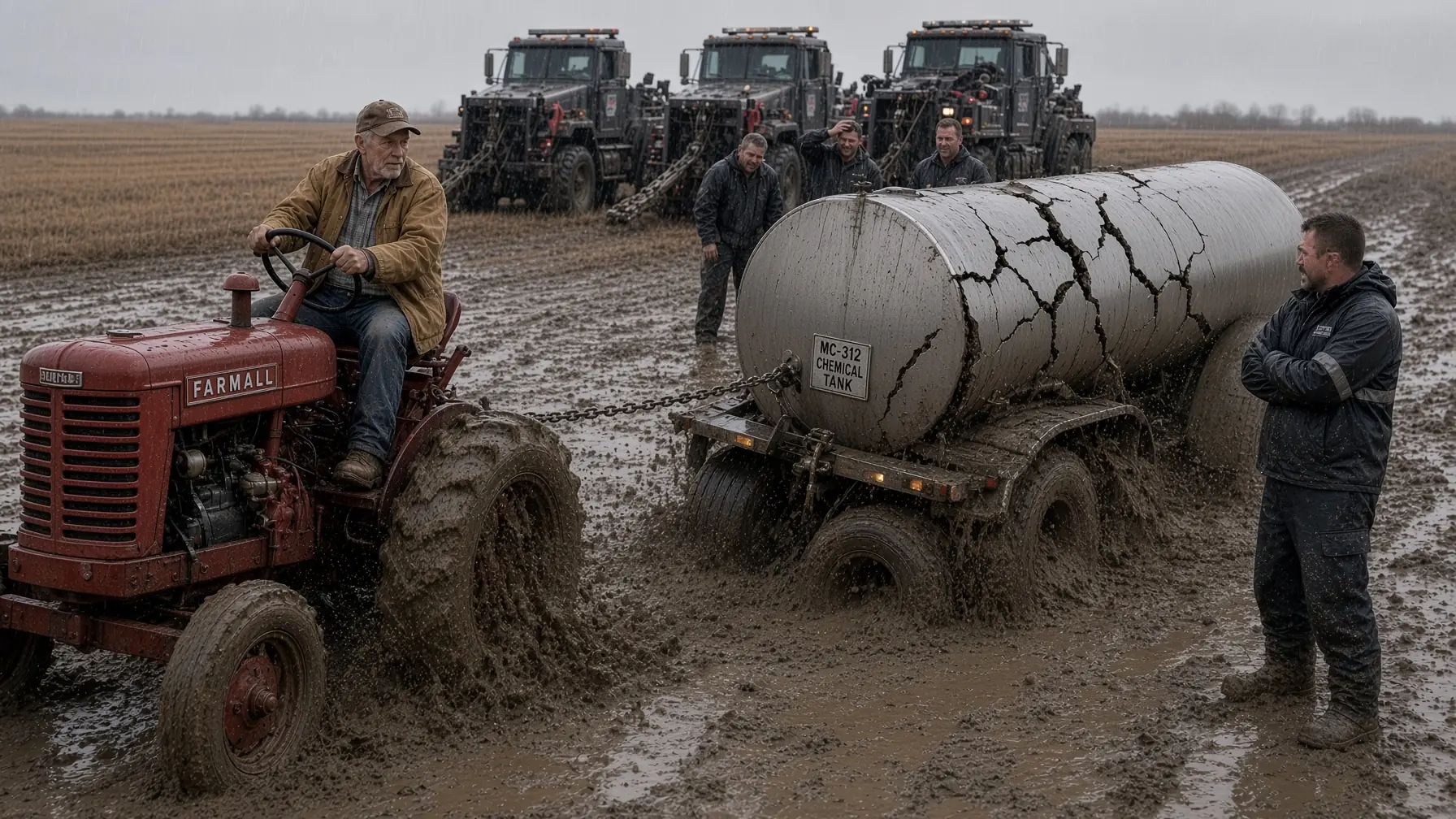
Derek Stone noticed it first. He was forty-four, broad-shouldered, sunburned across the back of his neck, and had spent twenty years building Stone Heavy Recovery into the company trucking firms called when ordinary wreckers were no longer enough. Beside him sat a fifty-ton underlift worth more than many houses in the county, along with two additional recovery units carrying enough steel, hydraulics, and winching capacity to rearrange things considerably heavier than the tanker in the ditch. Derek watched the old tractor approaching and laughed because, after six miserable hours, the alternative was probably swearing.
“Who called the museum?” he asked. One of his operators looked toward the Farmall, then toward Deputy Carl Moss standing beside the roadblock, and said, “Wasn’t me.” The tractor kept coming anyway, its faded hood shaking slightly above a narrow front end, its paint burned pink-red by sixty years of Kansas sun. Behind the wheel sat Harold Gaines, seventy-two years old and apparently unaware that several professional recovery men had already decided his arrival was funny.
Harold stopped well outside the active rigging zone and shut the engine down. He wore a tan canvas jacket that had been patched at one elbow, a gray plaid shirt buttoned to the throat, dirty jeans, worn leather boots, and a seed-company cap so old the logo had almost disappeared. His grandson Seth climbed from a pickup parked behind him and lifted a heavy recovery chain from the bed, while Harold walked slowly toward the tanker without introducing himself to anyone. Derek pointed toward the Farmall and said, “Sir, I’ve got more money sitting in one winch than that tractor’s probably worth.”
Harold stopped. He looked at Derek for perhaps two seconds, then shifted his attention back to the tanker. “That may be,” he said. “But your expensive winch is still on this side of the road and that trailer is still in the mud.”
A few of Derek’s operators looked down because they did not want their boss to see them smiling. Derek laughed again, though this time there was less amusement in it, and asked whether Harold had come to offer advice or entertainment. Harold lifted one shoulder and said, “Neither, unless you want one of them.” Then he stepped past nearly forty thousand dollars’ worth of rigging scattered on the shoulder and crouched beside the rut.
The trouble had started shortly after sunrise. Mike Reeves, thirty-nine, had driven County Road 7 enough times that he knew every bend, mailbox, bridge seam, and section where county maintenance left gravel thin after winter. He was hauling a sealed load of liquid agricultural chemical toward a distribution facility outside Salina, and although the product was not flammable, nobody wanted several thousand gallons of it leaking into a Kansas drainage ditch. The road itself was narrow but familiar, which was why Mike felt almost insulted when such an ordinary stretch of shoulder defeated him.
Three days of rain had changed the ground more than it appeared from the cab. The asphalt was dry enough by Tuesday morning, but the unpaved shoulder had absorbed water until the top layer looked firm while the clay beneath had become soft and slick. At 6:14 a.m., Mike moved slightly right to give an oncoming farm truck more room, and the trailer’s passenger-side tires crossed the pavement edge by only a few inches. He felt the first drop immediately.
Experienced drivers know the difference between a tire touching soft ground and a heavy vehicle beginning to surrender to it. Mike eased off the throttle, straightened, and stopped before momentum carried the trailer farther, but forty thousand pounds of truck, trailer, and load had already transferred enough weight onto the softened shoulder to collapse it. The rear tandem settled, then settled again, until clay rose around the outside tires and the trailer developed an angle Mike did not like at all. He set the brakes, shut down, and called dispatch.
His company reacted correctly. They notified the county, confirmed there was no leak, contacted their environmental-safety coordinator, and called Stone Heavy Recovery because nobody wanted an inexperienced operator jerking a loaded chemical trailer sideways. Derek arrived around seven thirty with his largest underlift and two men, studied the angle, checked the tanker placards, confirmed the cargo condition, and initially considered the problem straightforward. “Two hours,” he told Mike.
Derek’s first plan was conservative. The tractor portion of the semi still sat largely on firm pavement, so he positioned his recovery truck to draw the trailer back toward the road while Mike maintained steering and braking control from the cab. His crew attached only to approved structural recovery points, established an exclusion zone around the loaded lines, and slowly took up tension. The underlift’s winch barely seemed to notice the load until the mud became involved.
The cable tightened. The tanker shifted perhaps an inch, then stopped. Derek added controlled force, but instead of climbing toward the pavement, the buried tandem twisted slightly and the outer wheels pressed deeper into the clay.
“Stop,” Derek ordered. His operator released tension. Mike climbed down, looked at the new rut, and said, “That didn’t help.”
“No,” Derek answered. He was still confident. “But now I know what it doesn’t want to do.”
The second attempt involved mechanical advantage. Derek brought in a snatch block, repositioned the primary truck, changed the line route, and tried to create more favorable pulling geometry while keeping the tanker from increasing its lean. It took close to an hour because professional recovery is mostly setup interrupted by short bursts of visible action. When they finally pulled again, the tanker rocked enough to make everyone hopeful.
Then it settled back. The movement had packed the saturated clay more tightly around the lower portion of the tires. When Derek released the line, dirty water seeped slowly into the rut as though the ground were closing behind the machine.
He changed tactics again. Timber went under the most accessible wheel, another line was established, and a ground anchor was driven beyond the shoulder where Derek believed the soil might hold. The anchor looked impressive going in. Under real load, it moved.
Derek stopped the pull before the anchor tore completely free. By then, his shirt was wet beneath his jacket despite the cool morning, and the easy confidence he had brought at seven thirty had disappeared. He called for a second truck. At ten twenty, he called for a third.
Deputy Carl Moss had arrived before eight to close County Road 7. Carl was fifty-one, had worked rural patrol long enough to understand that road closures produced more anger than some criminal investigations, and spent most of the morning telling motorists the tanker would probably be cleared “soon.” By eleven, he had stopped using that word. Fourteen vehicles waited on either side of the scene, with more periodically turning around after drivers realized nothing was changing.
Mike remained near the tanker. The vehicle had not leaked, the tank itself appeared structurally sound, and its lean remained within a range their safety coordinator considered manageable, but every aggressive pull made him imagine fittings twisting or the trailer shifting farther into the ditch. He finally told Derek, “I’d rather sit here until tomorrow than tear something open.” Derek told him he felt exactly the same way.
The third recovery truck arrived before noon. Three professional units now surrounded one stuck tanker, and at that point brute capacity was no longer the issue. Derek had more available pulling force than he could safely use.
That fact bothered him. Recovery operators are accustomed to jobs where equipment limits the solution, but here the machines could exert far more force than Derek wanted transferred through the tanker’s structure. Every time he increased tension, the clay seemed to absorb the effort, and every time he changed direction substantially, he worried about increasing the trailer’s lean. The problem was becoming less about how hard they could pull and more about how much force they could safely apply before something expensive became dangerous.
Shortly after noon, Seth Gaines drove past the west barricade on his way home from the co-op. Seth was twenty-seven and farmed part-time with Harold while also working for an irrigation contractor, and he had inherited his grandfather’s curiosity without yet acquiring his patience. He slowed enough to see three recovery trucks, several cables, one irritated deputy, and a tanker that seemed permanently attached to Kansas. Then he called Harold.
Harold was repairing a hinge on a cattle gate when the phone rang. “What?” he answered, because Harold had never acquired the social habit of saying hello to relatives whose numbers appeared on his screen. Seth said, “There’s a tanker stuck on Seven.”
“How stuck?” Harold asked. Seth watched two operators walking around the ruts. “Three wreckers have been here most of the day.”
“That wasn’t what I asked.”
Seth sighed. “Rear trailer tandem is buried deep on the east side. Shoulder’s clay, soaked underneath, tanker leaning right, tractor mostly on pavement.” Harold stopped working. “They pulling straight?”
Seth looked toward Derek’s rigging. “Mostly toward the road, yeah.” Harold was quiet long enough that Seth knew he was picturing the scene.
“How deep around the tires?” Harold asked. Seth estimated perhaps sixteen or eighteen inches. Harold set the hinge down and said, “Come get the long chain.”
Seth laughed. “Grandpa, they have three heavy wreckers.” Harold said nothing. “You’re not serious.”
“Long chain,” Harold repeated. Then he hung up.
Harold Gaines had farmed the same part of Kansas for fifty-three years. He had not spent those decades studying recovery theory, but he had spent them getting heavy machinery into places it should never have gone and then finding ways to get it back out. He had buried tractors during wet springs, sunk grain carts beside terraces, watched combines settle into low ground that looked dry from twenty yards away, and once spent an entire night freeing a loaded cattle trailer from clay beside a creek.
He had broken things too. That part rarely appeared when people later called him experienced. Experience was simply the polite word for remembering enough previous mistakes to avoid repeating the expensive ones.
In 1978, Harold buried a tractor almost to its axle pulling a disk across ground his father had warned him not to enter. He attached another tractor directly ahead, pulled harder, and buried that one too. His father stood on the field edge for fifteen minutes without helping, which irritated Harold more than the stuck equipment. Finally the old man walked down and said, “You going to keep proving you own two tractors, or are you ready to look at the dirt?”
Harold never forgot that sentence. His father had them dig one side, change the pull angle, and ease the tractor sideways enough to break the packed clay surrounding the tires before trying to move forward. The recovery took half the day.
The lesson took longer. Harold spent years discovering versions of the same problem in different places. Saturated clay under enormous pressure could grip tires and components in a way that made direct pulling astonishingly inefficient, while a slight lateral disturbance could break the seal and reduce resistance dramatically.
He never called it suction in a technical sense when talking to farmers. “Mud has a grip,” he would say. “Break the grip before you ask it to give you the machine.”
The Farmall 560 had been on the Gaines place longer than Seth had been alive. Harold bought it used in 1971, repaired the engine twice, replaced the seat three times, welded one fender, rebuilt the hydraulic pump, and refused every suggestion that he repaint it. At perhaps sixty horsepower, it possessed a fraction of the power available from one of Derek’s recovery trucks. That was exactly why Harold was not bringing it to overpower anything.
He wanted something small enough to position where Derek’s heavy wreckers could not comfortably sit. The Farmall also had agricultural tires that could find usable bite on uneven ground if Harold chose his path carefully. Most important, its low hitch geometry could let him introduce force into the buried tandem at an angle completely different from the primary recovery lines.
Twenty minutes after Seth’s call, the tractor appeared on County Road 7. Derek laughed. Harold let him.
When Harold reached the tanker, he did not ask how many tons Derek’s underlift could pull. He did not touch the winches, inspect the snatch blocks, or question whether the men knew how to rig heavy vehicles. Instead, he walked directly into the muddy shoulder and pressed his boot beside the rear tires. Then he crouched and picked up a handful of clay.
He squeezed it. Water surfaced across his knuckles. Harold opened his hand and watched the clay retain almost the exact shape of his fingers.
“What is he doing?” Derek asked. One operator named Levi Carson shrugged. “Looking at mud.”
Harold moved to the back of the trailer. He studied the rut, the way the outer wheel had pushed clay outward, the location of the trailer suspension, and the slight ridge that had formed toward the pavement side. He walked several yards behind the tanker, then toward the ditch, then back again. Nobody interrupted him.
Eleven minutes passed. Derek had timed failed recoveries that lasted less.
Seth finally approached carrying the chain. “You see something?” Harold pointed toward the deepest tandem.
“They’ve packed it.”
Seth looked. “Packed what?”
“The clay around the backside and bottom.” Harold kicked lightly at the ridge. “Every straight pull makes the tire try to climb against this while the other side holds.”
Seth glanced toward the enormous recovery trucks. “They’ve been trying to pull it toward the road.” Harold nodded. “That would usually make sense.”
“Usually?”
Harold looked at him. “Usually is how you lose half a day.”
Derek had heard enough. He walked toward them and said, “If you’ve got an idea, I’m willing to listen, but we’re not hooking an antique tractor to a loaded chemical tanker and turning this into a circus.” Harold nodded immediately. “Good.”
That answer caught Derek off guard. He had expected an argument.
Harold pointed toward the heavy underlift. “Keep one safety line on it.” Derek looked at the tanker. Harold continued, “Not pulling hard, just controlling the trailer so if it breaks loose faster than expected, it can’t walk downhill.”
Derek’s expression changed slightly. That was a professional concern, not a farmer’s stunt.
Harold then pointed to a position several feet behind and offset from the buried tandem. “I want a low line there, shallow angle across the rut, not toward the pavement yet.” Derek stared at the location.
“You’re trying to pull it farther sideways?”
“An inch if I’m lucky.”
“Why?”
“To stop asking the whole trailer to climb before the mud lets go.”
Derek folded his arms. “We moved it sideways this morning.” Harold shook his head. “You pulled from high and far away.”
“That keeps the line clear and protects the equipment.”
“I know.”
“Then what are you changing?”
“The direction at the tire.”
Harold stepped into the mud and drew two lines with the heel of his boot. One ran toward the pavement, matching the general direction Derek’s crews had used. The other angled shallowly sideways and slightly downward from the chosen connection point.
“You’ve been asking the tire to come up this wall,” Harold said. Derek looked at the rut. “I want it to twist enough to open this side first.”
Levi crouched beside the drawing. “Break the packed edge?”
Harold nodded. “That’s my guess.”
Derek looked at him. “Your guess.”
“Everything here is a guess until it moves.”
That answer pleased Derek more than false certainty would have. He crouched beside Levi and studied the tracks again.
For the first time all day, somebody on Derek’s team asked about the soil before discussing the equipment. Levi pushed a pry bar into the clay and felt resistance change abruptly a few inches beneath the surface. Another operator dug beside the outside tire and found wetter material underneath a surprisingly firm compressed skin. Derek looked at Harold.
“You think we’ve built our own wall.”
“I think the trailer helped.”
Mike had climbed down from the cab and joined them. “What do you need me doing?”
Harold looked toward him. “Almost nothing.”
“That I can manage.”
“Keep the tractor straight, brakes ready, and if Derek tells you to stop, stop.”
Mike nodded. “You’re not trying to drag the whole truck with that Farmall?”
Harold smiled. “I’d like to keep my clutch.”
Derek finally laughed. It was the first time his laughter included Harold instead of being aimed at him.
They spent almost thirty minutes preparing for what later became a four-minute video online. That was the part most viewers never understood. Harold did not simply throw a chain around the tanker, jump onto the Farmall, and pull.
Derek’s crew inspected the structural point Harold proposed and rejected his first location because it was not appropriate for the forces involved. Harold did not argue. They identified a safe, lower approved recovery point that produced similar geometry without risking brake components, suspension damage, or frame distortion.
The heavy underlift remained connected through a separate line. Derek positioned it only to maintain light controlled tension and prevent unwanted movement toward the ditch. Chocks, cribbing, and spotters were adjusted, the exclusion zone expanded, and Deputy Moss pushed curious motorists even farther back.
Seth took out his phone. Harold saw him and said, “Put that thing away.”
“You’ll want this.”
“No, I won’t.”
“I will.”
Harold sighed. “Then record the wheels.”
Seth grinned. “Why?”
“Because that’s where the answer is.”
Derek climbed beside Harold before the pull. “I want one thing clear.”
Harold waited.
“If I tell you stop, you stop.”
Harold nodded.
“If that chain starts walking toward the tire, you stop.”
Another nod.
“If the tanker’s angle changes the wrong way, you stop.”
Harold stared at him. “You done?”
“Yes.”
“Good.” Harold climbed onto the Farmall.
The tractor started with a rough mechanical bark completely unlike the smoother diesel engines surrounding it. Its exhaust settled into the familiar heavy beat of an old engine working at low speed, and the hood vibrated above Harold’s knees. He positioned himself carefully, checked Derek’s signal, and eased forward until most of the slack disappeared from the chain.
Everyone cleared the line. Derek’s hand remained near the control for his underlift, but he kept his recovery winch at light tension only. Mike returned to the truck cab.
Harold increased the throttle slightly. The Farmall’s rear tires pressed into a narrow strip of ground Harold had chosen because grass roots and a slightly higher contour gave better traction than the polished mud closer to the tanker. The chain tightened.
Nothing happened. Derek watched the trailer wheels.
Thirty seconds passed. Harold did not add much more throttle.
Levi glanced toward Derek. “He’s barely pulling.”
“I know.”
One minute passed. The tanker seemed absolutely unchanged.
Derek’s operator standing beside the underlift said, “Primary line stable.” Derek acknowledged him.
At ninety seconds, Harold made a small steering correction. The Farmall moved perhaps three inches laterally, changing the chain’s angle only slightly.
Derek looked toward the buried tire. Something about the mud near the outside edge looked different.
“Hold everything,” he said. Harold froze.
Levi stepped forward after tension was reduced enough to inspect safely. A narrow crack had appeared in the packed clay beside the rear portion of the tire.
“That wasn’t there,” Levi said.
Harold looked from the tractor. “That’s what we want.”
Derek stared at the crack. He was no longer smiling.
They reset tension. Harold eased forward again.
Two minutes passed. The Farmall did not move much, and the tanker moved less.
Then the sound came.
It was a low, wet tearing noise from beneath the tandem, the sort of sound thick clay makes when something large finally separates from it. Mike felt the trailer shift in the cab and immediately called through the radio, “I got movement.”
“Half inch, maybe,” Levi shouted.
Harold did not turn around. He held the throttle almost exactly where it was.
The crack widened. Mud peeled away from a section of tire that had been almost invisible moments earlier.
“Keep it there,” Derek called.
The tanker moved sideways another fraction. The movement was unimpressive to anyone who did not understand what the previous six hours had looked like.
To Derek, it was enormous.
The trailer had moved without increasing its lean. More importantly, it had moved in the direction Harold predicted.
At two minutes and forty seconds, a wider section of clay separated around the outside wheel. Dirty water rushed into the newly opened space.
“There,” Harold said quietly to himself.
Derek saw it too. “Harold, little more.”
The Farmall’s engine deepened.
Its rear tires rotated slowly. One slipped, caught again, and continued.
The trailer shifted perhaps two inches.
The packed clay at the rear of the rut fractured.
Derek immediately changed his role. “Underlift, take five percent more tension, slow.”
The big wrecker’s winch engaged just enough to keep the trailer controlled as the resistance changed. Harold maintained the sideways pull.
Mike felt the tanker begin to roll rather than simply flex. “It wants to come,” he said over the radio.
“Do not drive it yet,” Derek answered. “Let us get the tandem out of that pocket.”
Harold adjusted his line another few degrees. Seth’s video caught the moment the deepest tire rotated for the first time.
The crowd reacted before the professionals did. Someone beyond the barricade yelled.
Deputy Moss turned and said, “Stay back.”
Three minutes had passed. The tanker had moved farther during the previous twenty seconds than it had during hours of direct pulls.
Derek stepped backward to keep the whole geometry in view. “Now we bring it toward pavement.”
Harold looked over his shoulder. “Not yet.”
Derek almost objected.
Then he saw why.
The second wheel was still enclosed by packed clay.
“Another foot sideways?”
“Less.”
Derek nodded. “Your call.”
That sentence would later bother him more than the laughter from earlier.
Harold continued. The Farmall strained, but he never turned it into a contest of horsepower.
He used enough force to maintain the movement already started. Derek’s underlift kept the tanker stable.
Then the second clay pocket broke.
The release came with another thick tearing sound and a visible collapse of the wall beside the tandem. The trailer dropped perhaps half an inch, rocked, then settled differently.
“Now,” Harold said.
Derek signaled his operator. The underlift increased controlled tension toward the road while Harold maintained a shallower lateral angle.
Mike released the brakes and applied only the smallest amount of forward power through the semi’s tractor. Suddenly the tanker was no longer being asked to climb vertically out of a clay mold.
It was rolling across a broken rut.
The first buried tire reached the firmer shoulder. Derek shouted for everyone to maintain exactly what they were doing.
Harold’s Farmall continued pulling steadily. Mike kept the truck creeping.
The second tire rose. Mud fell away in heavy slabs.
Seth’s video showed Derek turning once toward his crew with an expression that looked almost offended by how quickly everything was changing. Six hours had trained his brain to expect resistance.
The ground no longer cared.
At four minutes and twelve seconds after Harold first loaded the chain, the rear tandem rolled onto stable ground. Derek immediately signaled stop.
Mike set the brakes. Harold reduced the throttle.
The Farmall idled.
Nobody spoke.
For several seconds, all that could be heard was the old tractor’s exhaust, the larger diesel engines from the recovery trucks, and water dripping from clay stuck beneath the tanker. Mike climbed from the cab slowly.