The black SUV came into the underground garage too fast.
Nathan Harwood noticed before anyone else did.
He was pushing a yellow mop bucket across Level B3 of Langford Systems headquarters when the vehicle shot around a concrete pillar, stopped sideways, and blocked the executive sedan waiting near the elevators.
Three doors opened.
Three men got out.
Black jackets.
Gloves.
Faces covered.
Nathan stopped walking.
For three years, almost nobody in the building had noticed when he stopped walking.
That was one reason he liked the job.
At thirty-nine, Nathan worked nights for a facilities contractor, cleaning offices, replacing filters, changing lights, fixing doors, and handling the endless small problems people noticed only when nobody had solved them.
Employees passed him while discussing acquisitions worth hundreds of millions of dollars.
Executives stepped around his mop bucket without learning his name.
To them he was simply another man in a faded navy work shirt.
Invisible.
Nathan had worked very hard to become invisible.
That evening, however, invisibility gave him the best view in the garage.
Marissa Langford stepped from the private elevator at 11:47 p.m.
Founder and chief executive of Langford Systems.
Thirty-six years old.
Brilliant.
Private.
Feared by half her senior staff.
Admired by nearly everyone who owned company stock.
The business press called her the architect of one of Silicon Valley’s fastest-growing cybersecurity firms.
Nathan knew her mostly as the woman who arrived before sunrise and left after everyone else.
He had cleaned her office hundreds of times.
She rarely left personal objects behind.
No family photographs.
No vacation souvenirs.
No birthday cards taped to the wall.
Only computers, contracts, books, and a coffee cup that was usually untouched by the time it went cold.
Her driver opened the rear door of her sedan.
That was when the SUV blocked them.
Everything happened quickly.
One masked man grabbed the driver.
Another caught Marissa by the arm.
The third raised a handgun.
Nathan’s body changed before his thoughts did.
His shoulders lowered.
His breathing slowed.
The garage suddenly became distances, angles, exits, cover.
Old training.
Old instincts.
The parts of himself he had spent years trying not to need.
“Phone,” the gunman ordered Marissa’s driver.
The driver stared at the weapon.
“Now.”
He handed it over.
The masked man shoved Marissa against the SUV.
“Twelve million dollars,” he said. “Your company transfers it tonight, or you disappear.”
Marissa did not scream.
That caught Nathan’s attention.
She was frightened.
He could see it.
But she was still observing.
Counting people.
Watching hands.
Studying the vehicle.
Nathan recognized that kind of control.
He had once seen it in soldiers trying not to let captors know how afraid they were.
His daughter’s face entered his mind.
Lucy.
Seven years old.
Missing one front tooth.
Sleeping at his sister’s apartment tonight because Nathan worked late.
He had promised pancakes in the morning.
He had promised that his old life was over.
No more guns.
No more operations.
No more phone calls that began with, “We need you on a plane.”
No more disappearing from his child’s life.
The gunman pressed the weapon harder against Marissa.
Nathan looked toward the maintenance panel beside him.
Then toward the security camera above the ramp.
The attackers had positioned the SUV beneath its blind angle.
Professional enough to study the building.
Not professional enough to study the janitor.
Nathan made his decision.
His mop handle hit the floor.
The sound was small.
All three men looked toward it.
Nathan slapped the emergency barrier control.
A steel gate dropped across the exit behind the SUV with a violent crash.
At the same instant, the garage alarm began screaming.
One attacker spun toward the gate.
Nathan moved.
Later, security footage would show the sequence more clearly than any witness could describe it.
Nathan did not charge all three men.
He went only for the immediate weapon.
He knocked the gun away from Marissa’s head, drove the attacker into the side of the SUV, and forced the weapon loose.
The second man rushed him.
Nathan redirected him into the concrete pillar hard enough to take him out of the fight.
The third reached inside his jacket.
Nathan kicked the dropped handgun beneath the sedan and moved behind the engine block for cover.
Building security finally came running from the elevator corridor.
The third attacker saw three armed guards approaching and made the smarter choice.
He dropped to his knees.
Hands up.
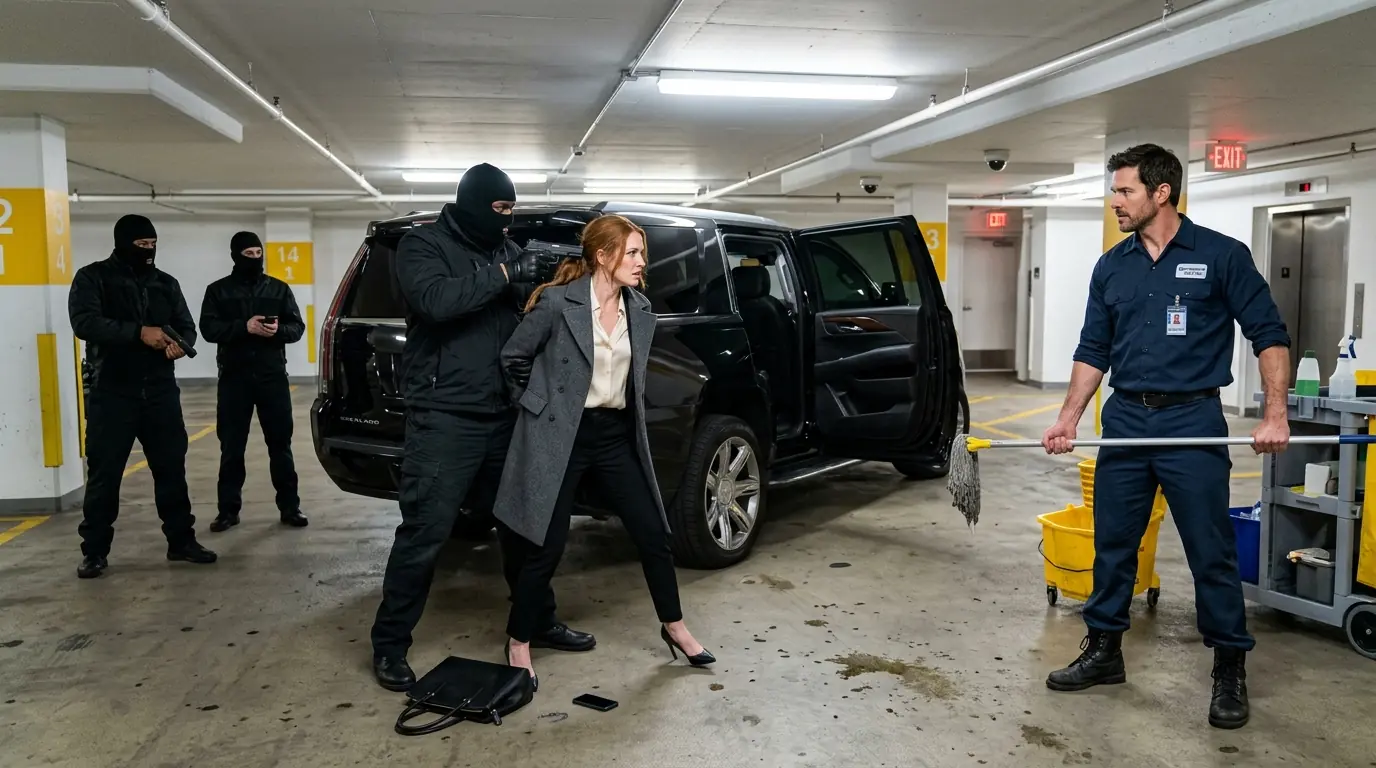
Twenty-three seconds after Nathan dropped his mop, the kidnapping attempt was over.
Nobody lay dead.
No shots had been fired.
Marissa was alive.
The driver was shaken but unharmed.
And Nathan stood beside the SUV staring toward the garage entrance, checking for a fourth attacker who never appeared.
“Sir?”
A security guard approached him cautiously.
Nathan seemed to return from somewhere far away.
He looked at the weapon on the floor.
Then at his hands.
Then at Marissa.
She was staring at him.
Not at the gun.
Not at her own torn sleeve.
At him.
Nathan picked up his mop.
“Police are coming,” he said.
Marissa’s voice was barely steady.
“Who are you?”
Nathan pushed the mop back into the bucket.
“Facilities.”
“No.”
She stepped closer.
“You’re not.”
He finally met her eyes.
For a few seconds, the exhausted night custodian disappeared.
Marissa saw something else there.
Something controlled.
Something old.
Then it was gone.
Nathan looked toward the service elevator.
“With respect, Ms. Langford, it would make my life much easier if I were.”
And before she could stop him, he walked away.
Nathan Harwood had not always cleaned office buildings.
For eleven years, he had served in the United States Army.
The final six had been spent in a special operations unit supporting hostage recovery, security planning, and high-risk evacuations.
He had been good at it.
Too good, sometimes.
Good enough that work kept finding him.
Then his wife Megan got sick.
At first, doctors said it might be treatable.
Then the word changed.
Aggressive.
Nathan requested stateside assignments.
Then leave.
Then anything that allowed him to be home.
He spent the final nine months of Megan’s life learning a kind of helplessness no military training prepared him for.
You could plan an extraction.
You could map a building.
You could rehearse a rescue until everyone knew where to step.
Cancer did not care.
Megan died when Lucy was four.
Nathan left the Army eleven months later.
Friends offered private security jobs.
Consulting.
Corporate protection.
Government contracting.
Salaries large enough to change his life.
He refused all of them.
Those jobs traveled.
Those jobs called at midnight.
Those jobs came with people wanting to know where he lived.
He wanted to take Lucy to school.
Pack her lunches.
Be home when she had nightmares.
So he took a night facilities job.
It paid less.
Much less.
But it had something Nathan valued more than status.
Predictability.
He could work while Lucy slept at his sister’s apartment three nights a week.
He could pick her up in the morning.
He could make pancakes.
He could be a father before being useful to anyone else.
People sometimes called that wasted potential.
Nathan did not.
The morning after the kidnapping attempt, Marissa watched the garage footage seven times.
Her security director, Rafael Quinn, stood behind her.
“Pause.”
The image froze.
Nathan’s hand was on the barrier control.
“Again.”
Rafael replayed it.
Marissa watched Nathan move toward the gunman.
Efficient.
No wasted motion.
No theatrical aggression.
“Military?” she asked.
“Likely.”
“Can we confirm?”
“We can check his employment record.”
“Do that.”
Rafael returned later with very little.
Nathan Harwood.
Thirty-nine.
Honorable military service disclosed during hiring.
Widower.
One child.
No criminal record.
Employed by Northstar Facilities for three years.
“That’s it?” Marissa asked.
“That’s what we are legally entitled to obtain from his employment file.”
She looked up.
“You can’t find his unit?”
“Not without digging into records we don’t have a legitimate reason to access.”
Marissa stared at him.
Rafael had worked for her seven years.
He knew that expression.
“Marissa.”
She disliked when employees used her first name at work.
Rafael did it only when she was about to cross a line.
“He saved my life.”
“Yes.”
“I want to know who he is.”
“Then ask him.”
She leaned back.
The answer annoyed her because it was correct.
That evening, Nathan found Marissa standing beside his old pickup.
He stopped twenty feet away.
“You know waiting beside someone’s truck after they’ve been involved in a kidnapping is a terrible way to make them comfortable.”
For the first time, Marissa almost looked embarrassed.
“I wanted to thank you.”
“You already did.”
“I said two words while in shock.”
“Still counts.”
She looked at the truck.
The paint was fading.
One rear panel had been replaced in a different shade of gray.
“You could be earning far more than this.”
Nathan’s expression changed.
There it was.
The sentence.
He had heard versions of it for years.
“You don’t know what I need.”
“I know you have extraordinary skills.”
“And?”
“I’d like to offer you a position.”
“Doing what?”
“Executive security.”
“No.”
Marissa blinked.
“I haven’t told you the salary.”
“That makes saying no easier.”
She was unused to people refusing offers before hearing the number.
“Why?”
Nathan placed his lunch box in the truck.
“Because I have a daughter.”
“That’s usually why people want higher salaries.”
He looked at her.
“My daughter needs my calendar more than she needs my paycheck.”
The words stopped her.
Nathan continued.
“I left a life where other people decided when I disappeared.”
He opened the driver’s door.
“I’m not going back.”
“You saved me yesterday.”
“Someone had a gun against your head.”
“So you still care.”
“Of course I care.”
He looked genuinely confused by the implication.
“You don’t have to build a career around everything you care about.”
Marissa folded her arms.
“You’re hiding.”
Nathan’s expression cooled.
“No.”
“You clearly are.”
“I chose a smaller life.”
“There’s a difference?”
“Yes.”
He stepped closer.
“A very big one.”
Marissa waited.
Nathan’s voice softened.
“My wife died while I was still telling myself I could balance everything.”
He looked away.
“I don’t make that mistake with Lucy.”
For the first time, Marissa had no answer.
Nathan climbed into the truck.
Before closing the door, he said:
“Your garage cameras have a blind zone near the west ramp. The contractors used it yesterday.”
Marissa’s eyes narrowed.
“There are two unsecured service doors on Level B2, and the executive-driver schedule is visible to more vendors than your security team realizes.”
He started the engine.
“You should fix that.”
Then he drove away.
Three days later, Marissa received a twelve-page security memo.
Not anonymous.
Nathan had signed it.
At the top:
Requested by no one. Provided because someone will try again.
Rafael read the document.
Then read it again.
“He’s right.”
“About what?”
“Almost everything.”
Twelve vulnerabilities.
Contractor badge controls.
Parking-garage camera placement.
Executive movement patterns.
Vendor access.
Emergency communication failures.
Some could be corrected immediately.
Others required larger policy changes.
Marissa called Nathan.
He did not answer.
She called again.
Still nothing.
At 7:03 the next morning, she received a text.
Putting my daughter on the school bus. Call after eight.
Marissa stared at the message.
Nobody texted her like that.
At eight twelve, Nathan called.
“You wanted something?”
She almost laughed.
“I want to hire you for two weeks.”
“No.”
“Consulting.”
Silence.
“Fixed term. No travel. Daytime hours while your regular facilities shifts are covered. You assess our security operation, train the team, then you go back to your life.”
Nathan considered.
“You’ll listen?”
“Yes.”
“Even when I tell you something expensive?”
She hesitated.
Nathan noticed.
“That’s what I thought.”
“I’ll listen.”
“Not the same thing.”
“I’ll act when the evidence supports it.”
Better.
“What about Rafael?”
“He stays in charge.”
Another pause.
Nathan said:
“Send the agreement.”
The arrangement changed both of them.
Nathan did not behave like a corporate consultant.
He refused the executive office Marissa offered.
He worked out of the security operations room.
He interviewed night guards before vice presidents.
Talked to receptionists.
Cleaners.
Drivers.
Food-delivery staff.
He asked who got ignored.
Who held doors open for strangers.
Which executives lent badges to assistants.
Which contractors learned routines nobody realized were routines.
Marissa watched him map the company through people rather than software.
“You trust janitors more than executives,” she said once.
“I trust people who know which doors are actually left open.”
“That sounded personal.”
“It was.”
He also challenged her constantly.
“You leave too late.”
“I work late.”
“You leave at the same time every Friday.”
“I have a standing investor call.”
“Now somebody else knows that too.”
“You want me to live randomly?”
“I want anyone planning to hurt you to work harder.”
She hated how often he was right.
Nathan hated how quickly she learned.
By the end of the first week, she could look at a room and identify weak access points before he pointed them out.
“You enjoy this,” he said.
“I enjoy understanding systems.”
“People aren’t systems.”
“That’s where you and I disagree.”
“No.”
Nathan shook his head.
“That’s where your company gets in trouble.”
Marissa stared at him.
He continued.
“You think if you understand enough variables, you can control the outcome.”
“And you don’t?”
“I used to.”
Something in his voice ended the argument.
Lucy entered Marissa’s life by accident.
Nathan was supposed to review an emergency evacuation drill on Saturday morning.
At 7:15, he called.
“I need to reschedule.”
“Why?”
“Science project.”
Marissa thought she misheard.
“What?”
“Lucy’s bridge keeps collapsing.”
“You’re canceling a security review because of cardboard?”
“Balsa wood.”
“Important distinction?”
“To a seven-year-old? Extremely.”
Marissa looked at her calendar.
Her Saturday contained emails.
Nothing that would remember her afterward.
“What kind of bridge?”
Nathan became suspicious.
“Why?”
“I studied engineering before switching to computer science.”
Silence.
“You want to help?”
“I did not say that.”
“You were about to.”
Marissa sighed.
“Send the address.”
Nathan did not.
Instead, he said:
“If you want to come, I’ll meet you at the coffee shop across from our building.”
That detail mattered.
He did not give her Lucy’s address simply because she was his employer.
Marissa respected him more for it.
Lucy Harwood had Megan’s eyes and Nathan’s habit of observing strangers carefully before trusting them.
She looked up at Marissa.
“You’re Dad’s boss?”
“Temporarily.”
“My dad has lots of bosses.”
Nathan handed Marissa coffee.
“She means everyone tells me what to do.”
“That sounds accurate,” Marissa said.
Lucy smiled.
The bridge sat on the apartment table.
One side sagged badly.
Marissa crouched beside it.
“What are we building?”
“A bridge that can hold ten books.”
“Currently?”
“It can hold two.”
“One and a half,” Nathan corrected.
Lucy glared at him.
“Dad broke it.”
“I tested it.”
“You broke it while testing it.”
Marissa hid a smile.
For the next two hours, she helped Lucy reinforce the structure with triangular supports.
No expensive kit.
No gift.
No private tutor.
Just glue, thin wood, string, and patience.
Nathan made grilled-cheese sandwiches in the kitchen.
Marissa noticed the apartment without meaning to.
Small.
Old.
Clean.
Water stain near the bedroom ceiling.
Books everywhere.
Lucy’s artwork taped carefully along one wall.
A photograph of Nathan beside a smiling dark-haired woman.
Megan.
The home lacked luxury.
It did not lack life.
Lucy suddenly asked:
“Do you have kids?”
“No.”
“Husband?”
“No.”
“Dog?”
“No.”
Nathan turned from the stove.
“Lucy.”
“What?”
“Interviewing guests is rude.”
Marissa said:
“It’s fine.”
Lucy considered.
“Who do you eat dinner with?”
Marissa almost answered, My calendar.
Instead:
“Usually nobody.”
Lucy looked horrified.
“Every night?”
“Most nights.”
“That’s sad.”
“Lucy.”
Marissa laughed.
Nathan stopped.
It was the first time he had heard her laugh without restraint.
It changed her face.
For a moment she looked younger.
Less guarded.
Lucy returned to the bridge.
“You can eat with us.”
Nathan looked toward Marissa.
She looked toward him.
“This is grilled cheese,” he warned.
“I’ve survived investor dinners. I can survive grilled cheese.”
That afternoon became the first time Marissa Langford had eaten at a kitchen table with a family in years.
While reviewing company property records the following week, Marissa recognized Nathan’s apartment building.
Langford Development, a separate family real-estate holding, had acquired the complex as part of a redevelopment package.
Residents were expected to leave within four months.
Marissa stared at the file.
Thirty-two households.
Relocation allowances that looked adequate on a spreadsheet.
Rental alternatives listed ten miles away.
None near Lucy’s school.
She called the development director.
“Why are we demolishing Oak Terrace?”
“Luxury redevelopment. Strong projected return.”
“Other options?”
“Renovation is possible, but lower margin.”
“How much lower?”
He told her.
Marissa looked at the number.
Months earlier she would have stopped there.
Now she asked:
“How many residents are elderly?”
Silence.
“How many children attend neighborhood schools?”
“I don’t have that.”
“How many have transportation limitations?”
“I can get it.”
“Why wasn’t it in the original review?”
“Because those aren’t normally investment metrics.”
Marissa leaned back.
“Add them.”
She did not save the building because she wanted Nathan to like her.
She ordered a new feasibility study.
The revised analysis showed renovation would still produce a sustainable return while preserving most units.
The redevelopment plan changed.
When she told Nathan, he stared at her suspiciously.
“You did this because of us?”
“No.”
She answered honestly.
“I looked because of you.”
Nathan waited.
“I changed it because the original decision was incomplete.”
That answer mattered more than a grand gesture.
“Thank you,” he said.
Nothing more.
She appreciated that too.
Two weeks became six.
Not because Nathan stayed on the same consulting contract.
He refused.
Instead, Langford Systems created a permanent resilience and crisis-planning role after an independent HR review established qualifications, reporting lines, and salary.
Nathan did not report directly to Marissa.
That was his condition.
“Why?” she asked.
“Because you and I are becoming friends.”
“Are we?”
“Yes.”
“You sound disappointed.”
“I’m cautious.”
“So am I.”
“That is not what anyone in your company says.”
She almost smiled.
Nathan continued:
“If this becomes something more someday, I don’t want my paycheck tied to whether we have an argument.”
Marissa went very still.
“Something more?”
“It could.”
She looked away toward the windows.
Nathan’s voice softened.
“That’s why boundaries matter before feelings make us stupid.”
Marissa finally looked at him.
“You say romantic things in a deeply unromantic way.”
“I’m rusty.”
“You’re terrible.”
“Also possible.”
Nothing happened between them that evening.
That mattered.
They allowed trust to grow before romance demanded a name.
Months later, Langford Systems received an anonymous message.
Attached were photographs.
Marissa leaving work.
Nathan and Lucy at a park.
Lucy outside school.
A picture of Nathan’s apartment entrance.
The message read:
Powerful people always create weaknesses.
Nathan’s face changed when he saw Lucy’s photograph.
Not into the man from the garage.
Something colder.
More frightened.
Marissa expected him to order everyone around.
Instead, he called law enforcement.
The FBI cybercrime liaison working with Langford identified the likely sender as Calvin Drexler, a former business partner convicted after Marissa testified in a federal fraud case.
Drexler had been released months earlier.
Nathan wanted Lucy’s school procedures changed immediately.
Marissa agreed.
No argument.
No pride.
That surprised him.
“You’re not going to tell me you refuse to live in fear?”
“I refuse to confuse recklessness with courage.”
He looked at her.
“You’ve been listening.”
“Occasionally.”
Security increased.
Pickup authorizations changed.
Family data was removed from several vendor systems.
The company began reviewing how much personal information executive-support contractors could access.
For several weeks, nothing happened.
Then someone made a mistake.
Not Nathan.
Not Marissa.
A third-party school transportation vendor failed to remove an old emergency authorization protocol from its system.
A woman arrived at Lucy’s school with convincing identification, Lucy’s photograph, and a temporary pickup code.
By the time the school discovered the authorization had been falsified, Lucy was gone.
Nathan received the call during a meeting.
For a second, he could not speak.
Then the old training returned.
Not violence.
Process.
“Call the police.”
Already done.
“Preserve camera footage.”
Done.
“Lock the pickup system.”
Done.
His phone rang.
Unknown number.
He answered.
Drexler’s voice.
“Twenty million dollars, Harwood.”
Nathan closed his eyes.
“Let me hear Lucy.”
A pause.
Then a small frightened voice.
“Dad?”
Nathan’s knees nearly failed.
He gripped the table.
“I’m here, bug.”
“I’m scared.”
“I know.”
“Are you coming?”
Nathan looked at Marissa.
She had tears in her eyes but her face remained steady.
“Yes,” he said.
“I’m coming.”
The line disconnected.
Marissa immediately said:
“We pay.”
Nathan shook his head.
“We cooperate with the negotiators.”
“I have the money.”
“I know.”
“I can transfer it.”
“I know.”
“Then why are we waiting?”
“Because he needs something from us.”
“He has Lucy.”
“And as long as he needs something, he has a reason to keep her safe.”
Marissa stared at him.
Every instinct in her wanted control.
Nathan’s voice broke slightly.
“I need you to trust the process.”
She nodded.
It was one of the hardest things she had ever done.
Federal agents established a command center at Langford Systems.
Nathan did not lead the operation.
He could not.
He was Lucy’s father.
Too emotionally involved.
Instead, an FBI crisis negotiator named Dana Webb took control.
Nathan briefed her on Drexler.
Marissa provided every company resource requested.
Network logs.
Threat records.
Financial data.
Vehicle access footage.
No rogue hacking.
No secret tracking money.
No CEO storming into a warehouse.
Professionals did the work.
But Nathan noticed something during the second ransom call.
A repeating metallic vibration behind Drexler’s voice.
Three seconds.
Pause.
Three seconds again.
He looked at Dana.
“Freight crossing.”
“What?”
“Rail crossing alarm. Listen.”
The audio team isolated the background.
He was right.
Combined with cell-tower data, traffic-camera records, and a vehicle captured near the school, investigators narrowed the search to an industrial corridor south of the city.
Then Marissa recognized a company name in one property record.
A warehouse once leased by a supplier Drexler controlled years earlier.
Teams moved.
Nathan stayed at the command center because Dana ordered him to.
It nearly destroyed him.
“I should be there.”
“No,” Dana said.
“I know those buildings.”
“You are her father.”
“I’ve done hostage recovery.”
“Not when the hostage was your seven-year-old daughter.”
Nathan looked at her.
Dana did not soften.
“You know I’m right.”
He hated her for several seconds.
Then nodded.
“Yes.”
Marissa sat beside him.
Not touching him.
Just present.
The tactical team entered the warehouse at 4:18 p.m.
Nathan watched a silent operations screen.
No live action movie images.
Only locations.
Radio updates.
Team moving.
Suspect sighted.
Secondary room.
Child located.
Nathan stopped breathing.
Then:
Child secure.
He covered his face with both hands.
Marissa closed her eyes.
The room kept moving around them.
Drexler was arrested alive.
Two accomplices were taken into custody.
Lucy had not been physically harmed.
When she finally came through the police doors wrapped in a blanket, she saw Nathan.
“Dad!”
He dropped to his knees.
Lucy ran into him.
Nathan held her so tightly that Dana quietly told him:
“Let her breathe.”
He laughed and cried at the same time.
Then Lucy looked over his shoulder.
Marissa stood several feet away.
For once, uncertain whether she belonged.
Lucy lifted one hand toward her.
Marissa broke.
She crossed the space and joined them.
Three people on the floor of a police operations center.
No photographers.
No executives.
No speeches.
Only relief.
That night, Lucy finally slept.
Nathan sat on the edge of her bed for nearly an hour afterward.
When he came into the living room, Marissa was still there.
“You should go home.”
“I know.”
She did not move.
Nathan sat opposite her.
“You followed every instruction today.”
“That sounds like praise from you.”
“It is.”
“I hated every second.”
“So did I.”
Silence.
Marissa looked toward Lucy’s room.
“When they took her…”
Her voice stopped.
Nathan waited.
Marissa tried again.
“I realized I love her.”
He looked down.
“And that scared you.”
“No.”
She surprised herself with the answer.
“What scared me was realizing there was nothing I could buy that guaranteed she would come home.”
Nathan understood.
“That’s parenthood.”
“I’m not her parent.”
“No.”
He looked toward the bedroom.
“But you matter to her.”
Marissa’s eyes filled.
Nathan reached across the table and took her hand.
“When Megan died, I thought if I made our world small enough, nothing else could get in.”
“Did it work?”
“No.”
He looked at her.
“It just kept good things out too.”
Marissa squeezed his hand.
“I don’t know how to do this.”
“Neither do I.”
“You’re a father.”
“I’m improvising constantly.”
For the first time that day, she smiled.
Nathan moved closer.
Not quickly.
Not dramatically.
He gave her time to move away.
She did not.
Their first kiss was quiet.
Exhausted.
Almost fragile.
Less like the beginning of a romance than two people admitting they were tired of pretending they needed nothing.
Langford Systems changed after the kidnapping.
Not because Nathan became some mythical warrior running corporate security.
He refused that role.
Instead, he helped build a resilience division combining cyber risk, physical security, employee safety, vendor controls, and crisis planning.
The school pickup failure led to a full review of third-party access systems.
The company funded a broader program helping vendors improve family-data protection.
Marissa also created a return-to-work initiative for veterans and single parents whose resumes contained gaps traditional hiring systems often punished.
Nathan insisted on one condition.
“Don’t make it charity.”
“What should it be?”
“Employment.”
He looked at her.
“If someone isn’t qualified, train them.”
“And if they still can’t do it?”
“Don’t hire them.”
Marissa smiled.
“You are terrible at inspirational speeches.”
“I’m excellent at useful ones.”
Their relationship stayed private for months.
When the board eventually learned, Marissa disclosed it formally.
Nathan’s reporting structure was reviewed.
Compensation decisions were separated from her authority.
Governance procedures were documented.
One board member asked:
“Do you understand the reputational implications of a CEO becoming involved with a former facilities worker?”
Marissa stared at him.
“Former Army officer.”
The man shifted.
Nathan touched her arm.
She stopped.
Then corrected herself.
“No.”
She looked around the table.
“That answer is wrong too.”
The directors waited.
“His military history is not what makes the relationship respectable.”
Silence.
“Neither is his current title.”
She closed the folder.
“If you need him to have an impressive résumé before you believe he deserves dignity, then you have learned nothing from this company’s last year.”
Nobody raised the subject that way again.
Lucy’s next science project was about emergency shelters.
She built several small structures from wood strips and cardboard.
Nathan helped her test weight.
Marissa helped with engineering.
Lucy did the presentation herself.
“My first bridge fell down last year,” she told the judges.
A few adults smiled.
“So I learned that when something breaks, you don’t always throw it away.”
She pointed toward the reinforced model.
“Sometimes you find where it is weak and give it better support.”
Nathan looked toward Marissa.
Marissa looked back.
Neither needed the metaphor explained.
Lucy won second place.
She complained for approximately six minutes.
Then celebrated with ice cream.
A year after the night in the garage, Marissa’s penthouse no longer looked like a showroom.
Lucy’s drawings sat on the refrigerator.
A pair of children’s sneakers appeared beside the sofa.
Nathan kept a coffee mug in the kitchen.
There were photographs now.
Not staged corporate photographs.
A camping trip.
Lucy asleep in the back seat of Nathan’s truck.
Marissa covered in flour during a failed attempt at baking a birthday cake.
Nathan laughing hard enough that the picture blurred.
Lucy turned eight on a Saturday.
Friends filled the apartment.
Children ran through rooms once quiet enough to hear the air conditioning.
After the last guest left, Lucy sat between Nathan and Marissa on the balcony.
She had resisted sleep for almost an hour.
Her head finally rested against Marissa’s shoulder.
“Tell the story.”
Nathan smiled.
“What story?”
“How you met.”
Marissa looked at Nathan.
“The true version?”
Lucy nodded sleepily.
“The one where Dad was secretly a superhero.”
Nathan groaned.
“I was not a superhero.”
“You fought three kidnappers.”
“Security helped.”
“You saved her.”
Nathan looked toward Marissa.
“Yes.”
Marissa brushed Lucy’s hair away from her face.
“But that wasn’t the biggest rescue.”
Lucy opened one eye.
“What was?”
Marissa thought carefully.
“Your dad reminded me that being strong and being alone are not the same thing.”
Lucy considered this.
Then looked at Nathan.
“What did she save you from?”
Nathan smiled faintly.
“Thinking that keeping you safe meant never letting anyone close to us.”
Lucy yawned.
“So you both were being silly.”
Marissa laughed.
“That is one interpretation.”
“The correct one.”
Lucy closed her eyes.
A few minutes later, she was asleep.
Nathan lifted her carefully.
Before carrying her inside, he looked at Marissa.
“You ever think about that garage?”
“Sometimes.”
“I almost didn’t move.”
She looked surprised.
“Really?”
“I thought about Lucy.”
“Why would that make you hesitate?”
“Because getting involved meant becoming visible again.”
Marissa watched him.
Nathan continued.
“I thought invisible meant safe.”
“And now?”
He looked through the glass door toward Lucy.
Then at the photographs inside the apartment.
Then at Marissa.
“Now I think being invisible is just another kind of hiding.”
She took his hand.
“And being seen?”
“Depends who’s looking.”
Marissa smiled.
“Good answer.”
Months later, Nathan proposed.
Not at a restaurant.
Not from the top of a tower.
He did it in their kitchen while Lucy was supposed to be asleep.
The ring was simple.
Marissa stared at it.
“You know I own jewelry worth more than your truck.”
“My truck is insulted.”
“I’m serious.”
“So am I.”
The band included a tiny stone from Megan’s old ring.
Only after Lucy and Megan’s mother both agreed.
Nathan explained that before Marissa could ask.
She touched the stone.
“You’re sure?”
“Megan is part of how Lucy and I got here.”
He swallowed.
“I don’t want loving you to require pretending she never existed.”
Marissa’s eyes filled.
“That may be the kindest thing anyone has ever said to me.”
“So?”
“Yes.”
Nathan smiled.
“Good.”
Lucy shouted from the hallway:
“Finally!”
Nathan turned.
“You were supposed to be sleeping.”
“I was waiting.”
Marissa laughed.
Lucy ran toward them.
And when the three of them embraced, Nathan understood something his younger self would have rejected.
A family could hold grief and joy at the same time.
One did not erase the other.
Years later, people inside Langford Systems still told the garage story.
It changed with every retelling.
Sometimes Nathan supposedly knocked out five kidnappers.
Sometimes seven.
One version claimed he caught a bullet with his bare hand.
Nathan hated that one most.
Whenever a new employee finally worked up the courage to ask him what really happened, he gave the same answer.
“Three men tried to take someone.”
“And you stopped them?”
“Security and I stopped them.”
“But you were trained.”
“Yes.”
“Special forces?”
Nathan usually sighed.
“Why does everyone need the dramatic part?”
Because people liked dramatic rescues.
They liked the idea of an invisible janitor secretly being more important than everyone assumed.
Marissa understood why.
But that was never the lesson she carried from that night.
Nathan deserved respect before anyone knew his military history.
Before he touched a weapon.
Before he saved a CEO.
When he was simply the man cleaning the garage.
Years later, Marissa spoke at the opening of Langford Systems’ new workforce center.
The program helped veterans, widowed parents, caregivers, and people returning after long career gaps rebuild professional lives.
Nathan stood near the back.
Lucy, now older, sat beside him.
Marissa looked over the audience.
“When I met the man who changed my life, I had passed him in the hallway many times.”
Nathan lowered his head.
Lucy grinned.
“I never learned his name.”
Marissa continued.
“I noticed him only after I needed something from him.”
The room became quiet.
“That is not a flattering story about me.”
She smiled faintly.
“But it is true.”
She looked toward Nathan.
“The lesson was not that the janitor secretly turned out to be extraordinary.”
She paused.
“The lesson was that I should not have needed him to be extraordinary before I saw him.”
Nathan met her eyes.
Years had passed.
He no longer wore the faded facilities uniform.
But he still remembered exactly how it felt to be invisible inside a building filled with people.
Marissa continued.
“Titles tell you what someone is doing today.”
“They do not tell you what they survived.”
“What they sacrificed.”
“What they know.”
“Who is waiting for them at home.”
“Or what they may become when somebody finally gives them room to be seen.”
Afterward, Lucy found Nathan in the hallway.
“Mom made you cry.”
“I had something in my eye.”
“You always say that.”
“It keeps happening.”
Marissa approached.
Lucy walked ahead, deliberately leaving them alone.
Nathan watched her go.
“She’s getting sneaky.”
“She learned from you.”
“I was trained by professionals.”
Marissa slipped her hand into his.
“Do you miss the old life?”
Nathan considered.
The missions.
The adrenaline.
The certainty of having a defined objective.
Sometimes.
But then he thought about Megan.
Lucy.
The garage.
The apartment.
The bridge that collapsed.
The night Lucy disappeared.
The life built afterward.
“No.”
He looked at Marissa.
“I spent years thinking I had walked away from the important part of my life.”
“And?”
“I was walking toward it.”
They entered the elevator together.
Downstairs, evening staff were beginning their shifts.
A custodian pushed a cart across the lobby.
Marissa stopped.
“Good evening, Mr. Alvarez.”
The older man looked surprised.
Then smiled.
“Good evening, Ms. Langford.”
Nathan noticed.
Marissa looked at him.
“What?”
“Nothing.”
“You’re smiling.”
“I’m allowed.”
The elevator doors opened.
They stepped inside.
And as the doors closed, Nathan glanced once more toward the man pushing the cleaning cart through the vast glass lobby.
Nobody else seemed to notice him.
Nathan did.
Because he remembered.
Sometimes a person can spend years believing that disappearing is the safest thing they can do.
Sometimes another person can spend years believing that needing nobody is the strongest thing they can become.
Nathan Harwood and Marissa Langford had been wrong in different directions.
He had confused invisibility with peace.
She had confused isolation with power.
It took a terrible night in an underground garage to introduce them.
But saving a life took only seconds.
Learning how to share one took much longer.
And in the end, that was the real story.
Not the gun.
Not the masked men.
Not the former soldier nobody recognized.
It was the quiet discovery that strength was never about standing alone.
It was about knowing when to protect.
When to trust.
When to ask for help.
And when someone finally reached for your hand—
having the courage not to pull away.