Story One: The Student Who Kept Asking for the Breath Test
At first, eighteen-year-old Caleb Morgan thought the stop would take five minutes.
A warning.
Maybe a ticket.
Then he would go home.
It was late, cold, and lightly raining when the patrol lights appeared in his mirror on the edge of a small Iowa town.
Caleb already knew what the problem was.
One of his low-beam headlights had burned out earlier that evening, so he had been using his high beams on the darker stretches of road and dimming them whenever another car approached.
It was not ideal.
He knew that.
He pulled over immediately.
Officer Daniel Reeves approached the driver’s window with a flashlight.
“Evening.”
“Hey, officer.”
“You know why I stopped you?”
“My headlight?”
“You had your high beams on.”
“Yeah. One low beam is out. I’ve been turning the brights off whenever somebody comes toward me.”
Reeves nodded.
“You understand you can’t drive around town like that?”
“My fault.”
Caleb was polite.
Not frightened yet.
He reached for his wallet when Reeves asked for his license.
Registration.
Insurance.
All routine.
Then came the questions.
“Where are you coming from?”
“A friend’s house.”
“Where does your friend live?”
Caleb answered.
“Anything to drink tonight?”
“No.”
Reeves paused.
“Nothing?”
“Nothing.”
The officer studied his face.
Then his eyes.
Then the inside of the car.
“Step out for me.”
Caleb looked surprised.
“Why?”
“I need to talk to you back here.”
Caleb complied.
He had a legally owned firearm secured inside the vehicle, which he disclosed.
Reeves had him place it in a visible safe position before moving away from the car.
Then came the question that shifted the entire encounter.
“You have any bombs, guns, drugs, anything else on you?”
Caleb almost laughed.
“No bombs. No drugs.”
Reeves did not smile.
Instead, he leaned closer.
“I can smell alcohol.”
Caleb stared at him.
“No, you can’t.”
The officer’s expression hardened.
“I said I can smell alcohol.”
“I haven’t had any.”
“You sure?”
“Yes.”
Caleb looked toward the patrol car.
“Then give me a breath test.”
Reeves paused.
“I’ll get to that.”
Caleb shrugged.
“Great.”
He was not worried.
That was the important part.
He knew he had not been drinking.
If a machine could settle the question, he wanted the machine.
“Can I record?”
Reeves looked at him.
“If you want.”
Caleb pulled out his phone.
He turned the camera toward himself.
“Officer Reeves thinks I’ve been drinking.”
Then toward the officer.
“I haven’t had anything. We’re about to find out.”
There was confidence in his voice.
Maybe too much.
Reeves did not like it.
“Put the phone away while I explain this.”
“I can record.”
“I didn’t say you couldn’t.”
Caleb lowered it slightly.
“What do you want me to do?”
The officer began a field sobriety examination.
Follow the finger with your eyes.
Do not move your head.
Walk heel-to-toe.
Turn.
Walk back.
Balance on one leg.
Caleb did them.
It was thirty-eight degrees.
He wore shorts.
Rain dotted his shirt.
By the time he stood on one foot, his legs were trembling.
Reeves noticed.
“Why are you shaking?”
Caleb looked at him in disbelief.
“Because I’m freezing.”
“You nervous?”
“You’re accusing me of drunk driving when I’m sober. Yeah, I’m a little nervous.”
Reeves stood in a jacket over a uniform.
Caleb pointed at it.
“You have three layers on.”
“I wear shorts when it’s below freezing.”
“Congratulations.”
The second officer nearby looked away, hiding a smile.
Caleb asked again.
“Can we just do the breath test?”
“We’re not finished.”
“How many more?”
“Stand over there.”
Caleb obeyed.
Another exercise.
Then another.
Every time he completed one, he expected the breathalyzer.
Every time, Reeves found one more thing to examine.
Caleb’s frustration increased.
“So when I blow zero, what happens?”
Reeves looked at him.
“What do you mean?”
“When the breath test says zero.”
“Why would anything happen?”
“Because you told me I smell like alcohol.”
“I’m conducting an investigation.”
“Okay.”
Caleb nodded.
“Then investigate the thing you think happened.”
The officer’s face tightened.
“You think you know how to do my job?”
“No.”
Caleb pointed toward the patrol car.
“I know how to blow into a tube.”
Nearly an hour had passed.
Finally, Reeves retrieved the portable breath tester.
Caleb’s mood changed instantly.
“Good. Let’s do it.”
He sealed his lips around the mouthpiece.
Blew.
Reeves watched the display.
Caleb watched Reeves.
The reading appeared.
0.000.
Caleb smiled.
“There we go.”
Reeves said nothing.
“Zero.”
The officer stared at the machine.
Caleb almost laughed.
“I told you.”
Reeves looked at him again.
Then said:
“When was the last time you used marijuana?”
Caleb’s smile disappeared.
“What?”
“When’s the last time you smoked?”
“I don’t know. Not tonight.”
Reeves narrowed his eyes.
“Your eyes look off.”
Caleb stared at him.
“So I blew zero, and now it’s weed?”
“I’m continuing my investigation.”
“This is ridiculous.”
“You admitted you’ve used marijuana.”
“Not tonight.”
Reeves began reading him his rights.
Caleb looked toward the other officer.
“Are you kidding me?”
No one answered.
He was arrested.
At the station, Caleb underwent additional evaluation.
No alcohol.
No evidence of recent drug impairment.
Nothing that justified what had begun as a broken headlight stop becoming hours of detention.
By the time he was released, he was furious.
Officer Reeves came near the desk.
Caleb looked directly at him.
“Remember what I told you when you first stopped me?”
Reeves did not answer.
“I said I had nothing to drink.”
The officer shifted.
Caleb continued.
“I asked for the breath test.”
“I conducted the stop based on what I observed.”
“You kept changing what you thought I did.”
“That’s not accurate.”
“It went from alcohol to drugs after the alcohol test came back zero.”
Reeves looked tired.
Caleb said:
“I deserve an apology.”
The officer did not give him one.
That mistake mattered more than Caleb expected.
Because Caleb had recorded.
So had the patrol cameras.
His father, Anthony Morgan, had spent years teaching both of his children one lesson about authority.
“Be respectful,” he always said. “But don’t confuse respect with surrendering your ability to ask why.”
Anthony was not a lawyer.
He was a maintenance supervisor at a manufacturing plant.
But he had spent enough of his own youth being frightened by uniforms to teach Caleb how to remain calm.
Ask what you are being detained for.
Do not physically resist.
Do not lie.
Do not guess.
Do not consent just because you are intimidated.
And document what you lawfully can.
When Anthony watched the video, he did not celebrate his son mocking the officer.
He actually scolded him.
“You called him a rookie?”
Caleb looked embarrassed.
“I was mad.”
“Being right does not make every sentence smart.”
“I know.”
Then Anthony replayed the part where Caleb requested the breath test.
Again.
And again.
He saw something else.
His son had been telling the truth from the beginning.
So Anthony helped him file complaints and preserve every video.
Caleb eventually posted portions of the encounter publicly.
The response was enormous.
Some viewers criticized Caleb’s attitude.
Others focused on the central problem.
Why did the investigation continue changing after objective evidence failed to confirm the original suspicion?
The legal process moved more slowly than the internet.
Reports were reviewed.
Video was examined.
Caleb learned a lesson that frustrated him.
Winning an argument on camera was not the same as proving misconduct in court.
But the incident stayed with him.
Not because he wanted revenge.
Because he understood how easily confidence in an accusation could turn into a search for something—anything—that made the accusation feel justified.
Years later, when someone asked what frightened him most about that night, Caleb did not mention handcuffs.
He said:
“The moment zero wasn’t enough.”
Because once the breathalyzer showed nothing, he expected the suspicion to shrink.
Instead, the suspicion simply changed shape.
That taught him something.
Sometimes the hardest thing for a person in authority to say is not “You’re guilty.”
It is:
“I may have been wrong.”
Story Two: The Fifteen-Year-Old Who Wouldn’t Stop Recording
When the two officers arrived on Daniel Harper’s street, the argument was already over.
His fifteen-year-old son, Noah, had been riding a small gas-powered bicycle with another teenager earlier that evening.
They argued.
Voices rose.
A neighbor called police.
By the time officers reached the quiet Utah neighborhood, both teenagers were home.
No fight remained.
No crowd.
No immediate threat.
Officer Steven Hall and his partner, Matthew Ruiz, walked toward Daniel’s house.
Daniel opened the door.
“Can I help you?”
“Are you Daniel Harper?”
“Who’s asking?”
“Police department.”
Daniel looked at their uniforms.
“I can see that. Names and badge numbers, please.”
Hall’s expression changed slightly.
“We’re here about an incident outside.”
“What incident?”
“The situation with the motorbike.”
Daniel stepped onto the porch.
“I’m not sure what you mean.”
“We need you to come down here and talk.”
Daniel shook his head.
“No, thank you.”
Hall stared at him.
“Step down here.”
“No.”
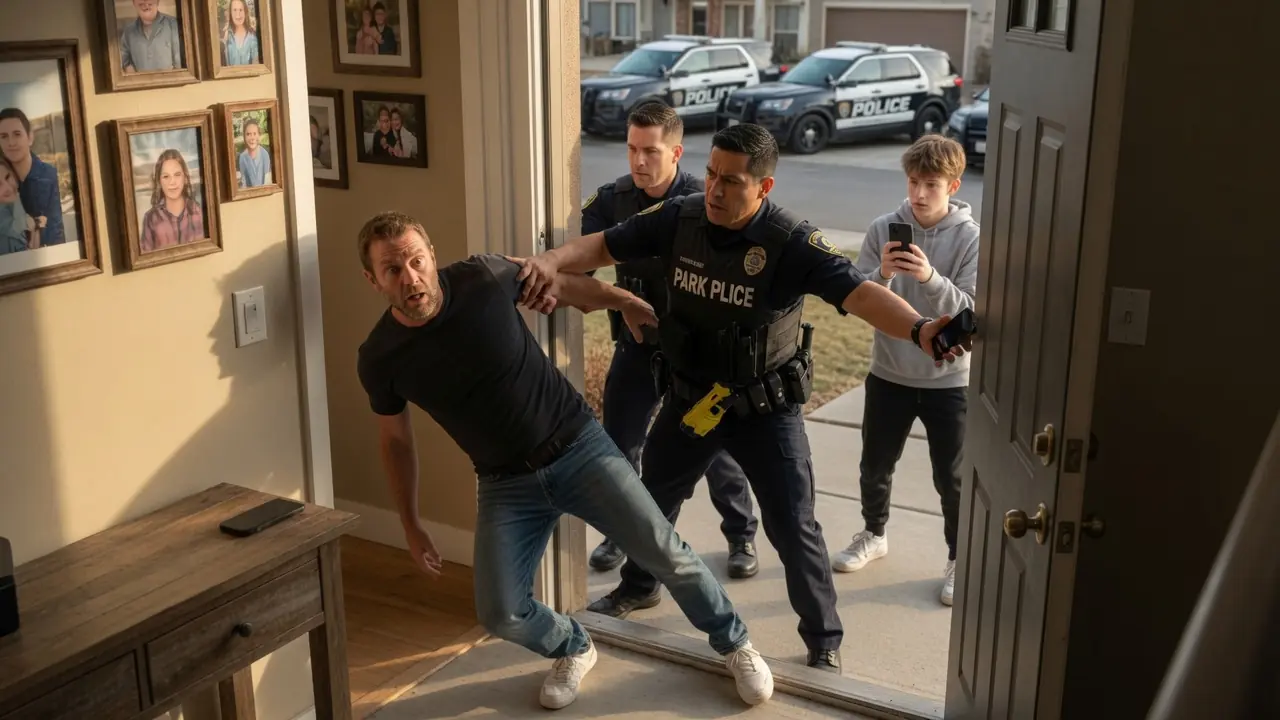
Daniel began moving backward toward his doorway.
The officer reached for him.
Everything changed in seconds.
“Whoa!”
Daniel threw his hands up.
“Don’t grab me.”
“Come outside.”
“I’m going inside my house.”
“No, you’re not.”
Daniel crossed the threshold.
Officer Hall followed.
Daniel’s voice rose.
“You cannot come into my house without permission.”
“Stop resisting.”
“I’m not resisting!”
The second officer entered too.
Daniel twisted as they grabbed his arms.
“What are you doing?”
A stun device activated.
Daniel screamed.
“Dad!”
Noah came running.
He froze in the hallway.
Two officers were wrestling his father toward the door.
Daniel shouted:
“Noah! Get my phone!”
Noah ran for it.
“Record this!”
The fifteen-year-old returned holding the phone.
The camera began rolling.
Daniel’s voice was strained.
“I am not fighting you. I’m trying to get you out of my house.”
“Move outside.”
“Why am I detained?”
“Resisting.”
“I wasn’t resisting before you grabbed me.”
Noah stepped closer.
One officer turned.
“Stay back.”
“I’m recording.”
“Give us space.”
“This is my house.”
“Back up.”
Noah did.
A few feet.
But the phone stayed up.
The officers dragged Daniel outside.
He kept repeating the same questions.
“What crime?”
“What am I detained for?”
“Why did you enter my home?”
Noah followed.
“Dad, I have it all.”
“Keep recording.”
Officer Hall turned toward the teenager.
“Back up.”
“I am back.”
“Farther.”
Noah stepped again.
“What’s your name?”
Noah looked at him.
“I don’t have to answer that.”
Hall’s face hardened.
For a fifteen-year-old, Noah was remarkably controlled.
He was scared.
His breathing was fast.
His hands shook.
But Daniel had spent years teaching him what to do when frightened.
Do not touch an officer.
Do not physically block them.
Do not run.
Keep distance.
Record.
Speak clearly.
Do not let panic make decisions for you.
So Noah kept filming.
At one point, one officer reached toward his phone.
Noah pulled it back.
“Don’t take my phone.”
“Stop interfering.”
“I’m not interfering.”
“You’re too close.”
“I’ll move back.”
He moved.
Then kept recording.
That frustrated the officers even more.
The camera was not aggressive.
It did not shout.
It did not argue.
It simply remembered.
One officer’s body camera became dislodged during the struggle and fell near the doorway.
When the officer went back toward the house to retrieve it, Noah moved too.
“Stay out of the house.”
The officer turned sharply.
“I’m getting my equipment.”
“You entered before without a warrant.”
“Noah,” Daniel called from near the patrol car, “stay calm.”
“I am calm.”
The officer stepped toward the boy.
“If you come past me again, you’re going to the ground. Understand?”
Noah’s eyes widened.
“I’m fifteen.”
“Then act like it.”
“I am standing on my property holding a phone.”
The exchange was captured from more than one angle.
That mattered later.
Police then began questioning Noah about the motorized bicycle.
“You were riding it?”
“Yes.”
“Gas-powered?”
“Yes.”
“You need a license.”
“No, I don’t for that engine size with the permit I have.”
The officer paused.
The boy had researched it.
Daniel had made him.
Before allowing Noah to ride the bicycle, he required him to read every local rule he could find.
Helmet.
Lighting.
Road restrictions.
Engine limits.
Permit requirements.
Daniel’s rule was simple.
“If you’re going to tell an officer you know the law, you’d better have done the homework before the argument.”
Noah had.
The officers did not like the answers.
But the camera kept rolling.
Daniel was taken away.
Noah stood at the curb watching the patrol car disappear.
Only then did his hand begin shaking badly enough that he almost dropped the phone.
His mother, Melissa, came outside.
She had been upstairs when the confrontation began.
“What happened?”
Noah looked at her.
“They came in.”
His voice broke.
“They just came in.”
She hugged him.
The tough teenager disappeared for a moment.
He was fifteen again.
And his father had just been taken to jail.
Daniel faced several charges related to the encounter.
Failure to obey.
Disorderly conduct.
Resistance.
The language sounded serious on paper.
Then attorneys watched the recordings.
The timeline mattered.
When had the officers attempted to detain Daniel?
Why?
When did they enter?
What happened before the alleged resistance?
What commands were lawful?
What did the officers know at each stage?
Video did what memory often could not.
It froze the order of events.
Daniel’s lawyers challenged the case.
Charges were eventually dropped.
The officers’ conduct underwent review.
Both eventually lost their positions after the incident and related findings.
But what people remembered most online was Noah.
A fifteen-year-old boy with a phone.
Commenters called him fearless.
He hated that word.
Months later, during an interview arranged by his father’s attorney, Noah corrected a reporter.
“I was scared.”
“You didn’t sound scared.”
“I was.”
“Then how did you stay calm?”
Noah thought.
“My dad told me what to do before I ever needed it.”
“What did he tell you?”
“That you can be scared and still pay attention.”
Daniel, sitting beside him, looked away.
Noah continued.
“He told me arguing isn’t the same thing as winning. You don’t win by being louder.”
“What do you do?”
“Remember.”
The reporter frowned.
“Remember?”
Noah held up his phone.
“If everybody remembers the same thing differently afterward, the person with power usually gets believed first.”
He lowered it.
“So record.”
Daniel looked at his son.
That was the moment he realized the lesson had traveled farther than he intended.
He thought he had been teaching Noah how to protect himself.
Instead, he had taught him how to become a witness.
Story Three: The Man Who Was Only Trying to Buy a Drink
The third incident began in a convenience store.
No stolen property.
No weapon.
No fight.
A fifty-three-year-old man named Thomas Reed was standing at the counter trying to pay for a drink.
Thomas had a cognitive disability and a neurological condition that affected the speed of his speech and movement.
Stress made both worse.
The cashier became impatient.
A security employee intervened.
Then another.
Thomas became confused.
He had cash in his hand.
He tried to explain.
“I’m paying.”
One of the security workers interpreted his hesitation as suspicious.
Police were called.
By the time officers Aaron Briggs and Kyle Mercer arrived, Thomas no longer understood who was trying to help him and who was trying to remove him.
That mattered.
People sometimes assume disability reveals itself clearly.
A wheelchair.
A cane.
A hearing aid.
Thomas’s disability was not immediately obvious.
He looked like a middle-aged man who was being difficult.
Officer Briggs approached.
“Sir, gather your money and step outside.”
Thomas shook his head.
“I’m calling the police.”
Briggs frowned.
“We are the police.”
“No.”
“Yes.”
“You’re security.”
“No, sir. Police.”
Thomas gripped the cash.
“I just wanted a drink.”
“Then take your money and come outside.”
“I don’t want to go outside.”
“We need you outside.”
“Why?”
“Because the business wants you removed.”
Thomas looked at the clerk.
Then the officers.
Then the security employees.
Too many faces.
Too many commands.
His processing slowed.
“I didn’t steal.”
“No one said you stole.”
“They said I took something.”
“Step outside.”
Thomas stayed where he was.
Briggs took his arm.
Thomas jerked away.
“You don’t have to touch me.”
“We need you to cooperate.”
“I’m calling the police.”
“We are police.”
The conversation began circling.
That is common when someone with certain cognitive disabilities becomes overwhelmed.
More repetition does not always create more understanding.
Sometimes it creates more panic.
Officer Mercer stepped closer.
“What’s your name?”
Thomas looked at him.
“None of your business.”
“Sir, identify yourself.”
“No.”
“If you refuse, you can be arrested.”
“For what?”
“Failure to identify.”
Thomas shook his head.
“I didn’t do anything.”
“Name.”
“No.”
“Hands behind your back.”
Thomas’s fear became visible.
“No. Please.”
The officers grabbed his arms.
“I’m not doing anything.”
“Stop resisting.”
“I’m not.”
“Hands back.”
“You’re hurting me.”
Customers moved away from the counter.
One person began recording.
Thomas begged.
“Please let me go.”
The officers took him outside.
He kept asking the same question.
“What crime did I do?”
Briggs told him trespassing.
Thomas looked toward the store.
“I was buying something.”
“You’ve been told to leave.”
“You didn’t let me buy it.”
“That doesn’t matter now.”
Thomas was pressed against the patrol vehicle.
His pockets were searched.
Cash was removed.
Medication.
Prescriptions.
Receipts.
The officers found paperwork bearing his name.
One officer held up the prescription information.
“Thomas Reed?”
Thomas said nothing.
“Is that you?”
Silence.
Then the officer made a comment he would later have difficulty explaining.
“If this isn’t yours, you’re going to have a much bigger problem with these medications.”
Thomas looked frightened.
“They’re mine.”
“So your name is Thomas?”
He stared at the ground.
The officers had finally obtained what they wanted.
But by then the encounter had gone far beyond identification.
Thomas was arrested.
At first, the paperwork made the incident look ordinary.
Trespass.
Failure to comply.
Resistance.
Then someone watched the video carefully.
Thomas repeatedly tried to pay.
Thomas repeatedly expressed confusion about who the officers were.
He asked for police while police were standing in front of him.
That was not necessarily defiance.
It could be evidence he did not understand the situation.
His family explained his disabilities.
Medical records supported them.
Advocates became involved.
The criminal charges weakened.
Eventually, they were dropped.
Then came the civil case.
Lawyers examined not only what the officers did, but what they knew and what they should reasonably have recognized.
Had Thomas been given enough time to process commands?
Were attempts made to de-escalate?
Could officers have reduced the number of simultaneous instructions?
Did anyone ask whether he had a disability?
Did confusion get mistaken for resistance?
Those questions mattered.
The officers had looked at Thomas and seen a man refusing orders.
His family looked at the same video and saw something familiar.
A man becoming overwhelmed.
A man whose speech became less organized under pressure.
A man trying repeatedly to return to the one fact he understood.
I was paying.
That sentence appeared again and again.
It became the center of the lawsuit.
Not because paying gave Thomas the right to stay indefinitely if a store lawfully asked him to leave.
But because it showed how the encounter began.
He had not entered intending to steal.
He was not threatening anyone.
The problem escalated from confusion.
And instead of reducing confusion, almost every person involved increased it.
Months later, Thomas’s sister, Rachel, watched the footage with him.
He hated watching it.
At one point, he covered his ears.
“Turn it off.”
Rachel paused the video.
“We don’t have to finish.”
Thomas stared at the frozen image.
His own body against the police car.
Officer beside him.
Money in another man’s hand.
“I told them.”
“I know.”
“I said I was paying.”
“I know.”
“They didn’t listen.”
Rachel took his hand.
“No.”
He looked at her.
“Why?”
That was the question no lawsuit could answer neatly.
Because they were impatient?
Because they misunderstood his disability?
Because once the scene became an arrest, everyone started seeing his actions through the idea that he was resisting?
Because people are often more comfortable calling behavior disobedient than admitting they do not understand it?
Maybe all of those.
Rachel did not pretend to know exactly.
She said:
“They thought they understood what you were doing.”
Thomas frowned.
“They didn’t.”
“No.”
“That’s bad.”
“Yes.”
He thought.
Then said quietly:
“They should ask.”
Rachel squeezed his hand.
“What?”
“If somebody’s confused.”
He looked at her.
“They should ask why.”
The case eventually resulted in discipline and policy review.
The details were less dramatic than viral headlines.
No courtroom exploded in applause.
No judge gave a movie speech.
There were reports.
Depositions.
Training records.
Disability accommodations.
Department procedures.
The slow machinery of accountability.
That was where the real lesson lived.
Police officers deal with people at their worst moments.
Drunk.
Angry.
Terrified.
Injured.
Mentally ill.
Disabled.
Confused.
Sometimes all at once.
Authority does not create perfect understanding.
It creates greater responsibility when understanding is uncertain.
A person who fails to follow a command may be defiant.
Or deaf.
Or frightened.
Or cognitively overloaded.
Or physically incapable.
Good policing requires determining which before turning confusion into another charge.
Years later, the three incidents existed mostly as videos online.
Caleb beside a roadside, asking again and again for the breath test.
Noah holding his phone while officers took his father away.
Thomas standing inside a convenience store saying:
“I was paying.”
Different people.
Different cities.
Different circumstances.
But there was a thread connecting all three.
Each encounter contained a moment when authority became more interested in compliance than understanding.
Caleb said he had not been drinking.
A machine eventually agreed.
The suspicion continued.
Daniel tried to retreat into his home.
The conflict followed him through the doorway.
Noah’s camera preserved what happened next.
Thomas tried to explain why he was standing at the counter.
His confusion became another reason to control him.
And in every case, recording mattered.
Not because cameras automatically create justice.
They do not.
A camera cannot physically stop a bad decision.
It cannot guarantee discipline.
It cannot make courts move faster.
But it can preserve the moment before everyone begins rewriting it.
That was why Anthony Morgan taught Caleb to document.
Why Daniel Harper shouted for Noah to get the phone.
Why Thomas’s case changed after people watched what had actually occurred.
The cameras did not make those people innocent.
They preserved evidence that allowed others to ask whether they had been treated lawfully and fairly.
There is an important difference.
And there was one more lesson.
The hardest one.
Rights are not magic words.
Caleb knew his rights and was still arrested.
Daniel invoked the Fourth Amendment and was still dragged outside.
Noah knew he could record and was still threatened.
Thomas asked what crime he had committed and still ended up in handcuffs.
Knowing the law does not create a force field.
Sometimes the safest thing in the moment is still to comply physically, document, survive, and challenge what happened afterward.
That can feel deeply unfair.
It often is.
But Caleb’s father understood something he later explained to his son.
“The goal isn’t to win the sidewalk.”
Caleb asked:
“Then what is it?”
“Come home.”
Anthony looked at him.
“Come home with the truth still intact.”
Daniel gave Noah almost the same advice after their case ended.
“Your phone mattered.”
Noah nodded.
“But you mattered more.”
Daniel put a hand on his son’s shoulder.
“If an officer tells you to move back, move back and keep recording from there. If they arrest me, don’t get arrested trying to prove I shouldn’t be.”
Noah smiled faintly.
“That’s not what you were saying that night.”
Daniel laughed.
“I was having a bad night.”
Thomas’s lesson was simpler.
When new officers later watched his case during disability-awareness training, a facilitator paused the footage before officers touched him.
Thomas appeared on the screen, money still in his hand.
The instructor asked:
“What do you see?”
Someone said:
“Noncompliance.”
Another:
“Possible trespass.”
Then the instructor played Thomas saying:
I’m calling the police.
He paused again.
“What else might that mean?”
Silence.
Finally, a recruit said:
“He doesn’t understand they’re police.”
“Good.”
The instructor nodded.
“So what changes?”
Different answers came.
Slow down.
One officer speaks.
Identify yourself clearly.
Ask whether he needs help understanding.
Reduce physical contact.
Check for disability.
Move from command to explanation if there is time.
The instructor nodded.
“Exactly.”
Then he said the sentence Rachel had learned from her brother.
“When somebody seems confused, ask why before you punish the confusion.”
That became the line recruits remembered.
Not the lawsuit.
Not the disciplinary findings.
Not the viral video.
One question.
Why?
Caleb had wanted an officer to ask why objective tests kept contradicting suspicion.
Noah wanted officers to ask why they believed they could follow his father through his own doorway.
Thomas simply needed somebody to ask why a frightened man kept insisting he was calling police while police stood directly in front of him.
Sometimes accountability begins with lawyers.
Sometimes with cameras.
Sometimes with complaints.
But better decisions often begin earlier.
Before the handcuffs.
Before the arrest report.
Before anyone’s pride becomes invested in being right.
At the moment when one person with authority looks at another human being and chooses not merely to command—
but to understand.