The afternoon sun pressed down on Route 66 like a heavy hand.
Heat shimmered above the cracked asphalt outside the Desert Lantern Diner, a weathered roadside restaurant standing alone between low Arizona hills and miles of open desert. Its red sign had lost several letters years earlier, and the canvas awning above the porch had faded from green to gray.
Beneath that awning sat sixty-eight-year-old Elias Mercer.
To the occasional traveler passing on the highway, he looked like a tired local man enjoying a quiet cup of coffee.
He wore faded jeans, worn work boots, and a plain charcoal T-shirt beneath an open canvas jacket. A battered baseball cap shaded a face marked by sun, age, and memories he rarely discussed.
At his feet rested Atlas.
The German Shepherd’s muzzle had turned almost completely white, but his eyes remained alert. Even while lying down, one ear faced the highway and the other followed movements near the diner.
Atlas did not rest like an ordinary house dog.
He rested like a soldier.
Years earlier, he had been a military working dog trained to locate explosives in places where one wrong step could kill an entire patrol. He had served beside Elias in Afghanistan, moving through narrow villages, abandoned compounds, and roads buried beneath dust.
Atlas had found wires hidden under trash.
He had warned men away from doorways.
Once, during a firefight, he had remained beside Elias after shrapnel tore into the captain’s leg.
They had survived together.
When Elias retired after twenty-four years in naval special operations, he spent nearly a year fighting through paperwork to adopt Atlas.
People told him the dog was government property.
Elias reminded them that Atlas had carried more men home than many decorated officers.
Eventually, the approval arrived.
Since then, they had traveled together in an aging red pickup truck, seeking places quiet enough to let the past settle.
That afternoon felt almost peaceful.
Elias lifted his coffee and looked toward the distant horizon.
Atlas rested his heavy head on the toe of Elias’s boot.
“Not a bad place,” Elias murmured.
The dog’s tail tapped the porch once.
Then the sound of motorcycles rolled across the desert.
At first, it was a distant vibration.
Within seconds, it became a violent mechanical roar.
Three stripped-down motorcycles came racing along the highway and turned sharply into the diner’s gravel lot. Their rear tires threw dust and stones against the parked vehicles.
The riders circled once before stopping near the entrance.
They continued revving their engines after the motorcycles were already in place, making the diner windows tremble.
Elias did not move.
Atlas raised his head.
The engines finally died.
The three men dismounted.
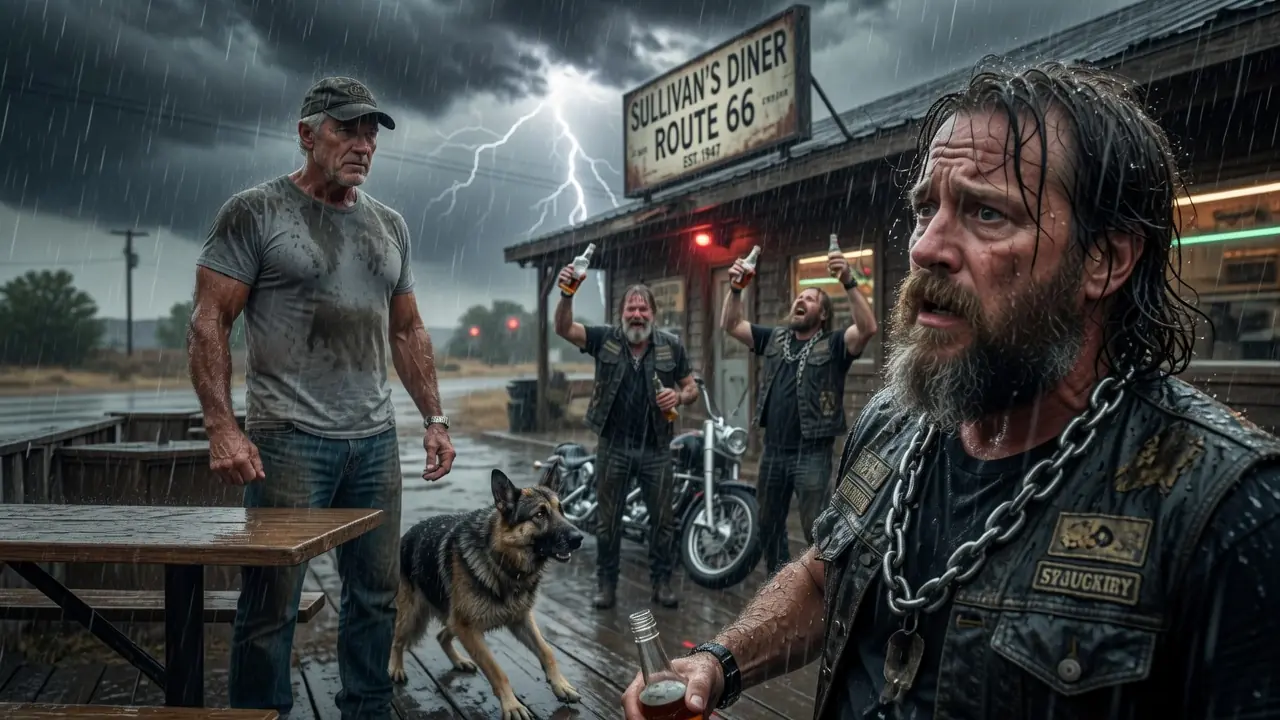
Their leather vests displayed the patch of a regional motorcycle club called the Dust Devils. All three smelled of alcohol despite the early hour.
The largest was Boone Carver, a barrel-chested man in his late thirties with a wild beard and a scar dividing his left eyebrow. A heavy hunting knife hung from his belt.
Beside him walked Cody Nash, thinner and younger, his eyes red and unfocused.
The third was Shane Rusk, who carried a steel chain looped over one shoulder. Shane had the careless arrogance of someone protected by a powerful last name.
His father was Sheriff Calvin Rusk.
In three surrounding towns, that fact had ended many arguments before they began.
The bikers climbed the wooden steps.
Boone kicked an empty plastic chair aside.
It struck the diner wall and fell over.
“Place looks dead,” Cody said.
Shane spat tobacco onto the porch.
“Maybe everyone heard we were coming.”
They laughed.
Elias continued looking toward the highway.
Atlas sat upright but remained close to his leg.
Boone noticed them.
“Hey, old man.”
Elias took another drink of coffee.
Boone stepped closer.
“You deaf?”
“No.”
“My friend said this place looks dead.”
Elias lowered the mug.
“It was quiet.”
Boone spread his arms.
“Not anymore.”
There were six empty tables beneath the awning.
Boone pointed at the one Elias occupied.
“We want this table.”
Elias glanced around.
“There are plenty available.”
“I didn’t ask how many tables there were.”
Boone moved into Elias’s shade.
“I said we want this one.”
Elias studied him.
He saw the looseness in Boone’s knees, the slow reaction in his eyes, and the tension in the hand near his knife.
Cody favored his left side and kept opening and closing his fists.
Shane held the chain as though he wanted someone to notice it.
The calculations happened automatically.
Three intoxicated men.
Two visible blades.
One improvised weapon.
Poor coordination.
Unstable footing.
Elias hated that his mind still worked that way.
He had come to the desert to stop measuring people as threats.
“Choose another table,” he said.
Cody noticed Atlas.
“What happened to that thing?”
“He got old,” Elias replied.
“Looks half dead.”
Atlas’s ears moved backward.
Cody took a step toward him.
“I hate German Shepherds.”
“Then keep your distance.”
The younger biker smiled.
“Is he going to bite me?”
Atlas released a low warning growl.
Elias touched two fingers to the dog’s neck.
“Quiet.”
Atlas immediately stopped.
Shane laughed.
“Well trained.”
“He had to be.”
Cody moved closer.
“Military dog?”
Elias did not answer.
Cody stared at the faded working-dog tag attached to Atlas’s collar.
Then he looked at Elias.
“Both of you used to play soldier?”
“Walk away.”
The softness disappeared from Elias’s voice.
Boone heard the change.
For one brief moment, instinct warned him to leave the old man alone.
Then Cody laughed.
“Or what?”
Elias looked directly at him.
“Nothing good comes after this point.”
Cody drew his right leg backward.
Elias saw the movement.
He began to rise.
But Cody was closer to Atlas.
The steel-toed boot struck the German Shepherd beneath the ribs.
The sound was dull and heavy.
Atlas cried out and slammed into the wooden leg of the table. His front paws slipped beneath him as he tried to stand.
Boone and Shane burst into laughter.
“Good kick!” Shane shouted.
Atlas struggled upright, breathing in short, painful bursts.
He did not attack.
Even injured, he looked at Elias and waited.
Years of training held stronger than pain.
Elias placed his coffee mug on the table.
The ceramic base made a quiet click against the wood.
His heart did not race.
His breathing did not quicken.
Instead, everything inside him became cold.
He saw Atlas standing in a burning road years earlier, refusing to leave a wounded Marine.
He remembered the dog collapsing from heat after locating explosives buried beneath a bridge.
He remembered lying in a military hospital with Atlas’s head resting beside the bed.
Cody had not kicked an animal.
He had attacked the last living partner Elias had brought home from the war.
Elias stood.
“You should not have done that.”
Cody turned toward him.
“What are you going to do?”
He swung a wide punch at Elias’s face.
The movement was slow, obvious, and careless.
Elias stepped inside it.
He redirected Cody’s arm, turned his hips, and sent the younger biker over the edge of a chair.
Cody struck the porch and rolled onto his side, stunned.
The entire exchange took less than two seconds.
Boone’s laughter stopped.
Cody tried to rise.
Elias placed one boot beside his shoulder.
“Stay down.”
Cody cursed and reached for Elias’s leg.
Elias shifted his weight and controlled the man’s wrist until Cody stopped moving.
No bone broke.
Nothing needed to.
Boone pulled the hunting knife from his belt.
“I’m going to cut you open.”
Shane unwrapped the chain from his shoulder.
Atlas attempted to stand between them.
“Atlas, down.”
The German Shepherd lowered himself reluctantly, his eyes fixed on Boone.
Boone lunged.
Elias moved aside.
The knife passed through empty air.
Elias used Boone’s momentum to drive him into the table. Coffee, napkins, and silverware scattered across the porch.
Boone spun and slashed again.
The blade caught Elias’s left forearm, cutting through the sleeve.
A thin line of blood appeared.
Elias did not react.
He trapped Boone’s wrist against the man’s own chest and struck him twice in the ribs with controlled, compact movements.
The air left Boone’s lungs.
His grip loosened.
Elias removed the knife and pushed him backward.
Shane swung the chain.
Elias turned Boone into its path.
The chain struck the larger biker’s shoulder and wrapped around both men.
They crashed against the front railing.
Boone fell to one knee.
Shane dropped the chain and stumbled away.
Elias stood between the bikers and Atlas.
Blood moved slowly down his arm.
His breathing remained even.
Cody crawled toward the steps.
Boone held his ribs.
Shane pressed his back against the diner wall.
“Stop,” Shane said. “We’re done.”
Elias picked up Boone’s knife.
He folded the blade and placed it on the table.
“Then stay where you are.”
Shane raised both hands.
“You don’t understand. My father is the sheriff.”
Elias knelt beside Atlas.
The dog was favoring his right front leg.
Elias ran his hands carefully along the ribs, checking for severe movement, swelling, or signs of internal injury.
Atlas whimpered but allowed the examination.
“Easy, partner.”
Behind him, Shane continued.
“My dad owns this county. You touch us, and you disappear.”
Elias looked over his shoulder.
“Call him.”
Shane stared.
“What?”
“Call your father.”
A faint, humorless smile touched Elias’s face.
“Tell him exactly where we are.”
Shane pulled out his phone.
His hands shook as he dialed.
Elias returned his attention to Atlas.
“You held your position,” he whispered. “Good boy.”
Inside the diner, owner Walter Sullivan stood behind the counter beside his young waitress, Jenna Miles.
They had watched the confrontation through the window.
Jenna held the phone with emergency dispatch already connected.
Walter stopped her before she spoke.
“Wait.”
“Those men attacked him.”
“I know.”
“Then why are we waiting?”
Walter pointed toward a small security monitor beneath the counter.
Four camera views showed every section of the porch.
The system had been installed only one week earlier.
For months, members of the Dust Devils had vandalized the property, threatened customers, and taken food without paying. Each time Walter complained, the sheriff’s department claimed there was insufficient evidence.
Elias had helped him install high-resolution cameras connected to an encrypted backup server.
The footage was already leaving the building.
Walter pressed a button and saved a protected copy.
Outside, Shane spoke frantically into his phone.
“Dad, we’re at Sullivan’s. Some old man attacked us. He has a knife. You need to bring everyone.”
Elias heard the lie.
He said nothing.
When Shane ended the call, Elias took out his own phone.
He dialed a number from memory.
A woman answered.
“Southwest field office.”
“This is Elias Mercer. Authorization Delta Nine.”
There was a pause.
Her voice changed immediately.
“Captain Mercer?”
“I need Director Kane. Route 66, Desert Lantern Diner, Oak Haven County. Local corruption issue. Possible armed escalation.”
“Hold.”
Another voice came onto the line.
“Elias?”
“Matthew, Sheriff Rusk is coming.”
Director Matthew Kane knew the name.
Federal investigators had been building a case involving the Dust Devils for more than a year. The club was suspected of moving narcotics, stolen weapons, and trafficking victims through isolated county roads.
Sheriff Calvin Rusk had repeatedly blocked local investigations.
Witnesses withdrew statements.
Evidence disappeared.
Search warrants were delayed until targets had time to leave.
The federal task force believed Rusk was involved, but belief was not enough.
“Are you secure?” Kane asked.
“For now.”
“Any civilians?”
“Diner staff inside. Three injured suspects. Atlas was kicked.”
Kane’s tone hardened.
“Stay there. State and federal units are moving.”
“How long?”
“Twelve minutes.”
“Make it ten.”
Elias ended the call.
He tore a clean strip of cloth from a bandana and wrapped his forearm.
Dust moved across the parking lot.
The heat remained oppressive.
Less than eight minutes later, sirens appeared from the east.
Three Oak Haven County cruisers came racing down the highway.
They entered the lot too quickly, scattering gravel against the motorcycles and the diner.
Four deputies emerged.
Sheriff Calvin Rusk stepped from the lead vehicle.
He was a heavy man in his late fifties, wearing mirrored sunglasses and a uniform tailored more for appearance than movement. His badge shone brightly against his chest.
He saw his son and immediately became furious.
“Shane!”
Shane hurried toward him.
“That’s the guy. He attacked all of us.”
Sheriff Rusk looked at Elias.
He did not examine Atlas.
He did not ask about the knife.
He did not speak to the diner employees.
His hand moved to his holster.
“On your knees.”
Elias remained beside the dog.
“Your son’s group attacked first.”
“I gave you an order.”
“They are intoxicated. Cody kicked my retired military working dog. Boone drew a knife. The injury on my arm is from that weapon.”
Rusk looked at Shane.
“Is that true?”
“No. The dog came at us.”
Atlas lay on his side, breathing shallowly.
The lie was obvious.
Rusk chose it anyway.
“Deputies,” he said, “arrest him.”
A young deputy named Evan Cole hesitated.
“Sheriff, should we separate witnesses and examine—”
“You questioning me?”
“No, sir.”
“Then do your job.”
Two other deputies approached Elias.
One was Deputy Miles Carter, a large man who had spent years serving as Rusk’s personal enforcer. The other, Deputy Nolan Webb, looked uneasy.
Elias slowly stood.
“Do not place your hands on me until you review the scene.”
Carter pulled out his cuffs.
“You think you’re giving orders?”
“I’m warning you.”
Sheriff Rusk laughed.
“You have no authority here.”
“I have the same rights as every citizen.”
“In my county, I decide what your rights are.”
The words were captured clearly by the porch camera.
Elias’s gaze moved toward the small black dome beneath the awning.
“Sheriff, you should reconsider what you just said.”
Rusk stepped closer.
“Cuff him. If he fights, put him on the ground.”
Atlas tried to rise again.
“Down,” Elias commanded.
The dog obeyed.
Carter reached for Elias’s arm.
Elias redirected the hand and turned the deputy off balance. Carter fell onto one knee, his own momentum carrying him into the porch post.
Elias immediately stepped back.
“I do not want to fight your deputies.”
Webb placed one hand near his weapon.
Elias looked at him.
“Don’t.”
Something in his tone stopped the deputy.
Sheriff Rusk drew his pistol.
The barrel pointed at Elias’s chest.
“You just assaulted an officer.”
Elias did not flinch.
“Lower the weapon.”
“I’ll shoot you where you stand.”
“You won’t.”
Rusk’s hand trembled.
“You think I’m afraid of you?”
“No.”
Elias nodded toward the awning.
“You should be afraid of the recording.”
Rusk glanced up.
The red light on the camera blinked.
“That camera captured your son kicking Atlas,” Elias said. “It captured the knife attack. It captured every word spoken since you arrived.”
Rusk’s mouth tightened.
“I can seize the recording.”
“There is no local recording.”
Walter opened the diner door.
“It uploads off-site,” he said.
Rusk turned toward him.
“You stay out of this, Sullivan.”
Walter remained inside the doorway.
“This is my property.”
Rusk pointed the pistol toward the ground but did not holster it.
“Where is the server?”
“Not in this county.”
The sheriff’s face changed.
For years, his power had depended on controlling what remained and what disappeared.
Now the evidence was beyond his reach.
“You’re bluffing,” Rusk said.
Elias looked toward the highway.
“Then you have nothing to worry about.”
A new sound approached from the west.
Not local sirens.
Heavy engines.
Four black SUVs appeared along Route 66, moving in formation.
They entered the parking lot and positioned themselves across the exits.
Doors opened before the dust had settled.
Federal agents in dark tactical equipment moved around the diner, securing the road, the cruisers, and the armed deputies.
“Drop the weapon!” an agent shouted.
Rusk froze.
“Federal agents! Put the gun down!”
The sheriff looked at his deputies.
No one moved to support him.
His pistol fell onto the porch.
Two agents secured it.
Matthew Kane stepped from the lead SUV.
He wore a gray suit despite the heat. His expression was controlled as he walked toward the porch.
He looked at Elias’s injured arm.
Then Atlas.
Then the bikers on the ground.
“I thought retirement was supposed to make you less complicated.”
“I wanted coffee.”
Kane glanced at the broken table.
“You seem to have found it.”
Rusk stared between them.
“What is this?”
Kane faced him.
“Sheriff Calvin Rusk, I’m Matthew Kane, regional director of a federal organized-crime task force.”
Rusk’s face lost color.
“We have investigated the Dust Devils for fourteen months. Drug distribution, weapons trafficking, extortion, and suspected human trafficking.”
Shane stepped away from his father.
“That has nothing to do with us.”
Kane ignored him.
“We also have evidence that members of the Oak Haven County Sheriff’s Office protected the organization, interfered with investigations, and warned suspects before warrants were served.”
Rusk attempted to recover his authority.
“You can’t come into my county and make accusations.”
“We did not come with accusations.”
Kane motioned toward the agents.
“We came with warrants.”
Several agents approached the cruisers.
One opened Rusk’s trunk and found an unregistered rifle, cash in sealed envelopes, and documents connected to the motorcycle club.
Another agent entered the diner to collect the security footage.
Kane looked at the porch camera.
“Today gave us additional evidence of obstruction, unlawful detention, excessive force, and conspiracy.”
Rusk turned toward Elias.
“You planned this.”
Elias shook his head.
“I planned to drink coffee.”
“You wanted me here.”
“Your son called you.”
Rusk looked at Shane.
For the first time, father and son understood that every attempt to use local power had made their position worse.
Kane gave the order.
“Take them into custody.”
Agents placed Sheriff Rusk in restraints.
Deputies Carter and Webb were temporarily detained pending interviews. The young deputy who had questioned the arrest was separated as a witness.
Shane began shouting.
“This is my father’s fault! He made us do everything!”
Boone cursed him from the floor.
Cody had regained consciousness and stared blankly at the federal agents securing his wrists.
Rusk’s badge was removed.
For decades, it had allowed him to silence witnesses and frighten citizens.
Now it rested inside an evidence bag.
A medical team entered the parking lot.
One medic approached Elias.
“Captain Mercer, let me see your arm.”
“Check Atlas first.”
The medic knelt beside the German Shepherd.
Atlas watched her closely but allowed the examination after Elias touched his neck.
She listened to his breathing and gently checked the ribs and front leg.
“He has significant bruising and possibly a small fracture,” she said. “His lungs sound clear, but he needs imaging.”
Elias released a breath he had been holding.
“Can you transport him?”
“A veterinary emergency team is meeting us in town.”
Elias crouched.
Atlas leaned his head against his chest.
“You held the line,” Elias whispered.
The dog’s tail moved once.
Kane joined him.
“You could have identified yourself to the sheriff.”
“It would not have mattered.”
“You are probably right.”
“He had already chosen his version of events before he arrived.”
Kane looked toward Rusk being placed inside a federal vehicle.
“That version will be difficult to maintain.”
The security footage showed everything.
Cody’s kick.
Boone’s knife.
Elias repeatedly attempting to de-escalate.
Sheriff Rusk refusing to investigate.
His order to use unnecessary force.
His statement that he controlled citizens’ rights inside the county.
Within forty-eight hours, federal agents executed warrants across Oak Haven.
Several Dust Devils were arrested.
A storage warehouse near the state line contained narcotics, weapons, stolen vehicle parts, and records connecting club members to a trafficking network.
Financial investigators traced payments to Sheriff Rusk and two senior deputies.
Local business owners began speaking after years of silence.
They described protection payments, threats, vandalism, and official reports that disappeared after being submitted.
Walter Sullivan provided footage from previous incidents at the diner.
The case against Rusk grew rapidly.
Elias spent most of the following day at an animal hospital.
Atlas had two cracked ribs and a badly sprained shoulder, but no internal bleeding.
The veterinarian ordered several weeks of rest.
Elias sat beside him until evening.
“You are getting too old for roadside fights,” he said.
Atlas looked at him.
“So am I.”
The dog closed his eyes.
Three months later, Sheriff Calvin Rusk was indicted on charges including obstruction, conspiracy, bribery, and deprivation of civil rights under color of law.
Boone, Cody, and Shane faced assault charges in addition to the federal organized-crime case.
Shane offered information against his father in hopes of reducing his sentence.
It did not earn him the sympathy he expected.
Deputy Evan Cole became a key witness after investigators confirmed he had privately documented several suspicious orders.
Deputy Carter was charged alongside Rusk.
Nolan Webb resigned and later admitted that fear had kept him silent.
The Oak Haven Sheriff’s Office was placed under temporary state supervision.
The Desert Lantern Diner reopened after repairs.
Walter replaced the broken table but left one section of damaged railing untouched.
Above it, he mounted a small plaque.
THIS PLACE IS QUIET BY CHOICE, NOT BY FEAR.
Travelers began stopping after hearing about what happened.
Walter disliked the attention but appreciated the business.
He placed a water bowl near the porch for passing dogs.
Several photographs appeared on the wall inside.
One showed Atlas during his military service, standing beside a convoy beneath an Afghan sky.
Another showed Elias much younger, kneeling beside him in full gear.
Walter never included details about Elias’s classified service.
The photographs were enough.
Six weeks after the attack, Elias and Atlas returned.
The German Shepherd walked carefully but without assistance.
Customers recognized him.
No one approached without permission.
Walter brought out two items.
Black coffee for Elias.
A grilled steak cut into small pieces for Atlas.
“On the house,” Walter said.
Elias looked at the plate.
“You’re going to spoil him.”
“He earned it.”
Atlas appeared to agree.
Elias sat beneath the awning at the same table.
The highway stretched empty in both directions.
Wind moved through the dry grass.
For several minutes, the world was quiet again.
Kane arrived unexpectedly near sunset.
He stepped onto the porch carrying a folder.
“You following me?”
“I came for the coffee.”
“Your agents told you where I was.”
“That too.”
Kane sat across from him.
“The federal case is strong.”
“I assumed it would be.”
“The security video will be central.”
Elias looked toward the camera.
“Walter wanted proof.”
“He got more than he expected.”
Kane placed the folder on the table.
“The Bureau would still like you as an adviser.”
“No.”
“You have not read the offer.”
“I have fought enough wars.”
“You would not be in the field.”
“That is what people always say before asking someone to enter the field.”
Kane smiled.
“Fair.”
Atlas rested beneath the table.
Elias reached down and touched the dog’s shoulder gently.
“We are going north.”
“Where?”
“Montana, maybe.”
“Why Montana?”
“Fewer people.”
“More bears.”
Elias considered that.
“Bears usually mind their own business.”
Kane laughed.
When darkness approached, Elias helped Atlas into the old pickup.
Walter stood beside the diner door.
“You coming back?”
“Eventually.”
“You always say that.”
“And I usually do.”
Elias started the engine.
The truck rolled onto Route 66.
In the passenger seat, Atlas settled carefully against a folded blanket.
Elias rested one hand on the steering wheel and the other briefly against the dog’s neck.
Behind them, the Desert Lantern’s lights became smaller.
The federal case, the sheriff, and the bikers would belong to lawyers and courts now.
Elias wanted no medals, interviews, or public recognition.
He had spent enough of his life being introduced by his service record.
He wanted to be an old man driving across the country with his dog.
Nothing more.
But peace had never meant refusing to act.
It meant understanding exactly when action became necessary.
Cody Nash believed kicking an old dog would make his friends laugh.
Shane Rusk believed calling his father would restore control.
Sheriff Rusk believed a badge could erase the truth.
Each of them misunderstood the same thing.
They saw age and assumed weakness.
They saw restraint and assumed fear.
They saw quiet and assumed surrender.
They never understood that Elias Mercer had chosen a peaceful life because he already knew what violence cost.
And when the moment came, he did not fight to prove he was dangerous.
He fought because a loyal old soldier named Atlas had trusted him to stand between cruelty and everything they had survived together.