The first deputy laughed when the quiet black man refused to move from the food court table. The second knocked his coffee sideways. The third leaned close enough to whisper. People like you need to learn when authority is talking. None of them noticed the black leather wallet tucked behind the man's chair or the reason he had deliberately chosen a table facing every entrance.
Less than 15 minutes later, the laughter would disappear. An FBI badge would be sitting on the table between them, and one of those deputies would realize the man they had decided to humiliate was actually waiting for someone far more dangerous than they were. 46-year-old Marcus Hail had spent most of his career learning how not to attract attention. He was tall, broad-shouldered, and carried himself with the controlled stillness of someone who noticed far more than he revealed. But that afternoon, he looked deliberately ordinary: navy baseball cap, faded dark work jacket, charcoal trousers, inexpensive boots, no visible watch, no jewelry, nothing suggesting rank or authority.
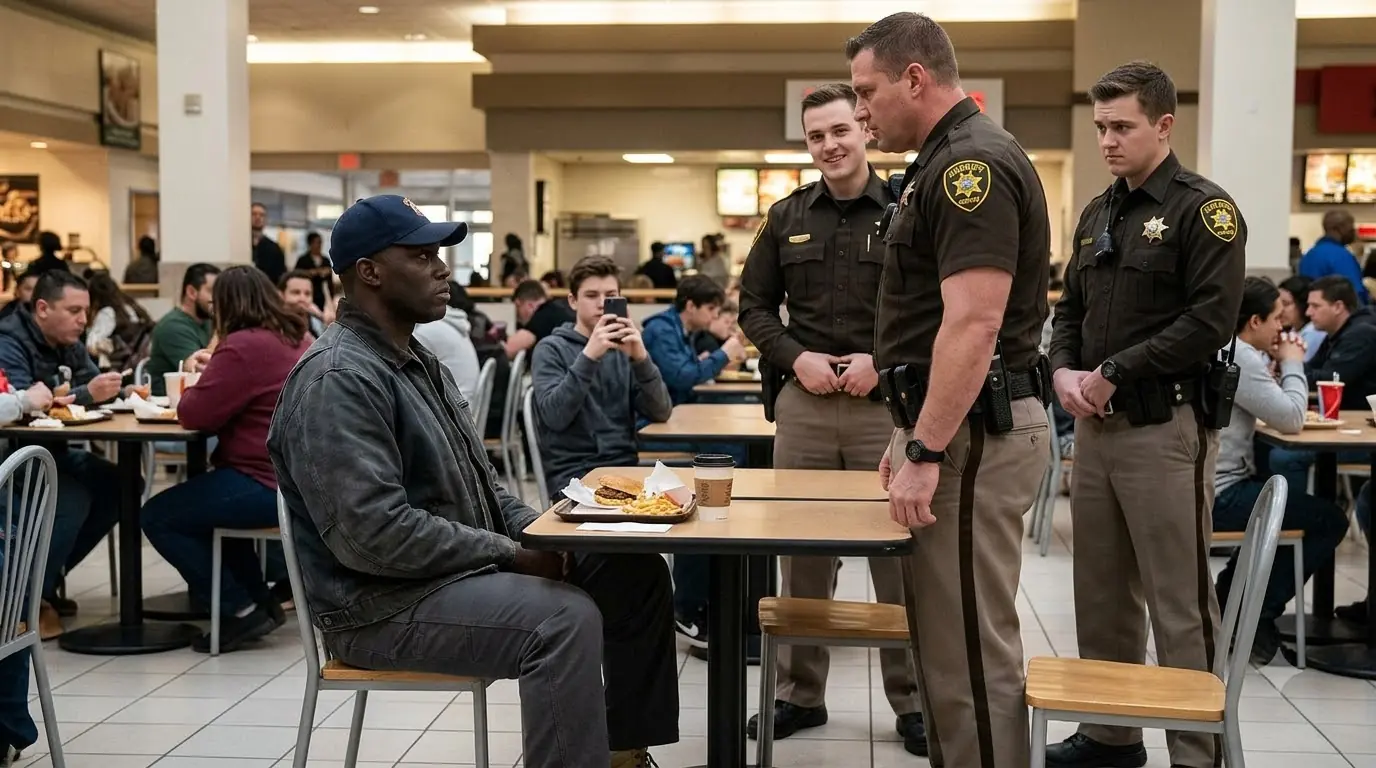
He sat alone inside the sprawling Westbridge Gallery food court, slowly drinking coffee beside a half-finished burger while hundreds of shoppers moved around him. Children chased one another between tables. Employees shouted order numbers. Music drifted from ceiling speakers. Marcus appeared to be another middle-aged man killing time before returning to work.
That was exactly what he wanted everyone to believe. At 1:17 p.m., he glanced toward the glass entrance for perhaps the 20th time. The person he was waiting for was 7 minutes late. Marcus didn't touch his phone. He simply adjusted his chair enough to see the entrance reflected in a polished metal pillar.
What nobody around him knew was that Marcus was special agent Marcus Hail, a veteran federal investigator assigned to a public corruption task force. For eight months, his team had been investigating an organized theft operation involving high-value electronics disappearing from commercial warehouses before reaching retailers. The thefts themselves were serious, but the investigation had become far more troubling when evidence suggested somebody with access to law-enforcement information was warning the suspects before warrants and surveillance operations. Three investigations had collapsed within hours of being authorized, targets vanished, vehicles disappeared. Phones were destroyed.
Somebody was leaking information. That afternoon, Marcus was supposed to meet a nervous warehouse supervisor named Ethan Cole, who claimed he could identify the person supplying confidential information. Ethan had refused to enter an FBI office. He believed he was being watched. He selected the crowded mall because he thought nobody would try anything surrounded by hundreds of witnesses.
Marcus had reluctantly agreed. Then three uniformed sheriff's deputies entered the food court. Deputy Ryan Mercer walked in first, muscular and confident, with two younger deputies, Tyler Boon and Kyle Harris, following several steps behind. They were there officially because mall security had reported a minor argument near a jewelry kiosk. But by the time they arrived, security had already resolved it.
They could have left. Instead, Mercer bought a drink and began walking through the food court as though the place belonged to him. Boon spotted Marcus first. "Look at this guy," he murmured. Marcus didn't hear the exact words, but he saw Boon glanced toward him and laugh.
Mercer followed his gaze. There was nothing remarkable happening at Marcus' table. He was sitting quietly eating lunch, but Mercer noticed something that irritated him. Marcus was observing the room instead of looking down when the deputies approached. Mercer changed direction.
"You waiting for somebody?" he asked. Marcus looked up. "Yes, a friend.", mercer smiled. "Got a name?" Marcus studied him for half a second.