1. If You Can’t Balance on One Leg for 30 Seconds, Your Functional Age Is Already Higher Than Your Real Age
Standing on one leg is a useful test of balance because it requires coordination among the eyes, inner ear, nervous system, muscles, and joints. Poorer one-leg balance is associated with declining physical function and a greater risk of recurrent falls in middle-aged and older adults.
However, failing to hold the position for 30 seconds does not scientifically prove that someone’s “functional age” is older than their chronological age. Balance ability varies with actual age, health conditions, previous injuries, vision, medications, footwear, and whether the eyes are open or closed.
Research often uses shorter thresholds in older populations. For example, an inability to stand on one leg for at least 10 seconds has been associated with poorer health outcomes in some observational studies, but one result cannot diagnose frailty or predict exactly how long someone will remain mobile.
A more complete mobility assessment may include walking speed, repeated chair stands, side-by-side balance positions, and other lower-body performance measures. The National Institute on Aging’s Short Physical Performance Battery combines several such tests rather than relying on one balance result alone.
Practical takeaway: Practice balance near a stable counter or wall, but do not attempt an unsupported one-leg test when you already feel unsteady.
2. Standing Up from the Floor Is True Strength—Not Muscle Size
Being able to get down to the floor and rise again requires much more than large muscles. It combines lower-body strength, power, balance, coordination, flexibility, joint mobility, and confidence.
Floor-transfer ability is especially important for older adults because a person who falls may need to stand up without assistance. Difficulty rising can increase the risk of remaining on the floor for an extended period, potentially leading to dehydration, pressure injuries, fear, and loss of independence. Recent research continues to evaluate floor-rise training as a practical way to improve this safety skill.
One observational study found that performance on a sitting-rising test was associated with survival, but this does not mean the test determines a person’s future or that everyone must rise without using their hands. People with arthritis, joint replacements, dizziness, osteoporosis, or neurological conditions may need support despite having useful strength.
Practical takeaway: Chair stands are a safer starting point. With professional guidance, floor-transfer practice can later be added according to the person’s ability.
3. Weak Ankles Are Behind Most Age-Related Falls—Do Heel Raises Every Day
Ankle strength and control are important for balance, walking, climbing stairs, and correcting small changes in body position. Heel raises strengthen the calf muscles and can support ankle function.
But saying weak ankles cause “most” age-related falls is inaccurate. Falls usually have several contributing factors, including reduced balance, general leg weakness, vision problems, unsafe footwear, medication side effects, low blood pressure, foot disorders, cognitive impairment, environmental hazards, and chronic disease.
Heel raises can be useful, but they should be part of a broader program that includes balance exercises, hip and thigh strengthening, walking or other aerobic activity, and movements that improve coordination. U.S. physical activity guidance recommends that older adults combine balance, aerobic, and muscle-strengthening activities.
A beginner may stand behind a sturdy chair, rise slowly onto the toes, pause briefly, and lower with control. People with severe balance problems, recent injuries, foot ulcers, or significant pain should seek professional advice first.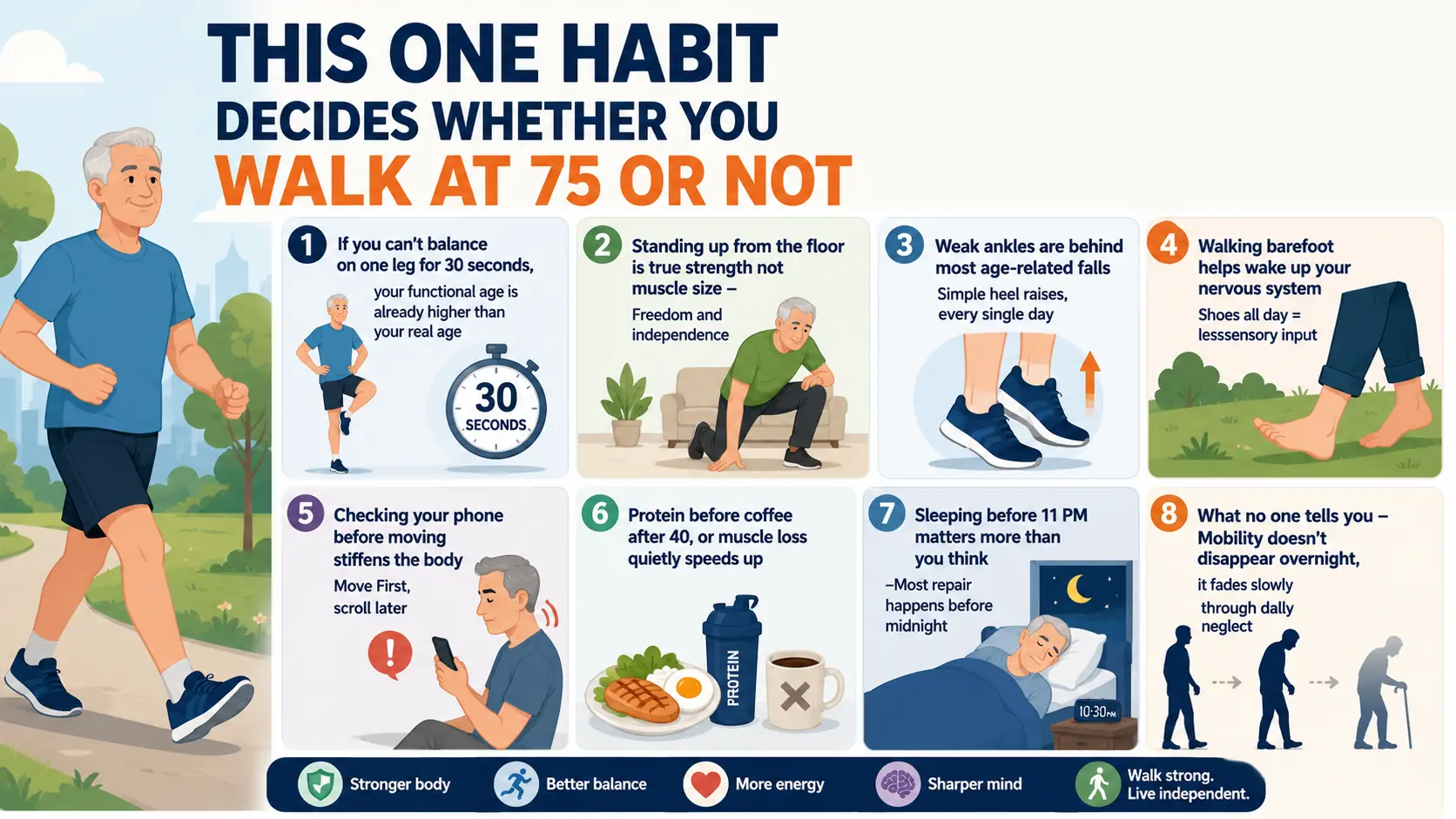
4. Walking Barefoot Helps Wake Up Your Nervous System
The soles of the feet contain sensory receptors that provide information about pressure, surface texture, and body position. Barefoot movement may increase direct sensory feedback and engage small muscles in the feet.
However, research comparing barefoot conditions with different types of footwear remains mixed, and there is not enough evidence to claim that everyone should walk barefoot to protect mobility. The effects depend on the person, the surface, the activity, and the type of shoe being compared.
Barefoot walking may be unsafe for people with diabetes-related neuropathy, poor circulation, reduced sensation, foot deformities, open wounds, or a high risk of falling. These individuals may not feel an injury and could benefit more from supportive, properly fitted footwear.
Wearing shoes all day also does not automatically “switch off” the nervous system. Poorly fitting or excessively restrictive shoes may interfere with comfort and movement, but good footwear can improve stability and protect the feet.
Practical takeaway: Healthy adults may safely perform brief barefoot exercises indoors on a clean, nonslip surface. Others should follow advice from a podiatrist or physical therapist.
5. Checking Your Phone Before Moving Stiffens the Body
There is no strong evidence that looking at a phone immediately after waking directly causes the body to become stiff.
Morning stiffness is more commonly related to prolonged inactivity during sleep, arthritis, muscle tension, previous exercise, poor sleeping position, or certain inflammatory conditions. Remaining sedentary for long periods can contribute to discomfort, but the phone itself is not the biological cause.
Still, the advice to move before scrolling can be a useful behavioral strategy. Beginning the day with a few minutes of walking, gentle mobility work, or normal household activity interrupts sedentary time and makes movement intentional.
Older adults are encouraged to reduce prolonged sedentary behavior and participate regularly in activities that support strength, balance, and endurance.
Try ankle circles, shoulder rolls, several supported chair stands, or a short walk. Movements should remain comfortable rather than forcing painful stretches.
6. Protein Before Coffee After 40, or Muscle Loss Quietly Speeds Up
Age-related muscle loss is real, but coffee before protein does not automatically accelerate it.
Muscle health depends mainly on sufficient total protein and energy intake, regular resistance exercise, adequate vitamin and mineral intake, and the management of illness. Older muscles become less responsive to small amounts of protein, which is one reason adequate dietary protein becomes increasingly important with age.
Many adults consume most of their protein at dinner and very little at breakfast. Including eggs, yogurt, milk, fish, tofu, beans, or another protein source in the morning may help distribute protein more evenly throughout the day.
Some studies suggest that increasing breakfast protein may support muscle mass, but the ideal timing remains uncertain. A recent review concluded that more high-quality trials are still needed, and broader evidence indicates that total intake may matter more than the exact hour protein is consumed.
Coffee is not a replacement for breakfast, but it does not need to be eliminated. Adults with kidney disease or another condition affecting protein needs should follow individualized medical advice.
7. Sleeping Before 11 PM Matters Because Most Repair Happens Before Midnight
Sleep supports memory, immune function, metabolism, hormone regulation, and tissue recovery. Consistent, sufficient sleep is therefore important for maintaining physical and mental function.
But the statement that “most repair happens before midnight” is misleading. The body does not recognize midnight as a universal biological deadline. Sleep structure depends on when a person falls asleep, how long they sleep, their internal circadian rhythm, and whether sleep is repeatedly interrupted.
Deep sleep tends to be concentrated earlier in a person’s sleep period, regardless of whether that period begins at 9:30 p.m. or later. Meanwhile, REM sleep becomes more prominent during later sleep cycles.
Going to bed at a consistent time that fits the body’s natural light-dark rhythm may improve sleep quality. Artificial light and electronic devices late at night can delay circadian signals in some people, but there is no single 11 p.m. cutoff that applies to everyone.
The more reliable priorities are adequate duration, regular timing, limited late-night light exposure, and evaluation of persistent insomnia, snoring, or daytime sleepiness.
8. Mobility Does Not Disappear Overnight—It Fades Slowly Through Daily Neglect
This is the strongest message on the list, although “neglect” should not be used to blame people whose mobility is affected by disease, injury, disability, pain, or limited access to safe exercise.
Muscle strength, power, balance, and endurance can decline when they are not used. A person may gradually stop taking stairs, getting onto the floor, walking longer distances, or carrying everyday objects. Because the decline is slow, it may not become obvious until a fall, illness, or difficult task exposes it.
The good news is that some age-related functional decline can be slowed—and sometimes partially reversed—through regular, appropriately scaled activity. Maintaining mobility is closely connected to the ability to remain independent, participate socially, and continue living at home.
Federal guidance recommends that older adults perform aerobic activity, strengthen major muscle groups, and include balance training each week. Exercise programs that combine strength and balance can meaningfully reduce fall risk.
The Habit That Matters Most
The most protective habit is not balancing for exactly 30 seconds, eating protein before coffee, walking barefoot, or falling asleep before a specific clock time.
It is consistently using your body in several ways:
-
Walk or perform another suitable aerobic activity.
-
Strengthen the legs, hips, back, and upper body.
-
Practice balance safely.
-
Break up long periods of sitting.
-
Eat enough protein and overall nutrients.
-
Get consistent, restorative sleep.
-
Address vision, medication, foot, joint, or neurological problems that affect mobility.
Mobility is not guaranteed, but it is trainable. Starting with safe, repeatable actions today can help protect the strength and confidence needed for the years ahead.