“We don’t take charity.” That was the first thing Wade Mercer said when the eighty-year-old woman in the faded blue apron held out a bowl of beef stew to him beneath the New Mexico sun. Wade stood six foot two in road-stained boots and a leather vest, tattoos running down both forearms, with thirty-one members of the Red Mesa Riders scattered behind him beside motorcycles that had begun overheating on an empty stretch of old Route 66. The woman looked up at him as calmly as if he were a neighbor who had arrived late for supper and said, “Good, because I’m not offering charity. Sit down before it gets cold.”
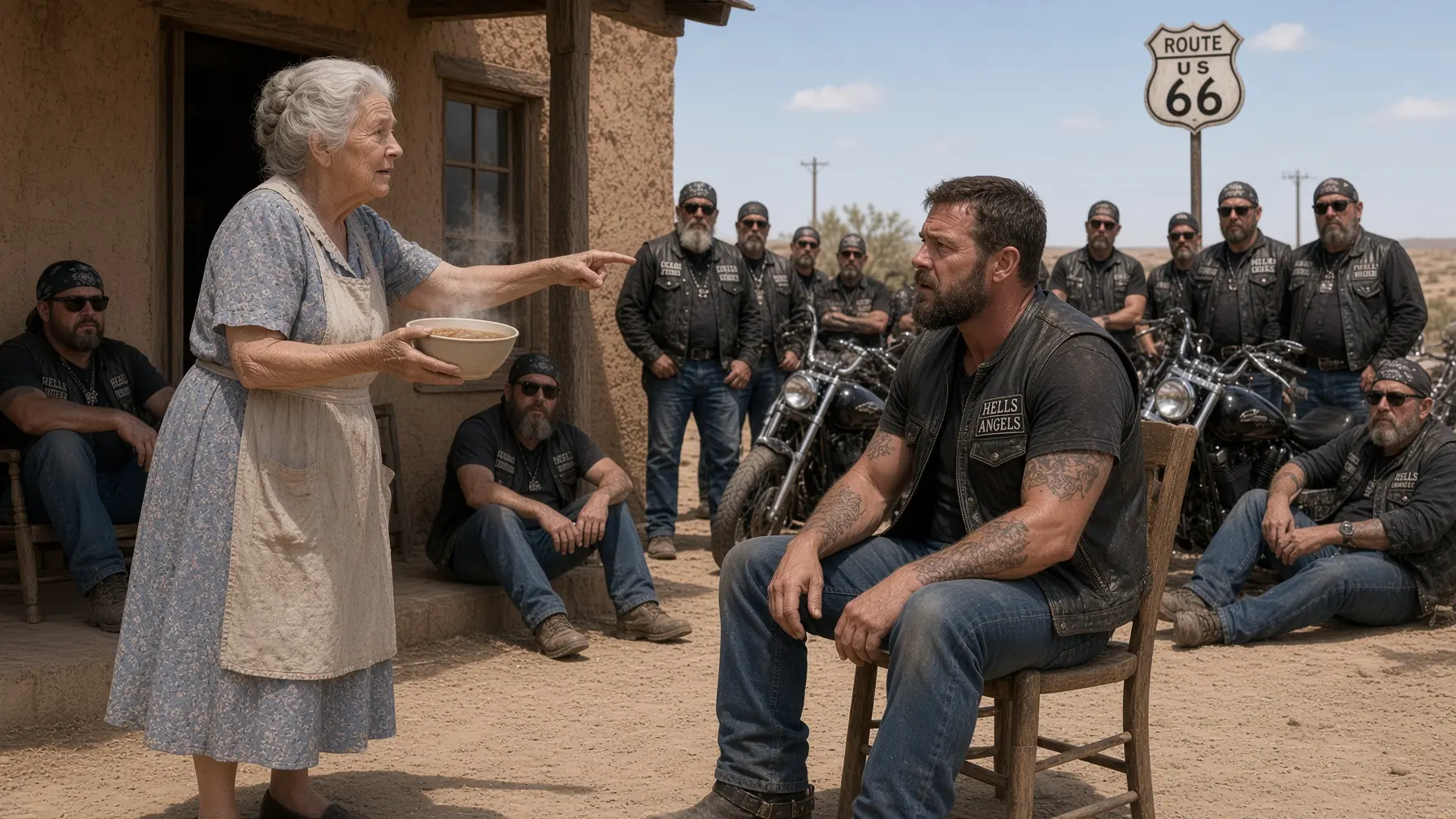
Wade sat down. Thirty-one other bikers followed him, some on porch steps, some beneath the pecan trees, some cross-legged in the dusty yard because there was nowhere else to sit. None of them understood yet that an overheated motorcycle had just brought them to a house they would remember for the rest of their lives.
The trouble had started forty minutes earlier when Wade noticed the temperature gauge on Deacon Miller’s old touring bike climbing too fast. Two other machines were beginning to run rough, and his own motorcycle had shuddered twice beneath him in that particular mechanical way experienced riders did not ignore. He raised one fist, slowed the column, and guided all thirty-two motorcycles onto a cracked shoulder where the asphalt dissolved into gravel and desert scrub.
The engines went quiet one by one. There was no service station in sight, no reliable cell signal, and almost no shade beyond what the bikes themselves provided. The men had water, but not enough to keep thirty-two riders comfortable if they remained stranded for several hours in triple-digit heat.
“How bad?” Wade asked. Deacon crouched beside his bike, studied the engine, and finally said, “Bad enough that if I ride it much farther before it cools, I’ll regret it.” Wade looked both directions along the road, saw nothing moving, then noticed the house.
It sat perhaps two hundred yards back from the highway behind a wire fence and a line of old pecan trees. The adobe structure had clearly been expanded over decades, each section slightly different from the last, with a covered porch wrapping around the front and an old shed leaning against the rear property line. Standing beneath one of the trees was a small elderly woman watching them.
She did not retreat when Wade noticed her. She simply studied the row of motorcycles, the leather vests, the tattoos, and the men standing beneath the sun, then raised one hand in acknowledgment. After that she turned and walked toward the house.
“She’s probably calling the sheriff,” Leo Barrett said. Wade removed his helmet and wiped sweat from his forehead. “Then she’s calling the sheriff.”
Two minutes later the front door opened again. The woman returned with a large pitcher in both hands, accompanied by an elderly man moving slowly behind a cane. They reached the gate, the man opened it completely, and the woman called across the gravel, “Cold water and lemonade over here if you need it.”
Nobody moved.
These were men who had crossed deserts, slept beside highways, repaired motorcycles beneath thunderstorms, and spent enough years being watched suspiciously that they usually knew exactly what strangers expected of them. An elderly couple opening a gate and inviting all of them into the yard created a problem for which none of that experience provided a script. Deacon finally looked at Wade and asked, “She serious?”
“She opened the gate.”
“That wasn’t my question.”
Wade looked at the overheated motorcycles, then at his crew. “We’re going.”
Thirty-two bikers walked across the gravel toward the little adobe house. They did not swagger, and nobody revved an engine or tried to make an entrance; the heat had burned most of the performance out of them hours earlier. The old woman stood beside a folding table with cups, lemonade, and two large water jugs as if hosting thirty-two strangers in leather had been on her calendar all week.
“My name’s Rose Calder,” she said. “That’s my husband, Walter. Cups are there, water’s there, lemonade’s here, and if you empty something, tell me instead of standing around pretending you’re not thirsty.”
Wade accepted the first cup. The lemonade was cold enough that condensation ran across his fingers before he had taken the second swallow. Around him, hardened men who normally seemed incapable of silence drank without talking for nearly two minutes.
Deacon finally asked what everyone had been wondering. “Why’d you open the gate?”
Rose looked at him. “Because you were stuck.”
“You don’t know us.”
“I know what the patches mean.”
Deacon glanced toward Wade. Rose capped the pitcher and added, “I also know heat exhaustion doesn’t care what club you belong to, and I had more water than you did. That was enough information for me.”
Walter had already returned to a chair beside the porch. He was eighty-three, tall even after age had bent him slightly, thin without appearing fragile, with swollen hands that looked as if they had spent sixty years around lumber, concrete, wire, and tools. Wade found himself standing near him because the hands told him something before Walter did.
“You built this place?” Wade asked. Walter nodded toward the house. “Started with two rooms in 1960. Added the kitchen after Rose and I had our first boy, then the back bedrooms once we realized children apparently require space.”
Wade almost smiled. “Construction?”
“Most of my life.”
“Me too, once.”
Walter looked at him a little more closely after that.
Wade had worked residential construction from his late teens into his thirties before motorcycles, trucking, and the accumulated complications of life sent him in other directions. He still knew what a failing load-bearing post looked like. He knew what water intrusion looked like too, and when he finally stopped seeing the Calder house as scenery and started seeing it as a structure, he noticed both.
The left porch post leaned several degrees. A crack ran from the north window toward the roofline, and the adobe beneath it showed discoloration consistent with prolonged moisture. Wade did not mention any of it because Rose had appeared in the doorway and announced, “There’s stew if anybody’s hungry.”
Leo stared at him. “Did she just say—”
“Yes.”
“For all of us?”
“Apparently.”
“Wade, there are thirty-two—”
“Stop calculating another woman’s stew.”
The pot could not feed thirty-two large men generous portions, so Rose did not try. She stretched it with cornbread, beans, sliced tomatoes, and whatever else appeared from cabinets and the refrigerator, serving small bowls until every person had something warm in his hands. Some men ate standing beneath the trees, several sat along the porch, and three younger riders ended up on overturned buckets beside the garden.
Something changed in the yard while they ate. The Red Mesa Riders were accustomed to people lowering blinds when they arrived, watching from behind cash-register counters, or asking them to leave establishments before anyone had done anything wrong. Rose had seen exactly who they were and made a different calculation.
Wade sat beside Walter and asked, “Does she always do this?”
“Feed people?”
“Strangers.”
Walter considered it. “If somebody’s hungry and she has food, she feeds them.”
“You never worry about who shows up?”
Walter looked toward Rose, who was handing Deacon another piece of cornbread. “I worry about plenty. I just try not to let fear make every decision.”
That sentence stayed with Wade.
Once the meal was finished, nobody seemed in a hurry to leave. The bikes needed cooling anyway, and the shade beneath the pecan trees made the afternoon bearable. Without anyone organizing it, the bikers began noticing things that needed repair.
Grant Holloway fixed the dragging gate hinge with a hammer and a replacement pin he found in his tool roll. Leo discovered the outdoor faucet was leaking around a worn washer, while another rider tightened loose boards along the garden fence. Rose protested once, realized nobody was listening, and went inside to wrap leftover cornbread for them.
Then Wade overheard part of Walter’s phone call.
“I know what the notice says, David,” Walter said quietly. “No, we’re not moving to Phoenix just because you’re worried. We’ll handle it.”
There was a pause.
Walter’s voice hardened. “I said we’ll handle it.”
When the call ended, Wade waited before approaching him. “County notice?”
Walter’s expression closed. “Nothing you need to concern yourself with.”
“Maybe not.”
Wade looked toward the north wall. “But that crack is structural enough to investigate, your porch post is failing at the base, and you have moisture intrusion behind that adobe.”
Walter stared at him.
“You really were a builder.”
“Fifteen years.”
Walter rested both hands on the cane. “County inspector came last week.”
“How long did he give you?”
“Thirty days to correct several safety issues or enter into a formal remediation plan.”
Wade nodded slowly. That was more realistic than an instant eviction, but for an elderly couple living on limited income, the difference might not feel large. Walter explained that the county’s concerns included the porch structure, damaged adobe, electrical work from several eras, and water management around the foundation.
“My son wants us to sell,” Walter said. “Move into something smaller near him.”
“And you?”
Walter looked at the house.
“I built it.”
That was the whole answer.
Rose and Walter had raised three children there. Walter’s father had spent his last years in the back bedroom, grandchildren had learned to walk across those floors, and Rose had cooked thousands of meals in a kitchen Walter had framed with his own hands. To anyone else it might have been an aging rural house; to Walter, selling it because he could no longer repair everything himself felt like admitting that age had taken ownership of his life.
Wade understood that more deeply than he wanted to.
“You have the inspection report?”
Walter nodded.
“Can I look at it?”
“You planning on arguing with the county?”
“No.”
Wade met his eyes. “I’m thinking about fixing what they found.”
Walter’s jaw tightened immediately. “We don’t take charity.”
Wade almost smiled because the words sounded exactly like something he would have said twenty years earlier. “Good, because you fed thirty-two men when you didn’t owe them anything. You treated us like people instead of a problem, so call what comes next whatever makes you comfortable.”
Walter said nothing.
Wade stood. “But I need to make some calls.”
His first call went to Luis Mendoza, a licensed general contractor in Albuquerque whom Wade had known since their construction days. His second went to Ray Navarro, an adobe restoration specialist. His third went to Benny Torres, a licensed electrician who sometimes rode with the club but had missed the trip because he was caring for a granddaughter.
By evening, Wade had something more useful than promises. Luis could send material pricing and help coordinate permits, Ray could inspect the wall the following morning, and Benny could evaluate the electrical system before anyone touched it. Wade made it clear to the Riders that enthusiasm did not qualify anyone to perform regulated work.
“If it needs a license, licensed people do it,” he told them. “If it needs engineering, we get engineering. Nobody turns this into a cowboy renovation because we want to feel useful.”
Grant nodded. “What can the rest of us do?”
“Whatever the professionals say we can safely do.”
That became the rule.
Ray arrived the following morning and spent nearly an hour examining the north wall. He found failed roof flashing that had allowed water behind an eight-foot section of adobe, but the foundation beneath it remained sound. The repair would be significant, though manageable if they replaced damaged material properly and corrected the source of the water before closing the wall.
Benny’s electrical assessment was less comforting. Several later additions had been tied into older circuits improperly, some wiring had deteriorated, and moisture had reached part of the service equipment. He shut down two questionable circuits immediately and told Rose she would be cooking with temporary approved power until he completed repairs.
“Can it be made safe?” Walter asked.
“Yes.”
“How much?”
Benny looked at Wade, then back at Walter. “Parts cost money. Labor is covered.”
Walter’s face tightened.
Benny added, “My grandmother fed me for twenty-seven years without sending invoices. Consider this delayed repayment to the human race.”
Rose laughed first.
Walter did not, but the corner of his mouth moved.
The riders returned in waves over the next two days, though not all thirty-two remained at once. Some had jobs and families waiting elsewhere, while others took turns transporting lumber, clearing work areas, digging drainage under direction, moving furniture, cooking, hauling debris, and doing the hundred small jobs that do not require pretending to be professionals. Luis coordinated structural carpentry with the county permit office, while Ray handled the adobe restoration and Benny supervised all electrical work.
Rose watched the first truckload of materials enter the yard with her arms crossed over her apron. She stayed very still until Walter came beside her and rested one hand against her shoulder. Wade saw the gesture and deliberately looked away.
Some moments did not improve by acquiring an audience.
The porch came first. Once Grant and Luis opened the base of the failing support, they discovered rot hidden beneath layers of paint, leaving far less sound wood than anyone had expected. Temporary shoring went in before the old post came out, and the replacement was placed on a properly detailed base that would keep it separated from recurring ground moisture.
Walter sat nearby watching every step.
The expression on his face troubled Wade. It was not distrust of the crew; it was the pain of a craftsman watching other hands perform work that his own hands once would have done. Wade finally sat beside him.
“You hate this.”
Walter looked at him. “I hate needing it.”
“That’s different.”
“Doesn’t feel different.”
Wade nodded. “Probably because pride is stupid about vocabulary.”
Walter laughed once despite himself.
Behind the north wall, Ray found something neither of them expected. It was not treasure, money, or some hidden historical artifact, only an old handmade brick that Walter had saved during a repair decades earlier. Scratched across one face were four numbers: 1960.
Walter held the brick for a long time.
“That came from the original foundation,” he said. “First week we started building.”
“Why’d you keep it?”
Walter shook his head. “Don’t know.”
Wade studied him. “Sure you do.”
Walter looked up.
“You built everything around it.”
The old man’s hand remained across the brick.
Saturday brought real rain.
By then the porch structure was secure, the roof flashing above the damaged wall had been corrected, and Ray had enough of the exterior protected that the rain posed far less danger than it would have three days earlier. Still, tarps were checked, drainage channels monitored, and exposed restoration areas protected because nobody involved intended to destroy good work by becoming careless near the finish line.
Rose responded to the weather by cooking.
She made eggs, biscuits, coffee, beans, and enough food to convince anyone watching that feeding workers was a competitive event. Carmen Alvarez, a carpenter who arrived after hearing about the project through Benny, brought tamales with her husband and two adult sons, and within an hour she and Rose were behaving like women who had known each other for twenty years.
The worksite became something Wade had not planned. It was no longer thirty-two bikers repaying an old couple for lunch. It was electricians, builders, riders, family members, neighbors, and friends of friends working inside a structure governed by people who knew what they were doing.
That distinction mattered.
At midday a black SUV pulled near the gate. A man in his fifties stepped out, stood for several seconds watching the activity, then asked for Walter. It was David Calder, Walter and Rose’s youngest son, who had driven from Phoenix after finally learning the extent of the county notice.
His first conversation with his father took place inside. Wade did not hear it and did not try. Twenty minutes later David returned wearing work clothes pulled from the back of his vehicle and asked Ray where he could help.
Ray handed him a shovel.
David spent four hours assisting with the drainage trench.
Walter watched.
The old tension Wade had seen in him whenever his son was mentioned seemed to loosen by degrees. David had spent months trying to save his parents by persuading them to leave the house, and now he was beginning to understand that helping them stay safely might have been the conversation they needed first.
The original brick returned to the wall late Saturday afternoon.
Ray chose a structurally appropriate location near the repaired section and let Walter inspect it before placement. The scratched 1960 remained visible.
Wade noticed that it sat slightly crooked.
Ray reached to correct it.
“Leave it,” Walter said.
Everyone stopped.
“It was crooked the first time.”
Walter touched the numbers with one fingertip. “Rose was pregnant with David’s oldest brother and I was trying to finish the foundation before he came. I set that thing in crooked because I was rushing, looked at it every year afterward, and told myself someday I’d fix it.”
Wade smiled. “Looks like someday finally came.”
Walter shook his head. “No.”
He looked at the brick.
“Someday I learned it didn’t need fixing.”
Ray left it exactly where it was.
Sunday became inspection day before the official inspection. Wade walked every repaired area with the professionals, making sure documentation was complete and that nothing depended on memory or storytelling. Benny labeled every circuit, Ray photographed the wall restoration in stages, Luis prepared invoices showing donated labor separately from materials, and permit records were placed in a folder for the county.
One remaining issue belonged to the utility company. The service conductors on the utility side of the meter showed enough age that Benny wanted them inspected, but only the utility could replace them. Wade called, explained the documented safety concern, and secured a Monday service appointment rather than pretending a personal connection could magically override the company’s process.
Monday morning, the utility crew arrived.
They evaluated the service, replaced deteriorated components on their side, and issued written confirmation that the supply was safe. Benny completed his final tests afterward. For the first time in years, every major circuit in the Calder house had current documentation behind it.
The county inspector arrived Tuesday.
His name was Daniel Brooks, and he had issued the original notice. He looked around the yard at the repaired porch, newly graded drainage, restored wall, permit notices, electrical documentation, and workers cleaning up the final materials. Then he began his inspection without commenting on any of it.
Nobody tried to charm him.
Nobody told him how kind Rose was.
Nobody mentioned thirty-two stranded bikers.
The house either complied or it did not.
Daniel spent nearly an hour inside and outside. He read Ray’s restoration documentation, checked Luis’s structural work, reviewed Benny’s electrical report, and confirmed the utility completion. He found two minor corrections—one missing protective cover and a drainage outlet requiring additional stabilization—both of which could be addressed without extending the case.
When he finished, Walter sat in his usual porch chair.
Daniel stood in front of him. “Mr. Calder, the original notice identified several conditions that required correction. Those major conditions have been corrected, and the remaining minor items can be closed after photographic verification.”
Walter’s hands tightened slightly around his cane.
Daniel continued. “Assuming those items are completed as agreed, there is no current basis for further enforcement action against the property.”
Rose covered her mouth.
Walter only nodded.
“Thank you,” he said.
Then he added, “For being fair.”
Daniel looked around the yard before leaving. “I see a lot of difficult properties in this job.”
His eyes moved toward the crew.
“I don’t often see this many people decide a difficult property belongs to all of them for a week.”
When his vehicle disappeared down the road, the yard released a breath it had been holding for days.
Grant sat down on the porch steps. Leo leaned against the fence and stared at the ground. Deacon walked behind the equipment trailer and stayed there long enough that nobody bothered asking whether he needed something.
Wade approached Rose.
“It’s done.”
Her eyes filled.
She did not hide it.
“I fed you because you were hungry,” she said quietly. “That was all.”
Wade shook his head. “You opened the gate.”
Rose looked toward the highway.
Then back toward the house.
“Maybe somebody had to.”
Later that afternoon, David found Wade near the tool trailer. He apologized for the assumptions he had made when his parents first told him thirty motorcycle riders were involved. Wade accepted without pretending the assumption was harmless.
“I thought keeping Dad safe meant getting him somewhere smaller,” David said. “I didn’t understand that this house wasn’t just where he lived.”
Wade looked toward Walter’s porch chair.
“You understand now.”
David nodded. “I took two weeks off.”
“For what?”
“There are things I want to repair beside him while he’s still here to tell me I’m doing them wrong.”
That answer earned Wade’s respect.
The final surprise came before the riders left.
Walter called Wade into the back bedroom and pulled a wooden box from the closet shelf. Inside were photographs dating back more than sixty years: Walter as a young man laying adobe, Rose beside unfinished walls, children sitting on lumber piles, and one picture of the original porch before the pecan trees were tall enough to provide shade.
Walter handed Wade the photograph of himself and Rose beside the half-built house.
“She was laughing because I dropped mortar on my boot.”
Wade looked at the picture.
“Third time that week,” Walter added.
“Did she reconsider marrying you?”
“She had already made that mistake.”
Wade laughed.
Walter closed the box.
“I’ve been trying to figure out what to say to you.”
“You don’t have to.”
“I know.”
Walter looked directly at him. “That’s why I’m going to say only what I can say accurately.”
Wade waited.
“In eighty-three years, I have seen enough meanness to know it exists.”
Walter rested one hand on the box.
“I’ve also seen enough kindness to know people make a mistake when they believe meanness is the deeper thing.”
Wade did not answer immediately.
Walter continued. “Thirty-two men broke down on my road wearing clothes that make half the world nervous. My wife saw thirsty people.”
He looked through the doorway toward Rose.
“You saw a broken house.”
Then he looked at Wade.
“I think we’re better off when people keep looking one layer deeper.”
Wade swallowed.
“Thank you for opening the gate.”
Walter nodded.
“Thank you for walking through it.”
The Red Mesa Riders left near five that afternoon.
They did not roar away dramatically because Walter’s neighbors did not deserve thirty-two motorcycles announcing a moral lesson across the desert. Engines started one by one, riders checked straps and fuel, and Rose packed food into saddlebags despite multiple objections.
Wade was the last to leave.
At the gate, he looked back.
The porch stood straight. The repaired north wall carried the original crooked 1960 brick, the drainage line ran away from the foundation, and inside the house every unsafe circuit had been corrected and documented.
Walter sat in his chair.
David stood beside him.
Rose stood on the porch beside Carmen, apparently having acquired a new best friend without consulting anyone.
Walter raised one hand.
Not a wave exactly.
The same quiet gesture Rose had given them from beneath the pecan trees when thirty-two overheated motorcycles first appeared beside the road.
Wade raised his hand back.
Then he rode.
Deacon pulled beside him after they had gone several miles.
For nearly a minute he said nothing.
Then his voice came through the helmet radio.
“Wade?”
“Yeah?”
“Next time my bike overheats, remind me not to complain too quickly.”
Wade smiled inside his helmet.
“Why?”
Deacon looked ahead at the road disappearing into New Mexico.
“Because apparently you never know what’s waiting on the other side of stopping.”
The Riders continued west as evening settled across the desert. Behind them, on an old stretch of highway most travelers crossed without noticing, a house built by two young people in 1960 stood beneath the pecan trees with its original crooked brick returned to the wall.
The house was not saved because thirty-two terrifying bikers arrived like heroes.
It was saved because an old woman saw strangers in trouble and opened a gate.
Because those strangers noticed trouble in return.
Because skilled people respected the limits of what they knew and called people who knew more.
Because a son learned there was a difference between moving his parents somewhere safe and helping make the place they loved safe again.
And because kindness, when treated seriously, has a peculiar way of becoming practical.
Sometimes it looks like lemonade.
Sometimes it looks like stew stretched across too many bowls.
Sometimes it looks like licensed electrical work, properly restored adobe, corrected drainage, permits, inspections, and people carrying lumber through the rain.
Most of the time it begins much smaller.
Someone sees another human being standing on the wrong side of a difficult moment and decides not to ask first whether helping will be convenient.
Rose Calder had looked across a wire fence at thirty-two men most people would have avoided.
She had seen heat.
Thirst.
Broken motorcycles.
People.
That was all.
It had been enough.
Months later, the Riders passed through New Mexico again.
Nobody broke down.
They stopped anyway.
The Calder gate was already open when they arrived.
Rose stood on the porch with her apron on and both hands planted against her hips.
“You boys eating?”
Wade removed his helmet.
“We don’t take charity.”
Rose stared at him for two seconds.
Then she pointed toward the house.
“Good. Because you’re fixing the loose hinge on my pantry door after supper.”
Thirty-two bikers laughed.
Walter sat beneath the pecan tree smiling.
And Wade understood then that Harold had been right about something larger than houses.
What lasts is rarely the perfect thing.
It is the thing people keep choosing to repair.