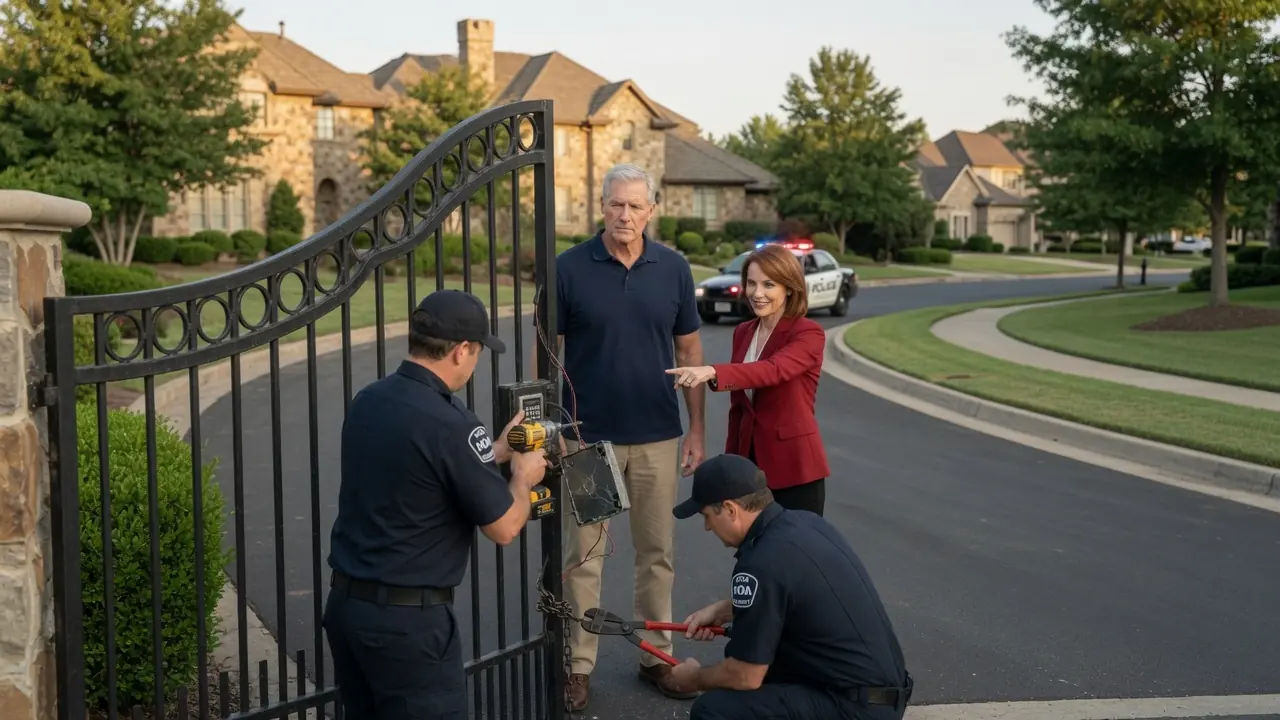
The first strike bent the steel guard protecting the gate’s lower hinge.
The second cracked the control box beside the keypad and left it hanging from a strip of wire.
I stood on the private side of my property line with both hands empty and visible.
Thirty uniformed security guards filled the road outside my home.
Only four were touching tools.
One held bolt cutters around the secondary chain. Another had positioned a pry bar near the damaged hinge. A third carried a compact impact tool. The fourth watched a tablet displaying an order that should never have reached him.
The remaining guards had been assigned to traffic control, recording, and perimeter observation.
They were not a mob.
That distinction mattered.
They were trained employees following a legitimate company system that had delivered an illegitimate instruction.
Standing beside the access team was Lydia Voss, president of the Cedar Ridge Estates Homeowners Association.
She wore a bright red blazer that seemed designed to make her visible in every photograph.
“The gate is an emergency obstruction,” she said. “Finish removing it.”
Behind me, the house was clearly occupied.
My wife’s coffee mug rested on the front porch rail. Our daughter’s SUV sat near the garage. Our grandson’s blue bicycle leaned against the brick wall, its helmet hanging from one handlebar.
Nothing about the property looked abandoned, public, or shared.
The field commander looked through the steel bars and saw all of it.
His name was Ethan Cole.
He raised his radio.
“Central, I need live confirmation of the service boundary.”
Static answered him.
Lydia stepped closer to the broken keypad.
“You have an emergency work package. Do not let him delay you again.”
The access supervisor looked at Ethan.
Her tablet still showed an active removal step.
The command to stop had not yet reached her separate channel.
“Secondary restraint first,” she ordered.
The bolt cutters tightened slightly around the chain.
Then the first black SUV appeared at the far end of the road.
A second turned in from the service entrance almost at the same moment.
Neither vehicle used sirens.
Neither accelerated.
They moved slowly toward the shoulders, leaving the center lane open.
Three more SUVs arrived during the next minute.
Men and women in plain clothes stepped out with their hands visible. Small green indicators blinked on their body cameras.
No weapons appeared.
No one crossed toward the guards.
The first vehicle stopped far enough away that every Sentinel Response truck could leave without obstruction.
A guard near the roadside whispered, “Who are they?”
I did not answer.
My attention was twenty yards behind me.
My wife, Ellen, had taken our daughter and grandson into the rear family room. Eight-year-old Noah had brought the paper airplane he had folded during lunch.
He had left the bicycle helmet on the kitchen counter.
The fact that he had obeyed without argument frightened me more than the tools.
I had retired because I was tired of bringing danger home.
Now it had arrived at the gate protecting the ordinary life I had promised my family.
Daniel Price stepped from the lead SUV.
For twenty years, Daniel had worked beside me in places where mistakes became headlines or funerals.
Now he ran the protection company I had founded and later left behind.
He stopped at the exterior edge of our property.
“Field Commander Cole,” he called. “My name is Daniel Price. We are the authorized protection detail for this occupied residence. We received a verified impact alarm at four twenty-eight. Our cameras are active, and your withdrawal lane is open.”
Ethan kept one hand near his radio.
“Your people remain where they are.”
“They will.”
“We are verifying authority.”
“That is all we are asking you to do.”
Lydia turned toward Daniel.
“These vehicles have no role in an HOA security operation.”
Daniel did not look at her.
He kept his eyes on Ethan.
“The resident denied consent on camera. Has forced-entry authority been confirmed?”
“No,” Ethan said. “The temporary hold remains active.”
“Then we will remain outside your work area while your company authenticates the order.”
Lydia pointed toward my damaged gate.
“The client representative authorized emergency removal.”
Ethan looked at her.
“A client code does not answer the property-scope question.”
For the first time that afternoon, Lydia appeared uncertain.
The five SUVs had not changed the law.
They had changed the number of witnesses.
Nine days earlier, none of this seemed possible.
That morning began with a bicycle bell.
Noah was visiting on Friday, and I had promised the blue bicycle would be ready.
It had spent the winter hanging above my garage workbench with a soft rear tire and a bell that produced more scrape than ring.
I tightened the brake cable and spun the wheel.
Ellen stood on the back step holding coffee.
“You checked that yesterday.”
“Yesterday it squeaked.”
“Yesterday you said it was perfect.”
“Those statements can coexist.”
She smiled over the rim of her mug.
Retirement had given us time for arguments that ended without meetings, deadlines, or calls from frightened people in distant cities.
For most of my adult life, ordinary mornings had belonged to someone else.
My phone vibrated on the workbench.
Routine check complete. No change.
The message came from Daniel.
There was no company name or location.
Nothing a stranger would have understood.
I turned the phone facedown.
Ellen noticed.
She always did.
“Routine?”
“Routine.”
The gate chime sounded at nine-twenty.
Lydia Voss stood on the common road with a clipboard beneath one arm.
She wore a white blouse, pressed trousers, and the patient smile she used when she believed a conversation was only a formality.
I walked down the driveway and stopped inside the closed gate.
“Martin,” she said, “I need a patrol access key.”
“For what?”
“We’ve had thefts near the northern perimeter.”
The thefts were real.
Two garages had been entered. Tools and expensive bicycles were missing. Residents wanted more visible patrols.
“Sentinel Response is expanding coverage,” Lydia continued. “Your driveway creates the only continuous route between the north road and the service entrance.”
She turned the clipboard toward me.
The neighborhood map showed a blue patrol line approaching our gate, continuing through our driveway, crossing beside the house, and exiting near the service road.
The map treated our occupied property as empty space.
“That is our private driveway.”
“It is the missing section of the perimeter loop.”
“Those facts can coexist.”
Her smile tightened.
“The board approved a security expansion.”
“The board approved an assessment and additional patrols in common areas.”
I had read the meeting minutes.
The same file identified Sentinel’s service boundary.
It covered community roads, the clubhouse, the walking trails, and the shared storage facility.
Our lot remained private.
“I can share motion alerts from the gate cameras,” I said. “Sentinel dispatch can receive clips when a person or vehicle approaches from the common road.”
“A camera cannot confront a thief.”
“Place an observation vehicle near the north turn. A guard can see both approaches without entering our property.”
“They still have to reverse or turn around.”
“In a verified emergency, call us. We can open the gate.”
“That creates delay.”
“So does confirming authority before entering an occupied home.”
I counted the alternatives on my fingers.
“Camera alerts. Observation from the common road. Entry during a verified emergency. Entry with our current consent.”
Then I lowered my hand.
“What I will not provide is a permanent patrol credential, unattended access, or permission to classify this driveway as common property.”
Lydia looked through the bars toward the open garage.
The bicycle rested on its kickstand.
Ellen’s coffee remained on the step.
“The neighborhood cannot function if every perimeter residence sets its own security policy.”
“A contractor’s route does not erase ownership.”
“Every part of the perimeter must answer to one authority.”
There it was.
Not observation.
Control.
“That authority ends at our property line.”
Lydia lowered the clipboard.
“This will become more difficult than it needs to be.”
“It became difficult when you asked for permanent access to an occupied home.”
She left without another word.
Before driving away, she remained parked on the common road for several minutes, typing into a tablet.
The records later showed what she entered.
At nine forty-three, Lydia changed the description of our approved residential gate.
It was no longer listed simply as a private access point.
She labeled it a security blind zone.
Two mornings later, Sentinel sent a route supervisor.
Priya Nolan arrived in a gray company vehicle and parked on the common road.
Unlike Lydia, Priya understood boundaries.
She photographed the gate, the street signs, and the occupied house before opening her tablet.
“I am here to compare the physical location with Sentinel’s service record,” she said. “I am not authorizing entry.”
Lydia arrived carrying the same map.
This time, the line through our driveway had been highlighted in yellow.
“The board authorized a full perimeter assessment,” she said. “Sentinel cannot complete it while Martin blocks the only continuous route.”
Priya opened the current service agreement.
The shared roads appeared in green.
Our property remained white.
“Routine patrol coverage ends at the common road,” she said. “A response on this lot requires a verified event and resident consent unless a separate lawful emergency authority applies.”
Lydia pointed at the route.
“This map shows access.”
“It shows one operational layer.”
“It is in your system.”
“That does not mean it is current.”
Priya selected another screen.
An older map appeared.
A faded blue line crossed the common road, passed through our gate, and continued beside the house.
A small square near the keypad was labeled:
AUXILIARY HOA ACCESS POINT
Priya checked the version date.
“This layer predates the current contract.”
“But it exists.”
“That is the problem.”
Lydia leaned closer.
“Then your patrols can use it until someone changes it.”
“No.”
Priya turned the tablet away.
“A field map cannot expand the client’s property rights.”
I showed her the architectural approval for the gate and the county access-control permit.
Both had been issued years before Lydia became HOA president.
“Even if the board disputed the gate,” I said, “it would require the normal enforcement process. A dispute would not authorize a contractor to dismantle it.”
“No one is discussing dismantling anything,” Lydia replied.
The answer came too quickly.
Priya opened a discrepancy report and attached photographs.
“The current contract excludes the residence. The older operational map labels it as auxiliary access. Compliance will trace the difference.”
She looked at Lydia.
“Until that review is complete, no field team should treat the old map as authority to enter.”
Lydia said nothing.
But before Priya closed the screen, she lifted her phone and photographed it.
Ellen had watched from the porch.
After they left, she found me inside the kitchen reading the HOA minutes again.
“You didn’t tell Priya what you used to do.”
“It wasn’t relevant.”
“That has never stopped people from using a title.”
To most residents, I was a retired operations consultant.
That was true.
It was also incomplete.
I had founded Hale Strategic Protection thirty-one years earlier.
What began with four employees in a rented office became a national risk-management and executive-protection company. We created emergency plans for corporations, public figures, hospitals, and families facing credible threats.
For decades, I directed responses to kidnapping attempts, stalking cases, civil unrest, and workplace violence.
The work consumed birthdays.
Anniversaries.
Dinners.
Ordinary Saturdays.
It also created enemies who did not disappear when I retired.
That was why Daniel maintained a discreet protection arrangement around our family.
His teams operated at a distance.
No checkpoint stood outside the house.
No armed guards followed us through grocery stores.
Most days, we never saw them.
I had spent enough years surrounding other people with visible security.
I did not want my grandson growing up inside a fortress.
Still, experience had taught me to distrust urgency around locked doors.
Years earlier, one of my supervisors had treated an access disagreement as a challenge to his authority.
A driver was injured before I reached the scene.
The company corrected the failure.
I never forgot how quickly professional confidence could become permission no one had granted.
Ellen sat across from me.
“I don’t want you pretending your old life never existed.”
“I’m not.”
“I just don’t want this house swallowed by it.”
Neither did I.
That afternoon, Sentinel’s compliance manager, Danielle Kerr, received Priya’s discrepancy report.
The following morning, I sent both the HOA and Sentinel a short notice.
Cedar Ridge Estates did not have our consent for routine patrol entry.
Sentinel’s current service boundary excluded our residence.
The old operational map appeared outdated.
Any route through our gate should remain suspended until the discrepancy was resolved.
I attached the current boundary page.
No biography.
No threat.
No mention of the company I founded.
Ellen read the letter over my shoulder.
“That may be the shortest thing you’ve ever written.”
“I am practicing retirement.”
“Keep practicing.”
Twenty-three minutes later, Danielle replied.
The notice had been received.
It was attached to the existing mapping review.
A no-consent warning had been added to the account while the review remained open.
That should have been enough.
It was not.
At two-seventeen that afternoon, a marked Sentinel patrol vehicle stopped outside our gate.
Priya was inside it.
Two guards stepped out.
Lydia already stood beside the keypad.
“What is this?” I asked.
“A controlled route test,” Lydia said. “Sentinel must determine whether a patrol vehicle can complete the northern loop.”
Priya looked through the bars.
“Mr. Hale, this instruction is for a non-forcible field check. Do you consent to entry for the test?”
“No.”
One guard found the acknowledged notice on his tablet.
Lydia folded her arms.
“He cannot block a safety test, then use the absence of the test as proof the route is unnecessary.”
“The route is unauthorized,” I said. “You are testing whether I will surrender access after refusing it in writing.”
Priya kept the work order open.
“We need three separate answers. Is there an active emergency?”
“The closed route creates an emergency,” Lydia said.
“Is a theft currently in progress?”
“Not at this moment.”
“Is there a medical or fire response requesting entry?”
“You know that is not what I mean.”
“Then there is no active emergency.”
Priya looked toward me.
“Do we have the resident’s current consent?”
“No.”
She turned the tablet so Lydia could see it.
“Does this instruction grant forced-entry authority?”
“I am the client representative.”
“That is not forced-entry authority.”
Lydia looked toward the guards.
“Cedar Ridge pays Sentinel to protect this community. Complete the route.”
Neither moved.
Priya’s voice remained calm.
“You may request a service. You cannot create authority from the roadside.”
“Then mark him noncompliant.”
“I will record that entry was requested and denied. I will also record that the team withdrew because there was no emergency, consent, or forced-entry authority.”
The team left three minutes later.
Nothing had been touched.
That evening, I opened the activity record.
Priya’s field note appeared first:
ACCESS DENIED. NO ACTIVE EMERGENCY. TEAM WITHDREW WITHOUT ENTRY.
Beneath it was a newer entry.
Lydia had changed the gate classification from mapping review to critical perimeter obstruction.
The system then displayed a menu that had not appeared during the earlier review.
Emergency mobilization.
I called Daniel.
Not because I wanted him to intervene.
Because I wanted someone else to examine the system without my history influencing the conclusion.
The following evening, Daniel sat across from me in the study.
Danielle Kerr appeared on the wall monitor from Sentinel’s operations center.
Two maps filled the screens behind her.
They did not match.
“The current contract stops routine service at your property,” Danielle said. “The old operational map incorrectly identifies your driveway as an auxiliary access point.”
“And Lydia’s authority?” I asked.
“Her login is genuine. Her emergency code is genuine.”
“So there is no impersonation.”
“No.”
Daniel leaned toward the screen.
“A real user is applying a real code to a location outside her authority.”
“Yes.”
That was more dangerous than a fake order in a quieter way.
No account had been stolen.
No document had been forged.
A false conclusion was moving through legitimate systems.
Danielle enlarged the record history.
Months earlier, someone had drafted a proposed patrol route through our driveway. The proposal was never approved, but the old digital boundary remained inside the field-assignment platform.
“Plain version,” Danielle said. “The contract ends at your lot. The stale geofence marks your driveway as HOA access. The emergency code can mobilize personnel while verification is pending, but it creates neither consent nor forced-entry authority.”
“Does the verification alert prevent deployment?” Daniel asked.
Danielle hesitated.
“It prevents confirmed access authorization.”
“That was not the question.”
“No. The old system allows mobilization and staging to begin while scope verification is pending.”
“Can it release an access task?”
“In some workflows.”
“Would the access team see the unresolved warning?”
“Not reliably.”
The room became silent.
The platform had been designed for emergencies where minutes mattered.
A fire.
An active attacker.
A missing child.
Its highest-priority code could redirect a district roster before every administrative question had been answered.
But the system assumed someone would confirm the authority before tools touched property.
That human checkpoint could be missed.
Lydia owned the false classification.
Sentinel owned the stale map and the verification gap.
Danielle added a mandatory warning to our address and requested emergency restrictions on Lydia’s account.
“When will they become active?” I asked.
“The map correction and access restriction require two regional approvals. Then the changes must propagate through our operational systems.”
“Tonight?”
“I cannot promise that.”
Daniel watched me.
I opened the contacts on my phone.
Several former executives would have answered immediately.
One call could have pushed the issue to the highest levels of Sentinel.
Then would come briefings.
Command calls.
People looking toward me for every decision.
The old structure still waited whenever I reached for it.
I turned the phone facedown.
“Build the family response,” I told Daniel.
He looked at me carefully.
“You want recommendations?”
“I want you to own the plan.”
He waited until he was certain I meant it.
Then he began.
His teams would remain at their existing observation distances.
No one would intercept Sentinel vehicles on the road.
Ellen, our daughter Rachel, and Noah would move away from the front rooms if a convoy approached.
If the gate registered verified physical impact, Daniel’s team could enter from separate lawful approaches.
They would keep a withdrawal lane open.
No displayed weapons.
No challenge over who controlled the common road.
They would document the scene and request an authenticated command decision.
“And if you start directing everyone from the gate?” Daniel asked.
It was the question only someone who knew me well would ask.
“Follow the plan,” I said. “Not my instinct.”
The following morning, Danielle sent Lydia a one-page authority summary.
The current contract ended at the common road.
The driveway route came from a stale map.
There was no consent or forced-entry authority.
Emergency priority changed none of those facts.
At eight-eighteen, Lydia opened and acknowledged the notice.
That timestamp became one of the most important records in everything that followed.
From then on, misunderstanding was no longer a credible explanation.
Rachel and Noah arrived before lunch.
His bicycle was ready.
He rang the repaired bell three times before entering the house.
We ate behind the home.
Noah showed me a paper airplane he had folded during the drive.
Rachel complained that we had purchased enough food for a week instead of an afternoon.
For several hours, we allowed the day to remain ordinary.
At three forty-two, Lydia used the same credential that had acknowledged the warning.
She relabeled our gate as an emergency obstruction.
For the incident basis, she cited the recent theft pattern.
No theft was in progress.
No fire or medical call existed.
No resident had requested help.
Then she selected Sentinel’s highest-priority response code.
Every checked-in guard assigned to the district received a new task.
Thirty people.
Lydia had not personally requested thirty guards.
The code automatically redirected the entire available roster.
At the district yard, Ethan Cole read the order twice.
“Residential street,” he said into the radio. “Confirm full-roster mobilization.”
“Confirmed,” dispatch answered. “Client-authorized emergency obstruction at auxiliary HOA access point.”
“Any police, fire, or medical call attached?”
“None. Incident basis is perimeter-security failure.”
A yellow warning appeared on Ethan’s command tablet.
SCOPE VERIFICATION PENDING
He asked whether the warning had been resolved.
Dispatch opened the old operational map instead of the current contract.
“System identifies client-controlled auxiliary access,” a dispatcher said. “Mobilization confirmed. Stage access equipment for field assessment.”
The access subgroup received a simplified downstream order.
The stale access label appeared.
The verification warning did not.
Its instructions included a preloaded removal step.
At four-twenty, Daniel called me.
“Sentinel has district movement entering Cedar Ridge from two directions.”
“Destination?”
“Not yet confirmed.”
Thirty seconds later, he spoke again.
“Your gate.”
I looked toward the kitchen.
Noah’s paper airplane rested beside his empty glass.
“Rear family room,” I said.
Ellen took his hand.
He reached for the bicycle helmet.
“Not now,” she told him. “Bring your airplane.”
Then I walked down the driveway alone.
Sentinel vehicles arrived in sequence.
The guards placed traffic cones to keep the common road open.
Cameras were activated.
Ethan looked through the gate at the house, SUV, and bicycle.
His screen said HOA access.
Everything before him said private residence.
He ordered dispatch to provide live confirmation.
Lydia stood beside the keypad.
“That is the obstruction,” she said. “The removal step is already in the work package.”
Ethan instructed the access team to stage its closed equipment cases on the roadside.
Then he issued a temporary hold through his command channel.
The hold did not immediately reach the access team’s separate channel.
I remained behind the gate.
“This is an occupied private residence,” I said. “The gate is approved and permitted. No one living here consents to entry or removal.”
Three body cameras faced me.
My own gate camera recorded everyone.
Ethan acknowledged the denial and repeated his request for source-of-truth verification.
Then dispatch incorrectly advanced the old work package.
The access supervisor’s screen changed.
REMOVAL STEP RELEASED
Lydia pointed toward the hinge.
“Proceed.”
The access team did.
The first strike folded the hinge guard.
Ethan shouted for them to stop.
The tool was already cycling.
The second strike cracked the control housing.
Then the hold reached the access channel.
The team stopped immediately.
No third strike came.
That distinction mattered too.
The supervisor had acted on a defective company release. The moment she received the direct hold, she obeyed it.
Inside the post, the gate sensor registered verified physical impact.
The silent alarm reached Daniel.
Five black SUVs began moving from their existing positions.
And that was how we arrived at the moment when Lydia stood beside my broken keypad, thirty guards filled the road, and five unmarked vehicles appeared without sirens.
Ethan’s radio finally clicked.
“Field Commander Cole, central control.”
He lifted it.
“Go ahead.”
Danielle Kerr’s voice came through the speaker.
“I have authenticated the current service agreement and linked resident notice. The Hale residence is outside Sentinel’s routine scope. There is no resident consent and no separate forced-entry authorization.”
Lydia moved closer.
“I used the company’s highest-priority emergency code.”
“The code is genuine,” Danielle replied. “It authorized mobilization while verification remained pending. It did not expand the service boundary or authorize access tools.”
The road became still.
Ethan changed to the full-response channel.
“All Sentinel personnel, authenticated stand-down. Stop all work. Access team, place tools on the pavement and disengage from the gate. Preserve radio, camera, tablet, dispatch, and vehicle records.”
The access supervisor responded first.
“Access team copies.”
She removed the bolt cutters from the chain and placed them on the road.
The metal struck the pavement with a hard crack.
The pry bar landed beside them.
Then the impact tool.
For several seconds, only idling engines remained.
Lydia turned toward Ethan.
“I am the elected client representative. I am ordering you to complete the emergency response.”
“The authenticated command supersedes the defective package.”
“You are letting private guards intimidate your team.”
Ethan glanced toward the SUVs.
Daniel’s people had not entered the work area.
They had not blocked the road.
They had not issued a command to Sentinel.
“No,” Ethan said. “Sentinel confirmed the order was outside scope.”
The black SUVs had not stopped the gate removal.
Records did.
The vehicles only ensured that what happened next would be preserved from more than one perspective.
Sentinel withdrew before sunset.
A licensed technician secured the gate and isolated the damaged wiring.
Daniel left one agent near the roadside until the temporary release was installed.
By midnight, Sentinel had placed a preservation hold on the entire incident.
Every portal entry.
Both digital maps.
Dispatch audio.
Body-camera recordings.
Vehicle logs.
The complete roster.
All thirty guards were reviewed separately.
Most had never gone near the gate.
Their names appeared on the redirected roster because the emergency code moved everyone.
A name on a list was not treated as guilt.
The four-person access team had received an invalid downstream release. Its screen did not clearly display the unresolved verification.
When the direct hold arrived, the team stopped.
Ethan faced a different review.
He had correctly recognized that an occupied home contradicted his screen.
He requested live verification.
But he allowed the access subgroup to remain close enough to the gate that a defective release could become physical contact before his hold reached its channel.
Sentinel acknowledged both facts.
He had made the right judgment and an incomplete isolation decision.
The company did not need to turn him into either a hero or a villain to understand the failure.
Lydia’s conduct required less interpretation.
At eight-eighteen that morning, she acknowledged the written notice stating she lacked entry authority.
At three forty-two, she used the emergency code anyway.
The two events appeared side by side in the signed audit export.
Our property claim covered only documented costs.
Replacement of the hinge guard.
A new control housing.
Sensor recalibration.
Temporary repairs.
I did not add a punishment number.
The insurance settlement paid the repairs and assigned responsibility between Sentinel’s verification failure and the HOA’s misuse of the client portal.
The settlement did not decide who was morally right.
It did not act as a court.
A separate state licensing review examined Sentinel’s procedures.
The company removed obsolete geofences.
It created a hard verification stop before access tools could be authorized at any address outside confirmed scope.
Emergency mobilization could still begin when lives might be at risk.
Forced access could no longer outrun authority.
Cedar Ridge’s board conducted its own review.
The recorded meeting minutes confirmed that the original vote authorized a security assessment and additional patrols in common areas.
It had never approved a permanent route through our property.
Lydia remained board president.
There was no dramatic resignation.
No public confession.
No applause.
But she lost the ability to activate high-priority security responses alone.
Any future emergency request required approval from a second board officer and independent confirmation from Sentinel.
Some neighbors wanted a larger punishment.
I did not.
Systems improve when responsibility is specific.
Not theatrical.
Six weeks after the confrontation, Rachel pulled into our driveway on a bright Saturday morning.
Noah’s blue bicycle rested on the rear rack.
He bounced in his seat while Ellen opened the gate.
“The lakeside trail opens in twenty minutes,” Rachel called. “Anyone still inspecting hardware gets left behind.”
I stood near the new control box with Daniel.
The replacement hinge guard sat straight against the post. The keypad light was steady.
Daniel held the final technical report on his tablet.
“Cycle is clean,” he said. “I’ll finish the closeout.”
For most of my life, that sentence would have kept me beside him.
I would have checked the sensor threshold.
Reviewed the report twice.
Asked whether every record had been archived.
I would have turned a family morning into another operation no one had asked me to command.
Ellen opened the rear door.
“Martin. The lake.”
I handed Daniel the spare remote.
Then I climbed into the vehicle beside my wife.
Rachel drove forward.
The repaired gate completed its ordinary arc.
Noah lowered the window and reached toward the bicycle.
The bell rang.
Small.
Bright.
Normal.
Daniel disappeared slowly in the side mirror as he finished the work I no longer needed to own.
The gate closed behind us with one quiet click.
The incident was over.
Not because five black SUVs had arrived.
Not because I once led a powerful company.
Not because Lydia finally learned who I had been.
It ended because authority was forced to answer a simple question before continuing:
What gives you the right to cross this line?
The stale map had no answer.
The emergency code had no answer.
The HOA title had no answer.
Thirty uniforms did not create one.
When the correct record finally reached the field commander, the tools went down.
That was the truth I carried from the confrontation.
Power does not become lawful because many people receive the same instruction.
Urgency does not create consent.
A system can deliver an order efficiently and still deliver it wrong.
And sometimes the most important protection around a home is not a steel gate, a hidden alarm, or five waiting vehicles.
It is one person willing to stop and verify before the second mistake becomes the third.