"Get away from that bike." Her voice came out smaller than she intended. The parking lot was dark. The two men were laughing and one of them had a tire iron already swinging in his hand. Rebecca Lawson was 28 years old, 5'4, and she hadn't slept a full night in 4 months, but she stepped forward anyway.
If you've ever done something terrifying not because you were brave, but because you simply had no other choice, this story is for you. The graveyard shift at Sam's All Night Diner didn't announce itself with drama. It arrived the way it always did with a jangle of keys, the smell of burnt coffee that had been sitting on the burner since 10:00 and the particular quality of silence that belongs only to places where tired people go to feel slightly less alone. Rebecca Lawson pushed through the back door at 11:47 p.m., 13 minutes before her shift officially started, because being late cost her 15 minutes of pay, and she had counted every dollar she had left in the world that afternoon.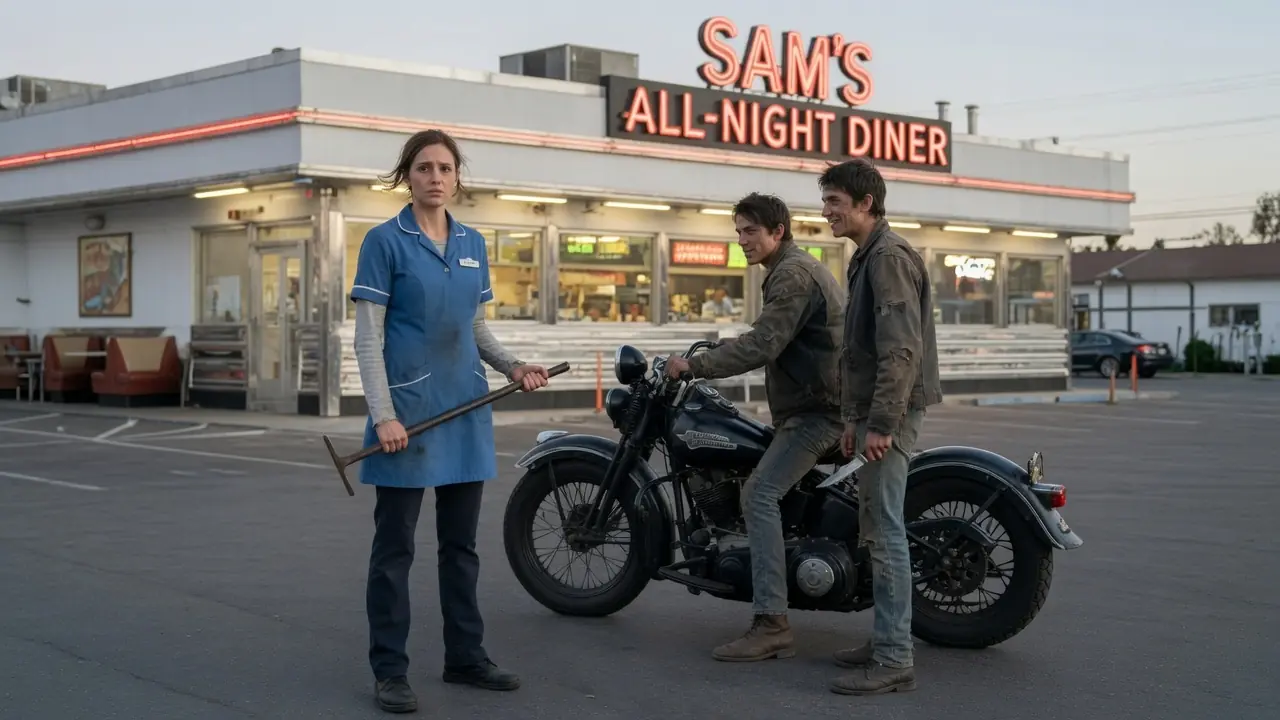
$42 and some change. She'd written it on the back of a receipt and tucked it in her apron pocket like it was a verdict. Bakersfield in October had a way of being cold without warning. One hour it was 60° and reasonable, and the next the wind came off the valley floor and cut straight through whatever you were wearing. Rebecca was wearing a thin blue uniform that Sam had provided on her first day and had never replaced, and she was wearing it over a long-sleeve undershirt she'd bought at the dollar store 3 years ago that had a small hole near the left elbow she covered with a rubber band.
She didn't think about any of that consciously anymore. It had become part of the background noise of her life, the constant low hum of not quite enough that she'd learned to function inside of. Leo was already asleep when she carried him in from the car. He was 6 years old and small for his age with a face that in sleep looked so peaceful that Rebecca sometimes stood and watched him breathe just to confirm that he was in fact breathing. That wasn't paranoia.
She settled him into the last booth in the back corner, the one farthest from the door where the light was dim and the vinyl seat was wide enough that he could curl on his side without falling. She tucked his jacket over him like a blanket and set his rescue inhaler on the table within arm's reach. Not because she expected him to need it tonight. Because she always set it within arm's reach. "You good, baby." She whispered.
Leo didn't answer. He was deep under the way only children can sleep completely surrendered to it, his small hand tucked under his chin. Rebecca stood there for one more second than she needed to. Then she turned and went to work. The diner on a Tuesday night in late October was exactly what you'd expect.
A trucker named Dale sat at the counter eating eggs and reading a paperback western he'd clearly read before because his eyes moved too fast and he never turned back a page. Two women in their 50s occupied booth three splitting a piece of pecan pie and talking in the focused intimate way of people who have known each other a long time and don't need to fill silence. A kid 19, maybe 20, sat by the window with a cup of coffee he'd been nursing for an hour staring at his phone with a specific hunch posture of someone who had nowhere else to be. Rebecca worked the room on autopilot. Refills, check-ins, a fresh slice of pie for the woman in booth three who ordered a second one with the sheepish delight of people who've decided to stop apologizing for what they want.
She smiled when smiling was called for, kept her voice warm, kept her movements efficient. The back of her mind never stopped running its own separate calculation. Leo's breathing, the clock, the $42, the letter from their landlord that she'd read four times that day and understood a little better each time, even though understanding it didn't change what it said. "30 days." That was what the letter said. "30 days to come up with $800 in back rent or the eviction process would begin."
She had $42. She'd applied for an emergency rental assistance program 6 weeks ago and hadn't heard back. She'd asked her shift manager, a decent man named Phil, who genuinely liked her if there was any possibility of an advance, and Phil had looked genuinely pained when he'd explained that Sam, the actual owner who Phil had never once seen set foot in the diner, had a hard policy against it. She'd done the math on picking up a second job and determined that between daycare costs for Leo during those hours and the transportation cost to get there and back, she'd net about 30 cents an hour. She'd sold the two pieces of jewelry she owned, a small gold necklace her mother had given her, and a pair of earrings she'd bought herself the year before Leo was born.
The last truly impulsive purchase of her pre-child life, and that had covered the electric bill. The $42 was what was left. She didn't tell people this. There was no one to tell really, and even if there had been, she had learned in the years since Leo's father left quietly without confrontation one afternoon when she discovered the closet empty, that there was a kind of exhaustion that came from narrating your own suffering. It didn't help.
It just made you perform it. So, she carried it without narrating it, and she kept moving, and she poured coffee, and she smiled at Dale the trucker when he looked up from his western and raised his mug. That was when she heard it. She heard the motorcycle before she saw it, before anyone in the diner saw it, because it was the kind of sound that doesn't ease into awareness. It doesn't knock.
It arrives. The engine of a 1947 Harley-Davidson Knucklehead, she would learn later, has a voice unlike anything manufactured in the last 50 years. It's not the high-pitched snarl of modern performance bikes or the refined growl of contemporary cruisers. It's something older and more elemental than that, a deep rhythmic thunder that seems to originate not in the machine, but in the road itself, vibrating up through the asphalt in the foundation and the soles of your feet.
Every person in Sam's all-night diner heard it. Dale looked up from his western. The two women paused mid-sentence. The kid at the window pressed his face slightly closer to the glass, though he tried to do it casually. Rebecca walked to the front window.
The man who climbed off the motorcycle was enormous. That was the first fact about him, the one that registered before anything else. Before the leather vest with its patches and its insignia, before the gray beard that covered most of his jaw, before the arms, which were covered from wrist to shoulder in tattoos so dense they looked less like individual images and more like a second skin. He was easily 6'3" broad through the shoulders in a way that suggested not gym work, but a lifetime of physical existence. Someone who had carried heavy things and absorbed heavy things and come out the other side still standing.
His hair was long and silver, pulled back. He moved across the parking lot toward the diner entrance with an unhurried certainty that Rebecca recognized from a specific category of human people who have never had to announce themselves because the room changes when they walk into it. The bell above the door rang. He stood in the entrance for one beat, scanning the room with the kind of flat, thorough attention that takes in everything and commits to nothing. His eyes moved to the trucker, to the women, to the sleeping child in the back booth, to Rebecca standing behind the counter.
When they landed on her, they stayed for 1 second longer than they had on anyone else. Not threatening, assessing. "Coffee," he said. His voice matched everything else about him. "Sure," Rebecca said.
"Sit anywhere." He took a stool at the counter, three down from Dale, who suddenly found his Western very interesting again. Rebecca poured the coffee. She'd poured 10,000 cups of coffee in her life and she poured this one the same way she poured all the others, filling it clean and setting it in front of him without spilling. And she said, "You want anything to eat?" He looked at the menu board, which was handwritten on a chalk board that Sam had installed in 1987 and updated approximately never.
"What's good?" "The eggs are fresh, biscuits are made here, everything else I'd steer you toward with full knowledge of the consequences." One side of his mouth moved, not quite a smile, an acknowledgement. "Eggs and biscuits." "How do you want them?" "However they come out best."
Rebecca wrote the ticket and clipped it to the wheel and went back to her work. And the diner settled back into its own rhythms around him and the coffee sat steaming in front of the enormous man with the silver hair who had not told her his name. She would find out later that the other people in the diner that night referred to him afterward, to their families, to their friends in the months of retelling that followed as simply the biker. But his name was Rooster and he had been riding for 11 hours straight and had stopped at Sam's All Night Diner for no reason more profound than that the light was on and he was hungry and the parking lot had enough room to leave the knucklehead somewhere he could see it from a stool at the counter. He sat and he drank his coffee, and he watched through the front window at his bike, and Rebecca brought him his eggs 12 minutes later, and for 45 minutes nothing happened.
She was refilling his coffee for the third time when he looked at Leo. She saw him look. She was trained to track it, the moment when someone noticed the child sleeping in the back booth, because it always prompted one of two reactions. Either a softening, a loosening around the eyes, or a flicker of irritation at the irregularity of it. A child in a diner at midnight, which occasionally led to a complaint to Phil about professionalism.
She'd become very good at reading which reaction was coming. This was neither one. He looked at Leo the way you look at something that cost you something to see. Like the sight of the sleeping child pulled something up from somewhere deep in him. Something he didn't advertise, and didn't discuss, and had been carrying for a long time.
"Yours," he said. "Yes." "How old?" "Six." He nodded slowly, his eyes still on Leo.
"What's his name?" She hesitated for just a moment, because even after years of working nights and bringing Leo along and watching him sleep in back booths while she works, some instinct in her still flinched at the question. Not because she was afraid of this man specifically, because she was afraid in a vague and permanent way of having things she couldn't afford to lose. And Leo was the thing she couldn't afford to lose. "Leo," she said. Rooster turned his coffee cup in his hands.
"Good name." "I thought so." A pause, then from him, "He okay? He's breathing kind of" "Asthma," Rebecca said. She kept her voice level the way she always kept it level when she said the word, because the alternative was to let 17 different emotions into it, and that didn't help anyone. "He's okay tonight. Some nights are harder." Rooster looked at the inhaler on the table next to the sleeping boy.
He didn't say anything for a moment. You carry that everywhere. Everywhere, she said. He looked back at his coffee. That's a good mom.
Rebecca didn't answer. She picked up a rag and wiped down the section of counter that didn't need wiping because sometimes you need to do something with your hands when someone says something that threatens to crack something open in you and you're at work and cracking open is not an option. So, it was 12:37 in the morning when the truck pulled into the parking lot. Rebecca noticed it because as she was behind the counter and the front window gave a clear view of the lot and the truck's headlights swung across the diner windows in a pattern that was wrong, too fast, too erratic, the arc of someone driving without full attention or without full sobriety. It was a dark blue pickup, older, with a cracked taillight on the driver's side.
It came in too hot and stopped too hard and the two doors opened within seconds of each other, the way doors open when people inside have already decided what they're doing. She watched them because she watched everyone who came into the lot. Not out of suspicion, out of habit, out of the same relentless low-level vigilance that had become her default operating mode. They didn't come toward the diner. They went toward the motorcycle.
She felt the specific cold clarity of a moment when your mind processes what your body already knows. It wasn't a thought exactly, more like a recognition, the same way you recognize the sound of a car that won't start or the look on a doctor's face right before they say something you don't want to hear. She knew before she consciously articulated it what was happening. "Hey," she said. Nobody heard her.
She was behind the counter and her voice was normal volume and the man at the counter three stools down was reading and the women in booth three were talking and the kid at the window had his earbuds in. She looked at Rooster. He was looking at his plate. "Hey," she said again louder, and this time he looked up and she nodded toward the window and his eyes tracked to where she was nodding. And what happened in his face in that instant was not panic.
It was not confusion. It was something older and colder and more controlled than either of those things. His jaw set. His eyes went flat and still. He was off the stool before Rebecca had finished saying your bike.
And then he was gone through the door moving faster than a man his size should be able to move. What happened next happened in a span of time that Rebecca in every retelling struggled to quantify. 30 seconds? 2 minutes? Long enough for everything to change and short enough that it later felt like a dream.
The kind of dream that was more real than the waking world that preceded it. She stood behind the counter for perhaps 4 seconds after Rooster went through the door. She could see through the window. She could see the two men, one already on the motorcycle trying to figure out the ignition. One standing lookout with something in his hand that caught the light.
Wrong, too long, too thin, not a phone. She could see Rooster coming out the door and across the lot. And she could see the lookout see him and she could see the lookout say something to the man on the bike. And she could see from 30 ft through plate glass that the situation was about to become something that had no clean ending. She didn't plan what she did next.
Planning implies deliberation and there was none. She came around the counter, grabbed the tire iron she kept under the hinge section of the bar because Sam had installed it there after a robbery 3 years ago and told her it was just in case. And she went through the front door of Sam's all-night diner at 12:39 in the morning into the cold October dark.