The field looked almost too beautiful to touch beneath the pale light of an early June morning. Red clover covered thirty-two acres from the gravel lane to the enormous oak at the northern fence, dense enough to hide the soil beneath it, and thousands of dew droplets turned the leaves silver whenever the breeze moved through them. Bees worked the purple blossoms while a thin layer of mist hung low over the valley. Eighteen-year-old Ruby Hensley stood beside the tractor with one hand on the fence post and stared at the best crop her family had grown on that ground in years.
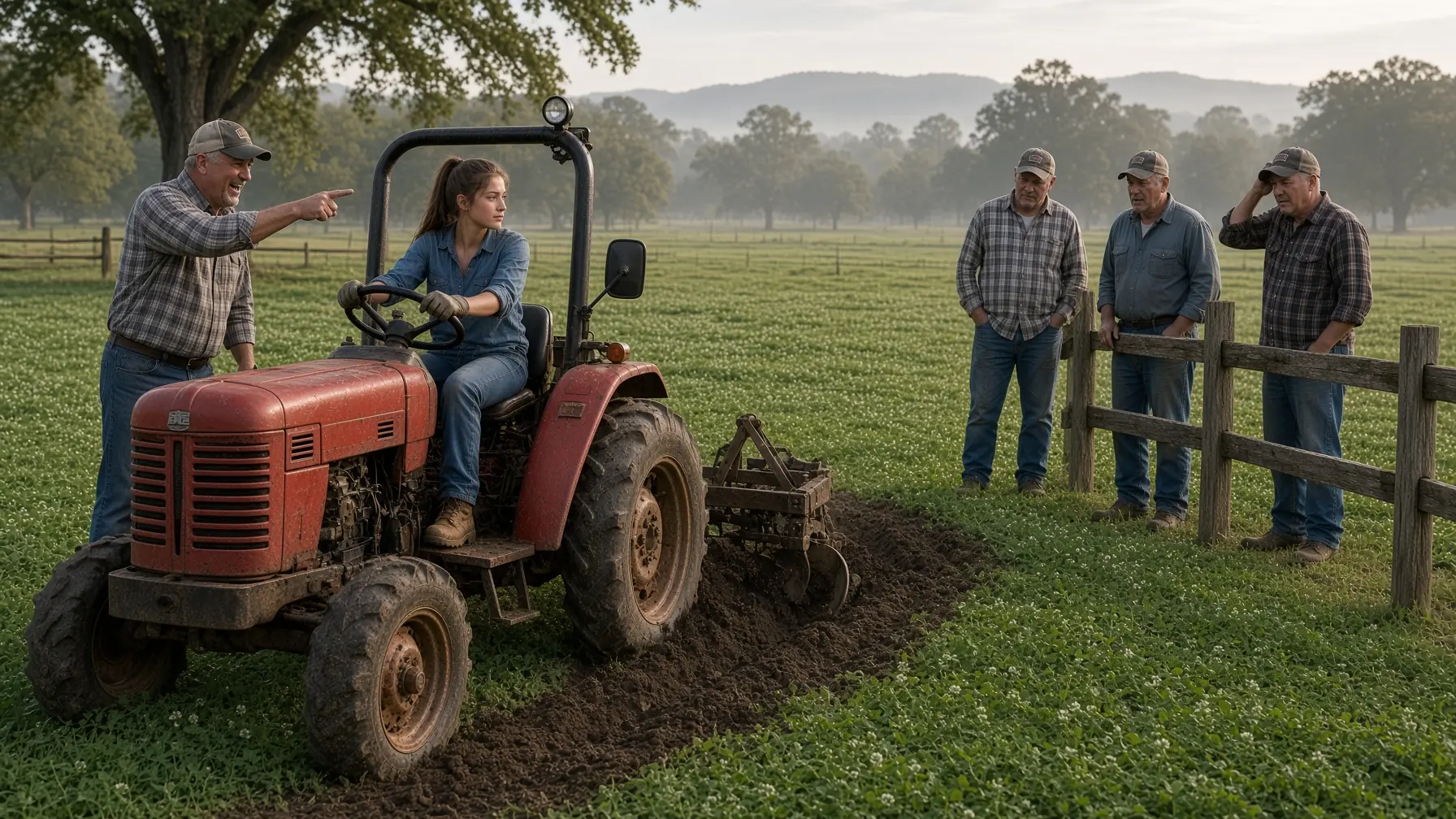
Then she climbed into the tractor and destroyed it. The old International coughed twice before settling into a hard mechanical rattle, and Ruby lowered the implement she had spent the previous evening adjusting. Instead of harvesting the clover for hay, she began incorporating it into the upper layer of soil in slow, deliberate passes. By the time the first strip of dark earth appeared behind her, a pickup had already slowed on the county road.
The second truck stopped completely. Three men eventually stood against the roadside fence watching the green disappear beneath the soil, and Ruby could see their mouths moving even though the tractor engine drowned out most of their words. One of them finally shouted loudly enough for her to hear, “Girl, you know that crop’s worth money, don’t you?” Ruby kept driving.
Another man laughed. “Hugh Hensley leaves the farm to a high school kid, and she buries the first decent thing it grows.” The oldest man among them, Milton Greer, did not laugh, although he did not defend Ruby either. He was seventy-two, had farmed next to her grandfather for four decades, and watched the soil rolling behind the tractor with an expression Ruby could not read. Before noon, nearly everyone within ten miles knew what she had done.
Eight months earlier, Ruby had stood inside the farmhouse kitchen holding a ring of keys that suddenly seemed to weigh more than anything she had ever carried. Her grandfather, Hugh Hensley, had died quietly in his sleep after seventy-three years of life and more than fifty years on the same Ohio farm. Ruby had spent nearly every summer of childhood following him between tractors, fences, and fields, but spending summers on a farm was very different from being responsible for one. The probate papers made that difference painfully clear.
The Hensley property covered almost three hundred acres, although less than half was active cropland. The rest was pasture, woods, creek bottom, buildings, and rough ground that Hugh had never tried to force into cultivation. Ruby was eighteen and completing her final semester of high school, old enough legally to inherit the property but young enough that almost everybody around her assumed she would sell it before winter. Her uncle Bryce arrived two days after the funeral to make the assumption sound like advice.
“You don’t have to prove anything,” Bryce told her while sitting at Hugh’s kitchen table. “I can buy the farm, keep it in the family, and you can go to college without spending four years wondering whether the bank is going to take the roof over your head.” Ruby asked what he would do with the place, and Bryce said he would expand his soybean acreage and probably sell the eastern woods to reduce the debt. She looked through the window at the fields and answered, “Grandpa didn’t leave it to me so I could sell it in the first month.”
Bryce did not argue. He merely placed his offer on the table and told her to keep it somewhere safe because she might feel differently after planting season. That quiet confidence irritated Ruby more than an argument would have. She folded the paper, put it in the desk drawer, and spent the next several weeks discovering how many expensive things could hide behind the phrase inherited farm.
There was a mortgage attached to improvements Hugh had made years earlier, along with property taxes, insurance, machinery repairs, seed costs, and fuel bills Ruby had never seen because Hugh had always paid them. An older cousin continued leasing some of the pasture, giving her a small stream of income, and a neighboring farmer rented sixty acres under an agreement Hugh had signed before his death. That left Ruby responsible for a much smaller portion than three hundred acres, but it was still more land and more risk than she had ever managed alone.
People watched her closely. At church they asked whether she planned to attend college in the fall, but their tone suggested they were really asking when she intended to give up. At the feed store, men who had known her since she was six explained nitrogen, crop insurance, and tractors to her without first asking what she knew. Ruby learned to smile, listen, and separate useful advice from the pleasure some people took in providing it.
Her grandfather’s fields had genuine problems. Years of corn and soybean rotations, heavy equipment, and occasional work performed when soil was too wet had left several areas compacted and low in organic matter. Hugh had recognized the decline near the end of his life, but deteriorating health and cash-flow pressure kept pushing him toward another market crop instead of the slower soil-building changes he had begun considering. Ruby discovered that in a leather notebook wedged behind old feed records inside the machine shed.
The notebook contained forty years of weather observations, planting dates, yields, equipment failures, and short comments written in Hugh’s small block letters. Some entries were practical, such as notes about which tractor leaked hydraulic fluid whenever the temperature dropped below freezing. Others sounded almost philosophical despite Hugh’s lifelong resistance to sounding philosophical. Ruby read until midnight.
One sentence appeared several times over the years. Feed the soil before asking the soil to feed you. On another page Hugh had written about an old farmer named Isaac Bell, who used red clover regularly and called it “the crop you grow for the next crop.” Ruby had heard Hugh mention Isaac before, but only as a stubborn old man who refused to purchase a tractor with a radio because he believed machinery ought to sound like machinery.
Ruby took the notebook to the county extension office. There she met Dr. Joanne Keene, an agronomist who resisted both extremes Ruby had already encountered: she did not tell Ruby she was too young to farm, and she did not pretend Hugh’s notebook contained secret wisdom capable of overriding soil science. Joanne asked for soil tests first.
The results were not catastrophic. They showed relatively low organic matter in the thirty-two-acre south field, areas of compaction, moderate phosphorus and potassium levels, and a pH that could support red clover with manageable amendment. Joanne explained that clover would not magically repair decades of soil stress in one season, but it could contribute biologically fixed nitrogen, provide living roots, feed soil organisms, reduce bare-ground erosion, and add organic material when terminated.
Ruby asked the obvious question. “How much money will I make from it?” Joanne replied, “If you’re growing it as a green manure, probably none this year.” Ruby stared at her, and Joanne added, “That is why farmers under financial pressure often know exactly what they should do for soil and still cannot afford to do it.”
That answer stayed with Ruby. Hugh’s notebook made the same argument repeatedly, usually after bad seasons when he postponed cover crops because another corn harvest promised faster cash. Ruby realized her grandfather had understood the problem long before she inherited it. What he had lacked near the end was time.
She bought certified red clover seed rather than using the dusty seed she found in Hugh’s barn because nobody could tell her how long the old seed had been stored or whether germination would be acceptable. The supplier recommended properly inoculated seed suited to the soil conditions, and Joanne helped Ruby calculate a realistic seeding rate. Ruby planted the thirty-two acres knowing that for one season the field would produce no market crop.
Bryce found out almost immediately. “You inherited debt, and you’re planting something you plan not to sell?” he asked over the phone. Ruby said, “That’s the idea,” and Bryce remained silent long enough that she could picture him closing his eyes.
The clover emerged evenly. By May, the field was greener than neighboring corn ground waiting to be planted, and by early June it had become so thick that people began suggesting Ruby had changed her mind and planned to sell it as hay. Even Ruby felt tempted.
She stood at the field one evening calculating what a decent cutting might bring. There were bills in the farmhouse, diesel in the tank, and a tractor transmission that sounded increasingly expensive whenever she shifted into third. Selling the clover suddenly seemed less like failure and more like survival.
Then she read Hugh’s notebook again. He had written about Isaac Bell terminating clover near early bloom instead of carrying it through for hay because maximum visible growth was not the same thing as maximum value to the following crop. Ruby called Joanne the next morning.
“Tell me not to sell it,” Ruby said. Joanne laughed and answered, “I’m not making that decision for you.” When Ruby complained that this was unhelpful, Joanne explained the tradeoff again: hay could produce immediate income, while incorporation would return more biomass and nitrogen to the field. Ruby spent another day looking at her accounts.
Then she chose the soil.
She did not bury the clover deeply with the moldboard plow as the town later claimed. Joanne had recommended shallower incorporation to avoid creating another compacted layer, so Ruby used equipment that mixed the vegetation into the upper soil profile while leaving substantial residue near the surface. From the county road, however, the distinction did not matter. Beautiful green clover disappeared behind a tractor, and that was enough to produce a story.
The laughter followed her into town. At the feed store, two men discussing her field assumed she was out of earshot and one said, “Walter—” before correcting himself. “Hugh Hensley probably wore a hole through his coffin when she turned that clover under.”
Ruby abandoned the mineral supplement she had come to buy. She drove home angry enough to cry and refused to do either until she had parked the truck behind the machine shed where nobody could see her. Then she sat with both hands on the steering wheel and wondered whether everyone else understood something she did not.
Bryce called that evening. “People are saying you destroyed a perfectly good hay crop.” Ruby said, “I know,” and he asked whether she wanted him to help her find a buyer for the farm before the bank became involved.
“It wasn’t a mistake.”
“How do you know?”
Ruby opened her mouth.
No answer came out.
The truth was less impressive than confidence. Ruby believed the decision was defensible because a county agronomist, modern research, soil tests, and her grandfather’s observations all pointed in the same direction. None of that guaranteed the result she desperately needed.
July brought drought. Days passed beneath a hard blue sky, then weeks, and the corn throughout the county began curling its leaves by afternoon to conserve moisture. Shallow ponds shrank around muddy edges, lawns turned brown, and pasture cattle gathered wherever trees still cast shade.
Ruby had no crop growing on the incorporated clover field, which meant she had nothing there to lose that summer. That fact did not prevent people from treating the bare field as evidence she had wasted a season. At a gas station, a man she barely knew called the whole thing a “school science project” and asked whether she planned to grow vegetables next.
Ruby kept pumping gas. She had discovered that some arguments were simply another form of entertainment for the person starting them. She preferred not to provide refreshments.
The farm’s finances were less easy to ignore. A transmission repair consumed more money than expected, property taxes came due, and Ruby discovered an outstanding balance on the equipment-building loan that Hugh had been paying from crop revenue. The farm possessed value on paper, but paper value did not write checks.
One August night Ruby sat at the kitchen table surrounded by invoices. Bryce’s offer remained in the desk drawer ten feet away, and for the first time she understood why Hugh had repeatedly postponed soil-building plans. A person could love next year’s soil and still have to survive this month.
Ruby pulled out Bryce’s offer.
She placed her phone beside it.
Then she cried.
Not because she had decided to sell, but because she finally admitted that keeping the farm might require more than determination. She was eighteen, exhausted, frightened, and tired of treating fear like evidence that she lacked character.
Afterward she washed her face and opened Hugh’s notebook. An entry dated July 9, 1988, described another terrible dry year and contained one of the strangest sentences Hugh ever wrote: Faith is cheap to talk about and expensive to practice. Numbers still matter.
Ruby smiled despite herself.
That sounded more like him.
The next morning she walked the south field before sunrise. The topsoil was dry, but when she pushed a shovel several inches into one of the areas where clover biomass had been heaviest, the soil below broke apart into smaller aggregates instead of hard plates. Earthworm channels appeared in several samples, and old clover roots had left fine pathways through the upper soil.
Ruby did not declare victory. Joanne had warned her that soil conditions varied naturally across a field, and one handful could prove almost anything a frightened farmer wanted to believe. Ruby took samples from marked locations and compared them with areas where the clover establishment had been thinner.
The differences were noticeable. Not miraculous, but noticeable.
Then rain finally came.
A late-August thunderstorm dropped nearly an inch in less than an hour after weeks of drought. Ruby stood beneath the machine-shed roof watching water strike the south field and expected the surface to seal and shed runoff the way it had during heavy storms in previous years.
Instead, much of the water entered the ground.
Across the road, runoff moved from a neighboring soybean field toward the ditch in thin muddy sheets. Ruby’s field still produced some runoff where slopes concentrated water, but the areas with stronger clover growth absorbed rainfall visibly better. She walked out after the storm and pushed her fingers into the dark soil.
Milton Greer stopped his truck at the fence.
He crossed without waiting to be invited, crouched beside Ruby, and scooped up a handful. For nearly a minute the old farmer said nothing.
Then he asked, “Hugh leave you those notebooks?”
Ruby looked at him. “You knew?”
“Knew he kept them.”
“Did you know about the clover?”
Milton rubbed soil between his fingers. “Isaac Bell used to run it through his rotation. Hugh talked about doing the same thing for twenty years and usually found a reason he needed the cash crop more.”
Ruby looked at the field.
“Did it work for Isaac?”
“Some years.”
That answer surprised her.
“Some?”
Milton laughed. “You think farming gives guarantees?”
“No.”
“Good.”
He dropped the soil.
“Isaac had better soil after twenty years of taking care of it. That’s different from saying clover makes rain.”
Milton climbed back into his truck.
Before leaving, he said, “Keep records.”
Ruby already was.
Two days later, she discovered the most important part of the field was the part that looked worst. Along the north edge, where establishment had been thin because of poor seed-to-soil contact and compaction near an old traffic lane, the ground remained harder and dried much faster. Twenty feet away, soil under the heavier clover biomass behaved differently.
Ruby marked both areas.
If everything had improved equally, she might have credited the clover too easily. The uneven result gave her something closer to evidence: treatment quality mattered, field history mattered, and one season had not erased every problem. She sent paired soil samples to Joanne.
The bank letter arrived the same afternoon.
The loan tied to the equipment shed was past due after the estate transition and required a payment Ruby did not have. The notice did not say the bank would seize everything in sixty days like the threats in cheap movies, but it did make clear that continued delinquency could trigger legal remedies against secured property.
Ruby called Bryce first.
He answered on the second ring.
She nearly asked him to buy the farm.
Instead, she said, “Do you know anybody at First County who actually understands agricultural loans?”
Bryce was silent.
Then he gave her a name.
The following morning Ruby met agricultural loan officer Nancy Whitaker carrying tax records, lease agreements, projected income, soil tests, and more nervousness than she wanted to display. She explained the clover year honestly, including the fact that the thirty-two acres had produced no cash crop.
Nancy did not praise her bravery.
She looked at numbers.
The leased acreage and pasture income were stable. Ruby had some equity, limited personal debt, and a plausible operating plan for the following season, but cash flow remained weak.
The bank agreed to restructure the past-due amount into a short-term repayment plan rather than immediately escalating collection. The agreement required Ruby to provide a realistic spring cropping budget and demonstrate how she intended to cover operating expenses. It was not forgiveness.
It was time.
Joanne called the following week with the soil results. The strongest clover sections showed increased available nitrogen relative to untreated comparison areas, modest improvement in measurable organic matter, and better aggregate stability, although Joanne emphasized that major organic-matter changes normally required years rather than a single cover crop.
“So I didn’t fix it,” Ruby said.
“No.”
Ruby laughed. “You could pretend to be encouraging.”
“I am encouraging.”
“That was encouraging?”
“You improved the direction.”
Ruby became quiet.
Joanne continued, “That is usually what soil management is. Direction.”
Then she explained the biology Ruby had understood only in pieces. Red clover partnered with rhizobia bacteria on its roots, allowing atmospheric nitrogen to be converted into forms that eventually became available to later crops as roots and plant tissue decomposed. The living roots also fed soil organisms and created channels, while surface residue helped protect soil from raindrop impact and reduce moisture loss.
None of those effects made the field drought-proof. They could, however, improve water infiltration and soil structure enough that rainfall was used more efficiently when it arrived. Combined with less compaction and a sensible fertility plan, the clover year had given Ruby’s next crop better starting conditions.
Hugh’s sentence finally stopped sounding mysterious.
Feed the soil before asking the soil to feed you.
Ruby spent winter planning the next season rather than dreaming about it. She had soil tests for every management zone, hired a local operator for one tillage pass rather than repeatedly driving her old tractor across damp ground, and worked with Joanne to reduce nitrogen fertilizer rates where the clover contribution justified it instead of assuming the cover crop replaced everything.
Bryce came over in February.
He looked through her figures.
“You did all this?”
“With help.”
“That wasn’t my question.”
Ruby met his eyes. “Yes.”
He turned another page.
For the first time since Hugh died, Bryce did not offer to buy the farm.
Spring came slowly. Ruby planted corn into the south field after conditions warmed and the ground was dry enough to carry equipment without smearing the soil. She stopped twice because portions near the north end remained wetter than expected, choosing to return later instead of forcing the planter through and recreating the compaction she had spent a year trying to reduce.
Graham Dyer, who farmed nearby, teased her for taking two extra days to finish. Ruby said, “I waited a whole year for this crop. I can survive forty-eight more hours.”
Rain came regularly in May.
Then June turned dry again.
Ruby walked the field almost every evening expecting disaster because she had trained herself to distrust anything going well. The corn was not extraordinary, but its root systems appeared deeper in several test pits, the leaves maintained better color, and areas that had previously stalled early remained comparatively uniform.
The north strip still lagged.
That pleased Joanne.
“It should.”
Ruby stared at her.
Joanne explained, “If one green-manure crop erased a traffic-compacted strip in a year, I would be unemployed.”
Ruby laughed.
They developed a multi-year plan involving additional cover crops, reduced traffic when soil was wet, more diverse rotations, and gradual organic-matter improvement. The goal stopped being one spectacular harvest.
It became keeping the farm productive for decades.
Harvest arrived beneath a clear October sky.
Ruby sat in the combine cab watching yield figures change across the field. The monitor showed areas significantly stronger than Hugh’s recent historical averages and weaker numbers along the problematic north boundary, exactly where her records suggested they should be.
When the final weights were calculated, the south field averaged 171 bushels of corn per acre. That was not a county record, nor was it the miraculous 194 bushels people would later claim after repeating the story enough times.
It was simply good.
More important, fertilizer expenses on that field had been lower than Ruby originally budgeted because the clover contributed part of the nitrogen requirement. The farm made money from the field again without stripping every available advantage from it.
Milton Greer appeared at the fence after harvest.
He stared at the stubble.
Ruby joined him.
“People are saying one-seventy-five.”
“One-seventy-one.”
“They’ll have you at two hundred by Christmas.”
“I know.”
Milton smiled.
“Hugh would’ve liked this.”
Ruby looked toward the farmhouse.
“I wish he’d done it himself.”
Milton considered that.
“Maybe he was leaving it for somebody with more time.”
The following week, Bryce drove over.
He no longer carried a purchase offer.
He carried Hugh’s notebook.
Ruby frowned. “Where did you get that?”
“I borrowed it from the kitchen yesterday.”
“You stole Grandpa’s notebook?”
“I was bringing it back.”
“You could have asked.”
Bryce ignored that.
He opened to the clover entries.
“How much seed did you use?”
Ruby stared at him.
“Why?”
“I’ve got forty acres behind my lower barn that’s been losing organic matter for years.”
Ruby smiled slowly.
“You want my advice?”
“Don’t make this unpleasant.”
“I have been waiting eighteen months for this moment.”
Bryce closed the notebook.
“I’ll ask Joanne.”
Ruby laughed so hard that two workers near the grain bin turned around.
The following spring, Bryce planted twenty acres in a clover-heavy cover-crop mixture rather than forty because his own agronomist recommended beginning cautiously. Other farmers experimented with cereal rye, oats, radishes, or clovers depending on their rotations and soil conditions. Nobody in the county suddenly abandoned corn.
That would have missed the point.
Ruby herself changed the system continuously. Some years she used red clover, other years different covers fit better between crops, and eventually she added small grains to part of the rotation because crop diversity provided benefits no single cover could reproduce.
The notebook remained on Hugh’s kitchen table.
Ruby added her own entries beneath his.
October 17. South field corn averaged 171. North traffic lane still weak. Clover helped, but compaction remains. Don’t get sentimental and pretend one good year solved everything.
She smiled after writing that.
Hugh would have approved.
Ruby graduated from high school that first spring and took agricultural courses at a community college while continuing to run the farm. She did not become an overnight expert because nobody does. She hired custom operators when owning another machine made no financial sense, called extension agents when she was uncertain, and learned that asking for help felt less humiliating after she stopped confusing independence with competence.
The bank loan was paid current.
Not because one corn crop saved everything.
The leased acreage, livestock pasture, careful budgeting, lower input costs, and improved harvest combined to create enough breathing room. Farming survived through accumulation more often than miracles.
Years later, people still told the story of the morning Ruby Hensley plowed under the greenest field in the valley. Depending on who told it, she had been seventeen, sixteen, or barely old enough to drive; the field had been fifty acres instead of thirty-two; and the following year she supposedly harvested more corn than anyone in Ohio history.
Ruby corrected people when she heard them.
The truth mattered more.
She had not discovered a forgotten secret.
Farmers had used legumes and green manures for generations.
Modern agronomy had measured why those practices could work.
Hugh had known part of it.
Isaac Bell had known part of it.
Joanne knew much more.
Ruby’s contribution was simply being willing to spend one season growing something she could not sell because the ground beneath it needed something first.
That decision remained difficult even after everyone called it wise.
Giving up immediate income had nearly pushed her finances past the point where patience was possible. Ruby never romanticized that part when younger farmers asked about soil health.
“Taking care of land costs money,” she told them.
“So does not taking care of it.”
Both statements could be true.
One October evening, several years after Hugh’s death, Ruby sat at the same kitchen table where she once considered calling Bryce to sell the farm. Outside, autumn light stretched across the south field, now planted in a diverse winter cover rather than left bare after harvest.
She turned to the final pages of Hugh’s notebook.
There she found an entry she had somehow overlooked.
A farmer can borrow fertility from the future for a while. The bill always comes due.
Ruby read it twice.
Then she added a sentence beneath it.
So can a family.
She closed the notebook and walked outside.
The old oak still stood at the northern boundary.
The road still ran above the field.
Trucks still slowed sometimes when Ruby tried something unfamiliar, although people were less eager to laugh now.
She did not mind.
The farm had taught her that the most important work was often the part nobody driving past could see.
Roots beneath the ground.
Water entering soil instead of leaving it.
Organic matter accumulating fractions at a time.
A young farmer learning when to trust herself and when to call someone who knew more.
Hugh Hensley had spent most of his life harvesting what his fields could give him.
Near the end, he had begun wondering what he should give back.
Ruby inherited the farm before he finished answering that question.
The first crop she truly grew on her own was the most beautiful clover field anyone in the valley could remember.
Then she buried it.
Everybody thought that meant the harvest had been wasted.
Years later, Ruby understood it was the first harvest she had ever grown that was never meant for people at all.