The iron skillet flew past the sheriff’s head and crashed through the front window of Henderson’s General Store. Shards of glass scattered across the dusty boardwalk below, catching the afternoon light like broken ice. Every man within earshot knew at once that Sienna Pierce was at it again. La Veta, Colorado, had seen its share of wild souls in the summer of 1878, but none quite like the flame-haired woman who had arrived three months earlier with nothing but a worn carpet bag and enough fury to match the Spanish Peaks.
The town sat beneath those great mountains, a rough settlement where ranchers, miners, trappers, drifters, and merchants crossed paths. Trouble was not unusual there, but Sienna seemed to draw it like dry grass drew sparks. Sheriff Dalton Hollard backed away from the storefront with both hands raised. “That is the third window this month, Miss Pierce,” he said. “You cannot keep destroying property every time someone says something you do not care for.”
Inside the general store, Sienna stood with her chest heaving and her green eyes blazing. Her auburn hair had come loose from its pins and spilled over her shoulders, catching the light through the broken window. She was twenty-two years old, barely over five feet tall, and carried the kind of righteous anger that made grown men rethink their choices. “Then perhaps you should tell Mr. Henderson to keep his wandering hands to himself,” she shouted.
Henderson, the portly store owner, crouched behind the counter with a scratch down his cheek and fear in his eyes. “She is touched in the head, Sheriff,” he wheezed. “Crazy as a bedbug. All I did was compliment her dress.” Sienna turned toward him with cold fury and said, “You put your hand on my backside. There is a considerable difference between a compliment and assault, you contemptible toad.”
A crowd gathered outside, as crowds always did when Sienna Pierce made a scene. Women whispered behind gloved hands, some disapproving, others secretly admiring her nerve. The men stayed farther back, having learned that this particular wildcat had claws. Old Timothy McCrea from the saloon chuckled and said, “That is the fourth man this month who has tried something with Miss Pierce. You would think word would spread by now.”
Frank Morrison, the blacksmith, shook his head with awe and concern. “She has got a temper like a wildcat,” he said. “Beautiful as sunrise, sure enough, but Lord help any man who crosses her.” Henderson stepped out with a broom and muttered that Sienna needed someone to tame her. Someone else muttered that maybe she did not want a decent man at all, and a few uncomfortable laughs followed.
Sienna emerged from the store with her small reticule clutched in one hand and her spine straight as a rifle barrel. She had come west to escape the suffocating expectations of Boston society. Her father had been a professor at Harvard, and after his death, his debts had left her penniless. Her relatives wanted to marry her off to settle their own problems, but Sienna chose freedom instead.
La Veta had seemed like a place where she could start over. She had hoped to become the town schoolteacher, but the position was already filled when she arrived. With no other choice, she took work as a seamstress and laundress and rented a small room above the boarding house. What made life difficult was not the work, but the casual disrespect she refused to accept.
She would not smile at crude jokes. She would not ignore grabbing hands. She would not pretend to be helpless just to make men feel taller. That made her fascinating to some, frightening to others, and inconvenient to nearly everyone. As she stalked down the boardwalk, the sheriff called after her, “Miss Pierce, you will need to pay for that window.”
The man on the lead horse made the town fall quiet. He was massive, broad-shouldered, and built by a lifetime of hard labor in the mountains. His dark brown hair hung past his shoulders, partly tied back with a leather cord, and a thick beard covered the lower half of his face. He wore buckskin pants, a heavy frontier shirt, worn boots, a wide belt with a hunting knife, and a rifle rested across his lap.
“That is Vincent Outlaw,” someone whispered, and the name rippled through the crowd. Sienna had heard of him, as everyone in that part of Colorado had. He was a mountain man, trapper, and hunter who came down from the high country twice a year to trade furs and buy supplies. Stories claimed he could track anything that moved and had once faced a grizzly with nothing but a knife.
No one knew which stories were true. What everyone knew was that Vincent Outlaw spoke little, kept to himself, and had no patience for fools. He dismounted in front of the trading post with two weather-beaten trappers beside him. At six feet four inches, with scarred hands and pale blue eyes, he commanded attention without asking for it.
Sienna caught herself staring despite her agitation. She had seen ranchers, cowboys, miners, and drifters in La Veta, but no man quite like him. He moved with the confidence of someone who had nothing to prove. His eyes scanned the street the way a hunter might scan the tree line for predators.
Vincent began trading with Patterson, the owner of the trading post. He spoke in a deep, quiet rumble, asking for powder, shot, coffee, salt, and tobacco if the price was fair. Sienna forced herself to look away and continue toward the boarding house. She had more important worries than a mountain man, no matter how striking he was.
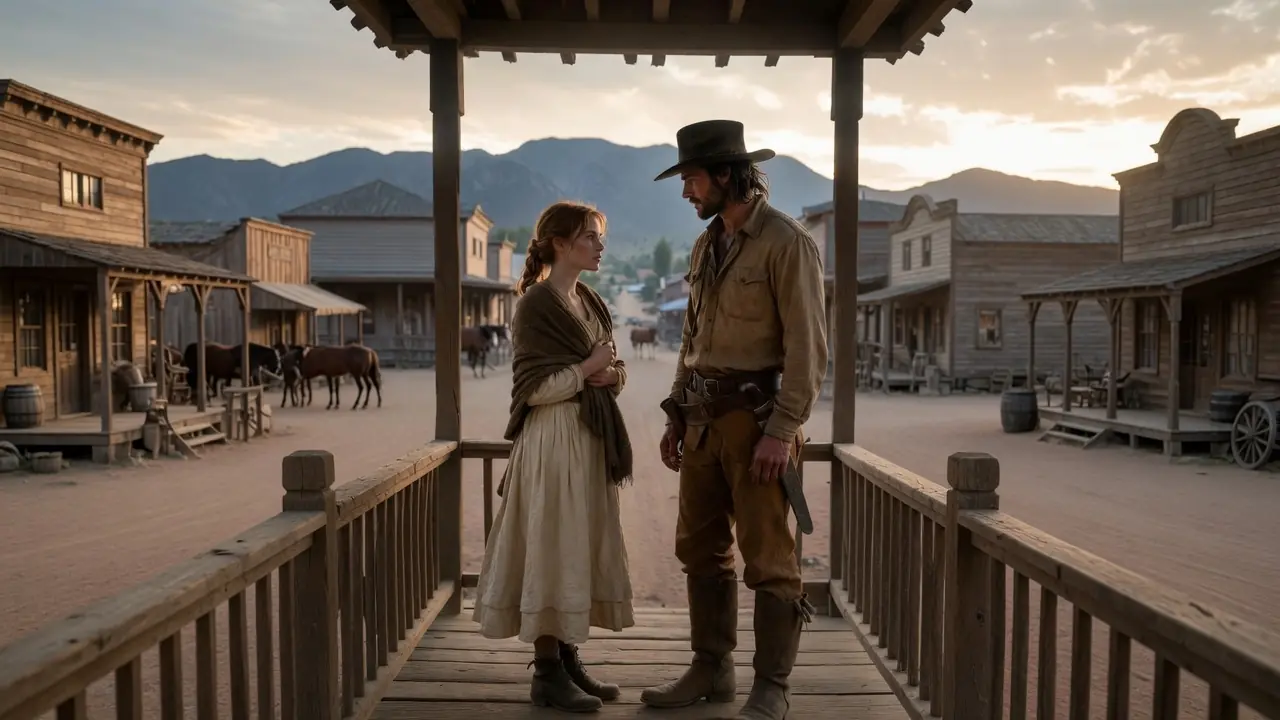
Fate had other plans. A rough voice barked, “Watch yourself, woman,” and Sienna realized she had nearly collided with one of Vincent’s companions. He smelled of whiskey and tobacco, and his eyes held the mean confidence of a man who believed women should step aside. “Perhaps you should watch where you are standing,” Sienna replied coolly, trying to move around him.
The trapper’s hand shot out and grabbed her arm. “Perhaps you should show some respect when talking to your betters, little miss fancy pants.” The words had barely left his mouth before Sienna slapped him across the face with a sharp crack. Then she brought her boot down hard on his instep.
The trapper yelped and released her. “Do not ever put your hands on me again,” Sienna hissed, her green eyes flashing. “I do not care if you are a trapper, a mountain man, or the president himself. You do not touch me without permission.” The crowd, which had started to disperse, suddenly became interested again.
The trapper’s surprise turned to rage. He lunged forward with his hand raised to strike her, but he never made it. A massive hand caught his wrist in midair and stopped the blow as easily as if the man were a child. Vincent Outlaw had crossed the boardwalk in three long strides.
“What did I tell you about drinking before noon, Cole?” Vincent asked quietly. His voice was not loud, but it carried more menace than shouting. “What did I tell you about starting trouble in town?” Cole tried to pull free and protested that Sienna had struck him first. Vincent looked at Sienna and asked, “That what happened?”
“He grabbed my arm after I accidentally stepped near him,” Sienna said, refusing to back down even in front of Vincent’s towering frame. “I was defending myself, as is my right.” Vincent looked back at Cole. “Did she ask you to touch her?” Cole muttered that she had not. “Then she had every right to hit you,” Vincent said.
He released Cole’s wrist with a shove that sent him stumbling. “Get yourself to the saloon and sober up,” Vincent said. “We leave tomorrow at dawn, and if you are not ready, we leave without you.” Cole shot Sienna a hateful glare but wisely left without another word. Vincent turned his full attention to Sienna.
She lifted her chin. “Thank you for your intervention,” she said formally, her Boston accent sharper when she was trying to hold herself together. “Though I was quite capable of handling the situation myself.” Something like amusement flickered in Vincent’s pale eyes. “Looked like you were handling it fine. Man should not put hands on a woman unless she wants him to.”
“A revolutionary concept in this town,” Sienna replied dryly. “Perhaps you should give lessons.” This time, Vincent’s amusement was clearer. He had heard she was the one who threw the skillet through Henderson’s window. Sienna did not deny it. “He deserved worse,” she said.
Vincent nodded. “Heard he grabbed you where he should not have.” She glanced toward Cole’s retreating back and said his friend had similar problems with boundaries. “He is not my friend,” Vincent replied. “Just a trapper who comes along for safety in numbers. I will make sure he stays clear of you while we are in town.”
“I can take care of myself,” Sienna insisted, though she found herself oddly reluctant for the conversation to end. Vincent did not lecture her. He did not tell her to be more ladylike. He did not suggest she had invited trouble. He simply said, “Did not say you could not.”
He studied her with curiosity. “You always this fierce?” “Only when provoked,” Sienna replied. “Which in this town seems to be several times a week.” Vincent touched the brim of his hat. “Then it sounds like this town needs to learn better manners.” With that, he returned to the trading post, leaving Sienna feeling strangely off balance.
Mrs. Garrison, the boarding house owner, appeared beside Sienna and warned her to stay away from Vincent. She said mountain men were not civilized, living alone in caves or ramshackle cabins. Sienna pointed out that he had just defended her from a drunken man. Mrs. Garrison sniffed and said that sort of man was nothing but trouble for a young lady.
Sienna did not bother arguing. Mrs. Garrison’s idea of proper life seemed to involve gossip, strict rules, and fear of anyone different. If she thought Vincent Outlaw was trouble, Sienna suspected he might be one of the more sensible men in La Veta. The rest of the afternoon passed in tense normalcy.
That evening, Sienna worked in her small rented room, sewing alterations and trying not to think about Vincent. Her mind returned again and again to the way he had stood beside her without trying to own the moment. She could not keep living as she was, barely surviving and fighting off men who thought her fair game. Moving was impossible without money, and marriage felt worse than poverty.
Every man who had shown interest in her wanted to tame her. They saw her temper and independence as flaws to be corrected. They wanted to break her spirit until she became soft, obedient, and quiet. Sienna would rather die alone in the wilderness than accept such a fate.
After dinner, she stepped onto the boarding house porch to breathe the evening air. The Spanish Peaks rose in the distance, painted purple and gold by the fading light. Somewhere up there, Vincent Outlaw made his home. The thought of such solitude, self-sufficiency, and freedom pulled at something deep inside her.
“Evening, Miss Pierce.” She turned and found Vincent walking up the street, apparently finished with his trading. He stopped at the bottom of the porch steps, making no move to come closer. “Wanted to check that Cole did not bother you again,” he said.
“I have not seen him since this afternoon,” Sienna replied. “Though I appreciate your concern.” Vincent nodded, then said he had heard people call her temper like a wildcat. Sienna stiffened, expecting the usual lecture. “Good,” she said firmly. “Perhaps nervous men will keep their hands to themselves.”
Vincent surprised her by laughing, deep and genuine. “Good point,” he said. “World could use more women with fire in them. Too many act scared all the time and let men walk all over them.” Sienna blinked. “You approve of women having tempers?” “Approve of anyone standing up for themselves,” he corrected.
They spoke a while on the porch. Sienna asked what life in the mountains was like, and Vincent said it was quiet, peaceful, hard, and honest. He said he did not have to deal with people’s nonsense most of the time. Sienna admitted that sounded wonderful.
“Sometimes civilization is more savage than the wilderness,” Vincent said. Sienna felt the truth of that in her bones. He asked why she had come west, and she told him more than she intended. She told him about Boston, her father’s debts, her relatives, and the unwanted marriage they had planned for her.
Vincent did not mock her or pity her. He said it took courage to leave everything and start again. The unexpected praise made her throat tighten. She could not remember the last time anyone had called her choice brave instead of foolish.
Before leaving, Vincent told her that if anyone bothered her while he was in town, she could let him know. Sienna said again that she could handle herself, but there was no heat in it this time. Vincent looked up at her from beneath his hat brim and said, “Never said you could not. But sometimes having someone at your back makes life easier.”
The next morning, Clara Jennings came running to the pump behind the boarding house. She told Sienna that Vincent was fighting the Morrison brothers in the street. Sienna’s heart lurched. Tom and Jack Morrison were ranch hands known for their tempers and love of brawling.
She followed Clara to the main street, where a loose crowd had gathered. Vincent stood in the center, calm and controlled, facing both brothers. Tom had a split lip, and Jack held his ribs as if they hurt. Vincent looked untouched, his pale eyes cold as winter ice.
The brothers were angry because Vincent had defended their sister Mary at the saloon the night before. Mary worked there and had endured men forgetting their manners. Vincent had stepped in when no one else did. Instead of thanking him, her brothers were furious that an outsider had acted where they had failed.
Tom lunged first. Vincent sidestepped, caught his arm, and used his momentum to send him sprawling into the dirt. Jack charged from the side, but Vincent grabbed his shirt, lifted him off his feet, and set him down hard enough to knock the wind out of him. Then Vincent turned to the crowd and asked, “Anyone else have a problem with men treating women with respect?”
The silence was complete. The Morrison brothers picked themselves up and slunk away, muttering curses but unwilling to continue. Vincent saw Sienna in the crowd, and something in his expression softened. She walked beside him as the crowd dispersed, the tiny fierce seamstress and the huge mountain man moving like an odd pair the town did not know how to understand.
“You are going to make enemies,” Sienna said quietly. “Standing up for women the way you do.” Vincent shrugged. “Already have enemies. Grizzly bears, mountain lions, winters that try to freeze you dead. A few angry men do not scare me much.” Sienna said he was either brave or foolish, and he answered that he might be both.
At the trading post, Vincent’s big roan gelding nickered softly when he approached. Vincent scratched the horse behind the ears with surprising gentleness. Then he told Sienna he would leave at dawn and return to the mountains until spring. The words struck her harder than she expected.
Vincent hesitated, then said he sensed she was not happy in La Veta. Sienna admitted that was an understatement. He told her that if she ever wanted to leave, she could come up to the mountains with him. He had a cabin, enough space, and he could teach her to hunt, trap, track, and survive.
Sienna’s heart stuttered. Vincent quickly added that he meant nothing improper. She could come as a partner and learn the trade, or as a wife if she wanted. Either way, she would be safe, free, and no one would dare lay a hand on her while he was there.
She stared at him, speechless. Other men had offered marriage like a cage, something meant to control her. Vincent offered partnership and freedom. He told her he saw her fire and would never try to stamp it out.
Something inside Sienna cracked open. After months of rage, fear, and loneliness, this strange mountain man saw her more clearly than anyone had in years. She told him she needed time to think. Vincent agreed and said he would be at the trading post until dawn. If she came, she should pack light and wear practical clothes.
That night, Sienna lay in her narrow bed and stared at the ceiling. What did she have in La Veta? A tiny room, barely enough work to survive, constant judgment, and men who saw her as a problem to solve. What would she have in the mountains? Hard work, danger, isolation, but also freedom.
She would learn to survive. She would become truly self-sufficient. She would have a partner who respected her strength instead of fearing it. As dawn brightened the sky, Sienna made her decision.
She dressed in practical clothes, packed her carpet bag, and left money on the dresser for Henderson’s window. Everything she cared about fit inside the bag, including a small photograph of her parents and the few pieces of jewelry her mother had left her. She hurried to the trading post as Patterson unlocked the door. Vincent was outside, checking his saddle.
“Mr. Outlaw,” she called, clutching the carpet bag. Vincent turned, and the expression on his face made every doubt worth it. His eyes lit up, and a slow smile transformed him. “You came,” he said, almost disbelieving.
“I came,” Sienna confirmed. “I have a few conditions.” Vincent said, “Name them.” She told him she wanted to learn everything and never be useless or dependent. She wanted her own space until or unless something changed between them naturally.
Vincent agreed to everything without hesitation. He promised no pressure, no expectations, and safe passage back to La Veta if she ever decided the choice was a mistake. Then he brought her a gentle paint mare named Clover. “She is yours now,” he said. “Hope you can ride.”
Sienna could ride, though it had been years. Vincent helped her mount, tied her carpet bag behind the saddle, and told her they had five hours into the high country. As they rode out of La Veta, Sienna looked back once. She felt no regret.
The ride into the mountains was breathtaking. They followed narrow trails through pine and aspen, crossed streams swollen with snowmelt, and climbed into wild country where the air smelled of stone and freedom. Vincent pointed out animal tracks, old bear markings, and signs of changing weather. Her education had already begun.
By afternoon, they reached a high mountain valley. Vincent’s cabin stood against the tree line, built from heavy logs with a stone chimney and a covered porch. A small stream tumbled nearby, and peaks rose in every direction beneath a blue sky that seemed endless. “Home,” Vincent said simply.
The cabin was cleaner and more organized than Sienna expected. There were supplies, books, a rough table, a fireplace, and enough space to make the arrangement proper. Vincent immediately began clearing storage so she could have the main room while he slept elsewhere. Sienna watched this huge, quiet man moving barrels and crates, and her curiosity deepened.
Over the next weeks, Sienna learned what real work meant. Vincent taught her to check traps, identify plants, read tracks, start fires, and move silently through the forest. Her hands grew calloused, her body stronger, and her confidence steadier. She learned to shoot, gather, cook, chop wood, and endure.
She also learned Vincent. He had been raised in Kentucky, gone to war young, seen terrible things, and returned to find his family scattered. He drifted west until the mountains gave him peace. He did not talk much about the war, and Sienna did not press him.
One evening on the porch, she asked if he ever got lonely. Vincent said lonely in the mountains was better than lonely in a crowd. Sienna understood at once. In La Veta, surrounded by people who did not understand her, she had been lonelier than she had ever been alone.
As summer turned toward autumn, their partnership deepened. They worked together, shared stories, laughed over mistakes, and settled into a rhythm that felt natural. Their silences became comfortable. Slowly, without one grand moment, they fell in love.
One late September evening, as the first snow touched the highest peaks, Vincent told her the truth. He said he was falling in love with her, but that he would honor their agreement and never pressure her. He told her she had become the most important part of his life. Sienna’s heart pounded, and when he tried to stop speaking, she told him to let her finish.
She said she was falling in love with him too. He was the first person who had let her be completely herself. He challenged her without making her feel inadequate, respected her strength without fearing it, and made her feel free. Vincent dropped to his knees before her and asked if he could kiss her.
“Yes,” Sienna whispered. The kiss was gentle at first, then deeper when she wrapped her arms around him. He was warm, steady, and real, and Sienna felt as if she had finally come home. When they parted, Vincent rested his forehead against hers and asked her to marry him.
He did not ask because it was proper. He asked because he wanted to spend his life beside her, raise children with her, and grow old in that valley. Sienna said yes without hesitation. Two weeks later, they rode back to La Veta and found a traveling preacher to marry them in the church.
The town reacted exactly as expected. Mrs. Garrison was horrified, the sheriff looked concerned, and Patterson seemed surprised. Clara Jennings served as witness and smiled with real joy for Sienna. When the preacher pronounced them husband and wife, Sienna felt her life had truly begun.
Winter arrived early, sealing them into the mountain valley. Sienna learned to snowshoe, ice fish, stretch supplies, and endure months of isolation. Instead of pulling them apart, the winter drew them closer. They read by the fire, worked side by side, and built private routines that belonged only to them.
When spring came, they planted a larger garden and planned for a more self-sufficient life. Sienna discovered she enjoyed the practical planning as much as the work itself. Vincent laughed and said she was beautiful when she was scheming. She teased that he was distracting when he looked magnificent doing chores.
Years passed in hard work, laughter, and love. Their first son, Samuel, was born on a cold February night with only Vincent there to help. He was strong, loud, and full of life. Vincent held him like a miracle.
Their daughter Elina came two years later, red-haired and green-eyed like Sienna. Vincent said she would need both beauty and fire to thrive in the world. Their children grew wild in the best way, learning books from Sienna and survival from Vincent. The mountain valley became not just a refuge, but a true home.
The family visited La Veta once or twice a year for supplies. Sienna noticed the town no longer looked at her quite the same way. She was Mrs. Outlaw now, the woman who had chosen the mountains and survived winters that would have broken weaker souls. Clara remained her friend and told her she looked happy.
Sienna was happy. She had everything she needed: a partner who loved and respected her, children growing strong and free, meaningful work, and beauty all around her. The people who once wanted her small and quiet had never understood her. Vincent had understood from the beginning.
In time, another son, James, completed their family. The children grew, left home, and found paths of their own. Samuel became a trapper, Elina studied medicine, and James became a writer in California. Eventually, the cabin grew quiet again, and Vincent and Sienna were alone together as they had been at the start.
They grew older in the valley. Vincent’s beard turned gray, and Sienna’s red hair streaked with white. Their bodies carried the aches of hard living, but their love only deepened. On the porch one evening, Vincent asked if she ever regretted choosing this life.
“Not for a single moment,” Sienna said. He had saved her from a world that would have crushed her spirit. Vincent said she had saved him too, giving him purpose, family, and a reason to care about tomorrow. They agreed they had saved each other.
Their children and grandchildren returned often, filling the cabin with laughter. Sienna taught them to read, stand up for themselves, and live free. Vincent taught them the land, the animals, and the patience of survival. The story of the wildcat woman and her mountain man became family legend.
On their thirtieth anniversary, Vincent gave Sienna a hand-carved wooden box filled with letters, pressed flowers, and memories. He told her every day with her had been a gift, even the hard ones. Sienna wept and told him it was the most beautiful gift she had ever received. He answered that she was the most beautiful thing he had ever been given.
Vincent passed away peacefully in 1912, his hand still holding Sienna’s. The grief nearly broke her, but she stayed in the valley they had built together. Their children wanted her to leave, but she refused. His spirit was in every tree, every stone, and every breath of mountain wind.
Sienna lived fifteen more years in that cabin, fierce and independent until the end. She tended the garden, checked the trap lines, taught her grandchildren, and watched the sunsets Vincent had loved. When she passed away in 1927, she was sitting in her rocking chair on the porch, facing the peaks. Her family buried her beside Vincent on a hillside overlooking the valley.
The cabin remained in the family for generations. On quiet evenings, people said they could hear laughter in the pines, the laughter of a wildcat woman and her mountain man. Their great-great-grandchildren still visited the valley and remembered the lesson carved into the beam above the door. She is fierce. She is mine. She is free.
Sienna Pierce had arrived in La Veta with a carpet bag and a temper. She left behind a legacy of love, strength, and freedom. Her life proved that the right person will not try to tame your fire. The right person will want to warm themselves by it for the rest of their days.