Ben Callaway heard the fence break before he saw the SUVs. It was not a small sound, not the harmless snap of an old wire giving way under weather, but the hard crack of cedar posts being forced out of the ground by machines that had no business crossing his pasture. He stepped out of the barn with a coil of rope in one hand and saw three black hunting SUVs pushing through the gap where his east fence had stood for twenty-seven years. Mud flew from their tires as they rolled across his grazing field, scattering cattle in every direction.
The lead SUV stopped twenty feet from him, engine still running, smoke curling from the driver’s open window. The man behind the wheel wore an expensive hunting jacket, leather gloves, and the bored smile of someone who had been forgiven for too many things. His name was Derek Whitmore, and every rancher in Harland Ridge knew his company had been swallowing up land across Montana for years. Ben looked at the broken fence first, then at the muddy tire tracks cutting through his pasture, then at Derek’s face.
“You drove through my fence,” Ben said. His voice did not rise, but the words carried cleanly through the cold morning air. Derek took a slow pull from his cigar and flicked ash toward the grass. “We have permits for the public hunting ground beyond your east pasture,” he said, as if that settled everything.
Ben turned his head toward the cattle. A red cow near the water trough stood with one front leg lifted, trembling from the sudden rush of vehicles and noise. Two young heifers had crashed through the far gate and were bunched against the corner fence, wild-eyed and breathing hard. Ben had raised cattle long enough to know panic could cost more than wood and wire. He looked back at Derek. “That cow needs a vet.”
One of the men in the second SUV laughed. Derek smiled wider, tapping the rifle case on the seat beside him. “Old man, you need to understand something,” he said. “The sheriff in this county plays poker at my house. The mayor eats dinner with me twice a month.” He leaned slightly out of the window, lowering his voice like he was offering advice. “So before you make this difficult, ask yourself who people will believe.”
Ben did not answer at once. He noted the license plates of the SUVs, the hunting tags on their vests, the rifle cases, the broken fence line, and the exact place where the tire tracks crossed the posted boundary sign near the east trees. Derek saw an old farmer staring quietly and mistook that quiet for fear. Ben saw a man so used to local protection that he had forgotten maps could be wrong and fences could mark more than property. The difference would matter in less than an hour.
“You said your permit is for the public hunting ground,” Ben said. Derek nodded impatiently. “That is what I said.” Ben pointed toward the east tree line. “That ground does not start where you think it starts.” Derek laughed under his breath, then waved to the other vehicles. “We’re going through.”
Before Ben could step closer, the thick-necked man in the second SUV climbed out with a rifle in hand and fired twice into the air. The sound cracked across the pasture, sharp enough to send the cattle into another terrified rush. The red cow stumbled but stayed upright, and Ben’s jaw tightened once before his face went still again. The man laughed as if frightening livestock were a game.
“Relax,” Derek called from the SUV. “Nobody touched your precious cows.” Ben looked at the red cow, then at the shattered fence, then at Derek’s cigar smoke curling into the cold. He did not curse. He did not threaten. He turned around and walked toward his house while Derek’s friends laughed behind him.
“Go call your sheriff,” Derek shouted. “Tell him I said hello.” Ben kept walking. He crossed the yard, climbed the porch steps, and opened the screen door without looking back. Inside, he set the rope on the kitchen table, filled the kettle, and took a faded folder from the top drawer beside the stove. It was not the sheriff’s number he reached for.
Ben’s land had an odd history, one that Derek Whitmore had never cared enough to learn. The eastern eighty acres of timber, the section beyond the pasture and before the public hunting ground, had been placed under a federal wildlife conservation easement more than a decade earlier. It protected a migration corridor for elk, cranes, and several nesting raptor species that used the ridge every year. Private ownership remained with Ben, but enforcement authority belonged to agencies far stronger than county politics.
The easement contract was stamped, recorded, and very clear. No civilian hunting, no unauthorized vehicle access, no discharge of firearms, and no entry with weapons during restricted seasonal periods. The eastern buffer was not public land, no matter what a satellite map or a wealthy developer’s confidence suggested. Ben had warned the county about that boundary twice when land agents began circling nearby properties. Nobody in Derek’s circle had listened.
The kettle whistled. Ben poured coffee into a chipped mug, opened the folder, and reread the clause he already knew by heart. Then he picked up the old landline on the wall and dialed the number written on a piece of tape beside the receiver. A calm woman answered from the regional wildlife enforcement office in Billings. Ben gave his name, parcel number, easement reference, and a plain description of what had just crossed his field.
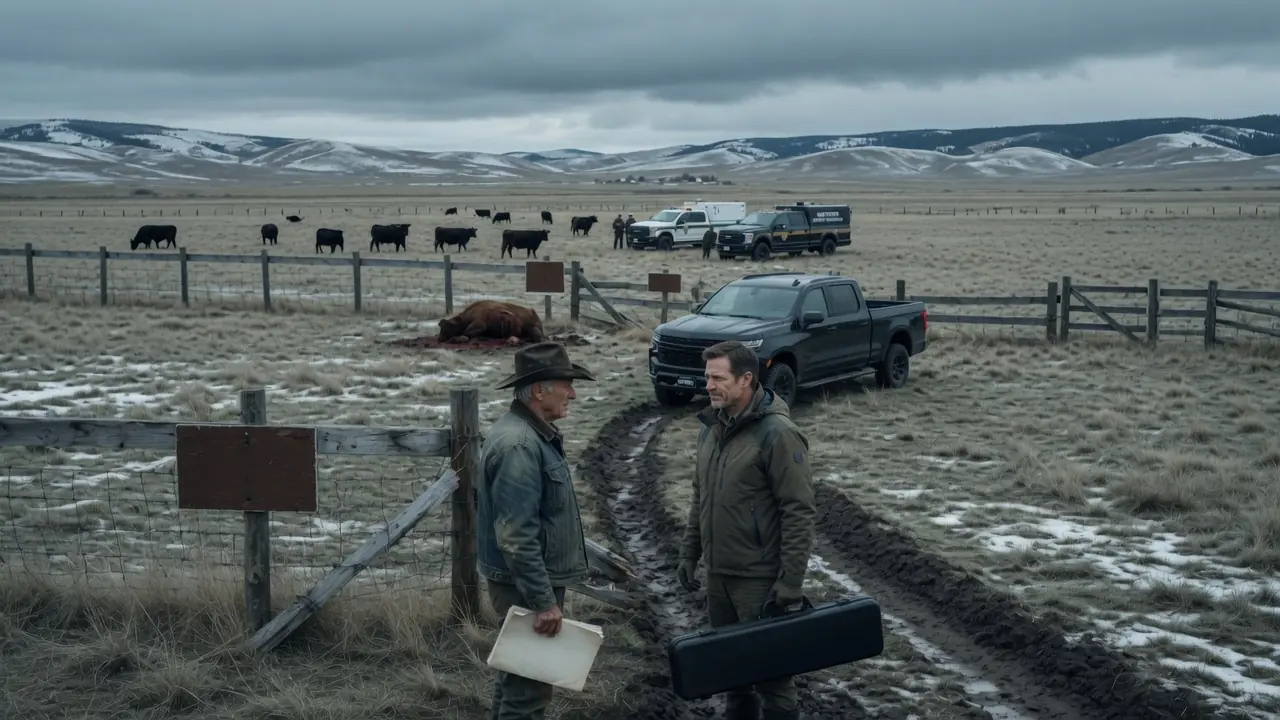
He described three black SUVs, visible rifle cases, two confirmed shots fired into the air, damaged fencing, and distressed livestock. He told them the men were headed toward the eastern buffer and likely believed they were entering public hunting land. The woman on the line asked him to stay clear and document only from a safe distance. Ben said he intended to do exactly that.
After he hung up, Ben called a veterinarian for the red cow. Then he walked to the porch, sat in the wooden chair he had built for his late wife Margaret, and watched the east tree line. He had nothing dramatic to do because the law, when properly called, did not need a man to make it louder. The SUVs had vanished into the trees, and the pasture slowly settled into a frightened quiet. Ben sipped his coffee and waited.
Derek Whitmore thought the old rancher had gone inside to sulk. That made him enjoy the morning more than he should have. He and his friends parked in a clearing beyond the trees, opened their gear, and joked about how easily country men folded when confronted by real money. Derek believed land was a matter of pressure, paperwork, and the right friendships. He did not believe in quiet boundaries until they closed behind him.
The clearing seemed perfect at first. Tall pines held back the wind, the ground was dry, and no other hunters were in sight. Derek opened a beer while his friend Marcus checked the rifles and the third man, Trey, tried to find phone service. Nobody noticed the faded yellow sign half hidden behind fern and fallen branches. It read: Federal Wildlife Buffer, Controlled Access, No Firearms, No Unauthorized Entry.
The first truck arrived without a siren. Then another rolled in behind it, white with green striping and federal wildlife enforcement markings on the doors. A third vehicle stopped near the trail, this one belonging to the state livestock investigator, called because gunfire and injured cattle had been reported on private pasture. Derek lowered the beer from his mouth. For the first time that morning, his smile did not return automatically.
Back at the pasture fence, Ben stood slowly when he saw the vehicles move past the tree line. He did not wave. He did not rush. He walked to the gap in the fence and waited beside the broken posts with the easement contract folded in one hand. A few minutes later, Derek came out of the trees with two agents behind him and his face pale beneath his expensive hat.
The agents stayed in the background, speaking to the other men and checking the vehicles, but Ben’s eyes were only on Derek. Derek’s rifle case was no longer in his hand. His jacket was still spotless, but his confidence looked dirty now, dragged through facts he had not prepared for. He stopped in front of Ben as if he wanted to reclaim the morning by sheer posture. Ben did not move.
“What is this?” Derek demanded. “Who called those trucks here?” Ben lifted the folded contract between them. “Your arrogance did,” he said. “My fence only marked the line.” Derek’s eyes flicked toward the agents, then back to Ben. His voice dropped. “You think this scares me?”
Ben stepped closer, just enough that Derek stopped pretending not to flinch. “You used my pasture like a road, scared my cattle, damaged my fence, and walked armed into protected federal land,” he said. “So no, Derek. I do not think you are scared yet.” His eyes stayed steady. “I think you are finally learning where your money ends.”
Derek’s jaw worked, but no answer came fast enough. One of the federal wildlife agents called his name and asked him to step aside for documentation. Derek glanced toward the road, toward the broken fence, toward the pasture where the red cow stood guarded by Ben’s old border collie. He had expected a local dispute that could be handled with a phone call and a favor. Instead, he had left evidence across every inch of Ben Callaway’s land.
The state livestock investigator arrived at the gap in the fence with a camera, measuring tape, and a clipboard. She photographed the tire marks, the snapped posts, the damaged gate, and the cow’s uneven stance from a safe distance while waiting for the vet. Derek tried to interrupt twice. The investigator cut him off the second time with a look so flat it silenced him better than shouting would have.
“This is a livestock damage report,” she said. “You can talk when I ask you a question.” Derek stared at her, stunned by the idea that his voice was not the most important one present. Ben almost smiled, but did not. He had learned long ago that silence could make a guilty man hear himself more clearly.
By noon, the vet confirmed the red cow had a leg strain and stress injury, treatable but serious enough to document. The federal wildlife agents confirmed the boundary markers, the easement status, the firearms violation, and the unauthorized vehicle access. Derek’s friends stopped laughing altogether. Trey kept whispering that he thought the map said public land, but nobody found comfort in that sentence.
Derek asked to make a phone call. He called the sheriff first, and Ben watched him through the broken fence gap as the call went unanswered. He called again, jaw tight, then called the mayor, who sent him to voicemail after two rings. At last he called his attorney, and this time Derek’s face changed while he listened. Federal wildlife violations did not disappear because a county sheriff enjoyed poker night.
The attorney told Derek to stop talking and comply. Derek lowered the phone and looked at Ben with anger that had nowhere useful to go. “This is not over,” he said. Ben folded the contract and slid it into his jacket pocket. “No,” he said. “Now it starts where you cannot buy the ending.”
The vehicles left slowly in the early afternoon. Two agents escorted Derek’s SUVs back through the pasture road, but this time they did not drive across the grazing field. They followed the outer lane Ben pointed out, the legal lane, the lane Derek could have used if he had knocked on the door like a decent man. Behind them, the broken fence posts lay in the mud like proof.
For the next three weeks, Harland Ridge talked about nothing else. Some people said Derek had only made a mistake. Others said every man with money eventually discovers whether his power is real or borrowed. The sheriff’s office issued a careful statement about cooperating with federal wildlife authorities, and the mayor suddenly became unavailable for comment. Ben repaired two fence posts before neighbors came and finished the rest without asking for pay.
The investigation did not end with Ben’s pasture. Once the agents opened the file, they began reviewing old land access complaints connected to Derek’s development company. They found reports from other ranchers who had claimed survey crews crossed private ground without permission. They found timber clearing near conservation easements, trail cutting beyond approved development boundaries, and hunting leases advertised on land that was not legally cleared for commercial access. Derek had not made one mistake; he had built a business model out of assuming rural people would give up.
Ben’s civil claim moved more quietly. It covered the broken fence, the damaged gate, veterinary expenses, stress to the herd, lost grazing time, and illegal entry. His attorney, Owen Garrick, was a patient man with a tidy desk and the dangerous habit of reading every line twice. When Crestfield Holdings’ insurance company sent a low settlement offer, Owen sent it back with photographs, veterinary reports, federal citations, and a letter so polite it sounded like a closed door.
The second offer was much larger. Ben accepted only after Owen confirmed it covered repairs, livestock loss, legal fees, and long-term easement enforcement signs along the eastern boundary. The money would not make him rich, and Ben did not want it to. It would fix what Derek had broken, strengthen what needed guarding, and make sure the next arrogant man had fewer excuses. That was enough.
Derek’s company suffered worse than he expected. The wildlife case triggered state review of several development permits tied to protected lands. Investors grew nervous when the story reached regional newspapers, especially after photographs of the broken fence and the posted buffer sign appeared beside Derek’s name. The man who had once bragged that the county belonged to him now avoided walking past cameras. Harland Ridge learned quickly how quiet powerful men become when their paperwork is finally read by someone honest.
Autumn returned to the pasture with a kind of mercy. The grass came back thick along the repaired fence line, and the red cow recovered enough to graze near the trees again. Ben replaced the old warning signs with new ones, bright and clear, though he suspected Derek would never forget the boundary now. The east forest stood unchanged, dense and watchful under the Montana sky. It had needed no speech to prove its value.
One evening, Ben sat on the porch with coffee while Owen Garrick looked over the repaired gate. “You know,” Owen said, “most men would have yelled first.” Ben watched the cattle move slowly across the field. “Most men Derek deals with are tired by the time he arrives.” Owen nodded. “And you?” Ben took a sip of coffee. “I was tired too. Just not beaten.”
The story spread farther than Ben wanted. People called him stubborn, clever, brave, and lucky, depending on what they needed the story to mean. Ben knew better than all of them. He had not beaten Derek with anger, strength, or surprise. He had simply known his land, kept his papers, and refused to confuse silence with surrender.
Months later, a young rancher named Caleb Reese came by with questions about conservation easements. His family owned pasture north of Harland Ridge, and a developer had begun calling about access roads. Ben invited him into the kitchen and laid the folder on the table. He showed him the clauses, the boundary map, the contact number, and the importance of writing everything down.
Caleb stared at the papers like they were tools he had never been taught to use. “I always thought contracts were for lawyers,” he said. Ben closed the folder gently. “Contracts are for whoever has something worth protecting.” Caleb looked toward the east field, where the new fence stood straight against the fading light. “And if they laugh?” he asked.
Ben leaned back in his chair. “Let them,” he said. “A laugh is not a deed, not a boundary, and not a law.” Outside, cattle moved against the evening, calm again, their shapes slow and dark across the pasture. The land looked ordinary to anyone passing by, but Ben knew ordinary land could carry extraordinary proof.
He walked Caleb to the gate at dusk. The new posts were sunk deep, the wire pulled tight, and the federal wildlife sign shone clean near the trees. Ben rested one hand on the top rail and looked east. He remembered Derek’s smile, the broken fence, the cigar smoke, and the way that smile vanished when the trucks rolled in. He did not feel triumph so much as balance.
There are men who think power means being able to cross any line without consequence. Ben Callaway had spent seventy-two years learning that lines matter because honest people spend their lives holding them. A fence is not only wire and posts. Sometimes it is memory, law, labor, and the last quiet warning before arrogance meets the truth. And when truth finally arrives, it does not need to shout.