Frank Holloway parked his rusted Ford F-250 in the far corner of the John Deere dealership lot, right beside the chain-link fence where nobody important ever parked. The truck coughed twice before the engine died, then settled into a tired silence that matched the worn farm boots on Frank’s feet. Across the lot, rows of bright green tractors sat under the clean Illinois morning light, shining like machines from another world. Frank sat for a moment with both hands on the steering wheel, looking at them through the dusty windshield.
He was seventy-two years old, with a weathered face carved by half a century of sun, wind, and harvest seasons. His old Carhartt jacket was faded at the shoulders, the zipper had been repaired with a small piece of wire, and his jeans were worn white at the knees. Nothing about him looked like money. Nothing about him looked like the kind of man who could walk into a dealership and change the biggest sales record they had ever seen.
Inside the showroom, the floor was polished so clean that Frank could see the bottom of the tractors reflected under the tires. Sales posters hung on the walls, brochures sat in neat stands, and glass offices lined the back like little rooms where men in pressed shirts talked numbers. A receptionist glanced up when Frank entered, gave him a polite but uncertain smile, then looked past him toward the parking lot as if expecting someone else to come in behind him. Nobody did. Frank removed his cap, held it in both hands, and walked toward the nearest desk.
The salesman behind the desk was young enough to be Frank’s grandson. His nameplate said Brad Keller, and everything about him looked polished, from his gelled hair to his expensive watch to the shoes that had never seen mud. Brad looked up, flashed a quick practiced smile, then let his eyes drop to Frank’s jacket, his worn jeans, and finally his scuffed boots. The smile stayed on his face, but something behind it closed.
“Morning,” Brad said, leaning back in his chair. “Can I help you find parts, sir?”
Frank looked toward the tractors lined along the showroom wall. “I’m here to order some equipment.”
Brad tapped a pen against his desk. “Used equipment?”
“No,” Frank said. “New.”
Brad’s eyebrows lifted slightly, and the pen stopped moving. He glanced again toward Frank’s boots, then toward the old Ford visible through the front window. “All right,” he said slowly. “What kind of new equipment are we talking about?”
Frank stepped closer to the desk and placed his cap on the edge of it. “John Deere 8R series. Fully loaded. Precision package, auto steer, section control, everything you can put on them.”
Brad’s mouth bent like he was trying not to laugh. “That’s a serious machine.”
“I know.”
“How many acres are you running?”
“Four thousand.”
Brad froze for half a second, then smiled again, but this time the smile looked thinner. “Four thousand acres?”
“That’s right.”
“Holloway Farms.”
Brad typed something into his computer, then stopped before he even finished. He looked Frank over one more time, and the judgment returned to his face, sharper now. “And how many tractors were you thinking about?”
“Twenty,” Frank said.
The showroom felt a little quieter after that. Brad blinked, as if the word had landed wrong in his ears. “Twenty?”
“Twenty John Deere 8R 410s,” Frank said calmly. “Same setup on each one. I want my son to have a matched fleet when he takes over the farm.”
Brad stared at him for a long moment, then leaned back and let out a small breath through his nose. “Sir, I don’t mean any disrespect, but an order like that is not something we just write up because somebody walks in and says it.”
Frank did not move. “I understand.”
Brad glanced toward the glass office behind him, then lowered his voice as if he were doing Frank a favor by keeping the embarrassment private. “You’re talking about close to nine million dollars, maybe more, depending on final options and delivery. We would need financing approval, business records, collateral, tax documents, and a very serious down payment. For most farmers, one of these is a major purchase.”
Frank’s face did not change. “I won’t need financing.”
Brad stared at him again. “You won’t need financing?”
“No.”
“Then what exactly are you planning to use?”
“Cashier’s check or wire transfer,” Frank said. “Whichever your office prefers.”
Brad’s polite face disappeared completely now. He looked around the showroom, then back at Frank, and his voice became smooth in the way people sound when they think they are dealing with someone foolish. “Sir, I appreciate ambition, I really do. But this is a commercial dealership, not a place to play pretend.”
Frank picked up his cap, turned it once in his hands, and set it back down. “I didn’t come here to pretend.”
Brad gave a small laugh and shook his head. “Look, Mr. Holloway, one of those tractors costs more than that old truck you parked outside has probably been worth in its whole life.”
Frank looked through the window at the Ford. “That truck still runs.”
“That’s not the point.”
“It has always been the point to me.”
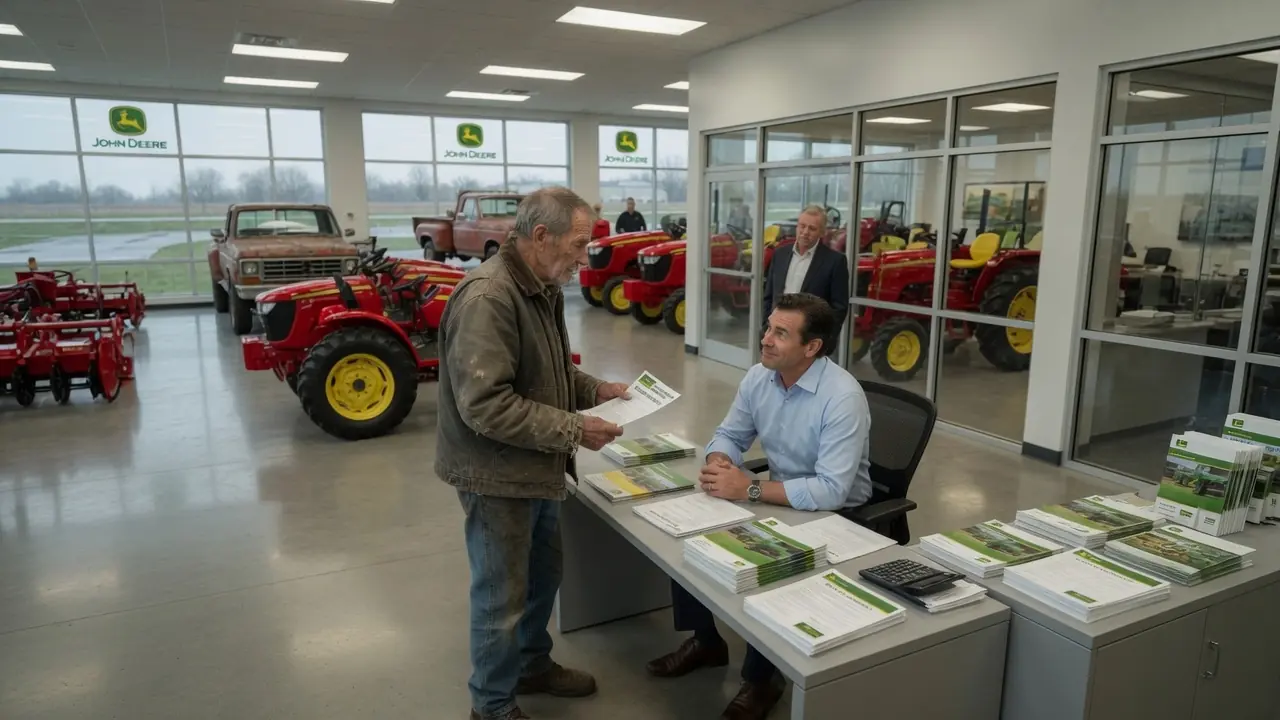
Brad leaned forward, his patience gone. “With all due respect, farmers come in here every week dreaming about equipment they can’t afford. They want the big machine, the big cab, the best technology, but when it comes time to sign, they don’t have the money. I don’t have time to build a fantasy order for someone who can’t even qualify for one unit.”
Frank stood quietly and let the words hang between them. Across the room, another salesman looked over from his desk. A mechanic passing through the showroom slowed down. Brad noticed the attention and straightened his shoulders, as if the small audience had made him braver.
“You don’t look like a man who can buy twenty tractors,” Brad said. “You don’t even look like a man who should be shopping for one.”
For the first time, Frank’s eyes hardened. Not with anger, but with the slow steady weight of a man who had heard the same thing in different ways for fifty years. He reached into the inside pocket of his jacket and pulled out a folded sheet of paper. He unfolded it carefully, smoothed the crease with his thumb, and slid it across the desk. Brad looked at it without touching it.
“What’s this?” he asked.
“Proof of funds.”
Brad picked up the paper with an expression that said he was only humoring him. His eyes moved across the page once, then stopped. He read the line again. Then he sat up straighter, holding the paper with both hands now.
The statement was from First National Bank of Springfield. The account name was Frank Holloway. The balance was twenty-three million, four hundred sixty-seven thousand, eight hundred twelve dollars and nineteen cents.
Brad’s face changed so quickly that the mechanic near the doorway actually stopped walking. The arrogance drained out of him first, then the color. His mouth opened slightly, but no words came. He looked from the paper to Frank, then back to the paper, as if one of them had to be lying.
“Mr. Holloway,” Brad said, and his voice cracked around the name. “I didn’t realize.”
Frank took the statement back and folded it once. “That was clear.”
Brad stood up too fast and nearly hit his knee on the desk. “Let me get my manager.”
He hurried toward the glass office, where an older man in a dark suit was reading through a folder. Frank watched Brad lean in and speak quickly, waving one hand toward the showroom. The manager looked through the glass at Frank, then at the old truck outside, then at the paper Brad had apparently described. Within seconds, both men were walking back toward the desk.
The manager arrived with both hands open and a smile wide enough to cover the whole mistake. “Mr. Holloway, I’m Dennis Parker, general manager. I understand you are interested in making a significant purchase today.”
“Twenty John Deere 8R 410s,” Frank said. “Fully loaded.”
Dennis nodded as if this were perfectly normal, though his eyes kept flicking to Brad. “Of course. That is a major order, but I believe we can help you.”
“I asked how soon you can have them ready.”
Dennis sat down at Brad’s desk and began typing. “Normally, with factory builds and scheduling, we might be looking at six to eight months.”
Frank looked at the row of tractors on the showroom floor. “Too long.”
Dennis paused. “Too long?”
“My son is taking over spring planting. I want them here before then.”
Dennis typed faster. “Let me make a few calls. With full payment secured, we may be able to source inventory from multiple dealerships across the region.”
Frank nodded. “Do that.”
Brad stood behind Dennis now, quiet and stiff, like a boy waiting outside the principal’s office. Every now and then he glanced at Frank, but Frank did not look at him. He looked at the tractors, at the tires, at the cabs, at the kind of technology his son Robert had talked about for years and never asked for directly. Robert was the reason Frank had come.
Frank Holloway had not always been old, and he had not always been quiet. He had once been a young farmer with strong shoulders and a sharp hunger to prove himself. His father, Walter Holloway, had left him eighty acres, a tired farmhouse, a shed full of hand tools, and a used Farmall tractor that needed coaxing every cold morning. Everyone in the county had thought Walter was poor. Everyone had thought Frank had inherited almost nothing.
But Walter had left something else. Not flash, not comfort, not reputation, but a savings account that shocked the lawyer reading the will. More than four hundred thousand dollars in 1971, built slowly by a farmer who had worn the same shirts, driven the same truck, and refused to buy anything he did not need. Along with the money was a letter. Frank had read it once in the lawyer’s office, then carried it in his wallet for twenty years until the paper nearly fell apart.
There are two kinds of wealth, his father had written. The kind that shows, and the kind that grows. The kind that shows impresses people for a little while, then becomes debt, maintenance, and worry. The kind that grows sits quietly, works quietly, and one day gives you freedom. Build the kind that grows.
Frank had built exactly that. He bought land when others were afraid. He repaired old equipment instead of replacing it. He drove used trucks until they begged to retire and sometimes drove them a few years beyond that. He let neighbors laugh, let them pity him, let them call him cheap, stubborn, and small-minded.
Year after year, harvest after harvest, the account grew. Eighty acres became two hundred, then six hundred, then twelve hundred, then four thousand. Frank never built a mansion and never traded his truck just because a new model came out. He employed good workers, paid fair wages, kept his debts low, and never missed a payment. To the outside world, he looked like a farmer barely getting by.
That was fine with him.
Dennis Parker returned to the desk after twenty minutes of calls. His face looked different now, not amused, not doubtful, but alert in the way men get when numbers become too large to ignore. “Mr. Holloway, I believe we can do it. Corporate is willing to expedite if payment clears today. We can pull units from dealer inventory across Illinois, Iowa, Indiana, and Missouri.”
“How long?”
“Three weeks,” Dennis said. “Possibly sooner, but three weeks is what I am comfortable promising.”
Frank nodded once. “Write it up.”
Dennis glanced at Brad. “Brad will assist with the paperwork.”
Frank looked at Brad for the first time since the manager arrived. “No.”
The showroom went still again.
Dennis swallowed. “Mr. Holloway?”
“He can watch,” Frank said. “You can write it.”
Brad’s face burned red, but he did not argue. Dennis cleared his throat, sat down, and began the process of building the largest order that dealership had ever taken. Options, packages, delivery schedules, serial numbers, payment instructions, legal names, transfer documents, insurance coordination. Frank answered every question clearly and without hurry. By early afternoon, the total stood at just over nine million dollars.
Dennis stared at the final number before turning the monitor toward Frank. “This is the full amount, including delivery preparation and all selected options.”
Frank looked at it for two seconds. “That’s fine.”
Dennis let out a breath he had been holding. “And you are comfortable paying the full amount upfront?”
Frank reached for his cap. “My bank will wire it today once my lawyer receives the agreement.”
Dennis nodded quickly. “Of course.”
Before Frank left, Dennis walked him to the door himself. Brad stayed behind the desk, pale and silent. Frank paused with one hand on the handle and looked back across the showroom. The tractors inside were bright, expensive, and new, but they did not impress him by themselves. A tool only mattered when it was put to work.
“Mr. Holloway,” Dennis said carefully. “Can I ask why now?”
Frank looked at him. “Because my son earned it.”
Dennis waited, sensing there was more.
Frank put his cap back on. “And because I’m tired of men assuming a farmer is broke just because he dresses like he works.”
He walked outside before Dennis could answer. The old Ford started on the third try, louder than it needed to be, and Frank drove away with the same slow steadiness he had brought in. By the next morning, the whole county knew. By Friday, people who had not called Frank in ten years were suddenly finding reasons to check on him.
At the diner, his usual booth became the center of every whisper. Men who had spent years making jokes about his truck suddenly lowered their voices when he walked in. Some said he must have won the lottery. Some said he must have sold mineral rights. A few said nobody honestly earned that kind of money farming, which told Frank more about them than it did about farming.
Robert came to the farmhouse the evening after the story spread. He was forty-eight years old, broad-shouldered, quiet, and worn in the way good farmers get worn, not broken, just shaped by labor. He stood on the porch while Frank drank coffee in the old chair that had once belonged to Walter. For a while neither of them spoke.
“Dad,” Robert finally said, “you didn’t have to do this.”
“I know.”
“Twenty tractors?”
“That’s what the acreage needs.”
Robert shook his head, looking out across the fields. “People are saying things.”
“They usually do.”
“They’re saying you hid money. They’re saying you should have lived better. Some are saying you should have helped people more if you had that much.”
Frank looked at his son. “I paid my men every Friday. I never cheated a landlord, never shorted a supplier, never borrowed what I couldn’t repay, and never asked the government for a dollar I didn’t need. Help doesn’t always come with a ribbon around it.”
Robert nodded slowly. “I know.”
Frank leaned forward, resting his elbows on his knees. “You worked beside me for thirty years. You never complained when the equipment was old. You never asked why Henderson had nicer things. You never made me feel like the life I chose embarrassed you.”
Robert’s eyes lowered. “Sometimes I wondered.”
“That’s fair.”
“But I never doubted you.”
Frank smiled faintly. “That’s why the tractors are yours.”
Three weeks later, the dealership lot looked like a green wall of steel. Twenty brand-new John Deere tractors stood in two perfect rows, each one clean, fueled, inspected, and ready. Employees came out of the service bays to stare. Drivers from other dealerships lingered after unloading, taking pictures with their phones and shaking their heads.
Frank arrived in the same rusted Ford. The contrast made people turn before he even stepped out. There was his old truck, dented and faded, parked in front of nine million dollars of new equipment. Dennis met him outside with a folder of documents, smiling carefully this time, the way a man smiles when he has learned respect the hard way.
“Everything is ready, Mr. Holloway.”
Frank signed the final papers in the manager’s office. Brad was there too, standing by the wall with his hands folded in front of him. He looked smaller than he had three weeks earlier. When Frank finished signing, Brad stepped forward.
“Mr. Holloway,” he said. “I owe you an apology.”
Frank capped the pen and looked up.
“I judged you,” Brad continued. “I shouldn’t have. I treated you like you were wasting my time.”
“You did.”
Brad swallowed. “I’m sorry.”
Frank studied him for a moment. “Remember it next time a man in work boots walks through that door.”
Brad nodded. “I will.”
Frank stood, took the folder of keys from Dennis, and walked back outside. Robert arrived a few minutes later, confused because Frank had told him only that he needed help moving equipment. When Robert pulled into the lot and saw the twenty tractors waiting, his truck stopped in the middle of the lane. He stepped out slowly, his face changing with every step.
“Dad,” he said, staring at the machines. “What is this?”
Frank handed him the folder. “Your fleet.”
Robert did not take it at first. “My what?”
“The farm is yours now,” Frank said. “The equipment is yours. You’ve earned the tools to carry it forward.”
Robert opened the folder and saw the keys, twenty sets arranged in labeled rows. His mouth tightened, and for a second he looked like the boy Frank remembered, the one who used to ride beside him in an old tractor cab with his boots barely reaching the floor. Then Robert covered his face with one hand and cried in the dealership lot. He did not turn away from the employees watching.
Frank put a hand on his shoulder. “You earned it. Now put them to work.”
The convoy began an hour later. Twenty John Deere tractors rolled out of the dealership one after another, heading down the rural Illinois roads toward Holloway Farms. Frank led them in the old Ford, its rusted tailgate rattling as if protesting the whole parade. Cars pulled over. Neighbors came out to porches. Men at the feed store stood by the road and watched with open mouths.
At the stop sign near County Road 14, Bill Henderson pulled up beside Frank in a spotless Ford F-350 King Ranch edition. Bill had farmed next to Frank for thirty years and had spent most of that time treating him like a man who never quite understood success. Bill’s barns were painted, his house was huge, his trucks were new, and his equipment always looked fresh from the factory. He had also spent decades speaking to Frank in a tone so polite it became insulting.
Bill rolled down his window. “Frank,” he called out, staring at the tractors behind him. “How in the world did you afford all this?”
Frank looked at him through the open window. For thirty years, he had listened to Bill make comments about thin margins, old machinery, and how some farmers needed to learn when to modernize. He had heard the jokes. He had seen the pity. He had said nothing because saying nothing was usually cheaper.
But that day, with twenty tractors behind him and his son waiting to take over the land, Frank decided silence had done enough.
“I saved,” Frank said.
Bill blinked. “Saved?”
“Every dollar you spent trying to look successful, I kept. Every dollar you borrowed for new trucks and toys, I invested. Every payment you made to impress people, I avoided. While you paid interest, I earned it.”
Bill’s face stiffened. The light turned green, but neither truck moved for a second.
Frank looked ahead at the road. “That’s how.”
Then he put the old Ford in gear and drove on, leaving Bill Henderson sitting at the stop sign with the window still down. Someone behind them must have heard every word, because by the next morning the story was everywhere. Some people said Frank had been too harsh. Others said Bill had earned every syllable. Frank did not care much either way.
What mattered was the farm.
That spring, Robert planted with the new fleet. The work moved faster than it ever had, cleaner, more precise, less punishing on the body. Frank watched from the edge of the field some mornings, leaning against the same old truck, drinking coffee from a thermos older than half the men in the county. He did not feel regret. He did not feel the need to explain himself.
One evening, Robert came to the porch after a long day in the cab. The sun was low over the fields, and the tractors were parked in a neat line near the machine shed. Robert sat beside his father with two cups of coffee and looked out at the land. For a while, the only sound was the wind moving through early corn.
“I put half the first quarter profits into savings,” Robert said.
Frank looked at him. “Did you?”
“Like you taught me.”
Frank’s throat tightened, but his face stayed calm. “Good.”
Robert smiled. “I guess the real inheritance wasn’t the equipment.”
“No,” Frank said quietly. “It never is.”
Years earlier, Frank had thought the money was the lesson. Then he had thought the land was the lesson. Then the tractors, maybe. But sitting there beside his son, watching the fields that had fed three generations of Holloways, he understood what his father had meant all along.
The real inheritance was discipline. It was patience. It was the strength to let people misunderstand you while you built something they could not see. It was the wisdom to know that wealth did not have to shout in order to be real.
People in town still talked about the day Frank Holloway bought twenty John Deeres in cash. They talked about Brad Keller’s face when he saw the bank statement. They talked about the convoy, the old Ford leading millions of dollars in machinery down the county road. They talked about Bill Henderson at the stop sign, sitting speechless beside the man he had underestimated for thirty years.
Frank let them talk.
He still wore the same jacket. He still drank the same coffee. He still drove the old Ford until it finally gave out behind the machine shed on a Tuesday morning and refused to start again. When Robert offered to buy him a new truck, Frank shook his head and said he would think about it.
He never did.
Because Frank Holloway had never needed the world to believe he was rich. He only needed his son to understand why he had lived the way he lived. He only needed the land to keep producing, the family to keep working, and the lesson to keep moving forward. The salesman froze because he did not see the money coming, but Frank had seen it coming for fifty-three years.
That was the difference between looking wealthy and being wealthy.
The kind that shows can impress a room for a moment.
The kind that grows can change a family forever.